Category: Featured

  • 7 Tips for Effective Fintech Content Marketing – Wittypen

    7 Tips for Effective Fintech Content Marketing – Wittypen

    The importance of content marketing has been well established as we transition into the coming years. While it primarily serves to engage with your audience across social channels, it also helps educate them, thus generating leads and resulting in better conversions. While content marketing is now the norm regardless of your domain, each demands its unique approach. 

    Financial Technology, or Fintech as it’s commonly referred to, is one such domain. Its content marketing needs are unique, simply because of the nature of the domain itself. Fintechs rely heavily on their audience’s trust, and they can only achieve this by educating them about their products and their benefits with the utmost transparency. If you’re a fintech or are planning on starting one, this article will give you eight key tips for successful fintech content marketing. 

    7 Best Fintech Content Marketing Tips That Drive Results

    1. Content Marketing Must Be Backed by a Content Strategy

    Every content marketing initiative must follow a content strategy. If you’re wondering how the two are different, here’s a quick roundup – content marketing includes blogs, guest posts, white papers, and reports, while a content strategy gives you a framework that sets goals and helps measure the efficacy of these marketing practices. Without a content strategy, content marketing would simply involve creating and publishing content, and hoping it brings in desirable results. 

    fintech content strategy

    On the other hand, a content strategy helps lay down a set of objectives and metrics that form the foundation of your content marketing efforts. Let’s take a look at Google Pay, a UPI-based payment app launched in India in September 2017.

    For instance, in its second year, the app saw a 3x growth to 67 million monthly active users. Let’s say for instance, that their target as per their marketing strategy was to reach about 50 million monthly active users in the same period. This objective would then form part of their strategy, thus laying down an objective for their content marketing efforts.

    The same works for every fintech – a content strategy is a must for fintech content marketing to be successful.

    2. Your Content Must Focus on Educating Your Audience

    Focus on educating your audience - Effective fintech content marketing

    Fintech can be a rather complicated domain for the average consumer to understand. The same goes for specific fintech offerings. The overarching goal of fintech content marketing must thus be to educate your audience about the benefits of your product or service and highlight the problems it solves. You must remember that the average consumer probably won’t understand the technology powering your product. On the contrary, their primary concern is knowing how it can make their financial operations easier while being safe. 

    Let’s take the example of Google Pay again. When the government at the centre banned the 500 and 1000 denominations, people found it rather difficult to always have cash in their wallets (as banks and ATMs were unable to meet the demand for money) This demonetisation is what formed the bedrock for the rise of cashless payments in India. 

    However, suppose Google Pay was advertised initially on the back of the technology behind UPI. In that case, the chances are that it wouldn’t have achieved the kind of initial success that it did. This is because the UPI system had already been launched a year earlier.

    Instead, their approach was to simply tell their audiences how their product would make it easier for them to safely make payments using their smartphones, and thus eliminate the need to carry cash. This, to put it in specific terms, was their value proposition. Add to this an enticing rewards program, and you have yourself a product that continues to grow steadily even three years later.

    The unsaid factor here is trust. Every fintech must get their consumers to trust them, and understandably so, especially since their usage relies on our money being safe. 

    3. Your Content Should Cater to Every Stage of the Marketing Funnel

    Given the nature of the domain and the technicalities that come with it, the buying cycle is longer than most others. In fact, it can take an average of three months to even a year to convert a lead into a customer, regardless of whether you’re business or customer-facing. 
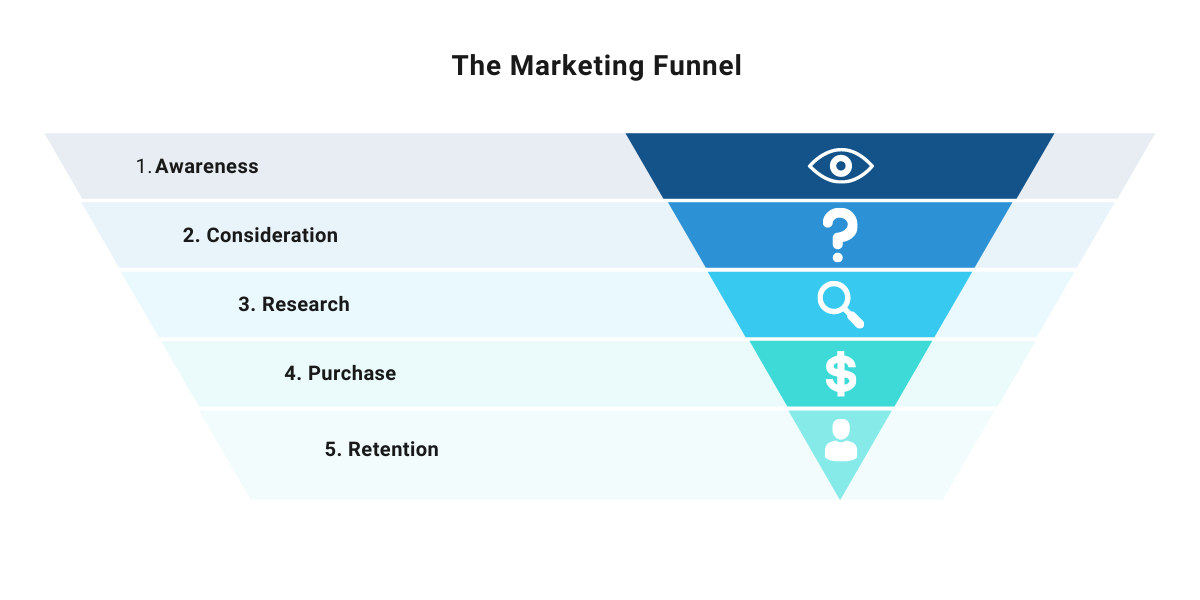
    marketing funnel

    Additionally, given that success as a fintech relies heavily on gaining your audience’s trust, it’s pertinent that your approach to fintech content marketing is consistent while continuing to educate. This can only be achieved through consistently marketing your offering across all social channels, while also addressing any possible concerns your audiences may have.

    A simple example could be the safety of their money itself. As a content marketer, it’s your job to convince your audiences that their money will indeed be safe and that your product has a lot to offer them. 

    Going further down the funnel as well, your content marketing must be tailored to your buyer personas. Doing this can include highlighting your product’s benefits in light of its competition, to further convince potential leads. The same goes for the final stage of the funnel as well. 

    However, this isn’t the end of it. Customer retention will further rely on how well you continue to support existing users of your product. Addressing their pain points, highlighting how the product can be used to make transactions easier, and assuring them of consistent improvements to your software will play a huge role. 

    4. Engage Audiences Across All Social Channels

    Every social media platform presents its own potential leads. If you are to successfully establish yourself as a product that’s worth considering, you must consistently interact with audiences across all social channels as part of your fintech’s content marketing. Additionally, sharing all your content on your social media handles is essential as it broadens your footprint. 

    All throughout 2020, and even going ahead, video is poised to be one of the most effective content marketing tools. And this holds even truer for the fintech sector. You must utilize high-quality video content that explains your products and services to your audiences, more importantly, because the video is a lot more attractive than text-rich blogs.

    To make the process of handling your social media easier, you should look into a social media management tool to organize and schedule all your social content based on your content calendar. This will ensure consistency, which is key to building your authority on these platforms. 

    5. Hire Expert Content Writers to Create Your Content for You

    Every single day can be challenging when handling and growing your fintech. And now that content has been established as your best bet, you must ensure that the content you put out is authoritative, well-written, and comprehensive, to build yourself as a thought leader in your domain. 

    Sometimes, however, this is easier said than done. Smaller teams can often find it hard to handle the tech, logistics, and content all at the same time. This is where it’s wise to hire expert content writers who can create content for your fintech with your vision in mind. It takes a huge chunk of work off your plate and gives you more time to focus on improving your product. 

    6. Building Backlinks Will Greatly Help Build Your Authority

    Going ahead, generating backlinks is bound to be one of the best ways for you to build your authority online. Backlinks are absolutely crucial, as they lend credibility to your content. Remember, Google won’t see your content as credible unless people link to it and rely on it as part of theirs. These backlinks will also help increase your domain authority or rating over time, which goes a long way in getting your content onto that first page. 

    The first thing to do is to identify what kind of backlinks you’d like to achieve. These could be from authoritative websites in your domain or those that include your keyword in their anchor text. These are the websites your backlinking strategy should be aimed at. 

    Further, you must also create content that’s more likely to be linked. These could be original research, diagrams, infographics, and even list posts. When your content consists of these elements, it’s more likely to be linked, thus boosting your domain’s authority over time. 

    Additionally, email marketing is also a brilliant way to gain backlinks. If you want to find out how you can effectively use backlinks as a part of your content marketing strategy, check out our in-depth guide to building backlinks. 

    7. Create High-Quality Content That Ranks Higher on Search Engines

    Last but not least, creating high-quality content should always be your top priority. The best way to achieve this is by assuming a content gap in whichever topic you’re creating content on. By doing this, you automatically aim to be as comprehensive as possible. It also leads you to maintain a sense of consistency across all your content, thus reflecting your brand’s tone. 

    With Google’s algorithms constantly being updated and improved, the need for high-quality content is essential if you want it to be present on that lucrative first page of Google’s results. 

    Read More: 25+ Content Marketing Tools – Drive Growth For Your Business

    In Conclusion

    Fintechs find themselves in a unique position owing to the length of the buying cycle. The need to establish the truth is paramount, and even more so when you’re business-facing. The best way for you to establish this trust is through effective and consistent content marketing. We hope this guide helped you figure out what you should include in your fintech content marketing strategy. 

    At WittyPen, we strive to create high-quality content that helps scale your business. If you’re in the market for expert content writers in your domain that you can trust, check out our services here.  

    Until then, good luck with growing your fintech! 

  • B2B Content Marketing Strategy: Step-By-Step Guide

    B2B Content Marketing Strategy: Step-By-Step Guide

    Most B2B companies start with writing a blog, creating a few eBooks, and optimizing their service pages, but never scale up from there.

    That’s mostly because they lack a clear B2B content marketing strategy that guides them to move forward and iterate their way towards consistent growth.

    This blog will help you set a clear pathway to building a content engine that keeps compounding. We’ll talk about the importance of strategy, how you can build one, and share which key growth metrics you need to measure.

    But Why Content Marketing?

    Content marketing helps you reach your target customers when they are at the top of the funnel and shows them that your company can help solve their problems.

    When used correctly, content marketing will not only strengthen your brand but also drive more high-quality traffic to your website and convert leads into customers.

    Importance of B2B Content Marketing Strategy

    Content marketing is a vital part of your company’s growth and having a solid strategy in place will help you scale it faster.

    Here are some of the key benefits:

    1. It helps you understand what your target customers care about and how they consume content. This way, you’ll be able to create topics that drive you the most amount of search traffic.
    2. It helps you find the right keywords to target so that your content can rank higher in search results. A good strategy will make sure you don’t miss out on any high-converting keywords.
    3. A strong strategy will help you create a calendar that shows what types of content needs to be created and when it should go live. It’ll also include all the channels where you should distribute the content.
    4. You’ll be able to track the success of each piece of content and see how it impacts your overall business goals. This will help you iterate and improve your strategy over time.

    Now that we know why having a strategy is important, let’s look at how you can build one for your company.

    Building a B2B Content Marketing Strategy

    Most people think that content marketing is easy. They believe they can start writing a few blog posts and convert more visitors into customers.

    Unfortunately, this isn’t true. Creating content at scale is one of the most challenging things to do in any B2B company. And we’ll help you show a clear path that makes this entire process simpler.

    Here’s a step-by-step process to build your b2b content marketing strategy:

    Step 1: Know Who is Your Audience

    Ask your sales team.

    This is one of the most basic things that most marketers miss. Your sales team is the one who speaks with the customers consistently and they can share:

    1. Which customers are easiest to convert
    2. Which industries have the most frequent use case for product or service
    3. The demographic details about your audience, location, company size, revenue, etc.
    4. Understand who is the decision maker
    5. What are the key KPIs for the decision maker

    You can have multiple buyer personas depending on the customers you are going after. Let’s look at Gong, a revenue intelligence tool. What’s interesting is how they have clearly defined their target audience:

    1. CROs & Sales Leaders – To educate about Revenue Intelligence
    2. Sales Managers – To understand how they can get visibility into their team’s performance

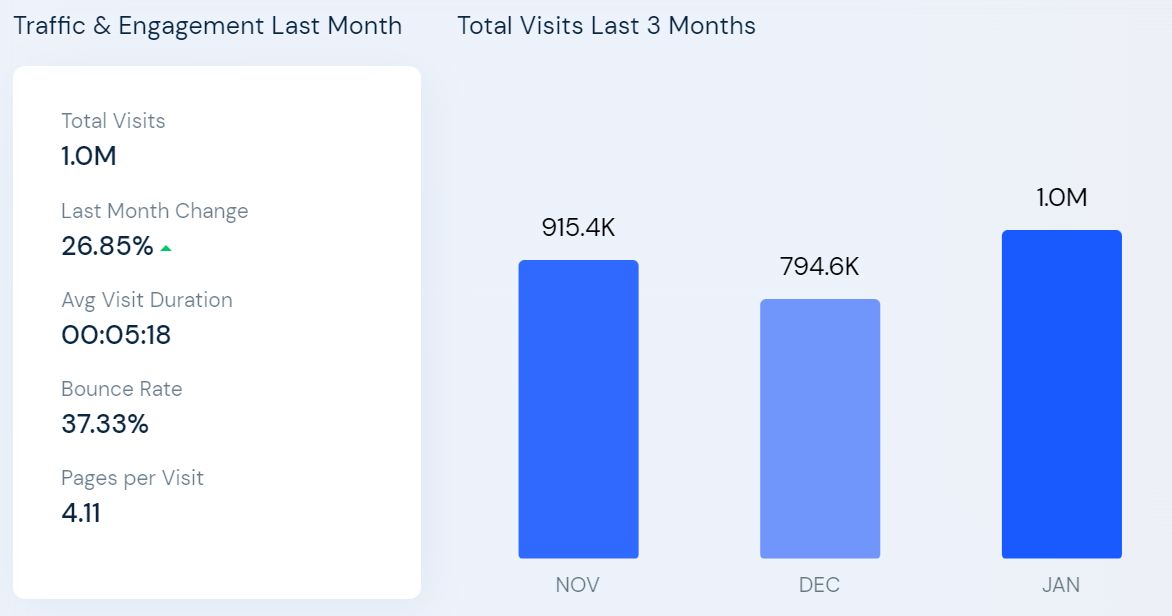
    Gong receives more than 1M visits every month, while 95.18% of its traffic is organic, and more than 22% of its traffic comes from search and social media channels. (Source: Similarweb)

    Step 2: Finalize the content types you will create

    The next step is to figure out what content you want to create for each audience persona.

    Let’s go back to the Gong example, here are some of their popular content pieces:

    1. THE SALES FORECAST TEMPLATE FOR SALES MANAGERS: Sales forecasting is one of the basic KPIs for sales managers. A quick google search for a template will help sales managers by saving time, and Gong grabbed this opportunity.
    2. Landing Pages: Gong creates multiple landing pages around Sales enablement, Conversation Intelligence, Revenue Intelligence, and more which becomes a high-value BOFU(Bottom of the funnel) content.

    These are all high-quality resources that educate their target customers about revenue intelligence and how they can their sales team’s efficiency.

    Step 3: Pick Your Distribution Channels

    Now it’s time to figure out where you’ll publish your content. The channel you choose will depend on the type of content, your audience, and how easily searchable that channel is.

    For example:

    • If you want people to read your blog post or article then a distribution platform like Medium can be a good choice as it has high visibility and allows people to share your content easily.
    • If you want to target CXOs and professionals, you might want to pick LinkedIn as the most preferred social media channel for distribution.

    Step 4: Define Key Content Buckets

    Now that you know your audience and the type of content you want to create, let’s understand how to define content buckets.

    In case of Gong, the key buckets would include

    • Revenue Intelligence
    • Sales Management
    • Selling Skills
    • Customer Stories

    For Intercom, the key buckets are:

    • Customer support
    • Growth & Marketing
    • Sales
    • Product

    Step 5: Build a Keyword Universe

    Once you have your content buckets ready, you should build a list of keywords that can drive the most amount of organic traffic.

    Tools like Ahrefs & Ubersuggest can help you find SEO keywords related to your business.

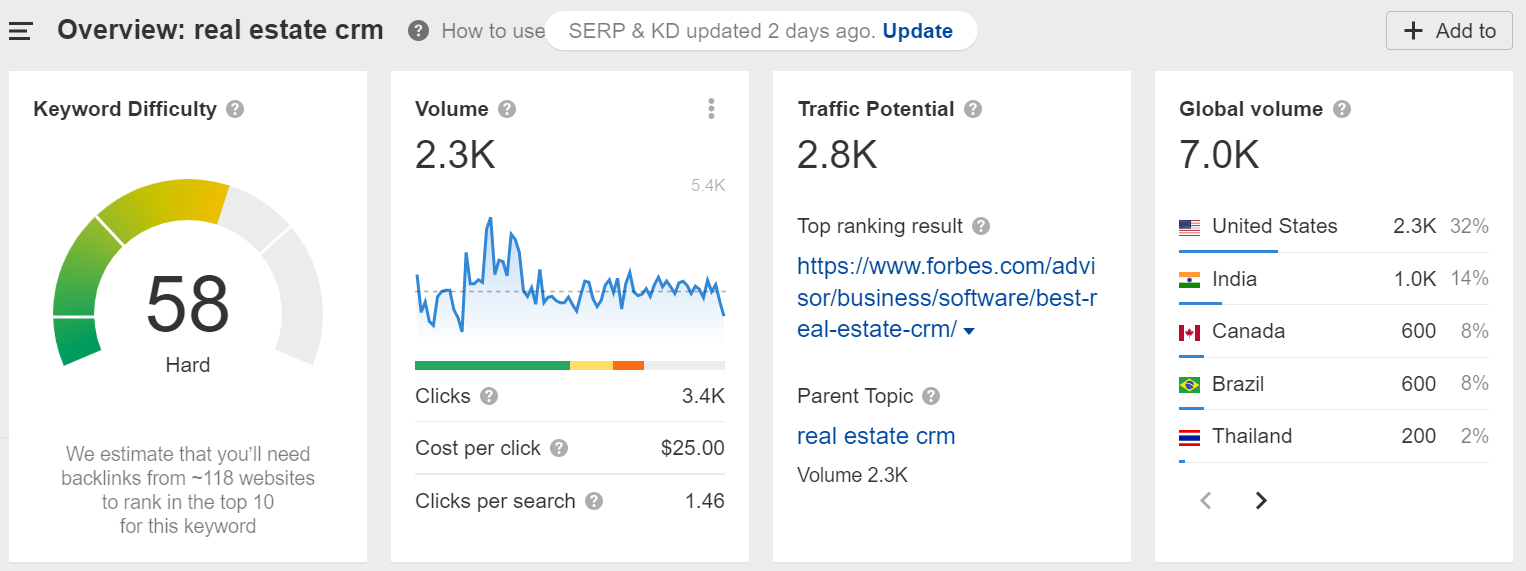
    Let’s say you are building a CRM for Real Estate, here’s how you can use Ahrefs to build your Keyword Universe.

    1. Start with searching the main keyword “real estate crm”

    In US alone, 2800 people search for Real Estate CRM every month and that’s a good step to start.

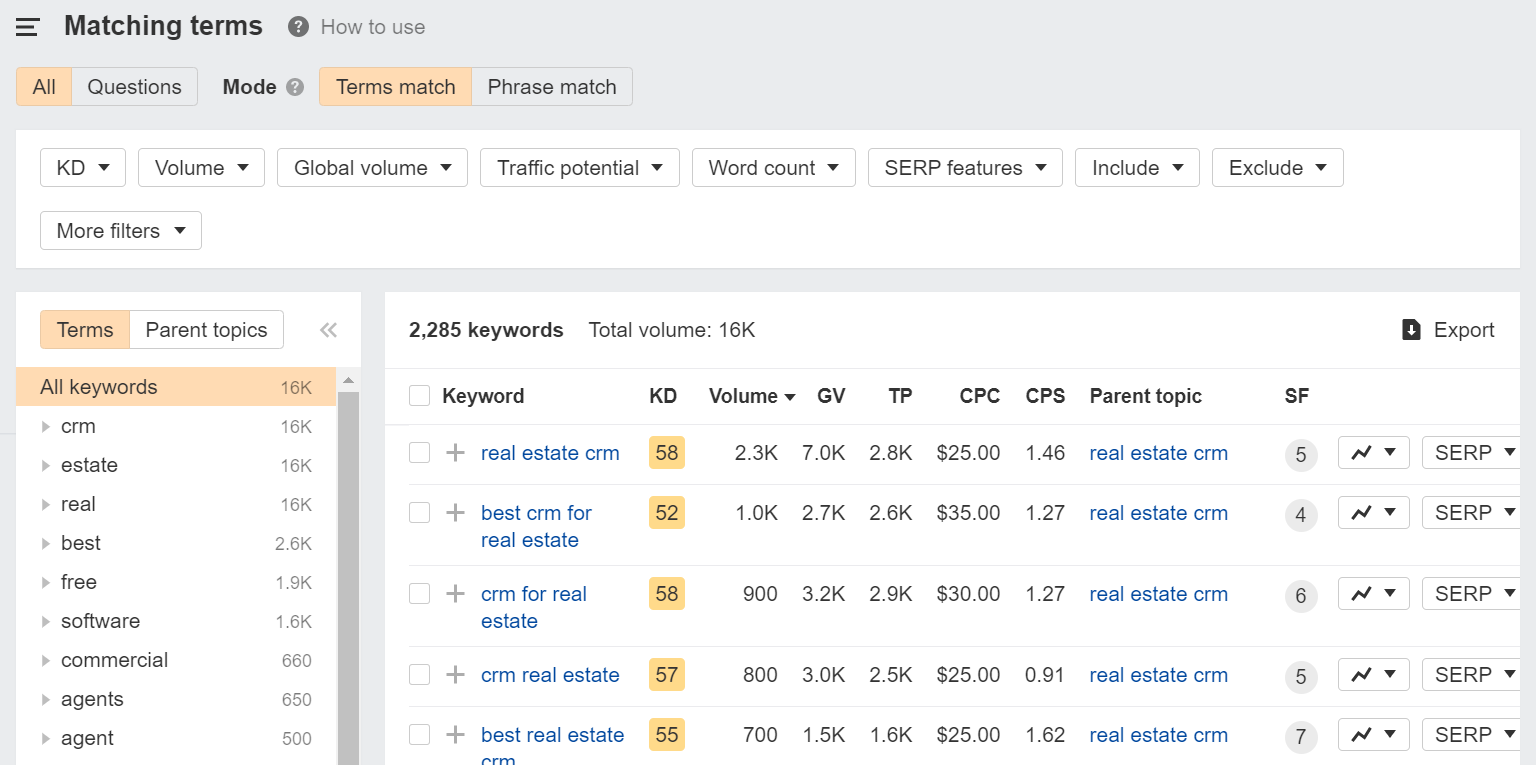
    2. Look for the matching and related terms and start building your keyword lists.

    You can filter these keywords as per the intent and relevance to your target audience. Once you are done, export the list of all keywords that you wish to target.

    Step 6: Create a Content Calendar

    You need to have a plan for your content. You should know when each piece of content will be published, on what channels will it be distributed, and how would it be repurposed.

    Tools like CoSchedule or Trello can help you in building your content calendar.

    Let’s define it in a few simple steps:

    – Set up a Google Sheet where you list down all the topics that are going to be published in a given month.

    – Create different tabs for each month and add the topics under them. You can also include columns like title, publish date, social media channels, and repurpose type.

    – Once you have all the topics in place, start filling in the publish date and other relevant information.

    – As you are publishing content, make sure to update the Google Sheet with the live link, social media posts, and any other required information

    Let’s try doing this from Gong’s perspective:

    Topic: 10 Coaching Tips To Guide Your Sales Team For Success

    Format: Blog post or article

    Target persona: Sales Managers

    Distribution Channel: LinkedIn

    This is a very simple way to define your content calendar and helps you stay focused on what’s important.

    Step 7: Define Roles in Your Team

    So far, we have defined all the information you need to build a b2b content marketing strategy. But before you go ahead and start executing it, there’s one more thing that needs your attention – defining roles in your team.

    Usually, different members of the marketing team are involved in creating content for the company blog or social media channels. However, you need to know who is going to do what in the team so that you can ensure proper coordination and alignment of efforts.

    Here are some of the roles that you might have in your team:

    • Content Writer
    • Content manager
    • Graphic Designer
    • Video Producer

    Each of these roles will have different responsibilities, and it’s important that you know who is doing what. You might want to also consider outsourcing content creation to continue to focus more on strategy and distribution.

    Step 8: Define key metrics to track

    Now that you have all the basics in place, it’s time to start tracking your content marketing efforts.

    There are a number of different metrics that you can track – depending on what’s important to your business. However, some of the most common ones include:

    – Website Traffic: This will help you understand how much traffic is being driven to your website from content marketing efforts.

    – Email List Growth: If you are using email marketing as a distribution channel, this metric will help you understand the growth of your email list.

    – Search Engine Traffic: This metric shows how much organic traffic is coming to your site through search engines.

    – Social Media Traffic: This metric shows the number of clicks that you are getting to your website from social media platforms.

    – Time Spent on Website: This is a great way to measure whether people are actually engaging with your content or not. If they spend more time, it means that they are consuming your content.

    – Conversion Rate: If you are using content to drive leads, then this metric is important for you because it will show how many people actually converted and became customers.

    Wrapping Up

    Think of content marketing as a marathon and having a clear guide will help you cherish the results towards the end. A content marketing strategy is an essential part of any company’s marketing plan and should be well-defined with roles, responsibilities, and key metrics to track. By following these simple steps, you can create a b2b content marketing strategy for your business that will help you achieve your desired results.

  • SEO in the Last Decade: Important takeaways for Organic Traffic

    SEO in the Last Decade: Important takeaways for Organic Traffic

    Search Engine Optimisation (SEO) has gone through a sea of changes over the past decade. SEO has always been a crucial part of a brand’s content marketing efforts, but these changes have meant that the ecosystem is constantly in flux and that brands need to keep on top of these changes to succeed. 

    As we came to the end of the last decade, we saw a core algorithm update from Google, which shook a lot of websites and was talked about in the SEO circle. After analyzing the recent update, our belief in the suggestions listed in this article has become stronger than ever! 

    Now that we’re firmly in the next decade, consider this article a trip down the SEO memory lane, as we review the key SEO takeaways from the last decade. 

    SEO Takeaways From the Last Decade – What Have We Learnt? 

    Align Your Content With User And Search Intent

    When planning your content, it’s important to focus more on solving your user’s problems, and less on your products, services, and offerings. Google tends to prioritize content that makes it easier for users to find the right answers to their search queries.  

    With the recent update, it was also observed that content that was structured well with a high focus on headings, saw a significant increase in the SERPs. 

    Another SEO trend that has contributed to the shift in user intent is the increasing use of voice search. Since people tend to ‘speak’ to Google as they would naturally speak to one another, the algorithm now demands that content marketers, in turn, create content that reflects this change. 

    Additionally, by curating your content to best answer what users are looking for, you stand a better chance of being ranked higher, which will result in more traffic and leads. 

    Long-Form Quality Content Over Mere Quantity, Any Day

    This is one of the most debated topics among SEO pros and marketers. While the fact that users have a shorter attention span than ever holds significant weight, one needs to understand the factors that help your content reach its intended audience. 

    Content above 2000 words has been shown to rank much better and outperform blogs with 1000 words or less. The reason why long-form content ranks faster is pretty simple –  to write a high-value, long-form article, you need to put in a ton of research, which is bound to provide immense value to the end user. And any content adding value to the users is given importance on SERP.

    To validate the point on short attention spans, a user need not spend a significant time reading the entire content, but only a little to read specific information as per the core intent. This solves the user’s problem and benefits your website, all at once.  

    The ideal approach, in fact, is to go as far as assuming the presence of a content gap in your domain or the subject of your content, and aim to fill it. This means curating content on the assumption that yours is the only piece of information on the subject. This makes you come across as more authoritative, and is also great for SEO!

    This ensures that readers find all the information they need by reading your content, reinforcing your value in their minds. Additionally, when readers are left satisfied, they’re also more likely to sign up for your services.

    Double Down Your Focus On UI/UX

    Websites have long since been the digital version of a storefront. The more attractive it is, the more likely it is that people will spend their time going through it to see what’s on offer. Over the years, however, the technicalities involved in optimizing websites to changing algorithms and user behavior have increased. 

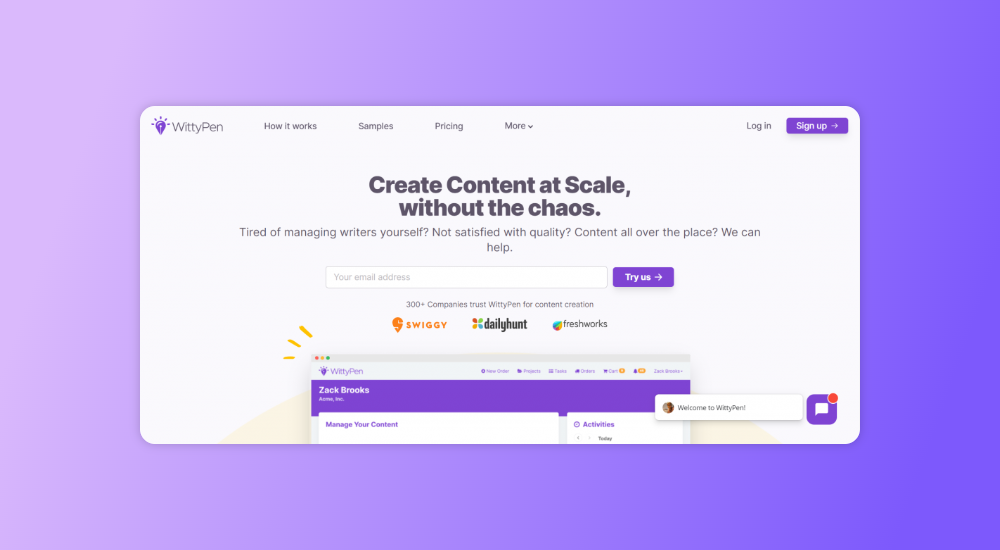
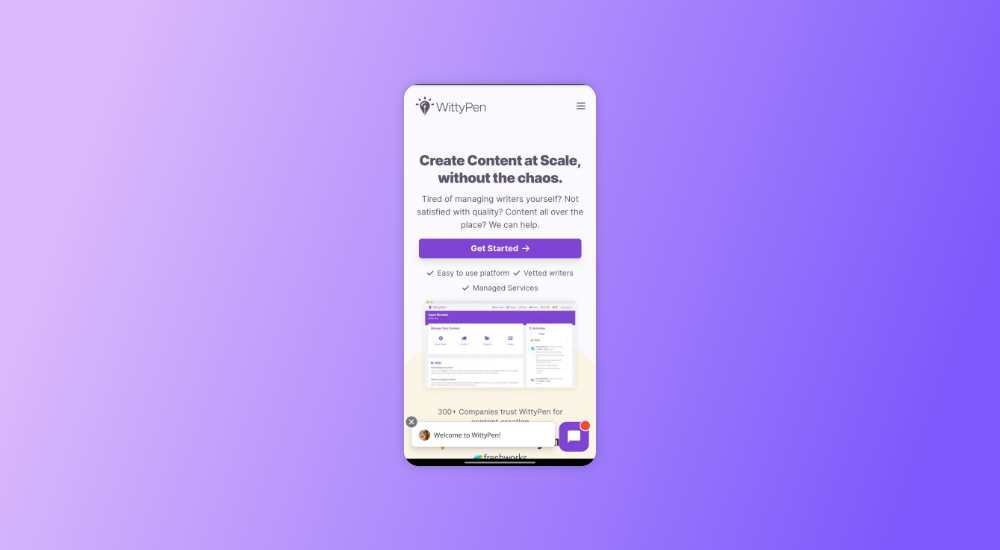
    Today, with search engines rewarding crisp, high-quality content, along with reducing time and attention spans on the part of the users, website content has had to shorten, while remaining equally, if not more informative. Here at WittyPen, we’ve revamped our website to reflect these changes and keep up with the times. Our website is now crisp, yet gives you all the information you’ll ever need about our services in a neat, easy-to-understand layout. 

    As you can see, the website is easy to read and navigate, with the chatbot always being at the tip of your fingerprint should you need detailed information. 

    Additionally, ensuring that websites load quickly and making them mobile-friendly has now become the norm. With people across the world relying primarily on their mobiles to consume content, brands have had to ensure that their websites are optimized to deliver the best results through this medium. At WittyPen too, we have had to optimize our website for mobiles to make it easy to access and readable at the same time. 

    In the image above, you can see that the website is very readable, the menu is easy to access, and so is the chatbot. 

    SEO Now Requires a Great Deal of Planning

    As mentioned earlier, SEO is no longer about simply stuffing a set of random keywords in a piece of content and expecting it to yield results. Today, achieving desirable results requires a comprehensive SEO plan. This includes, but is not limited to in-depth keyword research, identifying keywords, including long-tail keywords, creating content based on these relevant keywords, uniform social media marketing across platforms, backlinking, and building content communities. 

    Combining these elements in a carefully detailed plan that’s executed by a team of experts is what is now needed to build your website’s authority online. One can see a brilliant example of how consistent planning had led to achieving better results with Neil Patel’s website. As he outlined in his blog while planning his content marketing strategy in terms of using keywords, for example, using the right ones led to a significant increase in the number of clicks and impressions on his website. 

    Graphical representation of an improvement in Neil Patel's website's SEO.

    Source 

    Backlinking Has Become Tremendously Valuable 

    Guest blogging has become the most common mode of generating backlinks in recent years. At its very foundation, it serves as a give-and-take between the host and the individual providing the guest post. However, its benefits for your website’s SEO as we’ve come to experience them include – 

    • Building your brand’s visibility beyond the confines of your own website. 
    • Building its authority in your community or domain.
    • Generating more backlinks. 

    However, the backlinks themselves aren’t enough – the aim is to capture and convert them into subscribers. Going ahead, guest blogging is poised to continue to be a viable and rewarding strategy. It will also play a huge role in building content communities, which in themselves are likely to be among the most impactful content marketing trends, as we have highlighted in our previous blog post.

    Also Read: 25+ Content Marketing Tools – Drive Growth For Your Business

    In Conclusion

    SEO today has evolved significantly from the nascent stage it was at ten years ago. Change after change has meant that content marketing is no longer a one-person job, but one that demands a comprehensive plan and an entire team of determined marketers. However, they’ve also paved the way for newer ideas that can significantly drive traffic and result in valuable leads.

     We hope this article has helped you recall the freshen-up memories, understand the key SEO takeaways from the last decade, and inform you of what’s in store, such as long-form content, capitalizing on content communities, and so on.  

  • 5 Key Tips to Boost your B2B Content Marketing Efforts

    5 Key Tips to Boost your B2B Content Marketing Efforts

    B2B content marketing is defined as a marketing approach that involves attracting and retaining business through strategic marketing with the ultimate aim of converting them to actionable leads. While the ultimate goal of B2B marketing might be the same as B2C marketing, one must remember that B2B marketing often aims to forge long-term relations. 

    The foundation of a B2B relationship is thus the trust between the two businesses. Buyers want to be certain about to who they’re making a long-term commitment, and it thus falls upon the service provider to effectively build that level of confidence among their potential leads. 

    This begs the question – how should marketers think of B2B content marketing to drive the best possible results? We’ve detailed an approach that’s sure to help you achieve your content marketing goals going ahead. Read on to find out more. 

    B2B Content Marketing Practices That Drive Results

    Tips to Boost your B2B Content Marketing Efforts

    1. Write to Convert, and Not Always to Rank Higher on Search Engines  

    Content marketers across industries have always given keyword research a very high priority. This helps their content rank higher on search engines, which inevitably gives them the visibility that every brand aims to achieve on the web. However, in this quest to constantly rank higher, marketers often optimize content solely for keywords, rather than tuning it to drive meaningful conversions. 

    In fact, using keywords in a few strategic places such as the title, subheaders, and a few times across the body is more than adequate. The larger focus, however, must be on answering the user’s query. This approach is one that’ll benefit you in the long term, as opposed to simply focusing on ranking higher. The reason behind this is that while being higher up on the list of search results might give you more clicks, people will see through your content if it doesn’t really give them the answers they’re looking for, taking them more often than not to your competitor’s website. Creating content based on ‘user intent’ is the way to go. 

    2. Create Content That’s Both Evergreen and Answers Specific Questions

    The ideal B2B content marketing strategy must include creating two types of content – that which answers specific questions and holds true over time. 

    At WittyPen, for example, while it would certainly make sense for us to create content that provides a guide, as we have done here, the fact remains that by 2022, it will become largely redundant. On the other hand, if we were to create content on the topic of what we’ve learned from SEO over the past decade, or about the myths surrounding hiring in-house writers, viz-a-viz the benefits of freelance writers, we’d have content that continues to remain evergreen and relevant through the years. 

    However, to maintain this content as evergreen, this content must be revised and updated with time, and also constantly interlinked with newer content produced as part of your marketing efforts. This approach ensures that your content is more reliable and that your blog is a one-stop shop for all the necessary information in your domain.  

    3. Understand Your Audience’s Pain Points and Cater to Them to Build Trust 

    As a content marketer, you must reach out to your audience through every step of their buyer journey. This starts from the top of the funnel and all the way to the bottom. Through every stage, be it awareness, consideration, or purchase, your content must speak to the audience. 

    For instance, at the awareness stage, your content must inform your audience about who you are, and what services you offer, while also making a strong case for the need for this service. At consideration, your objective must be to make a strong case for your offerings viz-a-viz your competitors, while the final stage requires giving your leads a push to sign up or make a purchase. 

    While this is a tried and tested approach, it mainly benefits you as a business. However, your content must also benefit your audience by recognizing their pain points or issues and creating content that acknowledges and solves them. This approach is of immense value, as it shows to your audience or leads that you understand their needs and care for them. This, in turn, will benefit you, as you will be seen as the only natural option for them to even consider, while also building trust, which as we discussed, is the foundation for a successful relationship between two businesses. 

    4. Continually Track the Success of Your Content

    Your content marketing efforts will not bear much fruit if you don’t continually track its success. This involves analyzing its strengths and weaknesses to get an idea of how you can improve your approach. The use of a tracking system comes in very handy here, and there various options to choose from. Ahrefs is one such example.

    A major aspect of tracking is also a content-gap analysis. Once you’ve figured out what content you have, a content gap analysis helps identify gaps you can then fill. This helps make your approach a lot more comprehensive, and a detailed plan can also help you streamline your marketing efforts across various channels. 

    5. Keep Track of Your Competitors’ B2B Content Marketing Initiatives 

    The world of marketing is highly competitive, and will only continue to be so as more and more startups surface across various domains. Marketing your content, thus, cannot exist in isolation, and keeping track of your competitor’s content marketing efforts becomes of great importance. This helps achieve two main things – you can keep yourself aware of the topics they’re discussing, while also keeping track of the channels they’re using, and how they’re doing so. 

    Also Read: 25+ Content Marketing Tools – Drive Growth For Your Business

    In Conclusion

    Marketing your content is only successful with a streamlined approach to promotion. The latter, however, is heavily dependent on the former. A B2B content marketing strategy that guides your audiences through their buyer journey and continues to support them with the aim of retaining them is key to your business’ success. We hope this guide has helped you understand how to tune your content marketing efforts to drive the best results! 

  • 6 Content Marketing Trends That Will Continue In The Future

    6 Content Marketing Trends That Will Continue In The Future

    2020 has been a year of significant change in the world of content marketing. Unlike every other year, 2020 brought us a global crisis that changed the way marketers approached content. With an unexpected financial strain across sectors, brands and organisations have had to look beyond their traditional audiences and broaden their reach. With the end of the year around the corner, we’ve decided to review what 2020 has offered content marketers, but more importantly, what the key content marketing trends for the upcoming years are. 

    Content Marketing in 2020 – An Overview

    With more and more organisations moving online this year, along with the inevitably longer hours being spent in this space, 2020 presented content marketers with an audience that was now much easier to penetrate. Due to various COVID-related restrictions, people all across the world were confined to their homes for the longest time. Unable to step out, the luxuries of daily life became all the more appealing, thus making the job of marketers easier. 

    In terms of actionable trends, however, 2020 continued to build on various aspects. Long-form content, for example, saw immense popularity across industries as marketers aimed to provide their audiences with comprehensive and engaging content, thus bringing them a step closer to a final purchase.

    Additionally, the increasing use of voice search further ushered in the need for content that’s tailored for the audience, rather than for search engines themselves. Furthermore, the content was tailored to be more visually appealing and readable, ensuring that readers get the information they need through crisp snippets, rather than through unusually long paragraphs. 

    Looking ahead, content marketing is poised to see further growth across the aforementioned aspects, apart from several others. So let’s dive right into it and find out the top content marketing trends. 

    Top Content Marketing Trends That Will Create An Impact

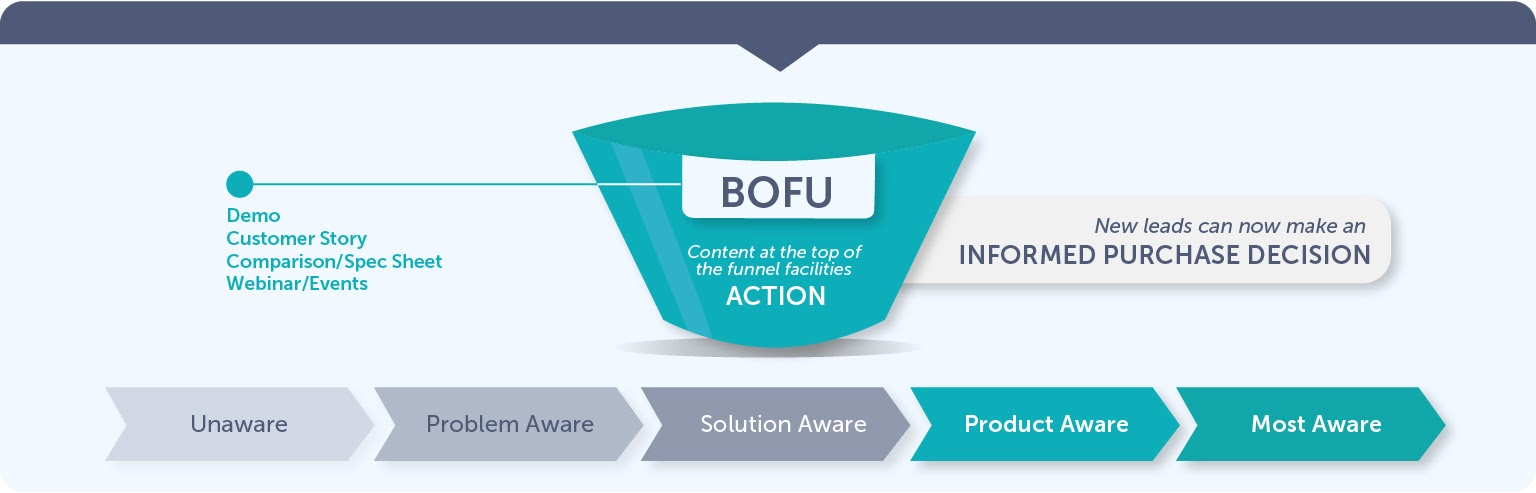
    1. Greater Focus on BoFu Content

    BoFu content

    The pandemic has led to brands and organisations moving all their operations online, including sales. The accompanying uncertainty of these times means that brands will increasingly focus on creating content that generates leads or sales, or in other words, moves them further down the sales funnel. This is the end game, after all, and is what all content eventually leads to. 

    Your buyer has done their research and is weighing their options at this stage. What they need from you as a marketer is that final push leading up to a purchase. Your content needs to be convincing enough to make them take this step.

    2. High-Quality SEO, Based on User Intent

    Seo for content marketing

    SEO has always been a content marketing essential. However, what 2020 changed was the need for more high-quality SEO, and this is only going to be true in the coming years. More importantly, all SEO efforts will have to cater to user intent if they’re expected to yield results. This will involve researching the most effective keywords, and also drilling down on long-tail keywords as part of a comprehensive effort to fill in a content gap in your niche. 

    This further goes hand in hand with another aspect that will influence content marketing efforts – the increasing use of voice search. Statistics predicted that by the end of 2020, almost 50% of all searches will be voice-based. What’s more, is that its convenience is only going to ensure its continued growth. It’s thus crucial that marketers create content and use keywords that cater to patterns emerging from this trend. 

    3. Building Content Communities 

    One of the biggest changes that 2020 has brought to the world of content marketing is the formation of content communities. With the sudden challenges brought on by the pandemic, building communities was seen as a surefooted method of increasing a brand’s reach. The benefits of these communities are varied, from engaging writers and their audiences with your brand to increasing contributions and word-of-mouth marketing. 

    Fostering a sense of community among your audience is one of the best ways to keep building on your brand’s engagement, along with doing wonders for your brand’s awareness across various channels. 

    4. Building Content Hubs to Generate Trust and Brand Awareness

    With the extent of competition in the market across sectors, it’s essential that a brand builds on its awareness and generate trust in its audience.

    Every company needs to be a media company they say, it is perhaps the most effective way to build customer loyalty and trust in your brand. It’s also a great way to build content ‘hubs’ that continuously educate audiences and further build their trust in you. 

    Recently, Cipla, a pharmaceutical company, created a content hub to educate people about Asthma and Inhalers. Iconic brands are created with consistent efforts to build trust and help customers. And with Breathefree, Cipla is leading from the front.

    Doing so requires consistency. Your brand’s messaging must be consistent across channels, and it must continue to educate its audiences with their best interests in mind. Remember, content is no longer created for search engines, but for the audiences themselves.

    Ask yourself what it would take for you as a customer to attach yourself to a brand, such that your continue to purchase their offerings without much thought, and then work on implementing a similar strategy for your brand. After all, wouldn’t it feel like a victory if your audiences recognized themselves as your loyalist? The boost that such trust could give your brand is tremendous. 

    5. Target Google’s Featured Snippets

    Over the years, Google has continuously tweaked its algorithm with the aim of providing users with the exact information they search for. This is often presented to them in what’s known as a featured snippet. However, to have a part of your content featured on top of Google’s web page requires creating content that’s targeted to the user’s intent, clearly answering the question they’re asking. 

    These featured snippets can be in the form of how-to lists, summary paragraphs, or even tables. Regardless, your goal must be to create content that’s crisp, clear, and structured as logically as possible for it to stand a chance to be featured. 

    Suggested Reading: 25+ Content Marketing Tools – Drive Growth For Your Business

    6. User-Generated Content

    There’s no way you can go wrong with this. Using user-generated content is perhaps among the best content marketing tricks for building your brand’s awareness and generating further trust in it.

    UGC leads to network effects and reaches scale without doing significant effort. If you are a B2C brand, moving towards UGC could be a smart way to reach scale and grow your organic traffic.

    And if you are a B2B company, take some inspiration from how Cisco got content generated by their employees for their campaign “We are Cisco”.

    Final Thoughts

    The coming years are going to be the years in which one gets the opportunity to hone the changes made to their content marketing strategies post the pandemic. And those who do this best will see the success they aim to achieve. At the core of a brand’s content marketing efforts is a keen understanding of your buyer persona to thus create content that helps drive them further down the marketing funnel. We hope this piece on the top content marketing trends answers the ‘how’ of this mission! 

    If you are searching for the best content writing services which can benefit your business and improve the overall performance of your content then you should definitely look for the best content marketing services.