Category: Growth Insight

  • How to Increase Brand Awareness With Effective Content Writing and Distribution

    How to Increase Brand Awareness With Effective Content Writing and Distribution

    It’s sheer psychology at play that people are more inclined to buying from brands they know about than from those they have not heard about.

    Imagine walking into a plush multi-brand clothing store.

    You see apparels from the best of brands on display. You recognize some brands and it’s a normal tendency to walk up to those sections where you see the brands you know.

    The brands you haven’t heard about may actually have a better selection to offer for a lesser price but you’d probably look through them because you hold the ones you recognise in higher esteem.

    The same is the story online. With myriad brands vying for your attention in the online marketplace, growing brand awareness is the key if you want to get noticed. And, how do you build brand awareness?

    Content writing and distribution is the answer. But first, let’s get down to the basics.

    What is Brand Awareness?

    Aren’t you instantly able to recognise some brands just by seeing their logos? The answer would be an affirmative.

    Just yesterday, you drove down to a busy road and noticed a big yellow ‘M’ staring at you from a distance. Your eyes gleamed up because you knew McDonald’s was approaching.

    Likewise, you are able to instantly identify the manufacturer of cars by just glancing at their logos.

    Have you seen the social media hits by Amul?

    Amul Hit

    Or new Mr. & Mrs. webseries by Girliyapa? If yes, Bosh received the brand awareness worth 14M video views for it’s Dish Washer, a new offering in India.

    Mr&Ms Bosh

    Recalling and recognizing a brand when you think of any product or service associated with it or when you look at its logo is called brand awareness. It is the level of familiarity consumers have with a brand like its name, characteristics, logo or anything else that is strongly associated with it.

    A purchase decision is strongly influenced by a consumer’s ability to recall a brand. Brand awareness is also the primary consideration when it comes to ascertaining consumer behaviour, strategy development, advertising management, and brand management.

    When you grow the awareness for your brand, you are helping a consumer or a prospect get acquainted about it or its offerings. Building a brand awareness campaign strategy is critical especially during the early days of a brand’s existence and growth.

    What Is Content Writing and Distribution About?

    The success of a brand is not only because of a brilliant idea no one else could think of. Also, pumping in money to boost ads to your customers is the clear solution.

    Well, here’s the deal.

    Creativity is the essence.

    While it is critical to have a content strategy in place, it is creativity that actually helps you stand out in the crowd and get noticed. You don’t need to copy what other brands are doing to get noticed. It probably worked for them for some xyz reasons but that doesn’t mean the same methods can work for you.

    Step into the shoes of your potential customer and think what kind of content you’d expect from a brand such as yours.

    Does anything about it excite you?

    What would you look forward to from its offerings?

    Does the logo or any of its characteristics intrigue you enough to want to pause and catch another glimpse?

    The logo looks pretty out-of-the-box. How does it relate to the brand in question?

    So much for the creativity of content and ensuring your message gets conveyed the right way to the target audience. Next, the distribution of content is important.

    There’s no point in writing amazing content if it doesn’t reach your audience the right way. Content distribution needs a strategy too. You need to know whether your content is reaching the right audience. If you want to increase brand awareness or get ROI on your content, you need to push it on to the screens of your relevant audience.

    What posts should go where and how must you time each to maximise eyeballs should all be a part of your content distribution strategy. There are three content distribution platforms – owned, paid and earned.

    • Owned Media – channels controlled by your brand like your website, mobile site, blog, social media accounts
    • Paid Media – channels you pay for to get a leverage like paid search, display ads and sponsorships
    • Earned Media – when customers become the medium for boosting your brand awareness such as word of mouth publicity and viral content that spreads (shared) like wildfire.

    While owned and paid media mean an investment, it is earned media that has a higher potential for propelling engagement and boosting traffic.

    This is exactly the point I am trying to make about interesting/creative content scoring high.

    10 Best Ways That Answer ‘How to Increase Brand Awareness’

    How to increase brand awareness

    Companies today have building brand awareness as one of their primary goals. They want their target audience to know sooner about them than in the normal course of things. Read on to know what can help you achieve your goal!

    1. A Strong Narrative Works!

    Give a good thought to the content and the message you intend to convey through the voice of your brand. If it appeals to or touches the cords of your audience, your job is half done. Such content is more like to be shared on various platforms than any other.

    2. Guest Blogging Gets You Traffic

    Two-way content partnerships can bring your brand to the forefront and gets your word out faster. By writing guest posts, you are actually leveraging the audiences of other sites to build your brand awareness. Writing guest posts on the blogs or media sites your prospects visit is a great way to grow your brand.

    3. Using Instagram Stories to Get Eyeballs

    Posting stories on Instagram is a rage today in both B2B and B2C segments. It’s the best way to provide targeted content to the audience and grow your brand awareness. Showcase your products or services in a sequence of Instagram stories that stay for a 24-hour period before getting wiped out automatically. Use features like Boomerang and slow motion to draw attention to your posts.

    4. Make Sharing Quick and Simple

    The advent of social media has made it possible to increase brand awareness like never before. Your audience will not shy away from sharing what they like to read. Use share links generously in your content to help your audience and followers share it in their networks quickly. Give them a variety of options of sharing it on chat apps, social media, and email.

    5. Infographics Instantly Catch the Eye

    The best way to capture interesting data and statistics and present them to your audience is with the use of infographics. Being a powerhouse of content, these pictorial depictions are educative and make it easy for the audience to absorb information. In addition, they are most likely to attract shares on the social media. If your patrons or prospects like and follow your infographics, it automatically becomes a part of your brand identity.

    6. Paid Social Advertising

    Social media platforms like Facebook and Twitter have a mindboggling reach and have a great potential of getting your content across to the target audience. Sponsored advertisements on Facebook and Twitter need you to shell out money but they still work economical on the budget. Manage the way your ad shows to the audience, set the preferences and review the metrics periodically to gain valuable insights into audience behaviour.

    7. Cut the Sales Pitch and Metamorphose into a Valuable Resource

    If you have the knowledge and expertise, why not share it with others and add value and credibility to your brand? If you can become a trusted resource for your audience, you’ve come a long way in your content marketing efforts. Gone are the days when marketers could use a cut-and-thrust sales pitch in their content. In the current times, you have to provide a value addition to your buyers and prospects.

    8. Initiate Promotional Partnerships with Other Brands

    Starting a promotional partnership with a brand that is in some way connected to your offerings in the supply chain can actually skyrocket your brand awareness. However, you must choose your promotional partners wisely, making sure it adds value to the purchase decisions of your clientele.

    9. Contests on Social Media

    Social media is a craze among people of all age groups and people spend a lot of time surfing through the feeds and often contributing to them. If it’s a contest, they are more likely to be game to participate in it. Use your social media channels to create contests and engage your audience.

    When someone from your target audience submits a photo or video and his/her friends vote for it, you are actually engaging not just your followers but also opening doors to new connections.
    Sounds like an awesome idea, eh?

    10. Sponsor Public Events

    Quite an effective way to create brand awareness! Sporting events, charitable events or social fundraisers are the best places to put your brand in the spotlight by using your company logo and name for a contribution in cash or kind.
    Now, you may ask what role content writing has to play in sponsoring such events? Well, it does have. Post about your contribution as updates on social media and reveal your philanthropic side to your target audience by telling them about such acts of goodwill. From your existing customers, the word about you is very likely to spread to others.

    In Conclusion

    With so much competition in the online marketplace, it’s important to use content as a powerful tool to get noticed. People are not interested in reading content with a preaching tone or one that carries advice they already know.

    Get creative.

    Use catch-phrases and come up with interesting jargons that have the ability to trend on social media channels. When such jargon becomes synonymous with your brand, it only means the brand awareness strategy you have been employing is successful.

  • 22 Awesome Ways to Increase Brand Awareness and Boost Conversions

    22 Awesome Ways to Increase Brand Awareness and Boost Conversions

    Content marketing has grown by leaps and bounds over the years, changing the way users are acquired on the internet. It is quite different from the pushy, revenue-driven advertising methods that have the sole intent of driving sales.

    Yes, content marketing is about building your brand and nurturing your prospective customers the right way to set your brand apart in today’s crowded market space. Its aim is to provide valuable content to the reader and establish your brand’s authority in its industry domain.

    But how can you increase brand awareness?

    Here’s the thing, be innovative and serve your content fresh if you want to outdo the competition. Your audience will not like to read stale write-ups with ideas they’d have already read like a thousand times before.

    So, how exactly do you create content that garners attention and cements your brand as an expert in the field?

    But, first things first.

    Importance of Brand Awareness

    When people increasingly become aware of your brand, it only fosters a healthy image of your company. If you want to improve your company’s reputation, you must work on increasing its brand awareness.

    Brand awareness directly indicates how aligned your content is to your brand.

    If people are well aware of your brand, it also means that they love and follow the content that has been putting your company under the spotlight.

    The Verdict Is Loud and Clear

    Your content is the backbone of online marketing success and is a great way to boost brand awareness. Also. your content marketing strategy should be created with the goal of improving brand awareness which will also help you analyze the right metrics to calculate your ROI.

    However, there are some prerequisites to make your content marketing efforts successful.

    If you are just in early days of promoting your brand is crucial to define your brand in clear terms. Have a clear vision and mission statement in place which should lay out your company values and goals.

    Determine your company’s voice and ensure that it is in tune with its mission.

    Know what do you want to be recognized as – friendly, authoritative, pushy, funny, customer-oriented, or an industry expert? Use a voice that suits your choice.

    So, How Does Content Marketing Increase Brand Awareness?

    Gone are the days of the revenue-focused brick and mortar establishments that managed to make enough money by selling their product or service using cut and thrust advertising methods.
    Today, the online world offers fierce competition with tons of companies having similar operations vying for your customer’s attention.

    Here’s the deal, creating fresh content is critical to any business’ brand presence. Bear the following pointers in mind.

    • Your audience must find your brand interesting
    • Your content must be relevant to your customer’s needs
    • Your content must be fresh, original and add value

    Use content as an asset to express what your company and brand stands for. Bring out the personality of your brand and let it shine through the words you sprinkle in it.

    Content marketing should establish a fit between the content created by a business/brand and customer needs. If you have the art of creating a narrative and telling people how your business relates to them, they will love to read whatever you say.

    Sound content marketing efforts also indicates to search engines that your business is an industry leader and deserves an organic search engine rank. Write blog posts and think up creative ways to increase brand awareness to show your presence on different online platforms by publishing intelligent and relatable content for your audience. There are many more ways which will help you ace the game, let’s have a look at them!

    22 Tips to Increase Brand Awareness Through Content Marketing

    Continuous exposure of your brand is important on social media and other online channels where your target audience frequently hangs out. Content marketing is among the best inbound marketing strategies for increasing brand awareness without interrupting your target audience.
    Here are some strategies that can help you increase brand awareness.

    1. Press Release

    Don’t let any healthy development in your business go unnoticed. Sharing news through official press releases is an effective way of building brand awareness. If it is your own voice, it is most likely to be held credible and read by the stakeholders, your current customers as well as prospective ones.

    2. Regular Content Posts

    A Survey by Hubspot said that businesses who posted 16+ blogs a month, received 3.5 times higher traffic!

    Create valuable content periodically to get noticed by both the search engine and your target audience.
    Blogs are extremely effective in drawing attention to you, and your products and services. Ensuring that they are unique and well-optimised will give you an SEO leverage and boosts your chances of being found online.

    3. Multimedia

    “Your organic traffic can increase up to 157% if you include a video in your blog post.”
    Often, plain content may not have the desired effect the way multimedia content like infographics, videos, presentations, and webinars will have. Be active on YouTube and social media and create regular posts to stay visible to visitors.

    4. Demos, Trials

    Interestingly, the word ‘free’ has a magnetic effect in the world of e-commerce. It immediately catches attention and keeps your potential and current customers hooked. Free samples, trials and demos are totally effective in building a brand and bolstering the trust of people towards your offerings.

    5. Downloadables

    The key to becoming an industry leader is by producing informative content. If your content has downloadables like whitepapers and eBooks which hold tremendous value, they are great tools for conveying your authority on your domain.

    Download your free content marketing editorial calendar template

    6. Engaging and Interactive Content

    Talk to your audience. Seek responses from them. Get them hooked by creating shareable content aimed at amplifying the conversion rates. Ask questions, create polls or quizzes, checklists and calculators that add value to your visitors, prospects and customers alike.

    For more detailed information read, “How to harness the power of interactive content?”

    7. Daily Posts on Social Media

    No, you don’t need pages and pages of content in your social media posts. Short and impactful content is a quick attention grabber! The idea is to stay active and post regularly to tell people you are in business. Keep in mind the angle of value addition so that your followers find your content useful and are prompted to share them, helping you expand your follower base.

    8. Industry publications

    Get in touch with magazines, news sources, industry blogs and other important publications, physical or online, to get your company’s news or content published. These offline and online platforms get a lot of eyeballs from industry leaders and prospects. Hence, there’s every possibility of your brand getting noticed.

    9. Link to Email Signature

    Mentioning your blog or website link in your email signature needs no investment yet is an effective way to increase your brand awareness. There is hardly any effort involved but the results can be quite commendable.

    https://blog-api.wittypen.com/wp-content/uploads/2018/10/Link-to-Email-signature-1.png

    10. Guest Blogging

    Be heard by a larger audience in your industry outside your usual domain by writing guest posts on portals that accept them. Guest blogging is a great way of establishing your authority in a domain and getting yourself known to a wider base of interested audience. In case people like your posts and share them on social media, you can enjoy a wider reach.

    11. Referral Programs

    Using incentives to reach your customers and prospects is an effective strategy for increasing brand awareness. Initiate a referral programme in which you directly credit a monetary incentive to the online account of the person whose referrals buy from you.
    This serves two benefits. Besides expanding your customer base, you also get people to share their details with you by registering on your portal.

    12. Offers Stating Limited Period and Quantity

    Create a buzz around your business by coming up with limited time and quantity offers from time to time. Make the best of festive occasions to get the word out. When people see an urgent need for action, they are prompted to act whether it’s buying a product, availing a service or submitting a contest form. See the below ad which was a part of recent campaign for Fastrack
    Example of Fastrack Ad

    Example of Fastrack Ad

    13. Contests and Freebies

    Give away little joys to your target audience in the form of free gifts if that translates to improving your social reach. Contests are a great way of drawing visitor attention. You can give many little rewards to participants and one or two big prizes to the winners. Ask your users to like your page, your posts and share them in their network.

    14. Polls/Surveys

    People like responding to questions or giving their opinion on something that is in their domain of understanding. Ask questions through Facebook or Instagram posts and tweets or create a survey using this feature on Twitter.

    15. Paid Social Ads

    LinkedIn is a credible social platform that can lend wings to your business. Considering the professional following there and an immensely targeted advertising capability, posting ads on this platform can quickly create a buzz around your brand. You can also have casual social hangouts like Instagram, Facebook and Twitter throw up your ads to audience who could be looking for your products or services.

    16. Social Blogging

    LinkedIn has a social blogging platform that helps users write informative and relatable content and have it published there. It not just creates a buzz around your business but also helps you interact with professionals in your field who post their blogs just as regularly as you do.

    17. Membership Rewards

    Convey to people that they can apply for paid membership on your website to avail free access to certain services or enjoy the perks of being a member. If you are able to provide a value addition, this can draw more spotlight on your brand.

    18. Loyalty Freebies

    Some customers deserve special treatment for the amount of business they give to you. Come up with loyalty programs and reward them with freebies for their years of association with you or for meeting the monthly/quarterly/yearly targets of spend.

    19. Closed Beta Launch

    Offer first access to a privileged few and this you can decide by planning a social contest so that only the eligible ones are chosen for the beta launch.

    20. Community Connection

    Having a direct sales intent does not work if you wish to carve a niche in the market. Show your involvement in the community and get yourself noticed. It works to sponsor local events or conduct your own events in areas of high traffic like malls and exhibitions or at your workplace. Invite your prospects to attend them. Think up creative activities aimed at the target age group or customers to conduct at schools or residential societies to build your brand awareness.

    21. Mutually Beneficial Partnerships

    Maintain a good rapport with local businesses in the industry to benefit from referrals through them.
    For instance, if a prospect approaches XYZ company for a service it does not provide but knows you can do justice to the requirement, he may refer the person to you. For building such enriching partnerships, you must harbour good relationships.

    22. Hashtags

    Hashtags have been a very popular way of reaching people on social media channels. Make sure you use relevant ones in your post to draw attention to them from people who search for those tags or click on them to see similar posts. Some hashtags you normally find trending on Twitter and Instagram are #ootd, #photooftheday, #instadaily, #cryptocurrency, #bitcoin, #tbt, #contest, and #giveaway.

    The Right Time to Act is NOW!

    Building a brand takes time and you cannot expect miracles to happen overnight. Spend time in chalking out a workable strategy and make sure you are consistent in your efforts.

    Get creative and make the best use of social media and blogging platforms to get your word out. Hiring content writing services can go a long way in helping you achieve your goals. Results won’t be too far if you are doing the right things at the right time.

    Good luck in your branding endeavour!

  • How can AI be used in Content Marketing?

    How can AI be used in Content Marketing?

    Last year, on April 1st, we announced at WittyPen one of our most ambitious projects – Project Nora. The response to that was better than what we could have expected.
    With the help of Artificial Intelligence, we offered to get your content written by some of the greatest minds in human history. Initially, the number was kept to 6 – Steve Jobs, Warren Buffett, JK Rowling, Bob Dylan, Bill Gates, and Philip Kotler.

    You pitch the idea, select the writer, and behind the scene, our AI algorithms would work to ensure the content as per your desire. Can you imagine how crazy it would be to have your brand story by J.K Rowling, and your sales pitch or PR article composed by none other than Steve Jobs?

    Project Nora WittyPen

    Keeping the huge amount of structured and unstructured data, complex algorithms, and the brilliant engineering aside, just think only from the perspective of the outcome. How beautiful it can be for you as a business owner to share your idea with the greatest minds in human history and let them speak for you!
    Nothing short of a fairy tale, right?

    People appreciated the idea of using AI in content marketing, talked about it, reached out to us, showed their interests, and asked for samples. It was simply an amazing response for a young startup like us.
    But if you read the first line again, and notice the date mentioned, it’ll come to you that it was a 1st April prank. Nonetheless, a beautiful one. People still casually talk about the uniqueness of the idea and the possibility of its execution.

    Well, pranks are supposed to be attention seeking and funny. It was both. But sometimes, there is a certain extent of reality involved in the prank. This, too, wasn’t a complete lie.
    With this prank, we were experimenting with the possibility of the adoption and acceptance of AI in the Indian content marketing space.

    The appreciation for Project Nora could have been the ‘initial enthusiasm’ for a fresh idea, but did the idea have the potential to generate success on a greater scale? Given the nascent stage of AI, and even content marketing in India, did the idea stand any chance?
    Directly connected to it, but the bigger question, is:

    Is AI in Content Marketing any Relevant?

    Whenever there is an introduction of a new technology, the debate of ‘Machine vs Human’ is almost mandatory. People are sceptical that the introduction of more efficient and powerful machines will replace professionals and snatch their jobs away.
    The best examples are Computers. When computers were introduced in India, people opposed it on the basis that it’ll take away all of their jobs.
    However, with time, it was proven that it wasn’t much of a threat to jobs. In fact, thousands of jobs in the Indian It sectors are created every year, thanks to computers.
    Now, coming to the freelance sector in the country, India is the land of 20 million freelancers. 1 out of 4 freelancers in the world is an Indian. A fair share of them consists of content writers. It is natural to think that the introduction of AI in content marketing will replace them. But, think again. Will it?
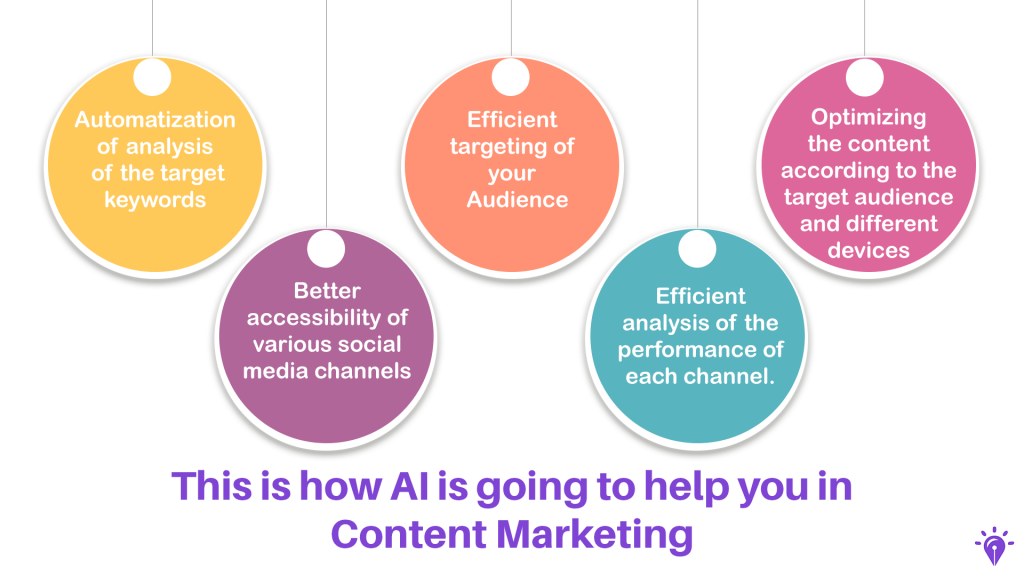
    No, it’ll not. However, AI will most definitely be helpful in:

    1. Automatization of analysis of the target keywords
    2. Efficient targeting of the Audience
    3. Optimizing the content according to the target audience and different devices
    4. Better accessibility of various social media channels
    5. Efficient analysis of the performance of each channel

    AI in content Marketing

    The above are just a few of the innumerable advantages AI has to offer. But, the thing is, AI will never replace the human creativity needed for quality content creation (at least, not in near future).
    The human brain is way more complex for algorithms to mimic anytime soon. That way, it is not going to replace the human creative effort, but will help optimize and make it more efficient.
    Now, the question is:

    How Artificial Intelligence can Help with Content Marketing

    Every content piece has a journey. It takes roots in your business, flourishes along with your target audience, grows with your prospects, and matures with your customers.
    Let’s see how AI can be used in content marketing.
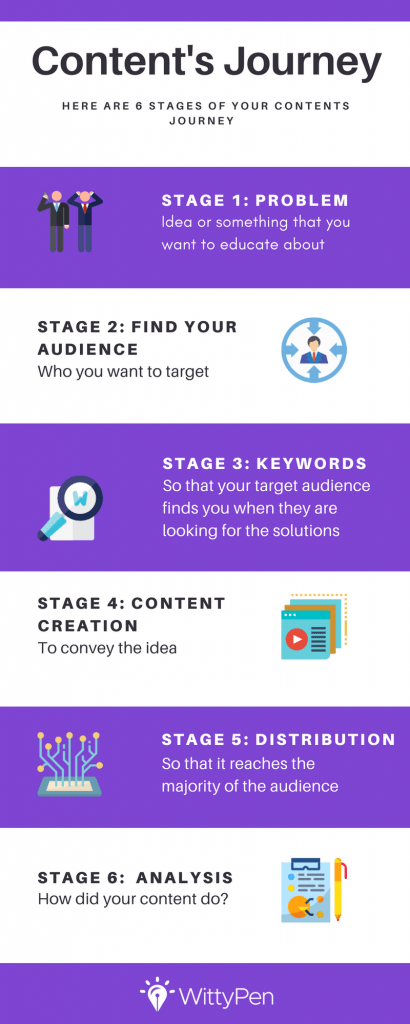
    If we break the journey down in stages, it’ll look something like this:
    Stage 1: Problem – Idea or something that you want to educate your readers about
    Stage 2: Find Your Audience – Who you want to target
    Stage 3: Keywords – So that your target audience finds you when they are looking for the solutions
    Stage 4: Content Creation – To convey the idea
    Stage 5: Distribution – So that it reaches the majority of the audience
    Stage 6: Analysis – How did your content do?

    Content's journey in 6 steps WittyPen

    Saying AI can help you at every single stage of the 6 mentioned, won’t be an exaggeration. Well, let’s see how:-

    1. Let’s Take a Start

    Taking a start is always difficult, but crucial.

    You know way too much about your business. Your business is not just a static object to you. It’s like a living person, breathing, moving, and growing along with you. You know every tiny detail of it.

    But others don’t know as much as you do about your business.

    The difficult part is to bridge that gap, and equally crucial as well. Crucial, because without bridging this information gap, you cannot have customers who put their trust in you.

    At this point, you are surrounded by thousands of content marketing challenges.

    How do I explain what my business is all about?
    Is it important to tell everything about it or only the benefits?
    How Should I approach my content strategy? Should I keep it formal? Should I keep it fun?

    Do I need to talk only about my business, or I can include other things as well?
    What are the things that I should make sure to cover in all the content pieces?

    Let me tell you, it is difficult to sort everything out manually, even if you have a team of professionals.

    AI can certainly help you there. AI can help you automate all the above-mentioned processes, which you have to manage manually. Not only it reduces the human effort, it is more efficient as well than doing it manually.

    2. Who is Looking for You?

    Youtube always leaves me awestruck. Their search recommendation service is simply brilliant. I, sometimes, think of a song, type the first word of it, and can easily find my song on the list, often at the topmost position.

    How do you do it, Youtube?
    The answer is AI.

    Youtube LogoImage Source

    But there is another aspect of Youtube, I am fascinated about is the accuracy of their advertisements. Most of the times, if not every time, the advertisements in my feed make sense to me. Whether I’m buying or not, is a thing for another day but I am considering it for sure.

    The world is a huge place, and a lot of people are looking for exactly what you offer. If you possibly could identify them all, and tell them what you do, half of your job is done. You are already set for stars.

    But how can AI help you with that?

    Exactly, the way it helps Youtube.

    Youtube records your browsing pattern, the kind of content you consume, and the products you previously have shown interest in. Based on this data, Youtube analyzes your persona, matches with the available records, and offers you exactly what you are looking for?

    AI can do the same for you, what it does for Youtube. It can connect you with your Target Audience.

    But this is not enough. Before you could serve them best, you need to know their requirements. You need to know:-

    3. What are They Looking for?

    Sometimes, starting from the very beginning is too boring, and sometimes telling too much is simply waste of time.

    So, what do you say to the people who are looking for your products/services?

    Exactly what they want to know.

    How?

    With the help of right keywords targeting.

    There is an entire industry working around SEO and keyword targeting. Based on the number of hits and frequency, keywords are chosen and inserted in the content. This approach is fruitful at times, and it can certainly be improved by matching these keywords with your target audience.

    SEO Keywords WittyPen

    Let’s say you are a business providing cloud services to Startups/SMEs, and large corporates. Going by your services and the keywords frequency hits, you may find – “Cloud Computing” as the most suitable keywords. You take this keyword and design entire content strategy around it.

    The problem with this arrangement is that most of the users clicking on your website are going to early college students, who are looking to learn the basics of Cloud Computing. I’m not saying that they will never buy from you but the chances of them buying your products are really thin.

    So, what happened there?

    You didn’t get the keywords frequency verified by your target audience.

    AI can keep you more targeted in that aspect. With AI, you can get it as accurate as possible.

    Okay, so now AI’s job is done, right?

    Clearly, NO.

    At this point, you know what your target audience is looking for, but:-

    4. Are you Providing the Same?

    The single most important question in your entire content marketing strategy – Are you providing the right solutions or just beating around the bush?

    Think of people who were so excited of the launch of the first iPhone that they waited overnight outside Apple headquarters for June 29, 2007 launch. These people believed that they are going to witness something that no one in entire human history ever had.

    img

    Image Source: media.wired.com

    Think of their enthusiasm and excitement for a product, just for a minute.

    Now, rethink what if the first iPhone wasn’t as good as people thought it would be. All the enthusiasm would’ve converted into a sham.

    You don’t want it to happen with your audience either. That is why, this is the most important step, and you don’t want to go wrong here.

    At this stage of content creation, AI can help you with:-
    a) Sentiment Analysis – Is the message is coming out right?
    b) Readability – Is it reader friendly or written for machines?
    c) SEO – Are you providing what users are looking for?
    d) Relevant External Links – Is it providing additional information to the reader?
    e) Image/Video Suggestions – Is it visually appealing and relevant?

    This is something, you can get more accurately with AI than a mortal human being

    5. Are You There, Where They Are?

    Facebook is the world’s biggest social network and if you watch your feed carefully you’d notice that it’s probably the biggest marketing network as well.

    LinkedIn is the biggest and most powerful network of professionals. You can find from college students, early professionals, to top corporate officials here.

    Every major B2C company is on Twitter and using it address the concerns of their customers.

    img
    Image Source – Pexels

    Are you using these?

    Also, are you using Quora, Instagram, Pinterest, and Reddit?

    How are you using these channels? Because the audience on each of these platforms is different from the other. You cannot target them all with the same approach.

    You need to adapt.

    But, how?

    AI can help you understand which section of your target audience is hanging out where? AI can also tell you which section of your target audience is interested in which feature of yours. Show them what they are looking for. Also, talk in their language but don’t lose your authenticity.

    6. How did it Go?

    Nothing’s perfect, and AI, anyway, is in a really early stage. You cannot expect it to hit the nail for you every single time.

    Because ultimately it is the people that you are dealing with. People like to make rational choices true to their conscious but often they go by their emotions.

    That is why there can be no single absolute theory that can decide your steps. The most you can do is to try to be as accurate as possible. Observe, evaluate, learn, and try new things.

    AI, again, can be helpful in evaluating the output produced by the content at each stage. You can take that into account and learn where you are going wrong.

    Where is it that you need to put a majority of your focus and energy? Once you are done with it, you need to:-

    7. Redesign the Content Strategy

    This is where you’ll love AI.

    Even though it may not be 100% accurate,AI in content marketing can surely evaluate the whole process and quickly suggest the steps to improve the overall content distribution strategy.

    AI will surely produce better results in future as it learns better. Learning is better because it identifies its own mistakes better.

    Let’s see how giants are using AI in their day to day operations:-

    Google Duplex: An AI System for Accomplishing Real-World Tasks Over the Phone

    Google: Solving problems with AI for everyone

    13 ways you’re using AI in your daily life

    Facebook: Suicide prevention tools powered by AI

    Facebook researchers use AI to turn whistles into orchestral music, and power other musical “translations”

    IBM: How Watson is powering IBM’s content marketing

    IBM WetherFX for Watson Campaign Automation

    Conclusion

    Technologies don’t die. They evolve and transform themselves into something better, something more efficient. Same is the case with AI. AI is here to stay, and it is all set to change the way we work or see the world.

    At present, we are discussing the scope of AI in content marketing and experimenting with its role, making effective use of content marketing resources and with time, this discussion will shape the reality.

  • How Can Online Content Writing Platform Help Your Content Marketing Campaign?

    How Can Online Content Writing Platform Help Your Content Marketing Campaign?

    There exist multiple online content writing platforms with a global presence, who are helping businesses grow through their dedicated content marketing efforts. According to Statista’s Forecast for 2019, global content marketing revenue is projected to increase to more than 313.4 billion US dollars. With such enormous amounts of investments in content marketing, stakes are high.

    Stats of content marketing

    Today, brands focus a lot on generating relevant content for multiple reasons. Some of these include:

    • Building original content to drive sales.
    • Generating leads through content marketing.
    • Brand Awareness.
    • Information/Knowledge exchange

    According to a B2B Content Marketing Survey by LinkedIn Technologies, lead generation is the top goal of content marketing, followed closely by thought leadership and market education. In fact, a majority of prominent organizations use content marketing as a business tactic.

    Some have proved themselves as pioneers in this regard. Take Amul for example. Amul has time and again proved to be the “Taste of India”. As a brand, it has become synonymous with creating witty content around the Indian political and entertainment developments. Consider the picture below for one such reference.

    Best content marketing examples

    What started as White Revolution back in 1948 has evolved into one of the finest brands, which understands its audience well and continue to create great content. It is clear that big brands are winning customers through content marketing.

    Content Writing Platforms Power your Content Distribution Strategy

    Continuing with the Indian Market, the primary objective of content marketing is thought leadership, with 59% of companies emphasizing on its relevance. It is foremost to understand what type of content marketing works for your business. If your content marketing strategy does not generate leads and bring desired results, all your efforts become negligible.

    Recent data shows that for 61% of B2B marketers, lack of resources such as staff, time, and funding remain some of the biggest obstacles to successful lead generation. According to the LinkedIn Technology Marketing Community, 51% of the brands find the lack of bandwidth to create content as the biggest challenge with their content marketing. Moreover, when it comes to 60% of B2B content marketing most  find it extremely challenging to produce engaging content, According to the Content Marketing Institute.

    Why Outsourcing Content Makes Sense?

    Fredrick Nael says, “It takes two sides to build a bridge”

    In this sense, let’s say you, being the business, constitute one side and your content marketing platform forms the other. Both of you together build the brand.

    It is this brand that generates leads, gets revenue, and makes your business grow further. In real-time, businesses need to understand the credibility of their resources. It is not always feasible to afford in-house writers. As a result, some brands may not possess the bandwidth to create original content.

    According to Curata, only forty-two percent of companies have an executive in their organization directly responsible for an overall content marketing strategy. Moreover, some businesses prefer handling their content marketing strategy with a need-based approach. 62% of companies outsource their content marketing with an aim to generate quality content. Content writing platform services can reduce such gaps and supply high-quality content which meets your business targets and ideology.

    Online Content Platform: They Create, You Curate

    Brands using content platforms can focus on marketing strategies and distribution while content creation can be outsourced. Having a dedicated team of professional writers/editors and copywriters can fuel your content marketing strategy. Online platforms provide brands with the skills, resources, and most importantly, the roadmap to power their marketing efforts.

    Associating with an online content platform will also dissolve your doubts of how to find freelance content writers for outsourcing. Online content writing platforms have a plethora of professional writers and industry experts to match your content needs. From social media posts, blogs, thought leadership articles to E-Books and Whitepapers, online content writing platforms have writers under every industry domain and vertical.

    By outsourcing your content to experts, you can:

    1. Get professionally written content which is optimized for search engines instead of micro-managing.
    2. Sustain proper time management with your resources. Outsourcing to online content platforms leaves you more time to invest in other business verticals.
    3. Track your content marketing efforts by measuring ROIs on the outsourced content.

    Furthermore, content outsourcing also helps your blogs rank higher on search engines:

    Online content writing platforms optimize content for search engines by:

    1. Well researched keyword Optimization.
    2. Using LSI keywords for SEO optimizations.(How to get better search engine ranking)
    3. Generating well structured, readable posts.
    4. Frequently creating content to continue building brand awareness and generate traffic.
    5. Focusing on meta-description and URL optimization.
    6. Using other technology tools to power content.

    Convinced to Try Content Writing Services?

    Such online platforms possess the expertise and resources to drive results. They possess sophisticated technology systems and applications to effectively generate content and strategize your marketing efforts. Moreover, the pricing and cost of writing services depend solely on your requirements and needs. This makes a lot of sense for brands, especially the ones who wish to see better ROI on their content marketing efforts.

    Best content writing services

    So, remember, whatever you do, an online content writing platform can help you do it better. That too with better infrastructure, tools, and a great team of dedicated writers and experts.

  • How to Do a Website Content Audit: A Comprehensive Guide

    How to Do a Website Content Audit: A Comprehensive Guide

    As the name suggests, a website content audit is an exercise to ascertain, measure, and value the efficacy of the content of a campaign. Annually, a well-executed website content audit can deliver relevant feedback and insights that can unlock the complete potential of your content marketing strategy. In today’s world of massive storage capabilities on the cloud, many-a-times content is never removed or deleted.

    This old content is stale, irrelevant, outdated and most importantly counterproductive as it may not be aligned to your brand strategy anymore. Thus, it makes sense to periodically review, evaluate, and measure our content and make sure that it is still relevant today. If not relevant, it needs to be recycled.

    A website content audit reviews all of the content of a campaign (or even website) and evaluates the relevance and effectiveness of this content based on key performance indicators (KPIs) that are agreed upon earlier. These KPIs can be similar to the ones used to assess the campaign’s performance. An audit can also be used as a base to build future content marketing strategy.

    An audit should not be confused with the content inventory exercise. Inventorying of content is simply a classification of all of a campaign’s content, whereas an audit is much deeper. Inventorying is only one part of the audit process.

    Benefits of conducting a Website content audit

    An efficient content audit will give you the following insights:

    1. Focus areas and learnings for the future, both in terms of better search engine rankings and from a marketing perspective

    2. Which is your most effective  types of content? I.e. which content is performing the best

    3. Which content does your target audience engage with most?

    4. Which content is now irrelevant and needs to be recycled

    5. Building a timeline for phasing out content

    Though each of the above points is important in its own way, most of the time, companies conduct website content audits mainly for SEO and content marketing. So, there is no harm is delving deeper into the benefits of a website content audit on this front.

    Content Audit SEO

    SEO: A website content audit is a great way of improving your content, so that it can be ranked better, and thus found more easily. By cataloguing the different sets of keywords, images and the other elements and comparing them to page ranking, you will be able to assess which content is more effective than others. It is like a feedback mechanism on your existing content. You can then take the key phrases that are better received and design your website/campaign with a greater emphasis on those words. If most of your traffic is organic, then conducting a content audit should not just be a yearly exercise, but rather an ongoing process.

    Content Marketing Audit

    Content Marketing:  The other popular reason for conducting content audits is to evaluate the effectiveness of your current content marketing strategy. Similar to SEO, a website content audit helps in analyzing and mapping your content inventory to target audience response and engagement. There will be certain types of content or distribution mechanisms that have significantly greater engagement, so, by breaking these down and understanding the critical success factors, you can recreate this success in the future. Similarly, you can learn from content that did not do well, and avoid those factors and mechanisms.

    How to conduct a Website content audit

    This is where the work actually starts. Briefly speaking, a content audit is about collecting your entire content library (could be for a specific campaign, or could be for a website), and then making an inventory based upon classifications that suit your campaign (generally this is time based). This is then followed by a rigorous analysis of the indexed content and then using this analysis to deciding the actions  to be taken regarding your content library – keep, improve, or remove. Have a look at this content audit guide to know all the steps:

    Content Ideas

    Step 1: Create a content inventory:

    There are many ways to doing this, and if you are doing this for the first time, be warned that this is the most time consuming part. We would strongly recommend using a tool for this, or building your own inventorying & indexing tool on Microsoft Excel. This step requires rigour and the ability to arranging data in a tidy manner. It is quite simple to build your own indexing tool on Excel. First of all, open and create a spreadsheet that will be used for auditing. You will be required to keep this neat and tidy.

    Once you have made a framework for collection – then is the time to compile all the content from your internal databases and sitemaps. We would recommend gathering them separately and the organizing them later. Relatively speaking it is easy to collect data from internal sources, but the challenge comes, when trying to gather all your indexable URLs. Here we would advise using free tools like Google Analytics or maybe even paid tools like Webmaster(depending upon the number of indexable URLs that you may have). A simple crawler could do the trick, but may end up missing out on a few URLs.

    Once you have gathered all of your content, it is them time to organize or index it onto your content spreadsheet. Once the framework for indexing is made, it is quite simple to arrange the content according to your chosen parameters. As a final word of advice, once organized, we would suggest going through the entire list to make sure the irrelevant content is removed, thereby sparing you additional work.

    Step 2: Measure your inventoried content on relevant KPIs:

    This part of the content audit is probably the most critical and will require you to think outside the box. First of all, you will have to select KPIs that are both relevant and can be used to measure all of your content uniformly. It is also a time that you should consider you additional metrics, than the basic ones you normally use. These metrics could be any of the following: mobile friendliness, page loading speed, content buffering speed, uniqueness of content, organic conversions, time spent on site or even ability to influence. Before proceeding further we would like to warn you that some of these metrics may not point out as clear results as one would hope.

    Many-a-times, the results have to be taken with a pinch of salt, as they may lead to multiple conclusions. We would suggest using multiple parameters and keeping an open mind. For example, some customers may know exactly what they are looking for and may spend as little time as possible on your content (this is because they know what they need) and this would lead to a speedy conversion, but the time spent on your content by this customer is very less.

    Alternatively, another customer may spend a lot of time on your content, thereby raising time spent on site, but may not lead to conversions. So, we would recommend using multiple metrics to evaluate your content, so that these scenarios are accounted for.

    Content audit dashboard

    Step 3: Build a Dashboard to compare asset data

    Once you have evaluated all of content, it is time to gather all of this data and arrange it in a logical manner to derive insights. Once again, we would recommend either using an existing tool in the market or creating a tool in-house. It is important to build a dashboard that can accomplish analysis at both a macroscopic level (analyzing all the content together in one shot)  and a microscopic level (pitting two pieces of content next to each other and comparing)

    Step 4: Carry out the Website Content Audit

    This is the part where all the action happens. Once you have built your dashboard and populated it with all the measuring data from step two – it is finally time to audit your content. Now is the time to analyze what content isn’t meeting your critical parameters – this could be due to it being irrelevant or due to a lack of quality, or even due to the existence of better substitutes.

    We would recommend making a scale and fitting all of your content on this scale. On the far left you would have content that needs to be removed, and on the far right you would have your best content that needs to be emulated or kept the same. Near the middle you have content that isn’t ideal but can be improved. Then you can draw the line, below which all content needs to be removed and above which, can be improved. This is also the stage, where we would recommend using SEO or content marketing tools, depending upon your objective.

    The reason for this is that, the results of your analysis (across various parameters – similar to the scale mentioned previously) will churn out a treasure trove of data that can be converted to actionable insights.

    A few examples of this data are

    1. SEO: Page title, keywords, content meta data, last updated, the bounce rate, average time spent on content and 404 links
    2. Content Marketing: word count, mobile friendliness, relevance and engagement

    Step 5: Take Action

    Once you have audited all of your content, the final step is to take action based upon the results of your audit. Before you can do that though, you will need to delve deep into your analyzed data to gain insights, draw conclusions and decide what action would be best for your campaign. Depending upon your overall goals you could carry out any of the following actions:

    1. Removing irrelevant content or recreating it
    2. Promotion of your best performing content
    3. Improving existing content (Sometimes it is easier to improve existing content, as compared to creating new content)
    4. Tweaking your SEO or Content marketing strategy based upon feedback gathered from current campaign

    Website Content Audit Checklist

    To ensure that you have carried out your auditing in the right way, check the following off your list:

    The Target Audience: Make sure that you have all the necessary data about your target audience. What languages do they speak? What device do they use? Where do they live? What are the pages they visit more or the terms they search for most? Questions like and similar to these will help you understand the kind of content you need to keep and the kind you need to remove for a more effective approach.

    The Navigation: Although not a direct part of content auditing, navigation is still essential to be touched upon. Make sure that your users are able to go from one content to the other easily. Another thing to keep in mind is that appropriate and effective CTAs and internal navigation links are provided after/in all your content pieces. This will allow you to increase your visibility significantly without any external help.

    The Sharing of Content: No matter how good or effective the content is, if the user is not encouraged to pass it forward to people in their community, it is going to go to waste. You will only be able to attract users that you have approached or the ones that have merely stumbled upon your content. However, ensuring that you create shareable content would allow your users to be a source of credibility and enable their respective circles to find and hopefully enjoy your content as well. Provide appealing and relevant content along with appropriately placed sharing buttons to increase shareability.

    Upgrading your content audit experience

    There are three ways in which you can use this exercise of a content audit to glean important information that you can use as a part of your content marketing strategy:

    1. Analysis of your competitors:
    You can carry out a content audit on all the publicly available competitor content. This will not only help you find gaps to fill, but also is a valuable exercise in picking up best practices. If time permits, carrying out content audits of your competitive frame of reference, will help you understand all of your competitors strengths and weaknesses, and this in turn should help you build unique content in the future by filling gaps. Similarly, you can help your own SEO efforts by analyzing and then incorporating content that is working well for your competitors.

    2. Understanding Social Media Signals:
    Sometimes, a content audit can reveal hidden gems about trends on social networks that may give you ideas about content that you can create that will be successful in the future.

    3. Links:
    Carrying out a content audit also lets you know which pages have links, where these links are from, and just how powerful these links are in the eyes of Google. These lessons are great in tinkering with your content marketing strategy and making it more effective. In the end, there are many ways of performing a  website content audit, and you should select one that is best suited to your needs.

    A content audit is not a process that you will perform only once, so the content audit process itself can be improved and built to exactly meet your needs over many iterations. A content audit should be an integral part of your content marketing operation as it is an element that forces you to become better every single time.