
Category: Growth Insight

  • 9 Evergreen Types of Content: Learn How to Choose Ideal Content for Your Brand

    9 Evergreen Types of Content: Learn How to Choose Ideal Content for Your Brand

    Every brand is different from the other so we cannot use the same types of content for every brand. Finding the right content for your brand is like finding a right key that unlocks the door to your brand. Your readers must be able to connect the content to your brand. To successfully match the ideal types of content to your content marketing strategy and your brand we must be clear of the base of what a brand and what are the various types of brands.

    What is a brand? A brand is a name, concept, service, term, design or other features that together distinguishes an organisation or a product from its competitors for a customer. It helps the company or the product stand out. According to advertising copywriter and ad agency founder David Ogilvy’s definition of a brand is “The intangible sum of a product’s attributes: its name, packaging, and price, its history, its reputation, and the way it’s advertised.”
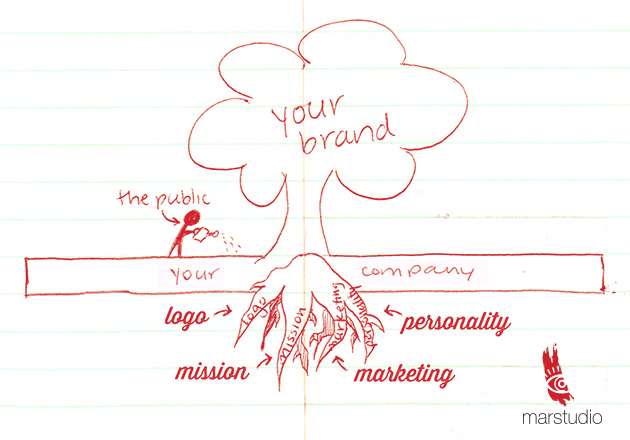
    Source: Marstudio

    Now Lets Identify your Brand

    There are different types of brands, it is necessary to identify your type of brand so you can jumpstart the development of your brand strategy by identifying the one that’s right for you. By selecting one type for your brand, you’re more likely to end up with a powerful brand strategy. Denise Lee Yohn, a brand leadership expert has classified brands in nine major categories, labelled by what characterizes or differentiates them the most from the others. They are as follows:

    1. Disruptive Brand: A Disruptive brand challenges the current ways of doing things and introduces new concepts that substantively change the market.

    2. Conscious Brand: A Conscious brand is on a mission to make a positive social or environmental impact or enhance people’s quality of life.

    3. Service Brand: A Service brand consistently delivers high-quality customer care and service.

    4. Innovative Brand: An Innovative brand consistently introduces advanced and breakthrough products and technologies.

    5. Value Brand: A value brand offers lower prices for basic quality.

    6. Performance Brand: A Performance brand offers products that deliver superior performance and dependability.

    7. Luxury Brand: A Luxury brand offers higher quality at higher price.

    8. Style Brand: A Style brand is differentiated through the way its products or services look and feel, as much as or more than what they do.

    9. Experience Brand: An Experience brand is differentiated through the experience it provides, as much as or more than the product or service. Here’s an image that will help you identify your brand better.
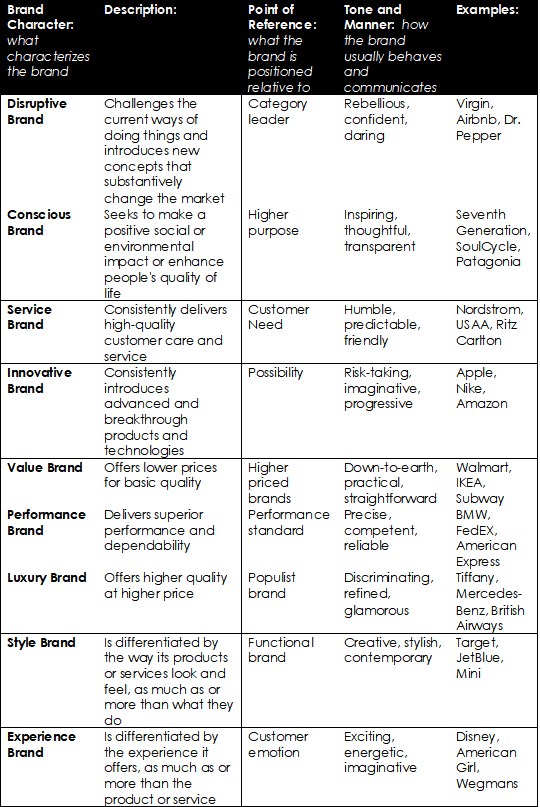
    Source: deniseleeyohn.com

    There are 5 guidelines to be followed to classify your brand in one of these nine categories:

    1. There are some characteristics that need to be and should be followed by all types of brands i.e. All brands should offer good service to their customers even brands not in the Service Brand. Service brand’s strategies, operations, and ultimately customer value propositions are all centered around service first. This puts added pressure on the Service Brands to deliver high quality customer care and service consistently.
    2. Identify your primary brand type, even though there maybe two or three brand types that might seem relevant to your brand type. A Primary brand type should be the one that aligns best with your brand’s goal resonates most with your organization, and gives you the most impact with your customers.
    3. Pick a brand type which is seems most evergreen or sustainable as your brand type has chances of evolving over the years with change in trends, culture, competitors and growth of customers.
    4. You might want to evolve your brand over the years to another brand type but the plans about such should be realistic as a value brand is likely to become a luxury brand.
    5. The difference between the purpose, scope, target customer and personality between different performance brands must be considered. Brand should establish an unique brand identity and a precise brand position for your brand.

    Identifying the type of your brand will not only help find the ideal content of it but will also determine the audience or customers your brand caters to which makes it easier to create content. A Luxury Brand and a Value Brand will have a different set of customers therefore their content strategy will be different too.

    What Types of Content are there?
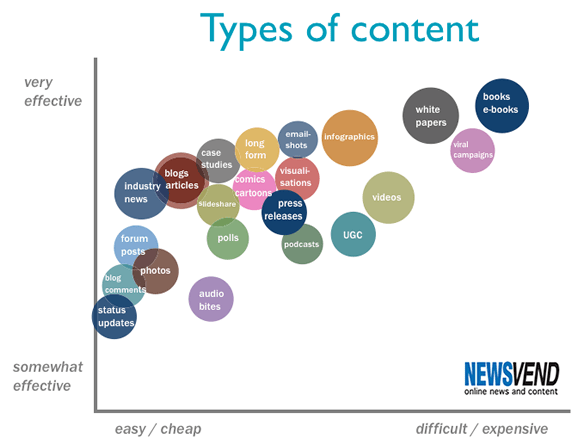
    Source: NewsVend

    Content Marketing goes beyond just traditional business blogs and social media marketing. Yes, they are an essential part of it but there is way more to it than just that. It is essential to know the various types of content so you can match the ideal one with your brand type. Here are nine different types of content:

    1) Blogging: Apart from being a traditional content type it is also the most effective content which makes it the most used content type therefore the first on this list. Blogs makes the central marketing strategy for many brands. They aren’t much time consuming and are relatively low cost. They attract a lot of audience and form a base of loyal readership by building a relationship with your readers. Maintaining a consistent blog with frequent, high quality posts can drive significant amount of traffic to your website. One must avoid these common mistakes while blogging:

    • Not posting regularly
    • Not optimizing your blog for leads or sales
    • Not linking to your own content
    • Ignoring keywords

    2) White papers: White papers are content type filled with information that contains data and solutions about a specific subject. White Papers focus on details and help build respect among their readers. Being it a filled it information a white paper takes a longer time to write and is a bit more expensive than a typical blog. White Papers are meant to focus on a very specific problem and then offer a solution to the problem. A white paper comes a long way to create your brand and sell your product.

    3) Case Studies: A content marketing case study explains what your product or service is and how it helped a client. They are in-depth examinations covering a specific scenario or an example, which should provide both knowledge and actionable information. A case study basically says, “Here is what we do, how we do it, and the results we get.” Case studies are highly sharable and unique as it comprises data of your brand. Your case study should be written in such a way that it doesn’t come off as pure marketing.

    Treat your case study like a blog post and use storytelling elements, focusing on the “why” and “how” parts of the equation. A good case study can really be an inspiring “success story.”

    4) Long form Content or Guides: Long-form content or Guides is available for free online for the readers. It helps readers build trust as they can depend on your brand for guidance hence increasing the subscribers. Ultimate Guides are one of the best types of long-form content that you can create. Many businesses have them separated from the regular blog. This content won’t just be 1,000 words; it might be 5,000-15,000 words.

    There will be several chapters, each on their own URL page. Because of this, they offer immense value. Users don’t have to go anywhere else for information on a subject, because you have literally covered it all. These guides are also free and available online, making them accessible. Remember to break guides down into comprehensible sections, and promote them heavily. You want users to know that they’re there.

    5) E-Books: An E-book is a long content compiled together in a PDF usually. E-books are often a downloadable product, available for free in exchange for joining a mailing list. They do take more time and money to make; you can outsource the process to a freelance writer who has experience with writing them. They can be five pages long or thirty pages long, but they must offer value and must offer real solutions. A good design of the E-book is essential. E-books without colours, graphics, and great formatting are considered not worth reading.

    6) Info graphics: Info + Graphic, as the name suggests Info graphics present information or data visually. They put a ton of information in one image making it visually interesting and easily digestible. Info graphics are perfect for communicating almost any idea or concept.

    Data, research, statistics, and findings work especially well. Info graphics are shared, viewed and loved more. They are a viral potential. As the back link to your info graphic is embedded within it, anyone who shares it properly will give you the valuable back links we all need for our content marketing.

    7) Templates & Downloadable Content: Templates and Downloadable content attract a wide range of visitors. They are a great resource for users to utilize again and again. They are not time consuming or require a lot of money to create. Templates and Downloadable content should have a clean organization along with a lot of white spaces, have a concise copy, and include your branding somewhere on it. They can be offered to the readers in an email subscription sign-up and can be promoted at the end of your blogs and videos.

    8) Listicles and How-to Content: Most articles you read these days on the internet do have lists. List appeals to masses. Even if a visitor doesn’t want to read the whole article, they can scroll through it and still get information. They are the most convenient content to read. One cannot go wrong with this content type. The more detailed your list is, the better.

    How-To Content is also extremely popular. It drives the curiosity and the want to learn something in the readers. One must identify a problem and then come up with a solution for it. You can never run out of How-To content and this type of explained content could be put up daily with diagrams, videos and pictures to enhance it.

    9) Videos: Most users prefer watching a video than reading a long post. They are engaging a nd ever changing. This is particularly true for both tutorials and product content; 4x more users would rather watch a video about a product than read about it. Done well, a video can be extraordinarily persuasive.

    These types of content can be used for social media marketing. The easiest way to use them in your content marketing is to upload them to YouTube, coordinate them with blog posts, and embed them in the relevant posts you write. You could also add a link at the end of the video to send them to your site. Videos aren’t supposed to be long. A good length could be two to three minutes.

    Putting videos on sharing sites like YouTube and Vimeo are great ways to improve your search results. Audience Before finding the right content for your brand, an organisation must study their audience. They must be aware of the type of content their audience consumes or will consume.

    Younger audience seems to prefer more of Listicles and Videos over white paper and e-books while professionals working would prefer that type of content. This makes it essential for a brand to study and know their audience. Most people prefer to buy from a brand they are familiar with, making it essential for the brand to know their audience’s preferences as familiarity for a brand comes from knowing that they will provide the audience with what they need. Variety of content helps reach out to different types of people. Video content is for social media marketing.
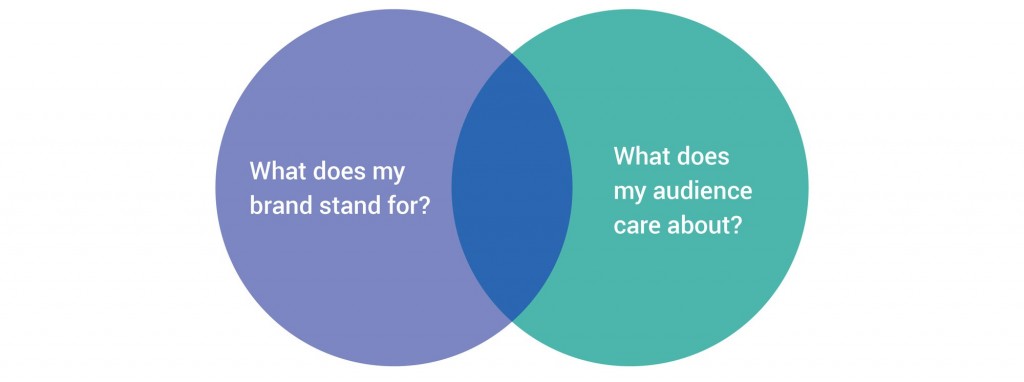
    Source: Think with Google

    Matching your Brand with the Ideal Content

    To find the types of content for your brand, you must be clear about your brand type, audience and the variety of content that is available to you. Let’s say you are a Value Brand or a Conscious Brand which is just starting up. You have specific set of target audience you cater to with not much finances at your disposable for content.

    The ideal type of content for you would be Blogs, Listicles and How-Tos related to your product. While for a Luxury Brand, Performance Brand or an Experience Brand, the audience wants to see the product rather read about it therefore Videos are the way to go for them For Innovative Brands like Apple, Amazon etc. they should opt. for long form content, whitepapers and case studies. Disruptive Brands like Zomato, Zostel etc. should consider content such as Info graphics and Blogging. Service Brands can provide their users with E-books and Guides along with Downloadable content whereas Style Brands like Vogue, Koovs etc. resort to Blogging, Listicles and How-Tos as their ideal content.

    As a brand you should also be aware of the type of content that meets your goal. The right type of content will have an direct impact on your Brand’s growth. Here are some examples of appropriate content for different situations:

    1. Brand awareness: You need to grab your target customer’s attention. Create relevant blog posts, exciting social media content, simple yet informative how-to videos, interesting Info graphics, and Slide Share presentations. Many brands are even creating memes to hook people with humour.

    2. Website traffic: You need to drive people to your website and keep them there. Consider long-form content, how-to guides, whitepapers, eBooks, case studies, info graphics, and videos. Offering original information, research, and data will mark you as an expert in your field and keep the visitors rolling in.

    3. Lead generation: You need to motivate your customers to fill out a contact form with their personal information. The best types of content for this task include contest submissions, eBook downloads, product demos, and podcasts.

    4. Customer retention: You need to keep buyers coming back for more. Get personal with your content, using data to tailor your content and make it relevant for your existing customers. Update your blog regularly, send email updates, and offer coupons for existing customers.
    Source: QuantamBooks

    Conclusion

    A brand will not have only one set of audience. There will be variations in the type of users. Therefore one ideal content type for a brand is not possible in this dynamic world. A brand must mix and match types of content with their brand identity and the need of their audience. People learn differently. Some people are visual learners, while others are more hands-on.

    Similarly, certain types of content will appeal more to different people. If you have more than one target audience, mix up your content to meet the needs of different consumers. Consider rotating the content on your blog or creating different landing pages for certain people. They must also realise that there is a lot of “Content” out there but most brands aren’t providing their audience with the right content type.

    Creating content takes effort and the effort should be put in consistently. Social Media is not the only channel to put your content and content is not created just to talk about the brand and their product. Just remember the 3 things before selecting your content:
    1. The type of your brand.
    2. Your goal.
    3. Your target audience.

  • How Can the Sales Team and the Content Marketing Can Work Together?

    How Can the Sales Team and the Content Marketing Can Work Together?

    Does your company want to see similar benefits of sales and marketing working together?

    Most companies keep their sales and marketing teams separate. They don’t know what the other is working on, they aren’t updated on the happenings in the other team nor do they have access to each other’s data which leads to a lot of lost opportunities. Marketing team doesn’t get to know what is working in the market or not and the sales do not get to communicate to the marketing team about what marketing material actually works in the market even if those are minute changes that could be made in the structure or the style of content created. A recent survey showed that “51 percent of marketers are not satisfied with the level of communication between the teams and 53 percent of sales professionals are not pleased with marketing’s support.” Therefore, it’s time to restructure the two teams to facilitate better workflow between them and to optimize the resources of the company as a whole.

    12 Ways in which content marketing and sales team can work together:

    1. Sharing data:

    The data collected by one can be and should be shared with the other. A sales team will know the buyer personas and the target audience better than the marketing team with their practical knowledge. The two can work together by sharing the data they have already or have come across recently. Making it easier for the other to strategize. A content marketing team could create content according to the data that a sales team provides to them.

    2. Creating a buyer personas:

    A unified buyer’s persona goes a long way to help the company grow. To sell anything one must know their target audience. A sales team functions around getting to the target audience while the marketing team works in the backend on creating content for the target audience according to their preferences. The image of the target audience or the buyer must be the same in both teams for the growth which would otherwise lead to a chaos. A sales team would be pitching the product to Young Adults while the marketing team would be making the content for Senior citizens. Therefore both the sales and marketing depts should be and need to be clear on who their buyers are.

    3. Making a Customer Journey Process:

    The sales and marketing team should sit together in a weekly meeting and form the customer journey cycle. Once the cycle is defined it will make them aware of the phase they are in as a company and what is the next step. The cycle should be understood by both teams about how qualified leads transform into a client with quality content. Over 68% B2B marketers haven’t identified their sales funnel. Both the teams need to define and understand the sales funnel. This will help improve the process as well as keep up with the changes in the process.

    4. Identifying leads:

    The sales team must help the marketing team understand the various ways in which a lead can be identified or what qualifies someone as a lead. Lead are of two types: a marketing-qualified lead (MQL), and a sales-qualified lead (SQL). Both the teams need to find a common ground to define a lead, if they continue to define the leads differently it will result to a lot of missed opportunities and improper crediting of leads within the company but if worked on it together, there could be content created for the common lead else it was leading to creation of content by the marketing team which didn’t match the sales leads needs.

    5. Creating content based on the sales funnel:

    The content needs of marketing and sales haven’t been clear which leads to creation of content by the marketing team that isn’t used by the sales team. Upto 70% of the marketing content goes unused. The content needs to get aligned to the interests and needs of the target audience for which sales team should make the marketing aware about the sales funnel and the direct outreach to the marketing as they know their target audience the best. They know the content that is desired by the audience and they should make their content needs clear to the marketing team, who can then create content which will inspire, inform, educate and attract the leads.

    Image Source: freepik.com

    The sales team will be able to utilize every marketing content created. This will optimize the use of resource and will increase efficiency dramatically to give better results.

    6. Using progressive profiling:

    Most leads produced by marketing team are rejected by the sales team. They don’t take those leads in the account or don’t use it at all which results in wasted efforts put in by the marketing team. The sales team needs to make the marketing team understand why a particular lead is not a fit. Else they will keep creating content for leads and working on leads which aren’t the right fit. Sales team ignores 80% of the lead created by the marketing team. Sales and marketing can together form a more effective technique to produce more qualified lead which will be the base for effective content marketing.

    7. Consulting one another:

    Before using, posting or sending off any content to the readers or the customers, sales and marketing teams must consult with each other about the content marketing strategy. Most buyers are looking for content that doesn’t talk much about sales. This is where content marketing comes in and this is where both the teams need to collaborate. A lot of times, the sales team writes emails and start a campaign without consulting the marketing team. Marketers have a better idea and experience in writing and creating content that will attract more visitors.

    8. Training Together:

    The sales and the marketing should also be trained together in technology. If the system remains the same for both teams, the flow of content creation smoothens too as both the teams know each other and won’t be hesitant to ask each other for help. This minimizes the problems due to the communication gap.

    Image Source: freepik.com

    9. Defining ‘Bad Leads’:

    Marketers must be informed by sales about what bad leads and how do they affect the business rather than simply labeling a bad lead. As for who their content is getting created for. Ideally, their content should be desirable by everyone a lead or not. Sales and content marketing should work on creating content that doesn’t fit every shoe.

    10. Recycling the sales leads to marketing:

    A lead that might not be converted must be given to the marketing team by sales. This is where content marketing comes in. If a lead who is looking for soaps and doesn’t want to buy our product produced soap, we can forward them to marketing with content related to types of soaps and its uses. Around 95% of buyers choose the product that provides them with knowledge and solution related content, helping the consumer through each stage of the buying process.

    11. Brainstorming together:

    Ideas about new content or campaigns can come up from both teams but it should match the expectation level of both as well. To avoid further more time dedicated towards changes. Brainstorming between sales and marketing team will help come up with content together. The business has a higher chance of increasing your ROI by focusing on KPIs that are significant to both departments: Lead generation, Email sign-ups, Social media engagement, Cost per lead and Landing page conversion rates.

    Image Source: freepik.com

    12. Company’s culture:

    It’s not just about only two specific teams in the company working together, the sales and the marketing team but also the company’s culture as a whole should also be encouraging enough for both the teams to work together. The other teams as well should be comfortable about working with each other on things like content.

    For example, if a customer is reading an email or following the company on social media, and then they get a sales call with a completely different tone and personality, it’s off-putting and detrimental to their buying process. When sales and marketing don’t work together it creates not only a divided office but a fragmented brand image and confused and dissatisfied customers. If sales don’t act as the left hand to marketing’s right, growth is a whole lot tougher. The whole experience a customer or a reader goes through must be standardized as per the brand the company represents as.

    “Culture eats strategy for breakfast.” was said by Peter Drucker.

    Collaboration and working can be encouraged by going on outings with the whole company’s office as a one team, working on a volunteer project together, creating standard processes, and agreeing on mutually-beneficial goals.

    The Takeaway:

    The benefits are astounding when there is a sales and marketing alignment — they are 67% better at closing deals. Almost 90% of companies that do collaborate sales and marketing teams to work together report measurable increases in lead conversion. A lot more can be achieved if two teams start working together towards an aligned goal.

    “Companies that align their sales and more practices in place generated 208% more revenue from marketing efforts” (Marketing Profs). “Companies with dynamic, adaptable sales and marketing processes report an average 10% more of their salespeople meet their quotas compared to other companies” (CSO insights). To conclude, working together is beneficial for every single team in a company. Sales and content marketing especially  as they go hand in hand because content created must be as per as the sales needs. Collaboration increases e the efficiency of the employees along with increasing profits.Use these content marketing tips and enjoy the benefits of sales and marketing working together!

  • Do you lack design skills or resources? Here is what you should do

    Do you lack design skills or resources? Here is what you should do

    Are you a content marketer who constantly frets about the lack of design resources in your company?

    If yes, then your problem is not a new one. This is the elephant in the room that we all really need to talk about.

    Design resources or design skills are expensive and most often not easy to find. It is a good idea to have in-house resources and also have some third parties outsourced for your design requirements.

    But what is a bad idea is to depend on them completely. So as a content marketer, it is important to have a sense of self-sufficiency, because there are times when deadlines are close, and your designers are already piled up with heaps of work.

    Then, there are times when your third-party resources bailout at last moment due to their other commitments. And you can’t just be a crybaby and put in demands like ” I want a graphic designer” in front of your boss. You need to be your own boss then and take prompt measures.

    Sometimes such times lead to disastrous designs made in the eleventh hour by you and maybe your colleague who unwillingly helps you out. Avoid that.

    Plan and prepare in advance.

    What is required is a little design knowledge, because it never hurts to have that. We want to talk about marketing collateral design and some online design tools that can help you teach fundamental design skills.

    This won’t require you to enrol in any of the professional graphic design courses. All you would need is patience, efforts and plenty of smart work.

    Before talking about polishing your design skills, we would also want to press on the need to have a better design in your brand strategy.

    Below are some statistics that would give you an idea of how important design is for brands and marketers.

    • 37% of marketers said visual marketing was the most important form of content for their business, second only to blogging (38%). (Source)
    • Given 15 minutes to consume content, two-thirds of people prefer to read something beautifully designed (as opposed to something plain). (Source)
    • If the content or layout of a website is unattractive, 38% of people will stop engaging with it. (Source)
    • When people hear information, they usually only remember about 10% of that information three days later. But if a relevant image is paired with that same information, people will remember 65% of the information three days later. (Source)
    • Tweets with images receive 150% more retweets than tweets without images. (Source)
    • Not getting enough likes? Facebook posts with images get 2.3 times more engagement vs. those without images. (Source)

    So, these statistics lucidly tell us that a brand’s recall value increases by manifolds when there is an attractive visual element to it. Therefore design is an integral element of any brand and a marketing strategy fails to run properly without an impressive design.

    Now is the time to talk about some online design tools that will teach you basic design skills.

    1. Canva

    Canva helps in creating social media and blog graphics. It offers a browser-based account as well as iPhone and iPad apps. In order to use it, you would have to create an account with Canva. The good part is that you get a lot of free templates, icons, designs, fonts without subscribing to the premium model. You also have an option to upload your own designs. This is one of the top design tools for any designer at the beginner level.

    2. Beam

    This is a free online tool for making charts. This is offered by platform Venngage, You don’t have to even take the pains of making your account. You will just need to enter your name and email address in order to download your data visualization (you can also opt to embed it or share it on Facebook and Twitter). Beam is fantastic as it allows you to choose from several different types of graphs and colour palettes, and you can edit the data in a spreadsheet, similar to PowerPoint — but the end result will be much better looking than a regular old slide deck.

    Beam

    3. Pixlr

    This is the perfect tool for editing pictures by giving them a smooth finish. And it is not just any regular photo-editing tool, its functionality is at par with photoshop. Pixlr is similar to photoshop in many ways except one, its price. It is free of cost and comes handy at times of need.

    Here is a mini tutorial that will explain the process of using this tool:

    4. Coolors.co

    You are ready with your basic design and layout, but you think it needs more colours to look appealing. This is when you resort to Coolors.co. This offers inspiration via a website, iOS app, Adobe add-on, and Chrome extension. The colour palette generator that it offers is amazingly done, it changes out swatches at the simple touch of a space bar, and you can input your existing brand colors to get complementary suggestions. You can also browse pre-created color palettes in a different tab.

    Coolors.co

    Here is a quick video on how to go about using this:

    5. Iconfinder

    This is the hub to find pre-made icons. It saves a great deal of time when you have deadlines to meet and very little time to brainstorm and create your own icon. They offer a mix of free and paid icons, as well as subscriptions, so there are various options to fit your budget.

    6. Recite

    This web-based free tool makes it simple to create and share a quote. Not only can you create quotes, you can instantly post them to Facebook, Twitter, Pinterest, Tumblr, and StumbleUpon from the Recite website, or download the image directly to share later.

    RECITE

    7. ColorZilla

    This is an extension for Chrome and Firefox and it is an expert in telling the precise six-number hex code for any pixel on a website. This even saves the history of color swatches you’ve picked, which is very helpful if you’re browsing the web and see a color you like that you want to save quickly.

    ColorZilla

    Here is a quick video as well that explains all about it

    8. Whatfont

    While ColorZilla lets you know the color code, Whatfont helps you hover over a font anywhere on a website page and automatically pulls the font name from the HTML code. This can be added easily as an extension to Chrome and Safari.

    Whatfont

    So, with this, we have come to the end of our list and we would just like to add that: In the realm of content marketing, a brand gets a face value by virtue of two components text and design. These two components work parallely,just as the benefits of sales and marketing working together to deliver a great content strategy. However, it is the element of design that makes your content alive, so you should always focus on bringing a solid design element to your brand. We hope that this article was of help to you. Here are some content marketing tips to keep your content marketing plan in shape.

  • Layoffs Are Hitting Professionals; We Have a Solution for You

    Layoffs Are Hitting Professionals; We Have a Solution for You

    If recent news reports and murmurs in the industry are anything to go by, times are not looking good in the corporate world, especially the IT sector. The start-up space hasn’t been spared either. Mass layoffs are announced more and more often. Therefore, these layoffs are hitting professionals real bad. Events like these create an atmosphere of pessimism and even panic which spreads faster than you’d like to believe. Before you know it, there are rumours in your company and sometimes those rumours turn out to be true.

    Layoffs

    Maybe there would be times where entire departments might be dissolved. But more often than not, managers have to choose people to let go.

    In these scenarios, we have some advice that might save you from the proverbial axe.

    Stay on Top of Your Work

    While it may seem obvious to say this but being consistent is always appreciated. Small errors or unread emails can be forgiven during better times. But when jobs are at stake, the impact of such mistakes multiply and manifold. So make sure you never give anyone the chance to question your work whether downsizing or not.

    Make Yourself Indispensable

    It is often said that no one is irreplaceable in the corporate world. But that’s easier said than done. Not only does hiring and training imply additional costs but it takes up crucial time as well. So just keep learning and make yourself the go-to person for when tasks need to be accomplished. That being said chances are that your manager will fight extra hard when it comes to keeping you on board. Of course the more you achieve, the precious you are but don’t take up anything and everything. So, you need to make sure that you do justice to what you’re given.

    Be Ready to Adapt

    When structural changes occur, it can be possible that your role and responsibilities also change. You might be asked to take on additional work to cover for reduced manpower or you might be assigned something new based on your strengths. At a time like this if you’re reluctant to change; your name is bound to be on the recommendation list for the PINK SLIP in the next round. Be accommodating and positive, Hence, statements like ‘it’s not my job’ isn’t acceptable during these times.

    Network and Be Noticed

    You give your best at your job day in day out; you stay away from trouble, interact with someone if you absolutely have to and basically lie under the radar for the most part. Unfortunately, all this stuff doesn’t really play in your favour. If ‘they didn’t do much wrong’ is the only saving factor, it might buy you a little more time than the others, but it does not help with ensuring longevity.

    Conclusion

    As layoffs are hitting professionals, it’s important to network and be noticed, have fruitful, healthy interactions and not just within your department. As a result more people will vouch for you. And this will solidify your position in unfavourable times. These are just a few suggestions, that might help you ride out the next turbulent patch. But there’s no guarantee that it will be enough always. Sometimes it is inevitable no matter what you try, it is thus in your best interest to be prepared. When it does happen, keep your dignity, figure out the next step and strive to achieve what you set out to do in your career.

  • Content Helps Both Marketers and Customers. Here’s How.

    Content Helps Both Marketers and Customers. Here’s How.

    Content Marketing is the vehicle that drives the brand to its destination – Right Audiences. Content helps both marketers and customers.

    Read Further to Know How Content Helps Both Marketers and Customers

    This enables the marketers to promote their brands in the right light. While Content never ceases to be the king for the marketers, it also rules the hearts of customers as it provides them valuable information. Content marketing through its various embodiments as blogs, videos, social media content, vlogs, listicles(Just like this one), white papers etc. Through these forms, it gives the customers the faith that they are doing something right by investing in this brand. Customer journey seamless and delightful if relevant content is mapped to different stages of the customer lifecycle. If you are a marketer looking out for your target audience or a customer seeking out for the best product, then we have content marketing tips for you. We have a list here that will convince you to believe that content is right there to help you with your problem statements. Let’ have a look.

    Compelling story-telling aspect of content that glues the audiences and the brand together

    What’s in for the marketers? If you find it difficult to distribute and organize your content, then this aspect of content makes things definitely easier for you. You as marketers would find it easier to distribute a wide range of content into small snippets.These small snippets suit different categories of customers at different stages. Through storytelling, your customers would find it easier to identify content that you provide at different stages as their own stories. And this will also help you give structure to your broad and disorganized content.

    What’s in for the customers? You would be able to find a solution beneath the various lines of content that is relatable to a part of your life and its problems.The brands through their storytelling perspective would not solve your problems. Through this, they would provide you with a service or a product that would solve your problem or resonate with your opinion.

    Enhances the customer experience while being helping marketers take better actions

    What’s in for the marketers? You as marketers can engage with your new and old clients by using content in various possible ways.The flexible nature of content allows you to tweak it and put it across through different channels to different customers. Your loyal customer base will increase by leaps and bounds through a systematic and strong content usage.

    What’s in for the customers? You as customers will be able to find a brand that you can associate better with. You would be able to filter out the brand that addresses your problems in the best possible way. This will strengthen your relationship with the brand.  This will also allow you to depend and rely on that brand whenever you face a problem.

    Educates both the marketers and the audiences

    What’s in for the marketers? You as a marketer may now be the Mr./Ms Know it all about your brand.  However, this tag won’t stay with you until you are up-to-date about the latest developments in your domain or industry. If you are well-versed with all the recent trends and developments in your domain, then you will give your audience the confidence that you are at the top of your game And this is what will let you keep that tag forever 😉

    What’s in for the customers? A good content will help you understand the product better and will also help you make the right decision. You will feel empowered as you will get to know that you are making a decision by knowing the in-and-out of the product..So for you, not taking a hasty decision while making a choice would be a sigh of relief. You will know for certain that this is the brand that you can trust the most and it will without fail, always solve all your problems now and in the future also.

    Helps marketers attain their goals and gives the audience what they are looking for

    What’s in for the marketers? A good content for you means a higher traffic on the website.This will also mean that you score a higher SEO rank in the directory of none other than Google Almighty. This will help you build your brand’s reputation and will place your brand in a position of authority in the eyes of your audience.

    What’s in for the customers? For you all, a good content about a product or a service will give you all the insights that you want. It will save you from the trouble of searching everywhere. Your search results will be more streamlined and your decision-making would be a hassle-free process. So with this excerpt, we hope that we were able to help you understand how content helps both marketers and customers-  the marketers understand that how content can assist you to win your races. And we also hope that we were able to make the customers understand that good  types of content will help you get exactly what you want.