Category: Content Writing

  • AI Content Writing vs. Human Content: Top 5 Factors That Separate the Two

    AI Content Writing vs. Human Content: Top 5 Factors That Separate the Two

    By the time you finish reading this sentence, AI could have written a 500-word article. But is it any good?

    As AI continues to reshape industries, content creation has become one of its most visible battlegrounds. Marketers, writers, and business leaders turn to AI content writing solutions for speed, efficiency, convenience, and scale. Given only a simple prompt, AI can churn out blog posts, captions, newsletters, or even poems in seconds.

    Here’s the kicker: content is not merely about filling a vacancy. It’s about fostering connections that matter, earning trust, and delivering results. Human writers can still, therefore, stand apart. 

    While AI remains revolutionary, it cannot replicate the core elements that make content truly exceptional. We discuss five core elements of human writing: creativity, emotional depth, strategy, brand voice, and critical thinking. Read on!

    Table of Contents

    1. The Evolution of Content Creation: From Typewriters to Algorithms
    2. Factors to Consider When Choosing Between AI and Human Writers
    3. Embracing the Hybrid Approach: Human-Led, AI-Enhanced Content
    4. Choosing the Right Approach: When to Use AI, Human Writers, or Both
    5. Blending AI Efficiency with Human Creativity Is the Future of Great Content
    6. FAQs

    The Evolution of Content Creation: From Typewriters to Algorithms

    There has been a significant change in content creation. For many years, it was mostly an industry consisting of human writers: journalists, marketers, copywriters, and storytellers who would use creativity, research, and emotional insight to write every message. 

    The digital age has created tools to increase productivity, but writing remains in human hands. Changes began to occur in 2022 when powerful AI tools like ChatGPT and other large language models entered mainstream use.

    Starting with simple text suggestions, it soon escalated into writing full blog posts, social media captions, product descriptions, and more.
    AI content writing

    Source

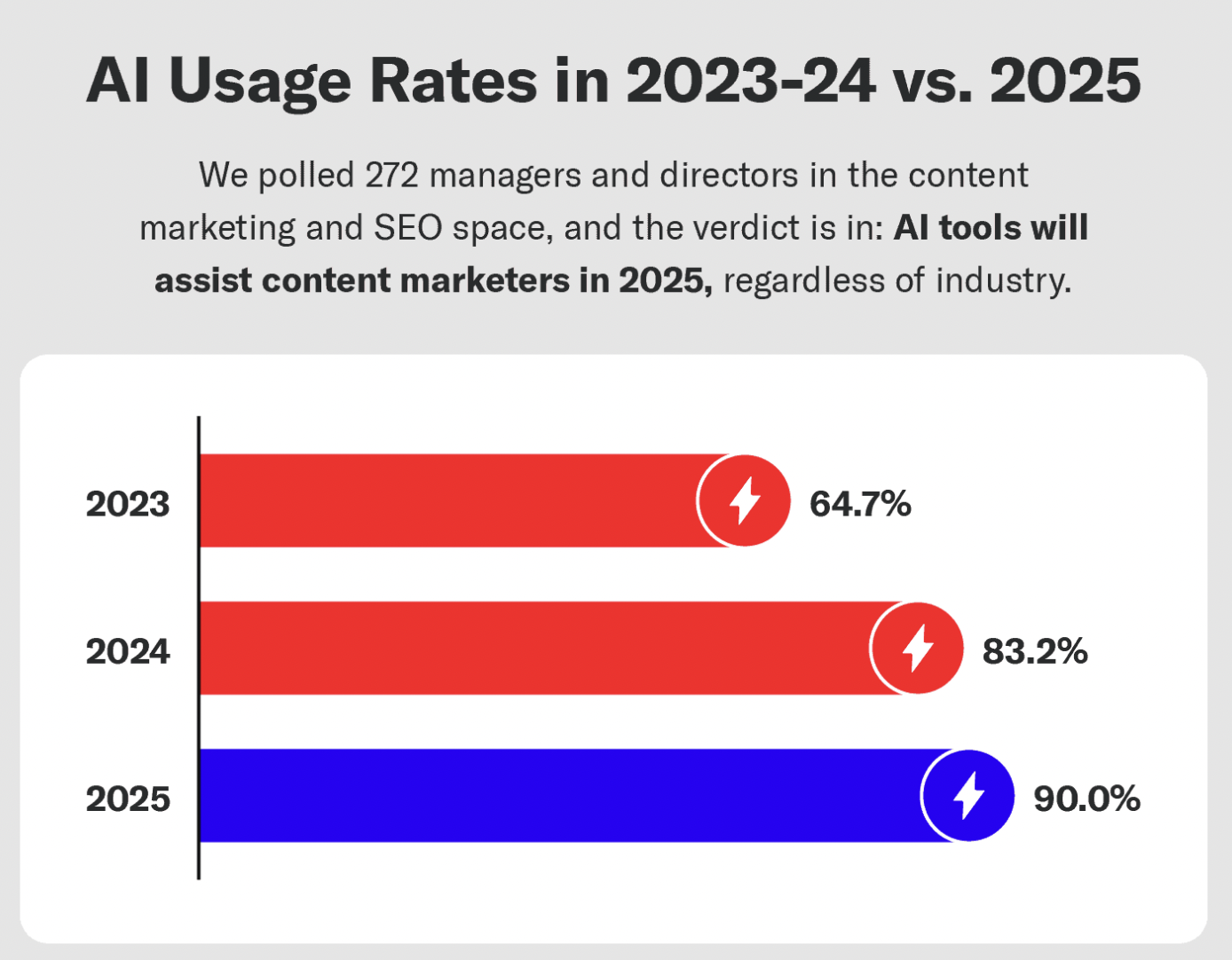
    AI content writing is now widely used in marketing and business to save time and scale production. But speed alone is not enough. The most impactful content still needs the human touch to deliver emotion, strategy, and originality.

    Did you know? A recent study by Bynder found that 50 % of consumers can correctly identify AI-generated content versus human-written copy. This highlights that while AI content is improving, readers are becoming increasingly adept at spotting it and may disengage when they do.

    Factors to Consider When Choosing Between AI and Human Writers
    AI content writing

    Source

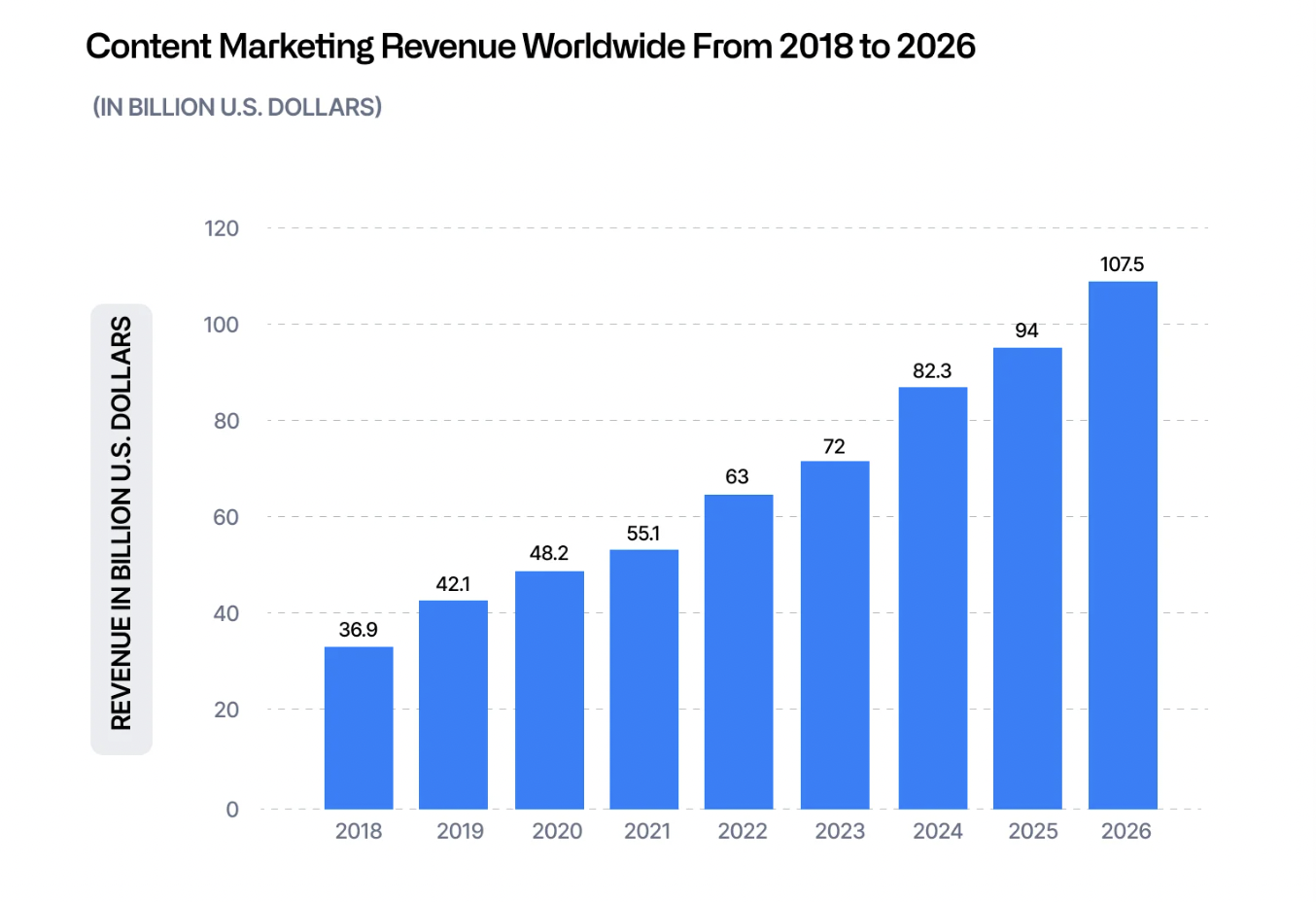
    When it comes to content marketing, startups need speed and scalability, while brands aim for deeper audience connections. Understanding the strengths of both AI and human writers helps you make the right choice.

    Below are the five most important factors to consider when deciding between AI-generated content and human-written content:

    Factor 1: Creativity and true originality

    Human approach:

    Humans use personal experiences, insights, and abstract thinking to create truly original content. They make unique connections, craft vivid metaphors, and spark fresh, thought-provoking ideas.

    • Humans generate new concepts rather than remixing old ones
    • They create analogies and metaphors that emotionally resonate
    • They can push boundaries, inspire change, and spark new conversations

    AI’s approach:

    AI is incredibly efficient at identifying patterns in existing data. It pulls from millions of sources and recombines them into coherent text. This is where AI content writing excels. But it does not create from scratch in the way humans do. What may seem original is often just a reshuffled version of existing content.

    • AI mimics originality by recombining existing phrases
    • It lacks lived experience and true creative intuition
    • It may produce content that sounds polished but lacks soul

    Factor 2: Emotional intelligence and empathy

    Human approach:

    By matching tone, vocabulary, and narrative to the reader’s emotions and frame of mind, human authors are able to create content that resonates by understanding emotional nuance.

    • Humans can naturally modify tone to fit the message.
    • To keep the reader interested, they employ cultural context and personal tales
    • They write with sincere feeling, kindness, and consideration

    AI’s approach:

    Though AI lacks true understanding and is unable to feel or empathize like a human, it may approximate emotional tone using patterns and keywords.

    • AI mimics human emotions without realizing the consequences
    • In delicate situations, tone can come out as strange or unsuitable
    • Even when employing emotive language, responses can seem robotic

    Factor 3: Strategic nuance and understanding intent

    Human approach:

    Effective content is rooted in strategy. Human writers can see beyond the prompt to understand the purpose of a piece, whether it’s to educate, convert, rank in search results, or build trust. They tailor content to match the reader’s intent and align it with business goals.

    • Writers consider the buyer journey and user intent
    • They optimize content not just for search engines but also for humans
    • They adapt messaging for different platforms, personas, and goals

    AI’s approach:

    AI creates SEO-friendly text using keywords and structure, but it often misses context and struggles with strategic alignment.

    • AI focuses on surface-level optimization
    • It may miss the underlying intent behind a search or prompt
    • It often lacks alignment with the brand’s broader strategy

    Factor 4: Authentic and consistent brand voice

    Human approach:

    A human writer understands your brand’s tone and values, ensuring consistency across formats while keeping the voice authentic and relatable.

    • Writers embody your brand’s personality with nuance
    • They can adapt their tone for different platforms and audiences
    • They add subtle voice traits that make your brand memorable

    AI’s approach:

    AI can replicate a brand’s tone to an extent if it is fed style guides and examples. This makes AI content writing a feasible option for many businesses. However, consistency can waver over time. Without ongoing refinement, AI may revert to a generic tone or fail to capture the subtle traits that make your brand unique.

    • AI mimics voice but often lacks emotional nuance
    • Tone can shift unexpectedly between outputs
    • Quirks, humor, and cultural cues may be missed or misused

    Factor 5: Critical thinking, ethics, and accountability

    Human approach:

    Human writers are not just content creators—they are fact-checkers, editors, and ethical gatekeepers. They verify sources, apply sound judgment, and take responsibility for what they publish. This ensures the content is both accurate and aligned with your brand’s integrity.

    • Humans critically evaluate sources and information
    • They understand ethical boundaries and potential implications
    • They are accountable for truthfulness, tone, and messaging

    AI’s approach:

    AI can generate content quickly, but it cannot reliably fact-check or assess credibility. It has been known to fabricate statistics, misattribute quotes, or present fiction as fact. Since it has no sense of right or wrong, it cannot be held accountable for what it creates.

    • AI may invent facts or use unreliable sources
    • It lacks the ability to assess fairness or ethical considerations
    • It cannot take responsibility for misinformation
    Also Read: 22+ Content Writing Examples, Useful Tools & Best Practices

    Embracing the Hybrid Approach: Human-Led, AI-Enhanced Content

    Rather than viewing AI and human writers as competitors, many forward-thinking teams are combining their strengths to create better, faster, and more scalable human-edited AI content.

    How the hybrid model works:

    • AI as a drafting tool: To reduce time spent on tedious activities and expedite the early development of ideas, an AI can assist in creating outlines, first drafts, headlines, or content variations.
    • Human as the creative lead: After that, a human writer edits, reorganizes, and refines the text to add originality, nuance, brand voice, and strategic direction.
    • Editorial oversight: Human editors evaluate facts, assess clarity and tone, and confirm that the content satisfies company goals and ethical standards.

    Benefits of the hybrid model:

    • Faster production without sacrificing quality
    • More consistent content across channels
    • Lower cost than fully human-generated workflows
    • Flexibility to scale while preserving originality and brand integrity

    Ideal use cases:

    • High-volume marketing campaigns
    • SEO content with storytelling layers
    • Email sequences with emotional appeal
    • Thought leadership supported by research and insight

    Choosing the Right Approach: When to Use AI, Human Writers, or Both
    AI content writing

    Source

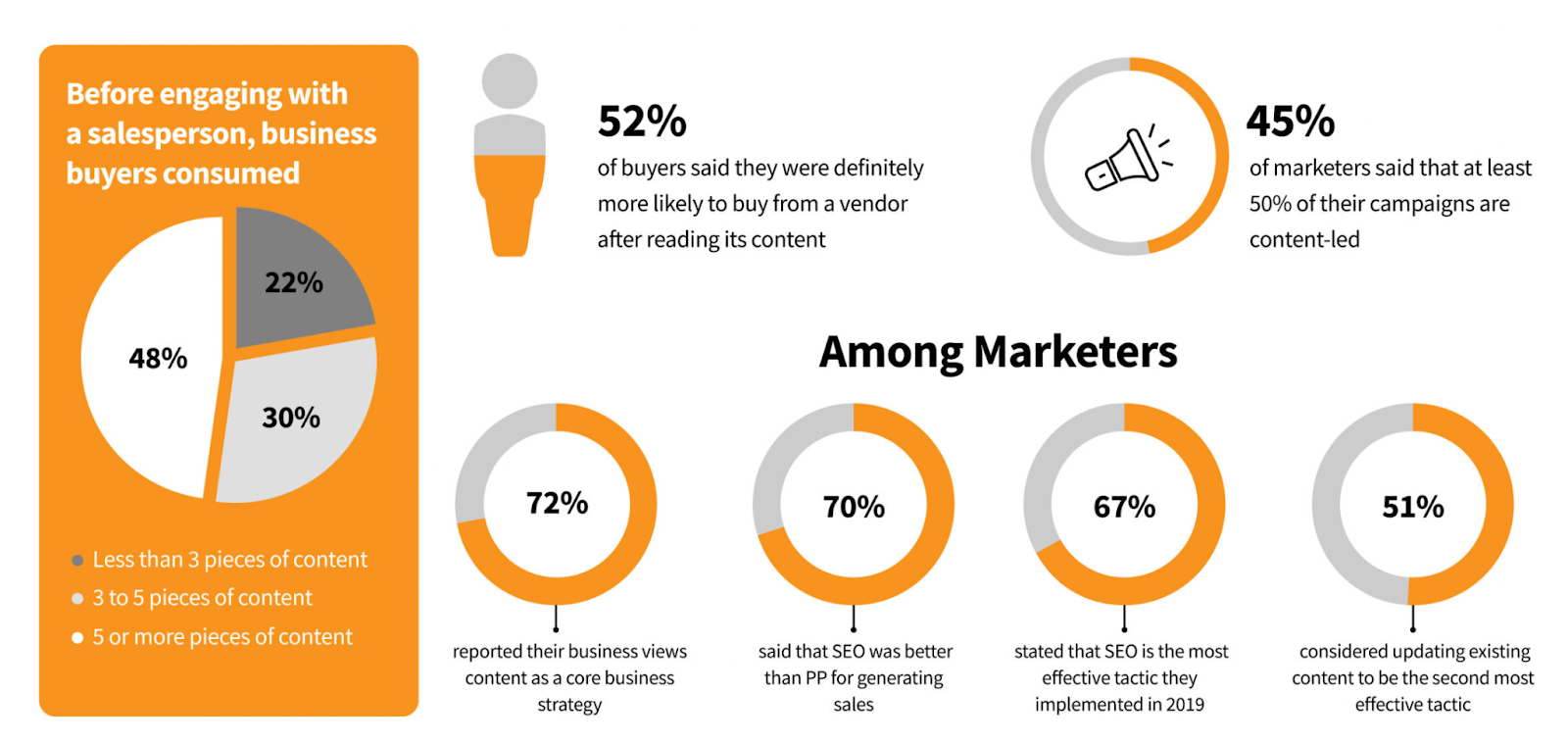
    In content marketing, different goals require different approaches. 

    The table below helps you decide when to use AI, human writers, or a hybrid model based on your content type, objectives, and desired outcomes:

    ScenarioBest approachWhy it works
    High-volume content creationAIFast, scalable, and cost-effective for simple or repetitive formats
    Complex or emotionally sensitive topicsHumanRequires empathy, context, and ethical judgment
    Tight deadlines with limited resourcesAI or HybridAI can speed up drafting; human input can fine-tune where needed
    Content that must reflecta unique brand voiceHuman or HybridEnsures personality, consistency, and emotional depth
    SEO-focused blog postsHybridAI can handle structure and keywords, while humans optimize tone and value
    Strategic thought leadershipHumanDemands original thinking, insight, and credibility
    Social media copy at scaleAI or HybridQuick generation of variants, with human review for tone and relevance
    Long-form storytelling or creative writingHumanCreativity, flow, and narrative require a human touch
    Pro Tip: To get the most out of your content strategy, use smart online tools like Grammarly, Surfer SEO, Jasper, or Hemingway Editor. These tools help refine grammar, boost SEO, spark ideas, and improve readability, saving time and enhancing content performance.

    Blending AI Efficiency with Human Creativity Is the Future of Great Content

    AI has transformed content creation, offering unmatched speed and efficiency. However, truly impactful content still requires the creativity, empathy, and strategic thinking that only humans can bring. The future isn’t AI or human; it’s both. By combining the strengths of each, you can create content that not only connects but also converts and stands out.

    At Wittypen, we blend technology with human expertise to deliver high-quality, results-driven content. Whether you prefer 100% human-crafted pieces or want to scale faster with AI-assisted writing and professional editing, we’ve got you covered.

    Connect with our team to find what works best for your brand!

    FAQs

    1. Does AI content rank well in the search results?

    AI content can rank well if it is well-structured and optimized. However, human-edited AI content tends to perform better, as it reflects improved user intent alignment and meets Google’s preference for helpful, people-first content.

    2. Should AI be used to write emotional content and that which drives storytelling?

    AI can replicate a tone. However, when an insight is truly critical, human understanding is indeed necessary. The stories with a heart, with a soul, and that can activate brands need the skills of at least one passionate human being.

    3. How can one get the best from a collaboration between AI and human beings?

    Let AI generate quick drafts and initial ideations; then bring in human writers or editors to incorporate nuance, strategically related implications, and the brand’s voice, ensuring both quality and the creation of ethical AI content that aligns with audience expectations and values.

    4. What are the best AI content tools to use?

    The best AI content tools include ChatGPT, Jasper, Copy.ai, Writesonic, and Grammarly, each offering unique strengths for drafting, editing, and optimizing content.


  • Top 7 AI Writing Tools That Work In 2025

    Top 7 AI Writing Tools That Work In 2025

    The rise of ChatGPT is not just a technological achievement but a game-changer for businesses focusing on creating content. According to HubSpot, around 25% of marketers even believe that AI content is more successful than content created without it.

    As such, AI writing has saved countless hours and significant financial resources, resulting in an improvement in overall productivity.

    Consistently generating high-quality content over the years has been a challenge, to say the least. This is where AI writing becomes indispensable. These platforms help you with everything, from brainstorming initial ideas to drafting comprehensive articles, ensuring a steady flow of engaging content.

    The true value, however, lies in selecting the best AI content writing tools that genuinely align with your strategic objectives and complement human creativity.

    The right tool empowers digital marketing professionals, content strategists, and business owners to optimize their content efforts effortlessly. This ensures that every piece resonates powerfully with the target audience while upholding the highest standards of quality.

      7 Best AI Content Writing Tools

      ToolWhat Makes it ClickBest for
      Claude AIEnhanced Context RetentionLong-form content requiring deep understanding
      ChatGPTVersatile Content GenerationGeneral content, brainstorming, diverse formats
      Surfer AISEO Integration ExcellenceSEO-optimized long-form content & audits
      JasperAIAI-powered CreativityMarketing copy, creative content, and brand voice consistency
      RytrCost-effective Content CreationShort-form content, quick drafts, and budget-conscious users
      WritesonicPersonalized Content at ScaleBulk content generation, diverse content types, e-commerce
      Copy.aiMarketing Copy & Sales ContentAd copy, social media posts, email campaigns

      1. Claude AI

      Claude AI: AI content creation software

      Source

      Claude AI primarily stands out for its ability to maintain context over extensive interactions, making it valuable for complicated content projects.

      This sophisticated understanding allows Claude to generate coherent and relevant long-form content, significantly reducing the need for constant re-prompting.

      What sets Claude apart is that it is able to grasp nuances in your instructions, leading to a more refined and accurate output.

      Core Functions

      • Excels in understanding lengthy prompts and conversations
      • Delivers highly contextual and precise responses
      • Retains information from previous turns in a conversation

      Standout

      • Maintains narrative consistency and flow in long-form content like reports or e-books
      • Reduces manual editing significantly, accelerating content completion

      Pricing

      • Free
      • Pro – $17 per month
      • Max – $100 per month per person
      • Team – $25 per month per person
      • Enterprise – Custom pricing
      • API – Custom pricing

      2. ChatGPT

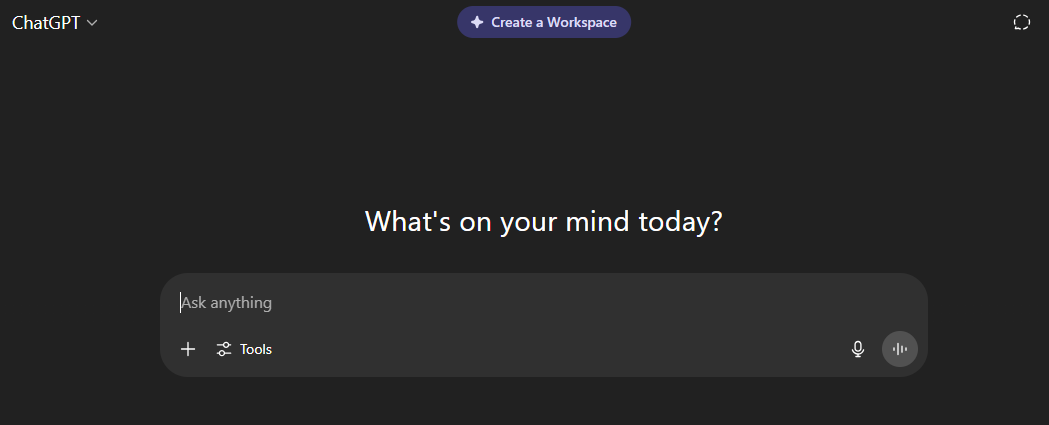
      ChatGPT: Best AI content writing tool

      Source

      According to a study, around 58% of business owners use ChatGPT for content creation.

      Chat GPT has become a household name for its remarkable versatility in generating a diverse pool of content formats. From quick social media captions to detailed blog post outlines, its adaptability makes it a go-to tool for diverse content needs.

      What’s more, it’s an invaluable assistant for brainstorming and rapid content prototyping as well.

      Core Functions

      • Broad knowledge base for creative and informative text
      • Adaptable to various content formats and styles
      • Can assist with SEO elements like meta descriptions and titles

      Standout

      • Its widespread adoption and continuous improvement make it a general-purpose powerhouse.
      • Excellent for initial ideation and drafting, complementing human refinement for impactful results

      Pricing

      • GPT’s pricing is based on models and their relevant efficiency level. Check out the pricing here.
      💡 Pro Tip – Fast doesn’t always mean finished. Even with powerful AI tools like ChatGPT or Jasper, incorporating human editorial review can boost content credibility and engagement. Consider setting up a lightweight editorial workflow where an editor reviews tone, accuracy, and brand consistency!

      3. Surfer AI

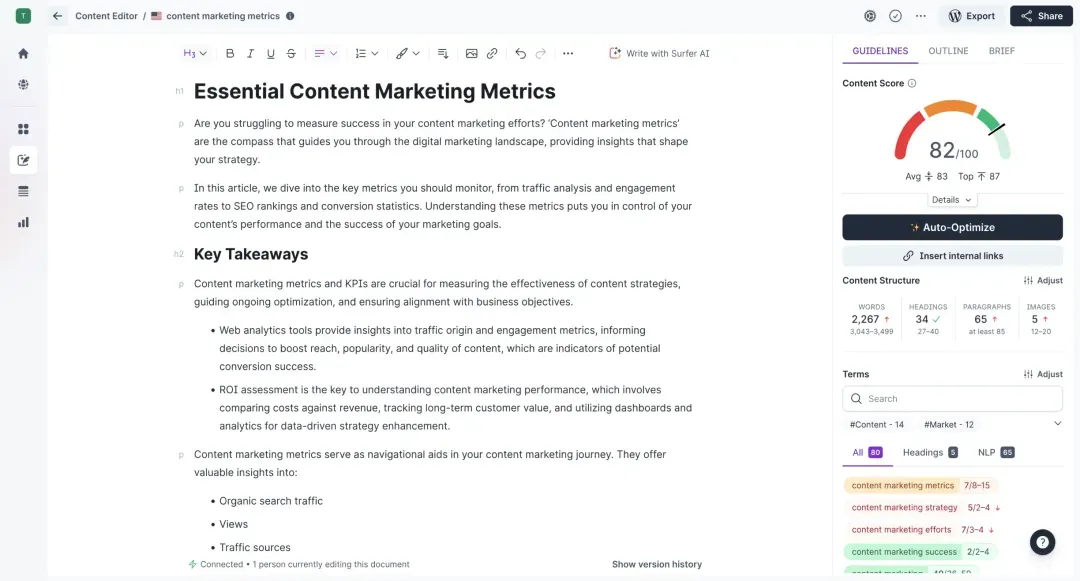
      Surfer AI: ethical AI writing platform

      Source

      Surfer AI is specifically designed for content that aims to rank high on search engines, making it a crucial asset for SEO professionals and marketers alike.

      It goes beyond mere keyword suggestions, analyzing top-performing content and providing data-driven recommendations for structure, word count, and keyword density, making it a must-have.

      Core Functions

      • Comprehensive content editor with real-time SEO feedback
      • Analyzes competitor content for data-driven insights
      • Supports multiple languages for global optimization

      Standout

      • Directly integrates SEO best practices into the content creation workflow
      • Ensures content is optimized for search performance from conception

      Pricing

      • Essential – $99 per month
      • Scale – $219 per month
      • Enterprise – Custom pricing

      4. JasperAI

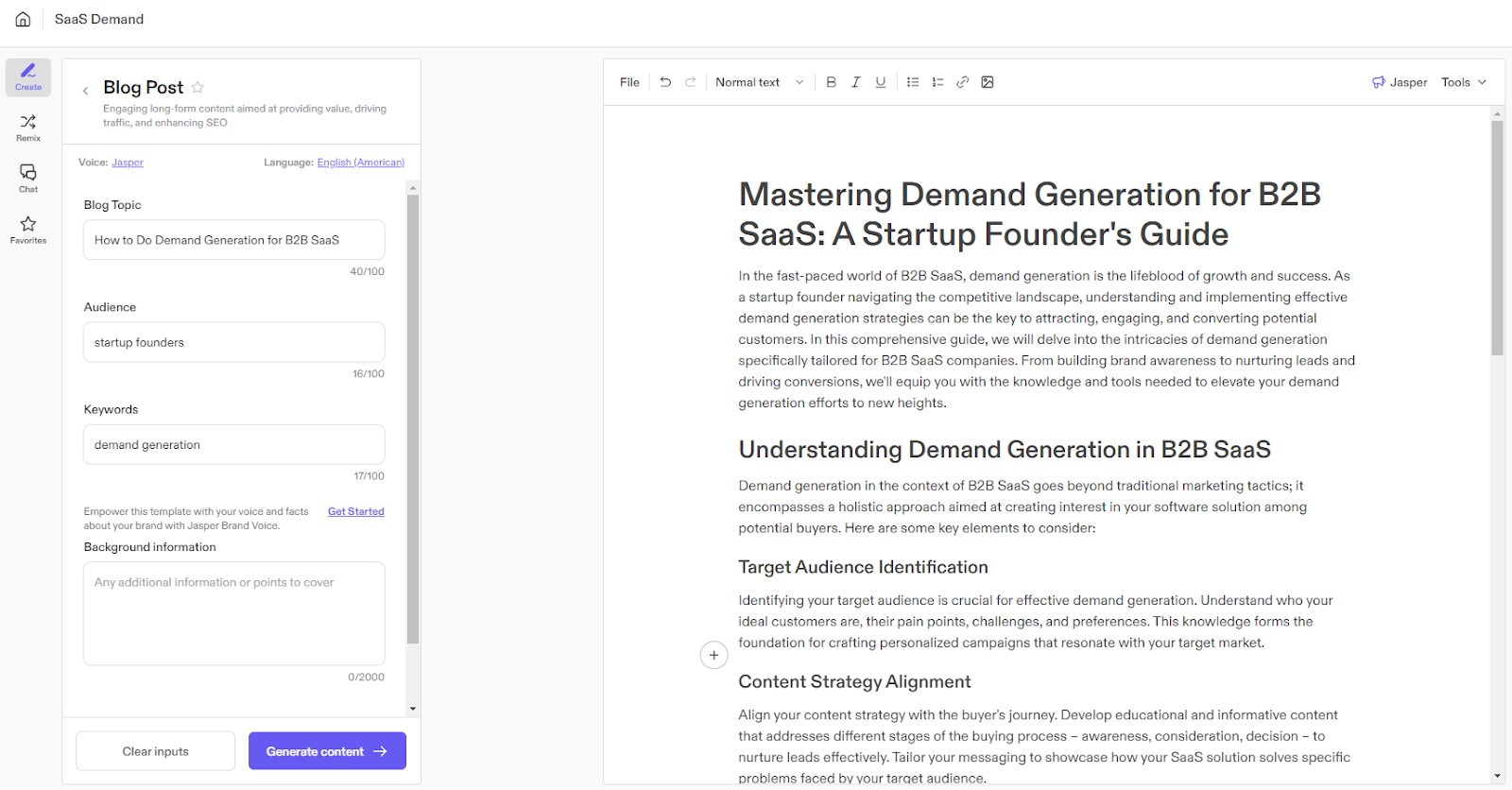
      JasperAI: Best AI content writing tool

      Source

      JasperAI, formerly known as Jarvis, is a powerful AI writing tool celebrated for its ability to inject creativity into content generation.

      It’s particularly effective for crafting engaging marketing copies that capture the brand voice and resonate with specific audiences. Jasper offers a diverse range of templates for various content types, including ad copy and blog posts.

      Core Functions

      • Excels in producing persuasive and imaginative text
      • Offers an extensive library of content templates
      • Guides users through a streamlined content creation process

      Standout

      • Strong capability in capturing and maintaining a consistent brand voice
      • Simplifies content creation, making high-quality drafts accessible to users

      Pricing

      • Creator – $49 per month per seat
      • Pro – $69 per month, per seat
      • Business – Custom pricing
      💡 Pro Tip – For consistent, on-brand content, integrate your AI writing tool with a brand style guide or tone of voice document. Platforms like Jasper and Claude can follow detailed instructions, but pairing them with brand-specific guidelines helps maintain personality and voice, especially in long-form assets like eBooks or whitepapers.

      5. Rytr

      Rytr: budget-friendly AI content writing

      Source

      Rytr is an excellent option for individuals and small businesses seeking a budget-friendly yet highly effective AI content creation software.

      It offers a straightforward interface and a wide selection of use cases, allowing for the rapid generation of various content types without a hefty price tag.

      Core Functions

      • Emphasizes speed and ease of use for quick content generation
      • Ideal for high volumes of short-form content
      • Offers scalability for growing content needs without proportional cost increases

      Standout

      • Its affordability, combined with effective content creation, makes it highly accessible.
      • Excellent for a consistent online presence with minimal time and resource investment

      Pricing

      • Free
      • Unlimited – $9 per month
      • Premium – $29 per month

      6. Writesonic

      Writesonic: Best AI content writing tools

      Source

      Writesonic is designed to help businesses generate personalized content at scale, making it a valuable tool for marketers managing large campaigns or e-commerce sites with numerous product listings.

      Writesonic also offers a broad range of AI templates tailored to specific content needs.

      Core Functions

      • Covers a comprehensive range of content formats (blogs, landing pages, ads)
      • Versatility allows the production of various content types from one platform
      • Aims to deliver high-performing, outcome-driven content

      Standout

      • Its focus on personalized content at scale streamlines large-volume content efforts.
      • Helps businesses achieve marketing goals by generating copy designed for conversion

      Pricing

      • Free
      • Basic – $20 per month
      • Lite – $49 per month
      • Standard – $99 per month
      • Professional – $249 per month
      • Advanced – $499 per month
      🎙️ Fun Fact – Writesonic goes beyond writing tools; it also offers Audiosonic, a feature that turns text into lifelike speech. Originally designed to support people with visual or reading difficulties, it’s now being used for audiobooks, interactive games, or voice-powered apps!

      7. Copy.ai

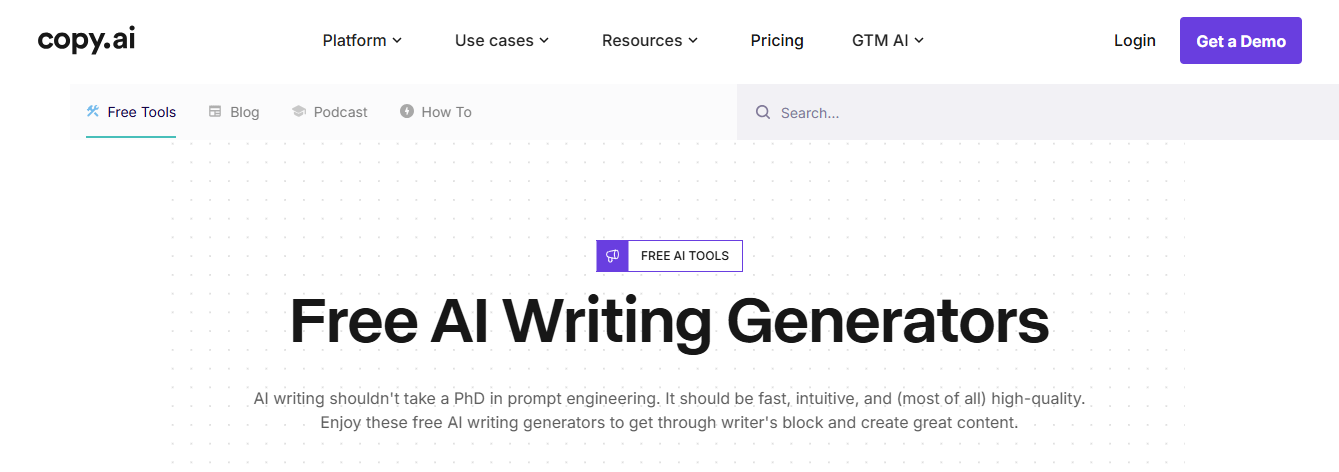
      Copy.ai: Free AI writing content writing

      Source

      Copy.ai is a leading AI writing tool specifically tailored for marketing and sales content. It offers an extensive library of templates designed to generate persuasive copy for advertisements, social media campaigns, website content, and email sequences.

      Core Functions

      • Quickly generates multiple variations of marketing copy
      • Facilitates A/B testing of different messages
      • Includes tools for brainstorming and rephrasing text

      Standout

      • Its focus on high-impact, short-form marketing copy is a significant advantage.
      • Provides an intuitive and efficient solution for rapidly producing compelling ad creatives and social media posts

       Pricing

      • Enterprise – Custom pricing

      Aligning AI Tools with Business Strategy

      The integration of AI content writing tools into your content strategy is crucial for optimizing efficiency and enhancing the quality of your output. That said, understanding the unique strengths of each tool, from Claude AI’s context retention to Surfer AI’s SEO prowess, will allow you to make informed decisions.

      To truly realize the full potential of these best AI content writing tools and ensure your content strategy is flawless, consider partnering with experts.

      Want content help? Discover Wittypen’s services for human-edited AI content solutions, which combine cutting-edge AI with expert human refinement, propelling your content efforts to new heights.

      Register today to know more!

    • 6 Signs You Need Managed Content Services

      6 Signs You Need Managed Content Services

      Brands today face intense pressure to produce high-quality content at scale. Customers expect relevant, timely, and valuable material across all digital touchpoints. But delivering this consistently is tough. That’s where Managed Content Services (MCS) come in. 

      MCS providers help businesses plan, create, distribute, and optimize content with minimal in-house effort. Whether you’re a growing startup or an enterprise struggling with scale, these services offer the speed, structure, and strategic depth you need to stay competitive.

      So, if your current setup is holding back your growth, it might be time to rethink how you manage content. Here are six clear signs that it’s time to make the shift.

      Table of Contents:

      • Sign 1- Struggling to Keep Up with Content Demand
      • Sign 2- Inconsistent Brand Voice and Messaging
      • Sign 3- Lack of SEO Expertise in Your Team
      • Sign 4- Poor Content Performance Analytics
      • Sign 5- Minimal Engagement on Social Media Platforms
      • Sign 6- Overburdened Internal Team
      • Evaluating the Right Time for Managed Services

      Sign 1- Struggling to Keep Up with Content Demand

      Did You Know? Over 55% B2B marketers say they struggle to consistently produce content that prompts a desired action like conversion.

      You know content matters. Blog posts, newsletters, videos, landing pages—the list keeps growing. But if your calendar is always behind, or your output lacks consistency, it’s a clear sign you’re overwhelmed.

      How MCS Help

      Managed Content Services gives you access to experienced writers, editors, and strategists. They help you scale without sacrificing quality. No more missed deadlines or rushed articles. Just consistent, high-impact publishing that supports your pipeline and brand authority.

      Read More: 8 Tips to Start Off with Marketing Content Writing

      Sign 2- Inconsistent Brand Voice and Messaging

      When different teams produce content without unified guidelines, the result is often jarring. One campaign feels bold and edgy, the next is overly formal. Customers notice.

      Inconsistency chips away at brand trust. When your tone shifts randomly or your visuals vary by channel, people don’t recognize your brand. That reduces recall, loyalty, and credibility.

      How MCS Help

      Brand voice is a core asset. Managed content providers help you document, standardize, and enforce it. They align messaging across platforms so every touchpoint feels on-brand.

      Managed Content Services creates a content framework that reflects your core identity. They embed within your marketing ecosystem and bring together content strategists, SEO specialists, designers, and analytics experts. 

      This unified approach enables you to plan smarter, execute faster, and continuously improve performance based on real data. Content workflows become streamlined, responsive, and aligned with your growth goals.

      Sign 3- Lack of SEO Expertise in Your Team

      Good content doesn’t matter if no one sees it. SEO turns writing into revenue. But many teams lack the skillset to optimize content for search. You may be missing keyword opportunities, link strategies, or even basic meta tagging.

      How MCS Help

      MCS experts audit your existing content, identify gaps, and create a roadmap. They ensure your articles are searchable, link-worthy, and built to perform.

      Read More: 5 SEO Content Writing Examples to Take Inspiration From

      Sign 4- Poor Content Performance Analytics

      You’re publishing regularly, but do you know what works? If reporting is ad hoc or limited to vanity metrics, you’re missing out.

      How MCS Help

      Managed services bring data-driven insight to your content operation. You’ll know what moves the needle and where to double down.

      Example: HubSpot uses its own marketing automation and analytics tools to measure which blogs, videos, and landing pages drive engagement and conversions, informing content strategy in real time.

      Sign 5- Minimal Engagement on Social Media Platforms

      Your posts get seen. But they don’t spark conversation. That’s a sign of misalignment between your message and audience expectations.

      How MCS Help

      Social content isn’t about frequency alone. It’s about resonance. MCS researches your audience, tests creative formats, and monitors trends, ensuring every post adds value.

      Example: Netflix’s social team leverages audience insights and agency support to scale content production (highly engaging, meme-driven content) that matches their viewers’ online behaviors and preferences.

      Read More: 4 Types of Content and How You Can Use Them For Your Business

      Sign 6- Overburdened Internal Team

      When your internal team wears too many hats, productivity and morale suffer. Designers are stuck writing social copy. Marketers spend hours editing blog posts. Strategic initiatives fall behind.

      This burnout leads to turnover, slower output, and declining quality. It also limits your team’s ability to innovate or respond to new opportunities.

      How MCS Help

      Managed Content Services absorbs the execution load. They take care of writing, design, and coordination, freeing up internal staff to focus on growth, campaign strategy, and customer experience.

      Example- Microsoft collaborates with multiple content agencies to manage global content needs, freeing internal teams to focus on innovation and customer relationships while maintaining quality at scale.

      Read More: Outsourcing 101: A Complete Guide on Outsourcing Content Writing

      Evaluating the Right Time for Managed Services

      If any of these signs feel familiar, it might be time to consider Managed Content Services. They offer speed, scale, and strategic clarity—without the overhead of building an in-house team. You get performance-ready content, consistent branding, and less stress.

      Today, content is business-critical. So is doing it right. MCS helps you meet demand while staying true to your brand. If you’re looking for a partner for your content needs, check out Wittypen. We can help you out with your entire content engine, from ideation to execution.

    • Level Up Your Technical Content Writing Game: Advanced Tips and Tricks

      Level Up Your Technical Content Writing Game: Advanced Tips and Tricks

      As technology constantly evolves, companies struggle to communicate clearly and effectively. Be it complex software, machinery, or even updated processes, the need for highly skilled technical writers is on the rise for heavy demand of technical content writing

      Lack of easy-to-understand writing would result in frustrated customers, wasted time, and decreased user adoption. In light of this, companies are willing to invest in technical content that captivates their audiences and boosts sales.

      Moreover, technical writers’ employment is expected to expand by 7% between 2022 and 2032, outpacing the overall growth rate. This guide aims to enlighten technical content writers, businesses, and digital marketers on how to create compelling content that not only educates but also establishes them as thought leaders in their fields/industries.

      So, are you ready to position yourself for success by learning advanced technical writing skills? Let’s dive in!

      What Is the Importance of Technical Content Writing?

      Most users struggle with understanding the technical side of most products and services despite a user manual being present. This is because most user manuals use complicated language that most people cannot understand.

      User manuals mostly contain charts, tables, illustrations, and diagrams that demonstrate how the product or service is supposed to be used. However, industry experts like engineers, scientists, programmers, developers, etc., write those manuals, which are full of technical jargon, making it difficult for users to understand. 

      Technical content writing bridges that gap!

      It takes the dry, statistical information found in sales copies or user manuals and breaks it down into easily readable and digestible material that anyone can understand. Each aspect of a topic is explained in easy-to-understand language; where necessary, images and videos are used to demonstrate and explain complex processes.

      Technical content explains how the information in the user manual can be applied in different scenarios to solve specific issues. Well-crafted technical content ensures your users have a smooth experience and increases customer satisfaction.

      Understanding Advanced Techniques and Why They Are Necessary

      Every writer is familiar with basic technical content writing techniques. But in an ever-changing digital space and with readers’ fleeting attention spans, what will make technical content stand out?

      Understanding advanced technical content writing techniques will make your content unique. Just like any other content, technical content must be visually appealing to capture readers’ attention. Further, SEO is another crucial aspect to ensure a high ranking on search engines.

      What is the need for advanced techniques in technical content writing:

      a)   Visual Communication

      Incorporation of visual elements into your technical content writing boosts understanding and increases engagement rates.

      b)   SEO

      SEO practices such as keywords, metadata, etc., will improve your content’s ranking, making it easier for your target audience to find in the search results.

      c)  Audience Understanding

      Using analytics to understand your target audience helps you tailor content to fit their preferences regardless of their area of expertise.

      d)   Engaging delivery

      Technical content is complex and difficult to digest. Advanced techniques like visual elements help break down the learning process, making it interactive and fun.

      e)   Accessibility

      Techniques like customization of content and user-friendly design ensure that your content is accessible across multiple devices and platforms.

      f)   Gives content a competitive edge

      Using advanced techniques will make content stand out and give it a competitive edge in a sea of content.

      In addition, technical content writers need to be knowledgeable in the specific industry to ensure reliable information.

      So, what are these advanced techniques? They include mastering tone and style, knowing your audience, mastering the art of clarity, and strategic use of visual elements.

      Technical content writing incorporates a variety of elements and techniques.Image Source

      1. Become a Master of Tone and Style

      Mastering style and tone is a powerful tool for capturing the audience’s attention, evoking emotions, keeping them engaged, and establishing the writer as a credible authority in that particular industry.

      While technical writing is usually precise and to the point, this technique can be used without interfering with the flow and professionalism associated with technical content writing.

      A well-crafted tone speaks directly to your audience and guides them through the content, encouraging them to keep reading through each and every step. It should also align with the intended message that one wants to pass across.

      For example, if one is writing about how to troubleshoot a computer or software, a supportive tone along with authoritativeness will keep the readers hooked. 

      2. Knowing Your Audience Inside and Out

      The importance of knowing the audience can never be understated. A good technical content piece is nothing if it doesn’t resonate with one’s audience.

      By understanding the audience inside and out, a technical content writer can tailor technical content to fit the target audience’s preferences.

      What do you need to know about your audience? 

      A writer needs to know the audience’s technical proficiency, preferred learning style, industry or domain knowledge, and the tools and technologies they use, and the industry or domain knowledge.

      After that, tailor content to fit their needs, proficiency, knowledge, goals, or even all of these. This approach increases engagement with the audience, builds loyalty, trust, and credibility, and positions one as a leading authority in that particular field/industry.

      Understanding your audience inside out is vital for the sucess of your technical content.Image Source

      3. Master the Art of Clarity: From Jargon to Plain Language

      Technical writing is where complexity resides. Clarity is paramount for effectively communicating complex information. Clear and concise content helps prevent misunderstanding, assists in learning and retaining technical knowledge, and facilitates comprehension.

      Remember, most of the time, the audience is not well-versed in technical jargon. By using plain language instead of jargon, technical content writers make sure they are understood by all, regardless of their knowledge or expertise in the industry. The use of plain and easy language builds trust and confidence in a brand and significantly improves engagement.

      4. Establish Business Contacts

      Even if technical writers have all the information required to create a draft, they must consider making connections both inside and outside the company for vital pieces of data.

      A solid rapport with the leads, teams, stakeholders, etc., from relevant departments will help create fantastic content. To accomplish the piece successfully, one must engage in one-to-one communication with the concerned authority. 

       5. Embracing The Power of Visual Beyond Screenshots

      Visual aids alone aren’t enough; they have to be used strategically. Therefore, don’t place all images and diagrams in the same place. Instead, ensure they are clear and visible to the readers. Know what type of visual aids to use and where and when to use them. Ensure the readers can easily understand the visual aids used. 

      How do you use visual aids effectively?

      • Tables: Put data sets and organized information in clearly structured tables.
      • Animations: Use animations to break down complex processes step-by-step, making the learning experience fun and interactive.
      • Graphs and charts: Use charts and graphs to show comparisons and patterns, making it easy to interpret complex data with just one glance.
      • Interactive elements: Clickables, 3D models, tooltips, or collapsible sections allow readers to explore your content and access additional information where needed. 

      6. Structure for Success: Creating a User-Friendly Flow

      Well-structured content is easy for the reader to understand and highly effective. It is presented logically and guides the reader from one point to another.

      To achieve that, clear headings and subheadings that break down the content into digestible chunks are essential. For images, placement and labelling must be considered. Moreover, bullets and numbers can be used for lists and step-by-step instructions to improve readability.

      7. The Content Doesn’t End Here: The Importance of Maintainance

      Technical content is not just written and published; it has to be constantly updated. The technology or machine documented will evolve or be upgraded, and the content should evolve with it.

      No reader wants to read about old technology when a new version is available. Thus, a technical content writer should be up to date with industry trends and update their content accordingly. Regular updates keep the content relevant and valuable to readers. 

      Case Studies

      Here are some recent examples that show how powerful well-crafted technical content can be:

      1. Whitepaper by Apple on its Carbon Removal Strategy (2024)

      Technical content like Apple’s whitepaper on carbon neutrality can be a powerful tool. By clearly outlining its environmental goals, Apple can attract eco-conscious consumers. Besides, it can reduce operational costs through efficiency improvements and potentially position itself as a leader in sustainable technology. This helps Apple to build a stronger reputation, lower expenses, and a competitive edge in the marketplace.

      2. OpenAI GPT-4 Technical Report (2023)

      OpenAI’s white paper on GPT-4 effectively employs technical writing to showcase the model’s capabilities and potential. The paper details GPT-4’s superior performance on various NLP tasks, highlighting its generalizable strengths across languages. Importantly, the paper emphasizes how clear explanations facilitated the prediction of GPT-4’s performance, demonstrating a strong link between technical writing and successful AI development.

      This transparency fosters trust and allows for further research on the safety and responsible deployment of GPT-4. Overall, the GPT-4 white paper exemplifies how technical writing can effectively communicate complex information, promote understanding, and pave the way for advancements in AI.

      Conclusion and Next Steps

      To become a pro in technical content writing, you must master both the basic and advanced techniques. Understanding the audience, adapting style and tone, and eliminating jargon will make content stand out.

      Now that you have learned the advanced techniques of technical content writing, it is time to put them into practice! With the knowledge you have gained, what next?

      • Audit your content: Review technical content to ensure it meets the standards. Make the necessary revisions and improve the content.
      • Make use of new tools: Explore the world of technical writing tools and identify which tools can assist in technical content writing.
      • Conduct tests: Experiment with a website, trying different combinations of fonts, colors, and layouts. Check to see which one appeals most to the audience. 

      For those who want to venture into technical content writing, research how to become a technical writer and incorporate these advanced techniques to set oneself apart as an industry leader.

      For businesses that want to leverage technical content as part of their marketing strategy, exploring WittyPen’s content writing services is the obvious next step. Make your content stand out with WittyPen.

    • How to use AI tools for Content Writing

      How to use AI tools for Content Writing

      As AI becomes more prevalent, content marketing is embracing it wholeheartedly. This not only revolutionizes the way content is created but also offers numerous benefits.

      AI writing tools, in this context, have emerged as powerful aids for content creators, offering a plethora of functionalities to streamline and enhance the content writing process.

      In this post, we cover how to use the power of AI tools for content writing. We’ll also explore insights on popular tools, optimal strategies, the evolving field of AI in content creation, and beyond.

      Read on!

      Demystifying AI Writing Tools

      AI-powered content writing tools streamline the creation process for various platforms like social media, blogs, emails, and websites. However, grasping the fundamentals of these tools is crucial before diving in.

      These tools improve the writing’s quality by minimizing language errors and giving suggestions for overall structure, tone, and style. Moving to their more advanced feature, AI tools for content writing can generate entire content from scratch.

      Let’s look at some key facts and trends regarding the relevance of using AI tools for content writing:

      • The global AI market value is projected to grow to $267 billion by 2027, and 85% of users claim that they generally use AI tools for article writing and content creation.
      • AI is expected to have a CAGR growth of 37.3% between 2023 and 2030
      • 47% of businesses claim to use AI tools for content writing, while 28% of them use them for design elements.
      • 87.7% of B2C and 81.5% of B2B businesses are expected to use AI tools to enhance their content writing sections in 2024.

      Thus, writers are not required to spend time on mundane tasks like before. The best part? The writers get room for creativity. 

      For example, Zoom uses AI companion tools in team chats or Zoom emails to ease the messaging process by using input from employees or clients. Many other businesses have also started using AI in marketing to improve their professional writing in automated chats. 

      AI and Its Use Cases in and around Writing

      Source

      Let’s look into some use cases that depict the relevance of how AI has revolutionized content writing:

      Brainstorming

      Check out how ChatGPT just came up with Sassy SEO with its enhanced NLP capabilities. Such tools can generate text, improve website structure, and analyze consumer queries.

      Text Generator tools help create original, plagiarism-free content within seconds. They can get information from a large database and create content best suited to their needs.

      Writing

      AI writing assistants like Grammarly or ProWritingAid can help improve writing quality by suggesting corrections for grammar, punctuation, and style. They can also offer insights on readability and tone.

      Editing

      Nothing beats tools like Grammarly and Hemingway Editor that can make text editing faster and more efficient for writers. These resources help writers in

      • Transitioning complex statements
      • Converting passive voice and adverb-based sentences into clear, concise, and readable content
      • Offering spell-check and basic grammar-based suggestions
      • Helping writers with better fluency and spelling, accuracy, and style-checking

      SEO Assistance

      One of the key objectives of building robust content is to enhance search engine visibility. This means it is vital for writers to use compelling keywords in meta descriptions, content structure, and even CTAs to improve SEO performance.

      Tools like Clearscope and SurferSEO can help writers optimize their content with SEO to outrank their competitors. They can provide you with target keywords and provide SEO analysis. 

      Research

      There is a plethora of resources that writers can refer to on the web. Open Educational Resources, research articles, academic papers, data sources, and verified articles can help writers convert complex topics into simple explanations. They can further add relevant and verifiable facts to strengthen the authenticity and credibility of the write-up.

      Tools like ResearchGate, NCBI, and Scholarcy can help writers highlight key points, suggest related research materials, offer links to other related and effective content, provide verifiable research and experimentation, and summarize complex topics.

      Plagiarism Check

      The last thing a writer could ever want is to deliver content that is copied or inspired. Originality of content is imperative and tools like Turnitin, QuillBot, and SmallSEOTools help them maintain that.

      These tools detect plagiarism by comparing your content with a large database of online content so that it remains original across the web. Whether plagiarism or intentional or unintentional, these tools help content creators maintain originality and uniqueness and eliminate any matches with existing content.

      Enhancing Readability

      Writers may have a strong knowledge of concepts and the skills to jot down their thoughts into words. But they also need the knack to enhance the readability of the content, make it engaging for the readers, and make the content clearer.

      Long paragraphs, poor sentence formation, using passive voice structures, or adding complex statements can hamper readability, Tools like Readable, Slick Write, and ProWritingAid help you write engaging and readable content. These tools:

      • Help improve the clarity of your text and evaluate readability scores
      • Offer suggestions to make the content easier to understand
      • Highlight complex sentences and common errors

      How to Use AI for Content Writing?

      Source

      Businesses and writers are plugging in AI-generated content to amplify their brand voice. 

      Here’s a detailed exploration of how AI can revolutionize content creation:

      1.  Content Creation

      Human minds are enormously capable of advancing creativity and innovation. However, when it comes to writing, getting the benefit of well-researched support from a vast array of content resources using AI tools, further enhances content writing skills. 

      AI tools for content writing can save the day with their large language model to brainstorm and generate ideas per requirement. Here are some outcomes that can be expected from content brainstorming:

      Beat the Blank Page Blues: Generating Content Ideas with AI

      Leveraging AI tools for content writing empowers creators to:

      • Overcome ‘writer’s block’ with AI-powered brainstorming, eliminating the struggle to organize thoughts and kickstarting the writing journey.
      • Embrace AI-powered content generation platforms like OpenAI’s GPT-3 to explore new realms of creativity and broaden content creation possibilities.
      • Tap into AI to enrich content credibility and depth by referencing diverse sources, as advocated by thought leaders like Seth Godin.
      • Boost idea exchange and streamline content creation workflows, fostering synergy and innovation from ideation to publication.

      Tailoring Content to Your Audience: AI-powered Keyword Research

      In the era of cutting-edge technology, curating content that resonates with the target audience is challenging. It is necessary to incorporate suitable keywords to create meaningful and SEO-friendly content. 

      AI-powered keyword research tools traverse enormous data sources to find the best-fitting keywords for websites or social media contentThis enhances the quality of content and attracts heavy traffic to the website. Some commonly used tools are Surfer Content Editor, Semrush, Marketmuse, and Cocolyze.

      2.  Content Creation and Writing

      Source

      AI tools allow automated content creation, and this AI-generated content is primarily SEO-aligned to ensure high visibility on the search result page. This cost-effective approach generates content according to the brand image to boost engagement.

      Here are the reasons why AI tools are considered for content creation and writing:

      • Speed and Efficiency: AI content tools streamline repetitive tasks, wherein bloggers spend about 2.81 hours writing a 2,000-word post, compared to 4.02 hours for those who don’t use AI.
      • Consistency: Generative AI ensures uniformity across large volumes of content. In 2023, 58% of marketers aimed to utilize AI for generating SEO content.
      • Accuracy and Personalization: An impressive 92% of companies use AI-driven personalization.
      • Scalability: Writers spend about 30% less time on blog posts, freeing up time for creative and strategic tasks. Google values high-quality content E-E-A-T, regardless of whether it’s AI-generated or human-written.

      Outlining Made Easy: AI-powered Blog Post Structures

      Neil Patel says, “AI helps you come up with ideas. And, AI helps you create content faster. But if you use AI to write your content, in most cases you will get less traffic.”

      While AI may not drive significant traffic when used for content writing alone, it excels at creating outlines. AI-powered tools craft comprehensive frameworks with unique headings, maintaining brand identity and streamlining content creation.

      By utilizing AI-powered blog post structures, creators can streamline their workflow, save time, and maintain a cohesive brand voice throughout their content.

      AI-generated Drafts: Jumpstart the Writing Process

      Studies show that 46% of businesses already utilize AI tools for content writing. Additionally, research shows that almost 95% of customer interactions will be powered by AI by 2025. This highlights the growing importance and widespread adoption of AI in content creation.

      When drafting content, it is crucial to separate writing from editing. After getting a unique and well-written outline, using artificial intelligence to create drafts can save time and effort without compromising quality. AI-generated drafts are more organized and sophisticated compositions of the given narrative.

      3.  Editing and Polishing Your Content

      Using an AI-powered writing assistant is the best way to filter content before presenting it to readers. From enhancing basic formatting to setting style or tone, AI-powered editing tools are the best companion in improving readability. Their advanced features include checking factual accuracies and simplifying the text. L

      Let’s look at some facts first:

      • Businesses demand nearly 90% accuracy in their content-related assignments, while 72% believe AI excels at handling repetitive tasks. Moreover, 71% perceive AI as more innovative than humans.
      • 80% of executives believe AI can enhance productivity, and 66% claim AI effectively mitigates human errors by processing vast amounts of data.

      Grammar Guru: AI-powered Proofreading and Editing

      Source

      AI-powered proofreading and editing tools allow adjustments and modifications in style, voice, and tone of drafts addressing the target audience.

      With Grammarly and QuillBot being widely used, other tools include Languagetool, GrammarCheck, Scribbr, and more.

      These AI tools for content writing remove errors in grammar, spelling punctuation, and redundancies with suggestions to make the draft more elegant, consistent and persuasive. It is necessary to check for plagiarism and factual inaccuracies with AI-generated content. 

      AI-powered tools for editing assist in:

      • Streamlining the editorial process and performing content research
      • Elevating the quality of proofreading and editing
      • Conquering writer’s block, enriching articles
      • Boosting reader engagement, and improving Google’s E-E-A-T value
      • Creating compelling article titles and developing customized GPT models
      • Recommending related readings and identifying dull paragraphs or weak messages
      • Refining content and enhancing workflow efficiency for content teams
      • Crafting content outlines and summarizing reports for efficient organization
      • Delivering thorough editing and assisting with business writing projects
      • Providing alternative writing suggestions and improving content readability and SEO

      Enhancing Readability: Using AI for Clearer Communication

      Communication is the most important component of content marketing. It is essential to convey the message to the target audience with the right content strategy. 

      AI-powered readability tools enhance the overall quality by smoothing transitions and the flow of the content. It involves improving readability through 

      • word choice
      • sentence structure and length
      • appropriate formatting 
      • simplifying complex sentences and paragraphs 
      • reducing technical jargon

      These AI tools for content writing help readers grasp the clarity of the message easily. It reduces the confusion in the minds of readers and, hence, increases engagement.

      Standard tools for enhancing readability are HyperWrite, AISEO, and Grammarly. By piloting AI content generation tools, many businesses reduce muddiness in their content and increase conversion rates.

      Popular AI Tools for Content Writing 

      Below are the top five AI tools for content writing that are widely used by content creators:

      1.  Grammarly

      Grammarly is an outstanding AI tool for content writing that analyzes and enhances your content. 

      Top Features

      • It offers advanced features like suggestions on spelling, clarity, vocabulary, grammar, and readability.
      • The best part of using Grammarly is that it also plugs in as an extension on multiple web browsers.
      • It allows content creators to focus more on article cohesion, adequate comprehension, critical thinking, creativity, and demonstration of learning.

      Pricing

      Besides the free package, Grammarly offers a premium Plan and a Business Plan, which can go up to $15 per month when billed annually and $25 when billed monthly.

      2.  Copy.ai

      Copy.ai is one of the most popular AI tools for content writing that works on a GPT-3 model

      Top Features 

      • It provides features like availability in over 25 languages, 90+ copywriting templates, and a built-in plagiarism checker.
      • This tool helps in confounding writer’s block and saves lots of time.  
      • It automatically makes your prompts better, and lets you personalize your brand voice for authentic messaging.

      Pricing

      You get a Free Plan limited to 2000 words, a Starter Plan at $49 per month, and an advanced plan at $249 per month with exclusive features.

      3.  Rytr

      While writing a short piece of content or generating an innovative idea for copy, Rytr is best known for enhancing content with AI. 

      Top Features

      • It boasts 80 lakh+ copywriters, businesses, and marketers for compelling and unique content.
      • The features offered by Rytr include free generation of 10k words per month, over 20 different tones of voice, 30+ languages, and plagiarism-free drafts.
      • This AI-powered writing assistance is best for business emails, e-commerce writing, and social media copy

      Pricing

      You get a plethora of free services. For a yearly plan,. you get the benefit of two free monthly plans, and for monthly plans, you have the leverage to cancel them anytime. You can try the unlimited generations plan at $7.50 per month or the Premium plan at $24.16 per month with extra, exclusive, and unlimited features.

      4.  Jasper

      Jasper is a meticulously designed AI tool for impressive AI-assisted content for brand voice. 

      Top Features

      • It helps you brainstorm, generate, rephrase, or remove plagiarism and promotes team assistance and project management
      • Jasper brings a competitive advantage to brands by offering 90+ templates, ensuring privacy and ethics
      • This AI tool is ideal for social media posts, blogs, and emails to accelerate organic traffic

      Pricing

      You can start with a 78-day free trial and then opt for their Creator Plans for $39 per month, Pro Plans for $59 per month, and Business Plans with unlimited feature usage (rate fixed after consultation)

      5.  Quillbot

      QuillBot is one of the most trusted AI tools for content writing by professional writers, marketers, and B2B entrepreneurs. 

      Top Features

      • Quillbot is ideal for re-writing content with other tools like a paraphraser, plagiarism checker, AI detector, proofreader, grammar checker, and spell checker
      • Users can accumulate all their work in one place with a smooth and user-friendly interface
      • It can employed as an extension on Edge, Chrome, and Word add-in

      Pricing

      Most of the tools are free, with prime features and upgrades available through Premium plans. QuillBot Premium offers competitive pricing wherein the annual plan costs $8.33 monthly, the semi-annual plan costs $13.33 per month, and the monthly plan costs $19.95.

      How to Effectively Integrate AI Tools into Content Creation Workflow?

      The primary goal of every business is to build a strong brand image with SEO-friendly content and high user engagement. To do so, integrating AI tools into the content creation workflow can be seen as a game-changer. 

      The process of utilizing AI tools for content writing is as follows:

      • First, select an AI tool that can assist in automated content creation without compromising quality
      • Second, use AI tools to generate ideas and relevant keyword research for the desired content strategy
      • Third, design content outline using AI tools 
      • Fourth, create the first draft using the formulated outline and revise it using AI suggestions
      • Fifth, incorporate AI tools for content writing to proofread and increase readability
      • Sixth, explore different methods provided by AI tools to approach the target audience
      • Seventh, observe the AI analytics and follow up

      Businesses and brands can increase organic traffic and visibility to their website by successfully integrating AI tools into the content workflow.

      In this regard, you can use Wittypen’s free AI tools to revolutionize your content creation process, from brainstorming innovative ideas to refining your final drafts. This way, you can enhance efficiency, improve content quality, and ultimately achieve your business objectives. 

      Best Practices for Using AI Tools in Content Writing 

      Source 

      Follow the practices mentioned below to refine your approach to using AI tools in content writing:

      1.  Browse Through Different AI Tools

      The first step in ensuring high productivity and the desired quality of content is selecting the best AI tools for the objective. You must select the right AI writers depending on the format of content like blog posts, emails, ads, website articles, or video templates. 

      2.  Be Specific with Inputs

      AI tools are trained to produce the desired outcome by learning behavior through inputs. You need to articulate specific and detailed inputs or queries, that will enhance the quality of the content generated.

      3.  Keep Experimenting with the Drafts

      Do not settle with the first draft, keep iterating and generate multiple variations of the draft. It may be tiresome and time-consuming but you can find more refined and creative content with every variation. You can use and blend discoveries according to your requirements.

      4.  Try to Define the Target Audience

      AI tools work on data insights, they search all over the internet to generate content. You must define the target audience, which will narrow your search and present you with more precise and innovative content.

      For better quality content, make sure you supervise, monitor, and control AI tools for content writing according to your preferences and requirements.

      The Future of AI in Content Creation 

      When it comes to utilizing AI tools for content writing, it’s all about maximizing efficiency and quality. As AI becomes increasingly integrated into content marketing, understanding how to use its power is essential.

      However, the challenges of authenticity, credibility, and ethicality should be addressed carefully to create synergy between humans and AI tools for content writing. 

      If you’re on the lookout for a reliable team of writers who can navigate these challenges seamlessly, Wittypen can help. Our talented pool of freelance writers is committed to delivering content that not only meets your needs but also upholds the highest standards of authenticity, credibility, and ethicality.