Category: Content Writing

  • How to Become a Freelance Technical Writer: 4 Steps

    How to Become a Freelance Technical Writer: 4 Steps

    Did you know that in May 2023, the median annual wage of freelance technical writers was $80,050, with the highest 10% earning more than $129,440? The top industries in which freelance technical writers worked were administrative and support services, publishing, scientific, professional, and technical services, and the manufacturing industry.

    In fact, as per the Bureau of Labor Statistics, the employment of technical writers is projected to grow at 7% from 2022 to 2032, which is faster than all the other occupations. This highlights the widespread demand by businesses for freelance technical writers who can make complicated ideas easy to understand for customers and stakeholders.

    It also highlights the lucrative career of freelance technical writing, which comes with competitive pay, the flexibility to set your own hours, the convenience and luxury of remote work, and the opportunity to select projects aligned with your passions.

    As a freelance technical writer, you will be able to develop your skills and expertise constantly through your work. With strong technical writing skills at your disposal, you will be able to establish yourself as a highly sought-after freelance technical writer.

    To assist you in unlocking your potential and be your complete guide on how to be a technical writer, the topics covered in this article are:   
    Step 1: Understanding the Skills Required

    Becoming a successful freelance technical writer requires a blend of technical writing skills, communication skills, business skills, and self-management skills. Let’s delve deeper into each of these vital components:

    1. Technical Expertise

    To succeed as a freelance technical writer, you need:

    • Expertise in your chosen field or domain to ensure clarity for your audience
    • Stay updated with current trends
    • Continuously upgrade your skills by reading and taking courses
    • Explore each subject in depth
    • Manage large volumes of information effectively

    2. Writing Skills

    A freelance technical writer must possess adept technical writing skills to effectively convey complex technical details in a clear, concise, and user-friendly manner to diverse audiences.

    The key best practices to consistently deliver high-quality content and distinguish yourself from competitors include: 

    • Conduct thorough research and make an outline
    • Write from the perspective of your target audience
    • Maintain a consistent logical sequence in your content
    • Ensure that the content is authentic
    • Implement on-page SEO optimization techniques
    • Use an on-page SEO checker to enhance visibility and SERP rankings
    • Trim excess words from your writing
    • Use grammatical tools
    • Edit and proofread thoroughly

    3. Communication Skills

    Considering that face-to-face communication with clients might not be possible, it is important that as a freelance technical writer, you have strong, clear, and effective communication skills, even over emails. This will help:

    • Manage client expectations
    • Cultivate robust client relationships
    • Effectively engage with project stakeholders, including designers and technical staff
    • Gather accurate information and enhance collaboration for the project
    • Efficiently conduct user research to foster a better understanding
    • Improve job prospects

    4. Organization and Time Management Skills

    To succeed as a freelance technical writer and demonstrate reliability and professionalism, you must have strong self-discipline and self-management skills. These will help you balance multiple projects while adhering to their deadlines.

    Tips to improve these skills are:

    • Prioritize tasks according to urgency, deadlines, and customers
    • Use frameworks like the Eisenhower Matrix or MoSCoW method to prioritize tasks effectively
    • Set SMART (specific, measurable, attainable, relevant, and timely) goals for each task to maintain focus and clarity
    • Establish a solid workflow for completing tasks efficiently
    • Break big projects into small chunks to enhance focus and productivity while allowing time for thorough research and writing
    • To effectively manage your schedule, estimate time for each task
    • Minimize disruptions by setting designated work hours and workspace boundaries
    • To recharge and maintain your productivity, incorporate designated break times into your schedules
    • During breaks, engage in activities like short walks, listening to music, drawing, or meditation
    • Use planning tools like Content Calendar Generator, Google Calendar, Notion, or a manual planner

    5. Business Skills

    To have a thriving career as a freelance technical writer, master basic business skills, including:

    • Set up professional invoicing procedures with company information on top for prompt payments and enhanced credibility
    • Meticulously track finances using automated software or spreadsheets for financial stability and informed decisions
    • Maintain accurate and organized records through accounting software or spreadsheets for streamlined tax preparation and long-term savings
    • Master contract negotiation by researching the client, defining solutions, leveraging past successes, fostering open communication, and being willing to walk away if necessary

    Step 2: Building a Solid Portfolio

    One of the most essential steps in becoming a freelance technical writer is creating an engaging and visually appealing freelance technical writing portfolio that professionally showcases your diverse skills.

    The 5 key steps to building a winning freelance technical writing portfolio are:

    1. Incorporate Existing Content

    To highlight versatility through your technical writing samples, include:

    •  Relevant content like blog posts and academic papers
    • For instance,  if your expertise lies in SEO optimization, include an article about on-page SEO elements like keyword research

    2. Create Targeted Samples

    To demonstrate your expertise,

    • Create samples targeting your desired niche
    • Samples can be in the form of white papers, user manuals, or in-demand content types like technical guides and manuals, business plans, case studies, and corporate reports

    3. Showcase Diverse Skills

    To represent yourself as an adaptable technical writer, include the following:

    4. Refine and Polish

    To leave a lasting impression, ensure that your portfolio is:

    • Free of any grammatical or typographical errors
    • Visually appealing by using professional design elements, layouts, and formatting
    • Well-organized and arranged logically, with clear sections and easy navigation for the viewer

    5. Seek Feedback

    Here’s what you can do to improve your portfolio quality and increase your chances of attracting potential customers:

    • Get feedback from industry top performers, colleagues, and experts
    • Implement their portfolio tips and strategies

    6. Acquire Relevant Experience

    To excel as a freelance technical writer, you must gain relevant experience in the field. This can be achieved through:

    • Collaborations with industry professionals
    • Submitting guest posts on prominent industry websites
    • Getting hired as a technical writer

    7. Establish Your Brand and Online Presence

    This is a requirement for freelance technical writers to get more projects and engage with potential clients. Thus, you need to:

    • Regularly post your work on social platforms like LinkedIn
    • Set up a website reflecting your work, client testimonials, and yourself

    Step 3: Nailing Your Pitch

    After you have built your portfolio, the next step is to nail your pitch. The 6 essential tips that a freelance technical writer must incorporate to win over clients while pitching for projects are:

    1. Thoroughly Research Clients

    To succeed as a freelance technical writer, you must craft an effective freelance technical writing pitch by understanding the client’s needs, motivations, and challenges. To ensure this, thoroughly research the client and project by:

    • Exploring their website
    • Going through their support pages and YouTube tutorials
    • Reading their blog articles
    • Analyzing relevant news articles
    • Conduct a meeting to gather insights through targeted questioning 

    2. Highlight Client Value Proposition

    In the pitch, a freelance technical writer must showcase your skills and experience in a manner that convinces the client that you will be able to address all their needs. The most effective way of doing this is by:

    • Identify and address client pain points like if your customers are getting confused by your how-to-guides, leading to increased support requests; show an example that highlights your clear, concise, detail-oriented, and easy-to-understand style of writing
    • Showcase how your services solve their specific challenges by using your similar past project and its success as an example
    • Highlight the unique benefits and advantages of working with you through past client testimonials

    3. Quantify Your Impact

    Highlight the returns that your client will receive in exchange for their investment. To do so, use:

    • Customer feedback and testimonials from past projects
    • Quantitative indicators like profitability, net revenue, increase in sales, and decrease in support tickets from your past projects and successes

    4. Develop a Clear and Concise Pitch

    To effectively communicate your message, capture your client’s attention, and increase your chances of getting the project, you need to develop a clear and concise pitch that is:

    • Easy to understand by all clients
    • Reflects an understanding of the client’s needs and presents a personalized and practical solution
    • Accurately demonstrates why you are the right choice for the project
    • Free from jargon, delivering information directly

    5. Confidently Deliver Your Pitch

    Before delivering, a freelance technical writer when pitching to clients, you must refine it so that you can confidently deliver it across all mediums. 

    • In a presentation, use empathy to connect with your clients. Keep them hooked on your pitch through storytelling that highlights how your expertise will solve their problem or improve their situation.
    • Use concrete examples and visual props to make your presentation memorable. Also, prepare for probable questions and answers and practice in front of a mirror to improve your body language, tone, and pace.
    • In an email, avoid using tentative language and filler words. Keep your language simple and to the point while sounding confident and not arrogant. 

    6. Set Accurate Rates

    No matter how good your pitch was, it would not matter if you are unable to charge appropriately for your expertise and skills. Tips that you must follow to set accurate rates as a freelance technical writer are:

    • Estimate the time it will take you to complete a task
    • Consider your experience level
    • Check current market rates from other freelancing sites like Upwork and Fiverr
    • Determine your rates based on whether the work is one-off or ongoing. Charges for one-off work are usually higher than for ongoing work, as you will have to spend more time looking for new projects and clients. 
    • Adjust rates based on client involvement. Usually, charges are more for small or new businesses as they will require more guidance than for large organizations. 
    • Factor in the task complexity and the research required
    • Account for deadlines and potential rush fees
    • Set up your hourly freelancing rates such that it is higher than your full-time, salaried pay. The rule of thumb is to double or triple your full-time hourly wage to arrive at your freelancing rate to cover your operating expenses, taxes, and other business costs. Websites like Payscale will help you find technical writer salaries.

    Step 4: Delivering High-Quality Work

    To ensure successful project delivery that upholds the freelance technical writing quality, you must follow these strategies: 

    1. Consistently Meet Deadlines and Budgets

    To build your reputation as a reliable freelance technical writer and drive more clients and projects toward you, you need to meet deadlines and budgets consistently. 

    Tips that you must follow to ensure this are:

    • Refrain from overcommitting to avoid delays
    • Keep a buffer between each deadline for unforeseen circumstances
    • Conduct an in-depth research and create a content outline to follow diligently
    • Proactively communicate with clients regarding project timelines and potential delays
    • Regularly track time and expenses to stay within the budget

    2. Ensure Effective Client Communication

    To ensure the satisfaction of your clients, you must:

    • Maintain open and effective communication with your clients
    • Actively seek their feedback
    • Promptly address their concerns

    3. Conduct Thorough Research and Fact-Checking

    To build your reputation as a freelance technical writer, you must:

    • Stay updated with industry developments
    • Fact-check your work using Google’s fact-check tools
    • Validate the legitimacy of your main source by assessing author credibility, publication date, citations, and publishing platform credibility
    • Seek input from subject matter experts to verify the accuracy
    • Support your main sources with supporting articles for additional validation

    4. Adhere to Style Guides and Client Requirements

    To portray yourself as a credible freelance technical writer, you must always:

    • Adhere to the standard guidelines and format required by the client
    • Use your expertise to choose the best course of action during conflicts between style guides and client specification
    • Correct any errors or inconsistencies

    5. Prioritize Proofreading and Editing

    Clients always appreciate polished work, which results in more projects and referrals. Thus, you must read it meticulously and make the necessary changes to ensure that your work is:

    • Free from grammatical and structural errors
    • Accurate and factually correct
    • Follows all the formatting guidelines
    • Easily understandable for the target audience
    • Consistent in tone and style throughout

    How to Become a Freelance Technical Writer?

    Skills RequiredAdept writing and editing skills, clear communication skills, strong organizational and time management skills, and basic business skills are essential for a freelance technical writer to succeed. 
    Build a Solid PortfolioA solid portfolio is versatile and has samples focused on your desired niche of industry and content format.
    Nail your Pitch and Get ProjectsThe key to this lies in understanding the client’s and project’s requirements, designing a pitch that fulfills them, and confidently delivering it.
    Deliver High-Quality WorkTo ensure this, follow the client’s requirements and formatting guides, proofread your work, ensure accuracy, and adhere to deadlines. 

    Conclusion

    Becoming a freelance technical writer requires continuous skill development, expertise in the desired technical field, and a passion for working hard and doing better.

    Such an approach will make your clients happy and satisfied, bringing you more work and success. The bonus for you is a career in which you are free as a bird, with your livelihood sorted in the best ways. 

    If you are in search of a stable career that offers you competitive pay, aligns your skills with the tasks, gives you the autonomy of choosing your projects, and helps you improve and develop your skillset, then join us to begin your career as a freelance technical writer with Wittypen.                                                                            

  • What is Freelance Writing and How Does it Work?

    What is Freelance Writing and How Does it Work?

    For those who are planning to consider freelance writing, you may wonder: What is freelance writing? How does it work? Do freelance content writers make a good living?

    Well, thanks to a survey by Payoneer, we just may have the answer. A freelance writer earns between $15 and $16 per hour globally on average.

    We frequently connect successful jobs with working for others or moving up the corporate ladder. However, with freelancing, you can make your own!

    Earning money as a freelance writer can be a fantastic side gig or even a full-time job. However, exactly what is freelance writing? Writing for clients as a freelancer differs from writing for an employer. You can independently set your hours and work from any location!

    This blog explores everything you need to know about what is freelance writing. From requisite skills to potential challenges and tips to avoid them, let’s set the ball rolling!

    How Does Freelance Writing Work?

    Confused about where and how to start? Here are the basics!

    Types of Freelance Writing Projects Leading the Market

    While the content writing market is brimming with possibilities, beginners may feel a little overwhelmed when considering the projects they want to take on.

    To help you get started, here are the major types of freelance writing jobs popular today!

    1. Blogging

    Writing content for a website and updating it frequently with blog posts in a particular niche is known as blogging.

    Bloggers update their pages with new content that is entertaining, educational, or useful.
    The article can cover anything from an individual’s biography to editorials meant to promote a brand or product. 

    2. Website Copywriting

    It is the process of creating marketing materials such as social media posts, advertisement copy, and web content. Effective copywriting can hold readers’ attention and frequently prompt them to initiate an action, like filling out a form or making a purchase.

    3. Whitepaper Writing

    A white paper is a document designed to increase a business’s standing as an industry authority. This kind of document is written to highlight a business’s effective solutions to problems that impact any specific sector.

    4. Ghostwriting

    Writing content on behalf of someone else where your name is not displayed on the byline of the finished product is known as ghostwriting. It is a great option for experienced writers who enjoy working on collaborative endeavors and tackling a wide range of subjects.

    Snapshot of a Freelance Writer’s Workflow Process

    1 Finding Prospective Clients and Initial Pitching

    Researching and identifying potential clients, crafting personalized pitches that highlight your expertise and services.

    2. Discovery Meeting

    This is a preliminary call to discuss the project requirements, timeline, and budget.

    3. Terms and Ways of Payment

    Drafting contracts that outline terms, including payment schedules, modes of payment, and deliverables.

    4. Proposal for Project Agreement

    Once the rates and quantity of assignments for a project are settled, freelancers can establish an agreement and send it to the client for signature.

    5. Client Briefing

    Final call to verify the requirements and guidelines, like added information on target audience, keywords, etc.

    6. Start Writing

    Thorough topic research, adherence to the topics mentioned, and maintaining proper tonality are basic requisites while writing content.

    7. Final Delivery of Work

    This includes submitting the final draft within the stipulated deadline and making revisions if required to ensure client satisfaction.

    How to Navigate Financial Management of Freelance Writing?

    A freelance content writer’s earnings are typically uncapped. Though this is a piece of the pie, you must utilize effective strategies to ace your financial management. From raising invoices to filing tax returns, here are a few aspects you must consider:

    1. Setting the Pricing

    When setting your rates, consider your expertise, industry standards, project complexity, and client budget. You can choose from three common pricing strategies: per word, hourly, or project-based.

    However, the pricing of a freelance writer varies as per:

    • Type of Projects: Blogs are charged based on the length and complexity of the topic, whereas product descriptions can be calculated per item or per word.
    • Key Performance Indicators: Writers who help improve a client’s search engine rankings through well-optimized content may set pricing as per performance. KPIs could include organic traffic growth, click-through rates, etc.
    • Deliverables: Freelance writers may charge a flat fee for one-time projects, such as website content refresh, or offer discounted rates for clients who sign retainer agreements for long-term content requirements.
    1. Establish Retainer Agreement

    A freelance retainer agreement is essentially a contract that specifies the amount of work (e.g., projects or hours) that will be completed for a client at a predetermined rate over a specified period. It takes over the role of fee agreements based on projects.

    A freelance writer can ask for a retainer fee, which is considered an initial downpayment for future writing services.

    1. Invoicing

    Make thorough invoices that include your rates, project scope, the terms of payment, and your contact details.

    1. Managing Taxes

    You must keep track of your invoices, outlays, and deductions all year to properly manage your taxes. Consider working with an accountant or using accounting software to ensure compliance with tax laws and optimize your deductions.

    Essential Skills and Qualities: How to Become a Freelance Writer?

    The days of needing only a strong writing ability to complete assignments are a thing of the past.

    If you want to pursue a long-term freelance career, you must equip your arsenal with varied skill sets. Therefore, a blend of hard skills and soft skills is the way to go when you aim to become a successful freelance writer.

    1. Research Competency

    Writing quality content requires thorough research because it increases value and, above all, credibility. Finding intriguing and reliable data from reputable sources is, therefore, essential.

    2. Strong Writing Skills

    “Writing is an exploration, You start from nothing and learn as you go.”

    -E.L. Doctorow

    The most basic must-have skill to become a freelance writer is to have excellent writing skills: crisp and concise copies, top-notch grammar, punctuation, tonality, and style are mandatory prerequisites.

    3. Organizational Skills

    Staying on top of the writing assignments you’ve taken on is just as important to organizational success as maintaining a tidy workstation.

    Remember your deadlines and maintain a calendar. Set priorities for your tasks to ensure you finish them all on time.

    4. Time Management

    Providing excellent content on time demonstrates your professionalism and dependability. Determine the quantity of work you can deliver before deciding on a deadline.

    5. Communication Skills 

    The freelance writing profession is largely anonymous, with most writers working remotely from all over the world to complete their assignments. Hence, you need to be a good communicator to pitch or collaborate with leading clients.

    Apart from hard skills, a successful freelance writing journey depends on several soft skills, as follows:

    6. Adaptability

    Adaptability is a necessary skill for writers to succeed in a changing market because it enables them to move fluidly between subjects, styles, and formats.

    7. Resilience

    Periods of low income, rejections, and unanticipated obstacles are part of the process. Gaining resilience to overcome obstacles, learn from your mistakes, and bounce back after failures is a crucial personal skill.

    8. Attention to Detail

    For freelance writers, attention to detail is crucial because it guarantees precision and competence in their work. It is important for creating content of the highest caliber, establishing credibility, and satisfying customer demands. 

    9. To-Do Mindset

    It takes a self-starter attitude to land clients and finish work efficiently, as you have complete control over your work as a freelance writer.

    Popular Tools for Freelance Writers

    No matter how talented you are as a writer, you can always improve by utilizing the myriad writing resources available online, like:

    1. Grammarly

    Grammarly is an outstanding online resource for proofreading and polishing your writing. It is mostly done by editors and writers for:

    • Spell and grammar check
    • Recommendations for improving vocabulary
    • Accuracy and writing style enhancements
    • Identification of plagiarism
    • Detection of tones and recommendations
    • Coherence and consistency checks
    • Writing advice specific to a genre 
    1. Hemingway

    Copywriters and bloggers can use Hemingway to make their articles and marketing copy readable and skimmable. Hemingway helps writers produce engaging content that connects with their audience by eliminating adverbs, long paragraphs, and the overuse of the passive voice. It is available for free!

    1. Copyscape

    Publishers and content writers frequently use Copyscape to detect plagiarism in written material. Copyscape assists freelance writers in ensuring their work is original and exclusive by detecting instances of duplicate content by analyzing a given text against an extensive database of internet sources.

    GrammarlyFlags grammar errors and provides context-specific suggestions
    HemingwayHelps optimize written content for readability and clarity
    CopyscapeIdentifies instances of duplicate content and helps to maintain the originality

    How to Get Started as a Freelance Writer?

    Here is a step-by-step guide to assist aspiring writers in launching their freelance writing careers:

    1. Create a Strong Writing Portfolio

    Kickstart your freelance writing journey by building a strong portfolio that highlights your writing abilities and reveals your level of expertise. You can present your writing services in the best possible way by designing your professional writing portfolio using these steps

    1. Determining your niche and target audience is the first step toward building a strong portfolio for your freelance writing. 
    2. Pick your best writing samples and present your versatility by incorporating a variety of writing styles, such as blog posts, case studies, landing pages, SEO writing, etc.
    3. Make sure the portfolio is easy to navigate!
    4. Write yourself an impressive bio including your education, skills and experience as a writer.
    5. Include testimonials from previous clients attesting to your writing abilities.

    You can use the customizable templates available online to edit content, alter images, apply unique colors, and add fonts and logos.

    2. Pitch Yourself!

    Here are some fantastic methods to spread the word about you:

    • Customize your proposals for each client by emphasizing how your work will advance their business.
    • Make your pitches unique and compelling to demonstrate that you have considered their needs and are a good fit for the project.
    • Create a succinct, impactful “elevator pitch” so you can introduce yourself to others at any time. You cannot predict who you might meet who might require a writer.
    • Reach out to organizations you admire and propose to write for their blog or produce sponsored content for your own blog regarding their offerings.
    • Make contacts with other independent writers by joining networking groups both locally and virtually. You will find shared job openings in many of these communities.
    • Check out websites like Wittypen, Upwork, and Freelancer.com that offer freelance services. Select jobs that you find fulfilling and, if necessary, use them as a launching pad for more ambitious endeavors.

    3. Steer Clear of Common Challenges

    Like any other profession, freelance writing comes with its own set of challenges. Here is how to overcome them and stay the course!

    • During an irregular flow of work, utilize this time to curate attractive pitches, stay alert for new opportunities, and think about expanding your writing repertoire to reach a wider clientele.
    • To establish competitive rates, consider the value of your services and industry norms. Aim for just compensation that is commensurate with your experience and diligence.
    • In instances of rejection, make the most of feedback to hone your craft, maintain your calm, and have faith in your writing abilities.

    How Does a Freelancer Writer’s Typical Day Look Like?

    Contrary to the conventional belief that a content writer just writes all day, a freelance writer’s day is quite exciting and diverse. From researching varied niches to client pitching, their responsibilities go beyond writing.

    A freelance writer’s schedule can change according to personal preferences, project requirements, and client deadlines. One major benefit of freelancing is flexibility, which enables writers to customize their daily schedules to maximize output and creativity.

    To get started, aspiring freelance writers can join online freelance platforms like Upwork, Wittypen, or Fiverr or contact potential clients directly.

    While some of these platforms are open to varied freelancing jobs, Wittypen is solely dedicated to content writing, bridging the gap between freelance writers and potential clients. With a huge pool of diverse clientele, writers at Wittypen can work with a brand that aligns with their preferred niche and expertise.

    Freelance writers are notified about available projects on the Wittypen dashboard regularly, where they can show interest in assignments of their choice to land exciting projects.

    The payment for each task is specified at the beginning of the project, ranging from 70p to 3Rs per word on average, and credited directly to the writer’s mentioned bank account after approval by the client.

    How to join Wittypen as a writer

    Wittypen currently provides a platform to 1000+ writers to work with multiple brands and agencies as freelance writers. Joining Wittypen as a writer is a simple process.

    Step 1: Create an account and register with your email address to begin the application process.

    Step 2: Tell us about your exprience, you detials by filling up a simple to help us get to know you better.

    Step 3: Add some sample content on the topic of you choice from the list provided and write based on the brief. This is short peek into what it’s like to write at Wittypen.

    Once this process is done, our internal team evaluates your application and basis on that writers are onboarded on Wittypen.

    Takeaway

    Free Macbook Pro Near White Ceramic Mug Stock Photo

    source

    Revenue generation in the freelance writing industry is on the rise and is expected to increase. Carving your niche and polishing your skill set are crucial to excelling in a highly competitive market.

    Kickstart your freelancing journey by signing up at Wittypen as a freelance writer. The platform aligns you with companies in your preferred industry, so you don’t have to spend endless hours looking for work.

    Join a pool of talented writers and get a chance to work with leading global brands!

  • B2B Writing Guide: How To Start And How To Monitor

    B2B Writing Guide: How To Start And How To Monitor

    What is B2B Writing?

    The B2B, in B2B Writing, stands for ‘Business-to-Business‘. As the name gives some of it away, B2B writing is when businesses create content, keeping other businesses in mind as a part of their target audience.

    While the popular content forms are blogs or case studies, the evolving nature of business has also brought about a broader and more robust scope to B2B writing. Along with the popular long-form content, B2B writing has significantly impacted social media marketing strategies as well.

    Ultimately, making the most impact in B2B writing lies in meeting the needs of a business, not direct consumers.

    With this quick preview, let’s highlight the key reasons B2B writing is a must for every business.

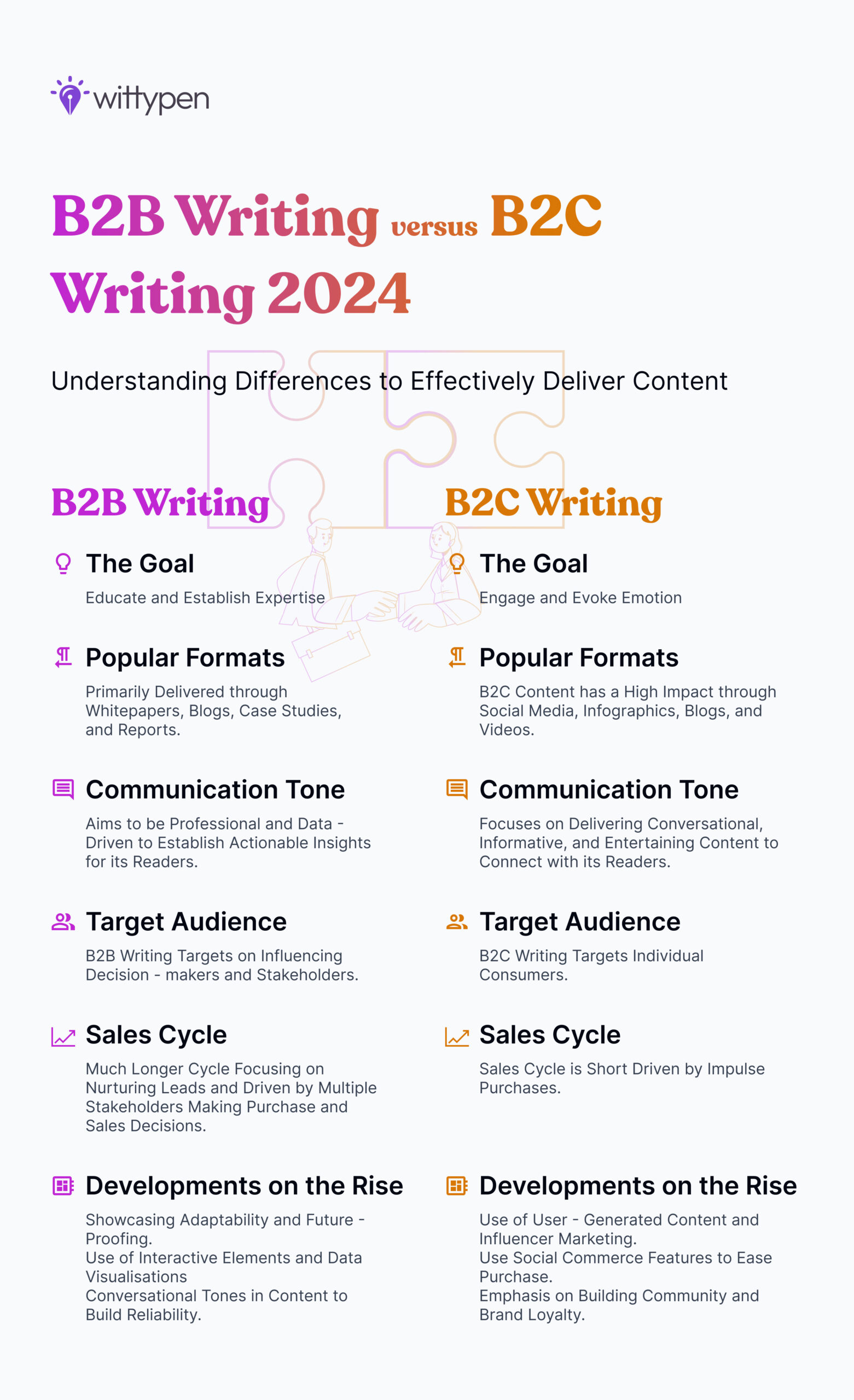
    B2B vs. B2C Writing: Clearing Up Differences

    B2B Writing Vs B2C Writing

    Copy Credits: Venkataraman Mahalingam

    Why Use B2B Writing?

    To shed light on the importance of B2B, here are the three key reasons businesses ought to use B2B content writing,

    Leads & Sales

    B2B writing has the power to boost reputation and awareness. In addition to these two elements, high-quality content, subtle but strategic CTAs, research, well-structured testimonials, and delivery, holds the potential to attract qualified leads and boost sales. You’ll be amazed to know that according to Hubspot, blogs and website content are the two channels with the largest ROIs.

    Balanced Cost Impact

    Among the many effective B2B marketing channels, like paid ads and events, B2B writing delivers a higher impact at lower costs. B2B writing formats, such as blogs and case studies, drive organic web traffic, and since organic business growth is unpaid, it is a very cost-effective long-term strategy.

    Brand Awareness

    When delivered consistently through strategic channels, B2B writing allows a business to quickly reach a wider audience and gain a positive brand image. In fact, 84% of B2B marketers confirm that content boosts brand awareness and is one of the pertinent goals for businesses worldwide.

    Position as a Thought Leader

    B2B writing helps establish a business’s expertise in the field by showcasing its willingness to impart knowledge and educate its viewers and clientele. With quality B2B writing, a business has the potential to be regarded as a thought leader in the field, boosting trust and reliability metrics amongst potential clients.

    Since achieving such crucial business goals has been established as the intent behind B2B writing, before understanding how to create impactful B2B writing content, it is also essential to know how it stands apart from any other business model.

    A Deep Dive Into Types of B2B Writing

    With a clear understanding of the focus, purpose, and critical details of B2B writing, let’s dive a little deeper into the popular formats of B2B content writing, what they are used for and their impact. Here are the top types of B2B writing,

    1. Blogs

    For B2B content creation targeted at improving readers’ knowledge and establishing a business’s expertise in their niche and industry, blogs are one of the most effective forms of B2B writing. In fact, nine out of ten B2B marketers use blogs to achieve their marketing goals, making it one of the most popular and effective forms of B2B writing.

    While the approach to delivering content with such goals is always comprehensive and research-driven, blogs as a form of B2B content creation can cater to all levels of the marketing funnel – from awareness to lead conversion.

    2. Case Studies

    Case studies are testimonials or showcases that allow your customers to understand how they will benefit from your product or service. This form of B2B writing is built around a detailed yet relatable scenario wherein a challenge was overcome thanks to being a customer.

    Built around indisputable and rigorous internal research data, case studies play a big role in persuading your reader to become your customer. In essence, they help generate an organic lead.

    3. Landing Pages

    Source: LinkedIn

    This B2B writing format is the airport of B2B content. When your potential customer clicks on a link from your promotions, ads, search results, or even your webpage, the landing page is quite literally where they land. Now, imagine how you’d want that to be.

    As you may have already guessed, landing pages focus heavily on effective copywriting, attractive CTAs, and crisp information delivery. In short, they can hold your customer’s attention just like LinkedIn’s landing page does. While the length of a landing page depends on the typesetting factors and design, it plays a vital role in boosting brand image and lead generation.

    4. Whitepaper

    Whitepapers are essentially comprehensive reports created with primary research data or verified secondary data. These B2B content formats are designed to showcase a business’s position as an expert in the field and play a massive role in how potential customers perceive the brand’s reliability and reputation. 

    Source: Zendesk

    These reports are quite in-depth and related to a specific niche; only invested customers would require this data. Considering this, whitepapers are often not exactly freely accessible. Like the Zendesk whitepaper example we’ve shared, businesses ask for basic contact details such as name, contact number, and email before sharing whitepapers to track leads, interest levels, and potential conversions.

    5. Newsletters

    This B2B writing format is also quite popular amongst B2C businesses and content creators. Newsletters are a form of email content and regular communication, often delivered via email to retain everyone who has subscribed.

    Newsletters can be long-form or short-form content with relevant backlinks. They often cover industry news, company updates, thought leadership pieces, and exclusive content offers. Newsletters are how businesses keep clients and interested leads updated on their growth, strengthen their position as thought leaders, and also encourage sales.

    Apart from newsletters, emails are also forms of B2B writing used as short, often personalized, and targeted marketing strategies to attract potential clients to their landing pages, blogs, and, eventually, products and services. 

    6. Use Cases

    Use cases are a more straightforward form of ‘case study‘ that highlights where and how your product or service is valuable. This B2B writing format focuses on delivering simple situations, thereby boosting the product or service’s image and impact and is usually short-form B2B content.

    While use cases are often perceived as a B2C content format, they are predominantly used in B2B SaaS content writing. An example can be presenting a use case for a project management software company by highlighting how its product solves communication issues through its automated mail feature.

    7. Technical Documentation

    Technical documentation is a vital part of every business, whether they are B2B or B2C. Each technical document, whether a user guide or troubleshooting manual, contains an in-depth guide to using your product.

    As a part of the B2B content journey, technical documentation facilitates an informed buying decision as it transparently shares the functioning and best use of what you offer. It also helps the existing clients with a seamless troubleshooting experience in case they need support addressing an issue.

    8. Product Descriptions

    Source: SAP

    As the name suggests, this B2B writing format involves delivering compelling descriptions of your products and services. This allows your potential clients to understand what you can offer in a brief yet coherent manner. Effective product descriptions are short, easy to grasp, and cover your product’s advantages and unique selling propositions (USPs). The SAP HCM solution is an excellent example of an effective B2B product description.

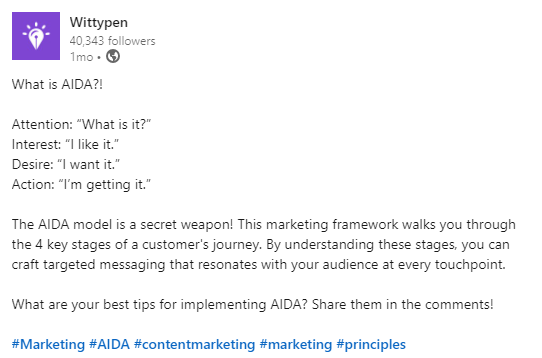
    9. Social Media Posts

    Source: Wittypen

    Social media posts include content for platforms like LinkedIn, Twitter, or Instagram, etc. This B2B content format has raked in quite a lot of popularity on account of how effective it is in building brand awareness and stitching a persona around a company’s values. For example, B2B technology giant Continental posted content highlighting the importance of staying healthy, which helps boost it as a top employer and organization with great ethical principles. 

    With so many diverse formats, creating quality content while focusing on developing innovative products, marketing strategies, and business continuity can be challenging. That’s where guidance from content experts like Wittypen, who can deliver top-quality content seamlessly, becomes vital to building your business.

    Tips for Writing B2B Content and Best Practices

    Now that we have cleared the air around the types of B2B content, let’s equip you with some tips and best practices. Here are key tips for writing effective B2B content, divided into focus on audience, content and SEO. 

    Understanding the Target Audience

    1. Research and Ground Work: While writing B2B content, your target demographic should be at the top of your mind, so do not compromise on your research. With the help of internal data and data analytics, ensure that you understand who you are talking to.
    2. Match Wavelengths with Language: Be conscious of the skillset and background of your target audience while typing up your content. For certain products and services, it is right to include technical jargon because the nature of the product is such that every stakeholder must have an in-depth understanding of it. They may even appreciate it as a show of respect. In cases where the buyers are more sales and negotiation-driven than technical, such content fails to attract leads.
    3. Understand Your Market Funnel: Understanding how your audience feels about your brand and where they are in the purchase cycle is crucial. With this knowledge, you can create appropriate content strategies and effectively write for that stage.

    Structuring Compelling B2B Content 

    1. Follow a Structure: Ensure you use the right hook, introduction, body, and CTA structure based on the intent and approach of your content. Informational and educational blogs require fewer CTAs, as action is not the intent, whereas product descriptions and landing pages need more alluring hooks and CTAs to attract leads.
    2. Build a Compelling Narrative: Content must be and stay engaging. Delivering your content as a narrative is much more engaging than a dry, unrelatable information hotchpotch. 
    3. Check and Check Again: To avoid any possible grammatical errors, proofread your B2B writing and have a qualified editor review your content, so you can deliver your best work.

    Incorporating SEO Best Practices 

    1. Keyword Research: SEO rankings are the key to increasing website traffic and lead generation. For a powerful online presence, ensure your content is optimized with well-researched and not overly generic keywords.
    2. Build Backlinks: When your content or website link appears on multiple websites, that counts as a backlink. It is often done when your content is used as a reference for data. Search engines understand this as a sign of credibility, thereby boosting your SEO ranking, and improving your visibility. By writing educational content, delivering fresh perspectives, or collaborating with other websites on related topics, more and more websites will be encouraged to backlink your content.

    The Importance of Monitoring B2B Content Performance

    While regularly publishing B2B content is an excellent step toward growth and success, it is not the end of the line. By reviewing how your content performs, you can identify how your viewers feel about your brand and measure your growth against your efforts. This understanding helps facilitate better strategy and is crucial to business continuity.

    Next up, we’ll be equipping you with the key metrics with which you’ll be able to track your B2B content.

    Key Metrics to Track for B2B Content

    Here are the metrics used to monitor your B2B content’s performance,

    1. Conversion Rate

    This measures how effective your content is in converting leads into potential customers. It is measured by the percentage of readers or visitors who take action after landing on your content page, such as the number of times a whitepaper was downloaded or the number of clicks on the CTA after reading a blog. 

    2. Return on Investment (ROI)

    This is the revenue generated or cost saved from your B2B content efforts, such as revenue from leads generated versus the cost involved in researching and writing the content.

    3. Average Engagement Time

    This is the average time your reader stays on your website or content page without switching to another page. Higher engagement times might mean users enjoy your site, and they are measured in seconds.

    4. Bounce Rate

    Bounce rate is the percentage of people who leave your site before viewing another page or completing a specified action. Higher bounce rates are bad; they show that your content isn’t appealing enough for them to take action.

    5. Social Media Engagement

    Every social media platform has a professional dashboard to measure this. Often, it is based on either interactions or click-through rate (the number of times the reader clicks on the link after viewing the content).

    Tools for Analysing B2B Content Effectiveness

    With these metrics in mind, here are tools that make analysing these metrics easier,

    Web Analytics with Lead Tracking

    Web Analytic Tools are available on platforms like Google Analytics with advanced configurations. They allow you to track website traffic, user behaviour, and, most importantly, how visitors interact with your content to become leads (e.g., downloading a white paper after reading a blog post).

    Heatmaps

    Visualise user behavior on your B2B content pages with heatmaps. These tools show where visitors click, scroll, and spend their time, revealing areas of engagement or confusion and helping you refine your content for a better user experience.

    On-Page SEO Checker

    SEO audits are vital to assess the ranking and visibility of your B2B content. On-page SEO checkers offered by content experts like Wittypen generate a free detailed SEO report for your blog and provide actionable insights to improve your SEO ranking.

    Social Media Professional Dashboards

    Instagram, Facebook, and other social media platforms offer professional dashboards specifically designed to review the number of accounts your content has reached, the number of likes or interactions, and growth. 

    Conclusion

    There’s no doubt that B2B writing is crucial for every relevant business to maximize leads and sales. Our comprehensive guide, which highlights the key tips to keep in mind and when to use content forms, will equip you to deliver effective B2B content.

    If you feel balancing effective content with your business’s strategic targets will prove to be challenging to manage alone, don’t worry; content outsourcing is the norm! You can contact our expert team at WittyPen for seamless, top-notch content writing services personalized for your business model. 

  • 8 Reasons Why Your Website Is Not Showing up on Google

    8 Reasons Why Your Website Is Not Showing up on Google

    You’ve spent countless hours optimizing your website, but when you type your domain name into the Google search bar, your heart sinks. It’s nowhere to be found. 

    The dreaded question echoes in your mind: “Why is my website not showing up on Google?

    Potential customers searching online won’t find you, leading to missed sales and reduced market share. But fret not! We’ve pinpointed the culprits behind why your website is not showing up on Google and armed you with effective solutions to banish it from Google’s ghost town. 

    8 Reasons Why Your Website Is Not Showing Up on Google

    Here’s why your website is not showing up on Google:

    1. Keyword Understanding: Google might not understand what your website is about.
    2. High-Quality Content: If your website is boring, people won’t stay long enough for Google to notice.
    3. Website Navigation: People want to find information easily.
    4. Backlinks: If other websites don’t link to yours, it’s like nobody is recommending you.
    5. Website Speed Optimization: No one likes waiting, especially online. 
    6. Mobile-First Focus: Most people search online via phones. 
    7. Technical SEO: Your website’s code might have problems, you will need to fix them.
    8. Local SEO:  If you have a local business but haven’t told Google about it. 

    Keyword Understanding: Speak Google’s Language for Higher Rankings

    Keywords are the bridges connecting users to your website. By strategically incorporating relevant keywords throughout your content, you signal the topics your website addresses to search engines like Google. 

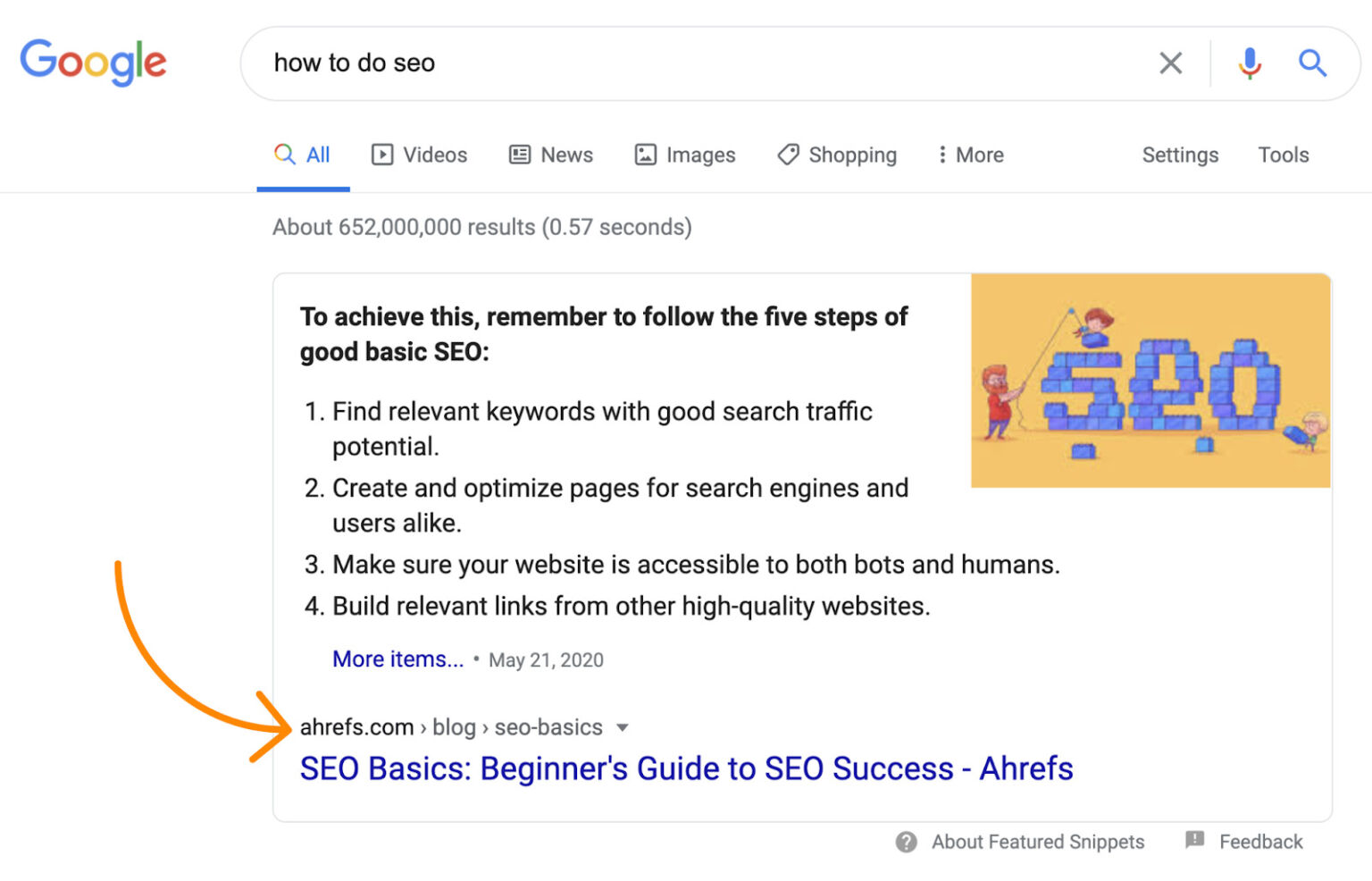
    Source: Ahrefs

    For example, if you search for “how to do SEO”, you’d get the above result. Keywords are they avenues by which Google understands what you talk about on your website.

    Imagine keywords as doorways – the more relevant your “doorways” are to user searches, the higher the chances of traffic discovering your content.

    Choosing Relevant Keywords with Potential

    Here are actionable tips for selecting powerful keywords with potential:

    1. Start by identifying key themes and sub-topics relevant to your website and target audience. 
    2. Don’t just focus on high-volume, highly competitive keywords. Long-tail keywords (e.g., “best hiking boots for women”) are more specific, have lower competition, and attract highly targeted traffic.
    3. Utilize free tools like Google Keyword Planner, Ubersuggest, and Ahrefs Keywords Explorer to research keyword search volume, competition, and related terms.

    High-Quality Content: Key to SEO Success and User Engagement

    High-quality content is your passport to Google’s top ranks. ‘

    Remember: Google rewards websites that empower users. Making interesting and useful content keeps people interested and helps ensure your website shows up on Google.

    Key Factors for Crafting SEO-Powered Content:

    1. Compelling Titles & Meta Descriptions

    • Title tags (50-60 characters): Make short, catchy titles with important keywords.
    • Meta descriptions (155-160 characters): Write summaries that make people want to click on your link.

    You can use Wittypen’s Meta Title and Description Generator to get the best titles and meta descriptions for your content. 

    2. Optimized Body Content

    • Incorporate keywords into your content seamlessly, avoiding excessive use.
    • Organize your content with clear headings, subheadings, and lists to make it easier to read.
    • Ensure your content provides valuable information, answers questions, and solves problems for your audience.
    • Keep your content up to date with new information and use engaging formats like videos or infographics.

    SEO Page Powerhouse: Check This Before You Publish!

    TaskDescription
    Target Keyword IntegrationInclude your target keyword naturally throughout the content, including the title, headings, and body text.
    Compelling Title & Meta DescriptionCraft a clear and engaging title and meta description (snippet) that accurately reflects your content and compels clicks.
    Content Quality & ValueCreate informative, well-written content that provides value to your readers and addresses their search intent.
    Headings & SubheadingsUse clear and concise headings (H1, H2, etc.) to structure your content and improve readability.
    Image OptimizationUse relevant, high-quality images and optimize them with alt text containing your target keyword.
    Internal LinkingLink to relevant pages within your website to improve user experience and website navigation.
    Content-LengthAim for content length that satisfies user search intent, typically ranging from 300 words for short-tail keywords to 1000+ words for in-depth topics.

    Website Navigation: Optimizing Clarity for User Experience and SEO

    Ensuring your website is easy to navigate is super important for people visiting your site and how well it shows up on search engines. Good navigation helps visitors quickly find what they’re looking for, keeping them interested and boosting your website’s ranking.

    Key Aspects of Clear Navigation

    1. Keep your menus simple and organized. 
    2. Use descriptive labels for menu items and links so people know what to expect.
    3. Include a search bar so people can find things directly if they can’t locate them in the menu. 
    4. Breadcrumbs show users where they are on your site and help them understand how everything is connected. 

    Navigation Audit Checklist: 10-Point Self-Assessment

    Here’s a self-assessment navigation audit checklist for your website: 

    1. Ensure the subcategories and categories make sense and are simple to use.
    2. Ensure the menu items are precise, descriptive, and free of ambiguity.
    3. Verify you can access important sites with only three clicks.
    4. Verify that labels accurately convey the information on linked pages.
    5. To prevent misunderstanding, make sure labels are unique from one another.
    6. Ensure labels (e.g., “Shop Now” vs. “Products”) contain verbs to promote user involvement.
    7. Verify the presence of a useful and accessible search bar.
    8. Verify that the search feature yields pertinent results.
    9. Verify whether breadcrumbs are used to display the user’s location.
    10. Ensure the breadcrumbs match the site’s structure and are simple to grasp.

    Backlinks: Building Trust and Authority for Higher Rankings

    Backlinks are like stamp approval for your website. They show search engines like Google that other sites trust and value your content. The more good-quality backlinks you have, the better your website can rank in search results. 

    Effective Link-Building Strategies

    1. Write helpful articles for websites in your field and include links back to your own content.
    2. Work with other businesses in your niche to share links and help each other.
    3. Find broken links on other sites and suggest your content as a replacement.
    4. Get your website listed in trustworthy online directories related to your industry.

    Website Speed Optimization: Enhance User Experience and SEO Performance

    Let’s look at some of the key elements that help enhance website speed:

    Key Elements for Website Speed Optimization

    1. Make your images smaller without losing quality so they load faster.
    2. Store frequently accessed data on your website to load quicker for returning visitors.
    3. Try to use as few plugins and scripts as possible, as they can slow things down.
    4. Use free tools like Pingdom to check your website’s speed regularly and find improvement areas.

    Mobile-First Focus: Ensuring a Seamless User Experience 

    In today’s mobile-centric world, a staggering 59.43% of all website traffic originated from mobile devices. So, if your site isn’t easy to navigate, read, and interact with on a mobile phone, you’ll likely encounter diminished website traffic and lower engagement.

    Image of laptop, mobile, and a tablet

    Source: Unsplash

    Mobile Usability Assessment

    To check if your website is mobile-friendly, you can use tools like SiteChecker’s “Mobile-Friendly Test.” This helps you see how your site looks and works on phones. Making sure your site is easy to use on mobiles means you’re catering to most people who browse the web.

    Technical SEO: Avoiding Hidden Roadblocks to Visibility 

    Sometimes, there are technical problems with your website that you can’t see, but they can affect how your website appears on search engines. Things like broken links or errors can stop your site from being seen by people searching online.

    Here’s how you can navigate these technical problems:

    1. Proactive Maintenance

    Using tools like Google Search Console helps you find and fix these technical problems before they hurt your website’s ranking. It’s like doing regular check-ups to keep your site healthy and easy to find online.

    2. Seeking Expertise

    If you need help fixing technical issues, you can ask SEO professionals for help. They are experts in this field and can sort out any tricky problems, saving you time and stress.

    Struggling with complex technical SEO issues? Partner with Wittypens’ SEO experts. We provide professional solutions delivered with a touch of wit, saving you time & boosting your online visibility.

    Local SEO: Attract Nearby Customers and Dominate Your Local Market

    Local SEO helps small businesses connect with potential customers around their base locality. This gives small businesses a better chance to compete with big companies. By ensuring your website shows up in local searches, you can get more local customers who are likely to buy from you.

    Key Strategies for Local SEO Success

    Let’s delve into three key practices that can solidify your local online presence:

    1. Google My Business Listing is a free tool from Google helps people find your business online. Make sure all your information is correct, and add pictures and reviews to make it more attractive.
    2. Get your business listed accurately in local directories and websites. This shows people your business is trustworthy and helps you get noticed in your community.
    3. Write blog posts or articles that talk about things happening in your area. Use keywords related to your city or town to help people find your content when they search online.

    Local SEO Powerhouse: Conquer Your Local Market


    StrategyAction Items
    Claim & Optimize Google My Business Listing– Create or claim your free Google My Business listing.
     – Verify your business ownership.
     – Fill out all information accurately: name, address, phone number, website, category, description, etc.
     – Add high-quality photos and videos showcasing your business.
     – Encourage customers to leave reviews and respond to both positive and negative reviews.
    Build Strong Local Citations– Search for relevant online directories and websites in your area.
     – Claim your existing listings or create new ones, ensuring consistency across all platforms.
     – Use online listing management tools to streamline the process.
    Create Local Content– Create blog posts, articles, or videos relevant to your local community and target audience.
     – Include local keywords throughout your content 
     – Optimize your website for local search by including your city/town in titles, meta descriptions, and content.
    Mobile Optimization– Ensure website responsiveness and user-friendliness across all devices, especially mobile.
     – Test mobile usability with tools like Google’s Mobile-Friendly Test.
     – Optimize website speed for faster loading times on mobile devices.

    Unlock Website Potential: Control Your Visibility 

    Dominating the digital landscape is a strategic pursuit, and your website is your launchpad. This article has equipped you with a powerful arsenal of insights into why your website is not showing up on Google.

    Remember, SEO is a continuous journey, not a one-time destination. As you meticulously craft high-quality content, optimize for technical prowess, and prioritize user experience, remember that you’re not alone. WittyPen’s team of SEO experts is here to guide you every step of the way.

    Think of Wittypen as your SEO compass, navigating you through the ever-evolving search engine landscape. We don’t just offer generic advice; we tailor our solutions to your unique website, target audience, and industry.

  • Only On-Page SEO Guide to Read in 2024

    Only On-Page SEO Guide to Read in 2024

    If you’re looking to boost your website’s visibility and dominate the digital space, on-page SEO is the game-changer you need in 2024.

    Think of it like this: On-page SEO is like the magic touch that makes your website shine brightly in the big online world. It’s like a magnet that effortlessly pulls in the people you want to reach.

    But how do you effectively use on-page SEO to make your website stand out? Don’t worry, it’s not as tricky as it sounds. As things change on the internet, so do the tips and tricks for success.

    In this post, we’ll share the latest tips and tricks to help your website not just keep up but also stand out. Here is a complete on-page SEO checklist:

    On Page SEO Optimization Checklist 2024

    What Is On-Page SEO?

    On-page SEO (also known as on-site SEO) refers to the practice of optimizing various elements of your website. This helps to improve its search engine ranking and user experience. It involves tweaking different parts of your webpage to boost its chances of ranking higher in search results. 

    To master on-page SEO, you’ll need to focus on optimizing key elements. This includes fine-tuning your content with relevant keywords, improving your site’s speed, and ensuring it’s visually appealing on mobile devices.

    In essence, the idea is to make your website as user-friendly and search engine-friendly as possible.

    What Does On-Page SEO Include?

    When it comes to on-page SEO, there are crucial factors to consider.

    1. At the forefront is content SEO on-page optimization, which emphasizes the creation of top-notch content that resonates with your audience and incorporates relevant keywords.
    2. Next up is optimizing your HTML tags, like your title tags and meta descriptions, to make them more informative and enticing. It’s equally important to pay attention to your site’s structure to ensure seamless navigation for both users and search engines.
    3. In addition, on-page SEO success hinges on factors like page speed, mobile responsiveness, and internal linking. Each of these elements plays a significant role in optimizing your on-page SEO effectively.

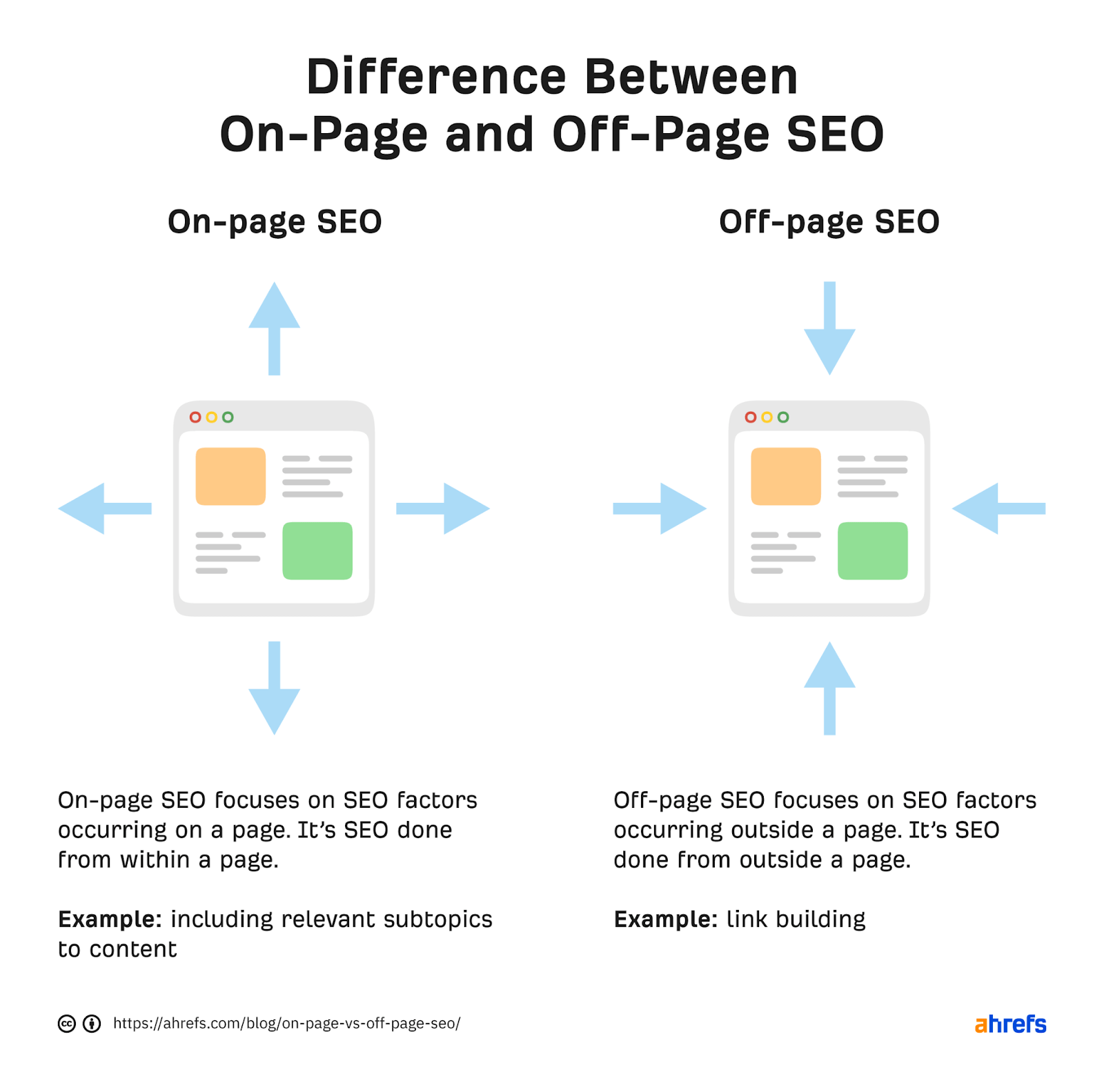
    On-Page SEO Vs. Off-Page SEO 

    On-page SEO and off-page SEO are like two sides of the same coin, each playing a crucial role in improving your website’s visibility and authority. 

    On-page SEO focuses on optimizing on-page SEO factors directly on your website, like content and HTML tags. Off-page SEO looks at external SEO on-page factors, like backlinks and social signals. Both are important for achieving higher rankings in search results, but they require different strategies and tactics. 

    With on-page SEO, you might focus on creating high-quality content incorporating relevant keywords and optimizing your site’s structure for better navigation. 

    Source

    On the other hand, off-page SEO might involve reaching out to other websites and influencers in your industry to build backlinks to your site and increase your online presence. 

    Ultimately, combining on-page and off-page SEO is vital to achieving long-term success in improving your website’s search engine visibility and driving more organic traffic.

    Below is a table highlighting the key distinctions:

    AspectOn-Page SEOOff-Page SEO
    Factors Controlled

    Within the Website

    External to the Website

    Examples

    Content Quality, Title Tags, Header Tags, URLs, Internal Linking, Page Speed, Mobile Responsiveness

    Link Building, Social Signals, Brand Mentions, Local SEO Events, Guest Posting

    Impact on RankingsDirectIndirect
    Tools UsedGoogle Search Console, Google Analytics, Yoast SEO Plugin, WittyPen

    MozBar, Majestic SEO, Ahrefs, BuzzSumo, HARO

    Main Objective

    Improve Relevance & User Experience

    Build Authority & Relationships

    By understanding the differences between on-page SEO and off-page SEO, you can develop a comprehensive SEO strategy that leverages both to improve your website’s visibility and ranking on SERPs.

    Where to Start the On-Page SEO Activity? 

    Beginning your on-page SEO journey requires setting a solid foundation for your website’s success. Before diving into more advanced techniques, take the initial step by utilizing the following tools.

    Below are some resources to help assess your website’s current status and identify specific areas that require improvement:

    Wittypen Free SEO Checker

    Take advantage of our free tool designed to provide personalized suggestions tailored to improving your website’s on-page SEO. It offers insights and tips based on industry best practices, which makes it easier for you to optimize your site.

    You can input your blog or the published URL and the keyword that you want the page to be optimized for. In one click, Wittypen’s On-Page SEO Checker will analyze the content and give you results on what is working for your page, what can be improved, and what areas are critical to fix for a better ranking.

    Google Search Console

    Google Search Console is your go-to for monitoring your website’s performance, checking its index status, and identifying any crawl errors that might be hindering your SEO efforts.

    Google Analytics

    Google Analytics lets you understand your visitors’ behavior, track conversion rates, and assess the effectiveness of your SEO campaigns. This valuable data will guide you in making informed decisions to enhance your website’s performance.

    How to Master the On-Page SEO Strategy? 11 On-Page SEO Techniques 

    Implementing effective techniques enhances your website’s search engine rankings, user experience, and overall online presence.

    Here’s a concise list of on-page SEO optimization techniques you can follow in 2024:

    1. Page Speed Optimization
    2. Mobile Optimization
    3. Schema Markup and Structured Data
    4. URL Structure and Canonicalization
    5. Keyword Research and Optimization
    6. Creating High-Quality Content
    7. Title Tags and Meta Descriptions
    8. Heading Tags and On-Page Formatting
    9. Optimizing User Interface and Navigation 
    10. Call-to-Action Optimization
    11. Engaging Multimedia Content 

    Let’s explore each technique in more detail:

    1.  Page Speed Optimization

    Page speed optimization is a vital on-page SEO technique to enhance your website’s loading times for an improved user experience and search engine rankings. Slow loading speeds can deter visitors, leading to higher bounce rates and decreased visibility in search results. 

    1. Make sure to reduce file size by compressing photos and videos without sacrificing quality. Smaller files download more quickly, keeping visitors interested and lowering bounce rates.
    2. You can also remove characters and whitespace from your code to make it lighter and faster to load. A cleaner, more concise code means less data for the browser to process, which results in faster page loads.
    3. Focus on enabling caching to keep frequently visited data locally. It helps with faster subsequent visits. Keeping items like photos and scripts on the user’s device eliminates the need to download them repeatedly.
    4. Defer the loading of non-essential resources until they are required, prioritizing crucial content. This prioritizes the components that visitors see first. It results in a speedier initial page load and a more seamless surfing experience.
    5. Use a CDN to spread content across numerous servers, lowering latency and improving loading times. 

    Implementing these strategies can significantly enhance your website’s page speed, leading to better user engagement and higher search engine rankings.

    2.  Mobile Optimization

    Mobile optimization is another crucial on-page SEO optimization tactic focused on tailoring your website’s design and content for optimal performance on mobile devices.

    Phone shopping reigns supreme, with over 70% of online purchases made using smartphones. Given the rising trend of mobile browsing, ensuring your site is mobile-friendly is essential for delivering a seamless user experience. 

    To optimize your website for mobile devices,

    1. Adapt to different screen sizes with ease to meet the needs of a wide range of mobile devices. This helps to provide a user experience that is free from annoyance.
    2. Focus on adding big, readable fonts make reading easier on smaller mobile screens. Doing so reduces eye strain and encouraging the consumption of content.
    3. Make sure to compress your images and videos, as it helps with the loading time of the page.
    4. Mobile devices incorporate a streamline navigation system. Users can find information quickly, which will require fewer clicks.
    5. Optimizing your website for mobile devices improves the user experience, reduces bounce rates, and enhances search engine visibility.

    3.  Schema Markup and Structured Data

    Schema markup and structured data are essential on-page SEO techniques designed to provide search engines with additional context about your website’s content.

    Incorporating schema markup and structured data can enrich search result snippets and boost click-through rates (CTRs). 

    Here’s how to implement them effectively:

    1. Enhance content details like ratings, reviews, and pricing with schema markup to provide search engines with valuable information.
    2. Implement structured data to make sure it offers search engines deeper insights into your website’s content and organization.
    3. Use Google’s Structured Data Markup Helper to generate structured data code for your site and test it with the Structured Data Testing Tool to ensure proper implementation.

    Integrating schema markup and structured data can elevate your website’s search engine visibility and encourage higher user engagement.

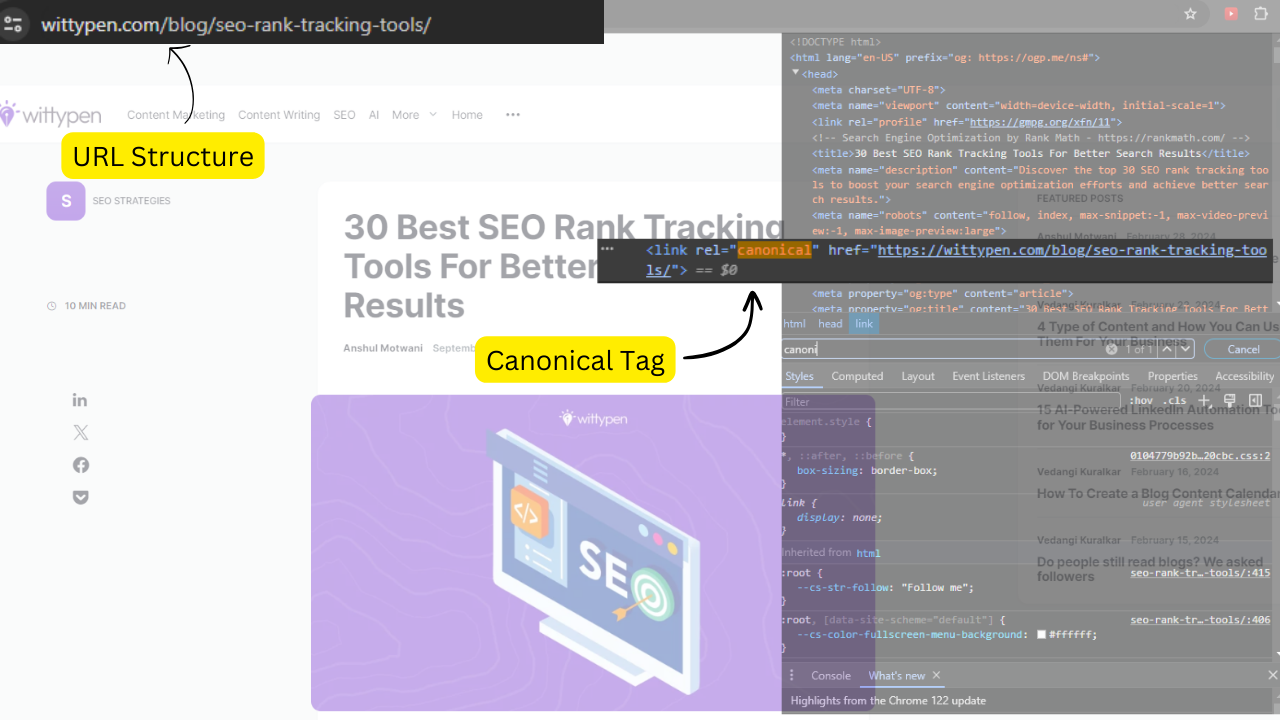
    4.  URL Structure and Canonicalization

    URL structure and canonicalization are vital for on-page SEO, influencing how search engines interpret and index your website’s content.

    A well-organized URL structure aids navigation for users and search engines alike, while canonicalization helps designate the preferred version of a webpage with similar or duplicate content. 

    Here are some strategies you can follow:

    1. Make sure to create user-friendly URLs containing relevant keywords. Clearly communicate page content to users and search engines.
    2. Always use hyphens to separate words. Improve the readability and understanding of your URL structure.
    3. It is best to avoid special characters, numbers, and excessive parameters. Maintain URLs that are clean and easy to remember.
    4. Always focus on implementing canonical tags. Specify the preferred version of a webpage to avoid confusion and improve SEO.
    5. Audit your website for duplicate content on a regular basis and implement redirects as needed. Maintain a clean and efficient website structure for the best search engine performance.

    Refining URL structure and canonicalization enhances crawl ability, indexation, and overall SEO performance.

    5.  Keyword Research and Optimization

    Keyword research and SEO on-page optimization are fundamental to on-page SEO, involving the strategic integration of relevant keywords into your website’s content to boost search engine visibility.

    Here’s what you can follow to excel at it:

    1. Keyword research is the first step in the process. This involves identifying relevant keywords and inserting them smartly into your blog. These keywords can be classified as small-tail and long-tail keywords. Utilize tools like Google Keyword Planner, SEMrush, or Ahrefs to identify pertinent keywords.
    2. Target specific, long-tail keywords with lower competition and high relevance to your audience. The majority of Google searches are long-tail keywords, which are more specific and detailed search terms.
    3. Incorporate primary keywords into titles, headings, meta descriptions, and content.
    4. Steer clear of keyword stuffing, prioritizing engaging, value-driven content.
    5. Track keyword performance using analytics to gauge rankings, traffic, and conversions.

    Through meticulous keyword research and on-page SEO optimization, you can effectively elevate your site’s visibility and attract organic traffic.

    Keyword OptimizationLet’s take a closer look at this specific example. We optimized a blog post for the keyword “30 best SEO rank tracking tools.”

    By strategically integrating this keyword throughout the content, from the title and headings to the body itself, we could signal the blog post’s precise topic and target audience to search engines.

    This strategic approach, coupled with other SEO best practices, has yielded impressive results.
    This example showcases the effectiveness of keyword optimization in driving organic traffic and achieving top search engine rankings.

    6.  Creating High-Quality Content

    Now, let’s explore what on-page SEO is in relation to content creation. High-quality content is pivotal to successful on-page SEO strategies, enticing visitors, fostering engagement, and establishing authority in your niche. To create compelling content:

    1. Focus on conducting thorough research to ensure your content offers valuable insights and information.
    2. Make sure to craft a captivating headline that grabs attention and encourages clicks.
    3. To enhance readability, always organize your content with clear headings, subheadings, bullet points, and visuals.
    4. Zero in on naturally integrating relevant keywords to increase search engine discoverability.
    5. Key in on regularly updating your content to maintain its relevance and accuracy.

    Consistently producing high-quality content aligned with user needs and search intent strengthens credibility, drives organic traffic, and enhances overall search engine performance.

    Google prioritizes three key factors when determining search rankings: high-quality content, a positive user experience on the page, and quality backlinks from other websites.

    7.  Title Tags and Meta Descriptions

    Title tags and meta descriptions play vital roles in on-page SEO, offering summaries of your web page’s content to search engines and users. To optimize:

    1. Craft descriptive and compelling titles that accurately depict your page’s content.
    2. Keep titles under 60 characters for full display in search results.
    3. Write meta descriptions that provide concise summaries of the page’s content, including relevant keywords.
    4. Limit meta descriptions to 155 characters for complete visibility.
    5. Avoid duplicating title tags and meta descriptions across multiple pages.

    By optimizing these elements, you can enhance your website’s click-through rates and search engine visibility.

    Try out our free tool to generate engaging meta titles and meta descriptions for your content.

    8.  Heading Tags and On-Page Formatting

    Heading tags and on-page formatting are crucial for on-page optimization, organizing content, and enhancing readability. To optimize:

    1. Use H1 tags for the main title and H2-H6 tags for subheadings, incorporating keywords naturally.
    2. Employ bullet points, numbered lists, and other formatting elements to break up content and enhance readability.
    3. Integrate relevant keywords into headings and subheadings.
    4. Utilize images and videos to enrich user engagement and provide visual interest.
    5. Ensure the content is well organized and easy to navigate.

    Optimizing heading tags and on-page formatting improves the user experience, engagement, and search engine visibility.

    9.  Optimizing User Interface and Navigation 

    Optimizing the user interface and navigation is a critical on-page SEO technique involving designing a clean, intuitive interface and navigation system. This enhances visitors’ ability to locate desired information, reducing bounce rates, improving engagement, and enhancing search engine visibility. To optimize:

    1. Utilize a clean, modern design aligned with your brand and audience preferences.
    2. Ensure easy navigation, allowing visitors to find information quickly.
    3. Provide clear and descriptive labels for navigation links and buttons.
    4. Implement breadcrumbs for clear navigation paths back to previous pages.
    5. Utilize internal linking to connect related content and improve navigation flow.

    By optimizing the user interface and navigation, you can elevate the user experience, reduce bounce rates, and improve search engine visibility.

    10.  Call-to-Action Optimization

    Regarding getting people to take action on your website, call-to-actions (CTAs) are like friendly nudges in the right direction. Here’s how to make them work better:

    1. Center your focus on putting your CTAs where people can see them immediately, ideally at the top of your page.
    2. Always keep your CTAs simple. Tell users exactly what action you want them to take, whether signing up or buying.
    3. Work on using eye-catching colors or bold text to ensure your CTAs are visually appealing.
    4. Consider tailoring your CTAs to different visitor types based on their behavior or preferences.
    5. Evaluate and experiment with different versions of your CTAs to see what works best and optimize for improved results.

    By sprucing up your CTAs, you can boost user engagement, increase conversions, and make your website shine.

    11.  Engaging Multimedia Content 

    Adding fun stuff like pictures, videos, and podcasts to your website can make it a lot more enjoyable for visitors. Here’s how to do it right:

    1. Make sure to use high-quality images and videos relevant to your content and visually appealing to your audience.
    2. Ensure your images and videos load quickly to avoid frustrating your readers with slow loading times.
    3. Direct your efforts towards creating informative and visually appealing infographics to break down complex information clearly and concisely.
    4. Concentrate on sharing interesting and informative podcasts related to your audience’s interests.
    5. Share your content on social media platforms to reach a wider audience and increase engagement.

    Adding fun stuff to your website can make it more fun to visit, keep people interested, and bring in more visitors.

    Top Metrics to Measure Your Efforts

    To see if your on-page SEO optimization efforts are paying off, you need to keep an eye on some important numbers.

    Here are the key metrics you can follow to track your progress and determine the success of your on-page SEO optimization efforts:

    1. Check how much traffic is coming to your site from search engines. More traffic usually means your SEO is working.
    2. See how many people leave your site after only looking at one page. A high bounce rate could mean your content isn’t grabbing their attention.
    3. Find out how long visitors stick around on your site. Longer dwell times suggest they’re finding what they need and liking what they see.
    4. See how many pages people view in one visit. The more pages they visit, the more engaged they are with your content.
    5. Measure how many visitors take the action you want them to, like signing up or buying something. A higher conversion rate means your site is convincing people to do what you want.
    6. Check how many people click on your site when they see it in search results. A higher CTR means your site’s title and description are appealing to users.
    7. Keep an eye on where your site shows up in search results for important keywords. Climbing up in rankings means your SEO efforts are paying off.

    On-Page SEO Checklist to Follow

    To make sure your website is in tip-top shape for search engines, go through this checklist:

    1. Find relevant words people search for to reach your target audience.
    2. Craft catchy titles and summaries for each page to explain its content.
    3. Break up your content with clear headings for easy reading.
    4. Create valuable and engaging content for your visitors.
    5. Optimize your images, compress them, and use descriptive names to avoid slowing down your site.
    6. Enable browser caching and compression for faster loading.
    7. Use structured data to improve your understanding of your content.
    8. Use clear URLs and avoid duplicate content issues.
    9. Describe images with alt text for better search engine understanding.
    10. Regularly check your website’s functionality, user experience, and performance. 

    Following this checklist will help ensure your on-page optimization is top-notch and ready to boost your site’s visibility in search results.

    Summing Up 

    Mastering on-page SEO gives your website the full package: better visibility, happier visitors, and a steady stream of organic traffic.

    Think of it as fine-tuning your website for search engines and users alike – faster loading, mobile-friendly, engaging content, and an overall smooth experience. To keep the momentum going, keep an eye on key metrics and tweak your strategy based on the data.

    Excited to boost your website’s on-page SEO?

    Try Wittypen’s On-Page SEO Checker today for SEO content solutions that work wonders!