Author: Vedangi Kuralkar

  • 30+ Quotes by Women in Marketing

    30+ Quotes by Women in Marketing

    As rightly quoted by Maggie Lena Walker “Let a woman choose her vocation just as a man does his. Let her go into business, let her make money, let her become independent, if possible, of man.”

    Women’s contributions to marketing and society as a whole are monumental. In marketing, they have shaped the industry in profound ways. As per research, women wield significant influence, accounting for 85% of consumer purchasing decisions.

    Moreover, statistics from LinkedIn reveal that women dominate the marketing sector, constituting 60% of the workforce in North America. There has been a substantial rise in women holding managerial positions as well, with 59% occupying Manager-level roles and 52% serving as Chief Marketing Officers.

    Success in marketing, transcends talent and expertise; it’s about building connections, seeking mentorship, and displaying resilience. That said, various organizations dedicated to women’s empowerment provide invaluable support, offering a platform for sharing experiences, and career advancement opportunities.

    A few reasons why some women, if not most, excel in this field are because:

    1. They are brilliant when it comes to forming connections, mentoring, and resilience.
    2. Women play a crucial role in breaking gender stereotypes and biases in marketing and advertising.
    3. Women bring a diverse perspective to marketing strategies.
    4. Their exceptional emotional intelligence and sensitivity inspire them to connect with audiences on a deeper level.
    5. Women also exhibit almost equal ability when it comes to adaptability, collaboration, and a holistic approach to problem-solving when compared to their male counterparts.

    Popular women networking groups are:

    • Women in Marketing (WiM)
    • SheSays
    • Girls in Marketing
    • Lean In founded by Sheryl Sandberg
    • Women in Tech SEO

    Celebrating Women in Marketing on Women’s Day with WittyPen

    At Wittypen, the team sincerely believes in the quote penned down by the senior manager, Vinita Yadav: “Content marketing is an asset, that has a tangible value that appreciates over time – it creates what consumers truly desire.”

    The entire Wittypen team proudly celebrates the achievements of women in marketing, especially on International Women’s Day.

    Here are a few highlights of Wittypen’s continued efforts towards women’s empowerment.

    It’s always better to celebrate the women in our lives!

    Highlighting the people who matter!

    Go team!

    Contributions of Women in Marketing

    Of late, numerous influential women in marketing have made significant strides towards greater gender equality. Let us look at the most popular quotes along with their marketing quotes coming from these female go-getters:

    1. Maggie Chan Jones
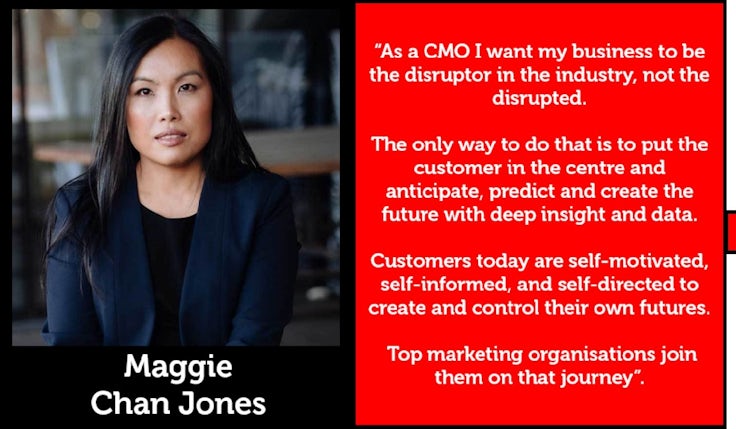
    source

    With an MBA from Cornell University, Maggie began her marketing career at Microsoft. In 2017, Forbes named Maggie the 15th Most Influential CMO in the world. She has now moved on and founded Tenshey, a company focused on empowering people of all backgrounds to achieve equality in leadership.

    2. Ann Hadley

    Ann Handley - MarketingProfs | LinkedIn

    source

    Ann, renowned as the bestselling author of “Everybody Writes” and “Content Rules,” has disseminated valuable marketing advice through various platforms, including Entrepreneur, IBM, and the Wall Street Journal.

    Her famous quotes include:

    1. “Even when you are marketing to your entire audience or customer base, you are still simply speaking to a single human at any given time.”
    2. “Does your content lead readers on a journey, or does it merely stuff them as leads into a pipeline?”
    3. “Smart brands don’t just ride trend shifts. They start them.”
    4. “Think bigger, braver, and bolder. The biggest missed opportunity in content marketing is playing it too safe.”
    5. “Engaging content is far more about brains than budget.”
    6. “Good content isn’t about good storytelling. It’s about telling a true story well.”
    7. “Use tone of voice to attract the like-minded and avoid the timid.”
    8. “You need to create ridiculously good content—content that is useful, enjoyable, and inspired.”
    9. “Make the customer the hero of your story.”

    3. Cara Scharf

    A Fearless Trailblazer | New Frontier of Digital Marketing | Cara Scharf

    source

    With more than 25 years of experience in advertising and marketing, Cara founded Fearless Media, a company focused on providing comprehensive strategic planning, PR, media, and marketing services. She rightly quotes:

    • “One of the most difficult issues women face is that people don’t always take you seriously. You don’t need confidence to start, you need guts.”

    4. Michele Linn
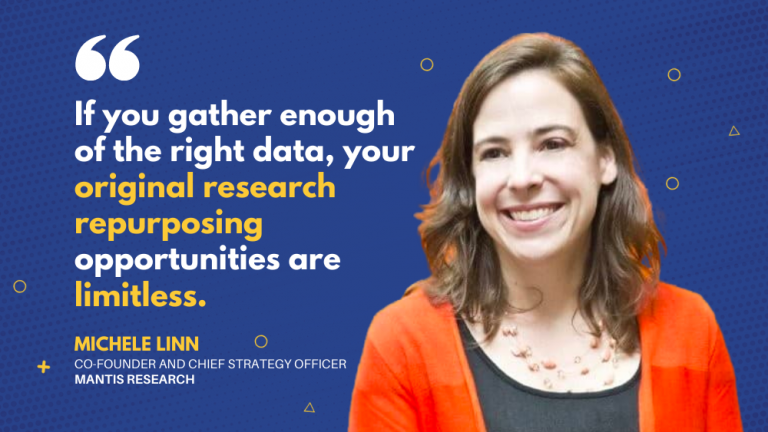
    source

    When the Content Marketing Institute was founded in 2011 to help advance the practice and field of content marketing, Michele Linn was hired to help launch the blog and editorial strategy. In 2015, Michele was named one of the “Top Women in Media” by Folio magazine, and in 2017, Michele co-founded Mantis Research. Among her famous quotes are:

    • “Content is the atomic particle of all digital marketing.”
    • “Content marketing is the gap between what brands produce and what consumers want.”

    5. Beth Comstock

    source

    Elizabeth “Beth” Comstock is an American business executive who was also the former vice chair of General Electric. Her famous marketing quotes are:

    • “Marketing’s job is never done. It’s about perpetual motion. We must continue to innovate every day.”
    • “Be where the world is going.”
    • “You can’t sell anything if you can’t tell anything.”

    Precious Marketing Quotes Contributed by Women Leaders Across the Globe

    1. “Creating marketing that works should not be rocket science.” — Allen Gannett
    2. “Word of mouth can be as important, if not more important, for neighborhood businesses as traditional advertising.” — Ekaterina Walter
    3. “I have never worked a day in my life without selling. If I believe in something, I sell it, and I sell it hard.” – Estee Lauder
    4. “Your website is your greatest asset. More people view your webpages than anything else.” — Amanda Sibley
    5. “My best successes came on the heels of failures,” – Barbara Corcoran
    6. “Never doubt a small group of thoughtful, committed people can change the world. Indeed, it is the only thing that ever has.” — Margaret Mead
    7. “You can never go wrong by investing in communities and the human beings within them.” — Pam Moore
    8. “Content is king but engagement is queen, and the lady rules the house!” — Mari Smith
    9. “The presence of a brand proclaims that item’s ownership. It’s the marketing equivalent of signing your painting; it tells the world ‘our company produced this’”. – Jenni Romaniuk
    10. “Spending energy to understand the audience and carefully crafting a message that resonates with them means making a commitment of time and discipline to the process.” — Nancy Duarte
    11. “Focus on the core problem your business solves and put out lots of content and enthusiasm and ideas about how to solve that problem.” — Laura Fitton
    12. “Brand should never be a deception; it should be a delightful expression of a product’s truth, and ultimately a positive force in people’s lives.” – Emily Heyward
    13. “Google only loves you when everyone else loves you first.” — Wendy Piersall
    14. “This is a learning process and sometimes you have to fall to learn things.” — Christine Korda
    15. “The importance of gratitude is never forgotten.” — Deborah Lee
    16. “Take a risk and keep testing, because what works today won’t work tomorrow, but what worked yesterday may work again.” — Amrita Sahasrabudhe
    17. “I’ve learned that people will forget what you said, people will forget what you did, but people will never forget how you made them feel.” — Maya Angelou
    18. “You can’t buy engagement. You have to build engagement” – Tara-Nicholle Nelson
    19. “Companies whose cultures wither instead of thrive because their leaders can’t articulate the stories of why they do what they do.” – Kindra Hall
    20. “Fear is used by many brands as a key motivator to drive consumer action. Fear-based marketing is useful when fear is used as a motive to overcome fear, not instill it. There’s a big difference.” – Shantini Munthree

    Women in Marketing: Future Trends

    Women in the marketing industry are literally reshaping its future. They have capitalized on emerging trends and transformed the marketing world according to evolving audience preferences. Some of the future trends include:

    1. Female influence is particularly pronounced in niche marketing, where attention to detail and authenticity are paramount.
    2. The digital landscape has revolutionized marketing, with women leading the charge in adopting and optimizing digital tools to ensure that strategies remain relevant and forward-thinking.
    3. Moreover, there is a growing emphasis on authenticity in advertising, with women marketers at the forefront, breaking barriers and championing online presence, self-promotion, and continuous skill enhancement.
    4. Women are also sought after for their emotional intelligence in advertising, commitment to sustainable and ethical marketing practices, and dedication to inclusivity and diverse representation in media.

    Final Thoughts

    Female marketers are seizing opportunities, and positioning themselves as industry leaders is no longer a rarity. While gender equality has taken remarkable strides in workplaces, challenges still persist, especially for women from diverse backgrounds.

    By echoing the voices and experiences of inspirational women, progress toward gender equality can continue globally. As the marketing world evolves, the field is rife with opportunities for women to emerge as the next generation of leaders.


  • 4 Type of Content and How You Can Use Them For Your Business

    4 Type of Content and How You Can Use Them For Your Business

    Everyone interacts with content writing daily, whether through a business’s email, a marketing reel, a product description, or even this article. 

    Content writing is creating and editing written content for the digital audience. It can be in blogs, social media posts, website copy, product descriptions, emails, etc. Anyone using the internet is exposed to diverse types of content writing daily. 

    So, in the realm of content, how many types of content writing are there? And how do these help businesses? Let’s find out!

    What are the Different Types of Content Writing?

    All written content that a person interacts with on the internet can be broadly divided into 4 writing categories based on their aim or intent:

    1. Blog Writing

    Blogs can cover a wide range of topics and writing styles depending on the brand’s goals. Usually, these are long-form content that are written in a conversational style. Blogs aim to educate, inform, and provide value. 

    Businesses use blogs to connect with target audiences by producing valuable and educational content. For example, this blog aims to educate on the types of content writing and how businesses can utilise them to meet their goals. If you want more examples, check out more blogs here. 

    2. Copywriting 

    Contrary to blog writing, copywriting aims not to educate but to motivate readers to take action. The action can be anything, such as making a purchase, clicking on a link, donating to a cause, or scheduling an appointment.

    Copywriting is the process of writing persuasive marketing and promotional material. These written material can be product descriptions, social media posts, press releases, advertisements, and even scripts used for videos.

    Copywriting needs to be creative and extremely catchy. For instance, have a look at this Hinge advertisement. 

    hinge example

    Image Source

    Hinge is an online dating app, and through its creative copywriting, it is urging people to use Hinge to find love.

    Often, copywriting is the first contact of potential customers with a brand. Therefore, it plays a crucial role in making a brand memorable and, thus, creating awareness. 

    3. Technical Writing 

    Experts utilise technical writing as a communication tool to share knowledge about specific subjects. For environmental regulations, computer applications, or medical procedures, there is a need to explain technical concepts or offer instructions, and that is exactly what technical writing entails. 

    Technical writing is not necessarily complex or too robotic. It is a methodical writing style that aids readers in finishing an assignment, learning about a product, finishing a process, etc.

    An example of technical writing we come across often is Google Help articles that explain how to use certain features or formulae step-by-step. Technical Writing ExampleBusinesses may use technical writing in manuals, white papers, ebooks, or how-tos to explain how their product or service works and educate potential and existing customers on the specifics. 

    4. SEO Writing 

    SEO stands for Search Engine Optimisation. As the name suggests, it includes any digital written content that is optimised for search engines. This means that the goal of SEO writing is to rank on search engines like Google when a relevant query is added to the search box.

    For example, when someone searches for “Top travel destination 2024,” the top search results that appear usually are the SE-optimised ones. 

    Source

    SEO writing ensures that relevant keywords are added and the content focuses on answering the user’s intent. Almost all businesses today use SEO writing to divert organic traffic from search engines to their websites. Creating relevant content that helps them rank well increases business visibility, leads to more visits to their website, and leads to more purchases of their products or services. 

    How Does Content Writing Help Businesses? 

    All forms of content writing are excellent tools for marketing. In fact, it is an indispensable tool for businesses to interact with their audience and create visibility on the internet.

    For businesses, well-written content:

    • Increases audience engagement and connection
    • Improves brand awareness and visibility
    • Generates and converts leads
    • Contributes to customer retention
    • Gives a competitive advantage

    And much more.

    A survey of organisational goals of content writing found that most businesses (around 84%) use content marketing to boost brand awareness. This is followed by lead generation (83%), engagement (81%) and sales (75%). 

    Content writing importanceImage Source

    But, with so many types of content writing available, which one should a business focus on? 

    Each of the four content writing types has its benefits:

    • Blog writing helps businesses connect and communicate with their audience, including current and potential customers. Blogs help a brand’s visibility and awareness. 
    • Copywriting is integral to all marketing campaigns. It helps businesses run successful marketing campaigns and create effective messaging for their website, blog, social media, and online ads. 
    • Technical writing comes in handy when businesses want to help their audience understand their product or service. By breaking down complex information and presenting it in a simpler version, technical writing helps customers understand a product in detail. 
    • SEO writing is integral for all businesses to increase visibility and generate organic traffic. SEO-optimised content can ensure a higher ranking, which translates into more impressions and clicks for the company. 

    So, based on the specific requirements and goals, a business should choose the type of content writing most suited to them. However, ensuring that the content written is effective is also vital. For this, let’s dive into 10 tips to optimise content writing. 

    10 Tips for Effective Content Writing 

    10 tips that can help businesses, writers, and content marketers ensure the best from their written content are:

    1. Identify and Analyse the Target Audience: Knowing who your potential customers are is the first step to creating a customer base. It includes understanding their requirements, likes, dislikes and needs that the business can meet. 
    2. Use Compelling Titles/Headlines: Add headlines and titles that are attention-grabbing, interesting, catchy, and relevant to the content that will follow. The aim is to get clicks. A user should be compelled to click on your blog or product link. 
    3. Write in Simple and Concise Language: Using a non-verbose, easy-to-understand language ensures that your audience is able to easily engage and connect with what you are trying to convey. 
    4. Use Active Voice: Using active voice over passive voice ensures that the content is more readable and, thus, engaging.
    5. Write only Value-adding Content: Fluff should be avoided at all costs. The content should provide value to the audience, be it information, entertainment, or inspiration. 
    6. Use Images and Infographics: Infographics and images make the content more lively, readable, and dynamic. 
    7. Ensure Good Formatting: Formatting the content so that it is easy to read is important. Make sure you use H1, H2, and so on to make the content not only look well-organised but also improve SEO. 
    8. Edit and Proofread: To err is human; always ensure that you re-read any piece of written content to make necessary changes and avoid errors. 
    9. Research and SEO: No good writing can take birth without good research. Therefore, it is important to research well and from credible sources to draft your content. It goes without saying that SEO is an integral part of all types of content writing. Add relevant keywords, maintain a frequency, and avoid stuffing to optimise the content for search engines. 
    10. Beware of Plagiarism: Copying content is a serious offence and should always be avoided. Check your written content on plagiarism tools like Copyscape to avoid any unexpected plagiarism. 

    Conclusion

    In summary, content writing encompasses various forms like blogs, copywriting, technical writing, and SEO writing, each serving unique purposes for engaging audiences and enhancing brand visibility. By understanding these types and employing effective strategies, businesses can connect with their target audience and achieve marketing goals. 

    While all four types of content writing play essential roles in the growth of a business, it is equally important to ensure that the content is effective. Effective content writing is not just about conveying information but also about fostering connections and driving action.

    To ensure the most effective content across the writing categories, there are many types of content writing services available that businesses can outsource. Wittypen is one such platform that provides content writing services across blog writing, copywriting, technical writing, and SEO writing.

    If you want content that connects and drives revenue, visit Wittypen and see how it works wonders for your business! 

  • 15 AI-Powered LinkedIn Automation Tools for Your Business Processes

    15 AI-Powered LinkedIn Automation Tools for Your Business Processes

    LinkedIn has built itself as the premier social media network for professionals, facilitating an environment primed for networking and collaboration. When combined with the power of AI, professionals can fully harness its potential and optimize their business operations. 

    Marketers claimed generative AI tools for content creation and personalization to have the most potential. With the prowess of artificial intelligence, LinkedIn professionals can utilize tools to:

    • Expand their demographics
    • Optimize marketing and campaign efforts
    • Diversify their network

    Using AI tools is key to making the most of this diverse and interconnected platform. That’s why here are the 15 best LinkedIn automation tools for 2024.

    We will explore their key features, benefits, and how they can revolutionize your business processes on LinkedIn.

    Which Processes Can Be Automated on LinkedIn?

    Businesses can optimize their operations, save time, and chase better outcomes with AI tools on LinkedIn. 

    Let’s explore the key processes that can be automated on LinkedIn and how automation can add value to your business strategy.

    1. Profile Optimization

    Automation can help streamline the process of profile optimization on LinkedIn. AI-powered tools can analyze user profiles and provide actionable recommendations for improvement.

    • Automation tools can identify keywords, suggest changes for the headline and summary, and provide insights into how profiles can be improved to attract more views and engagement.
    • Businesses can make sure that their LinkedIn profiles are always updated and optimized for maximum visibility by automating the profile optimization process.

    2. Content Scheduling and Posting

    Posting regular and engaging content on LinkedIn is necessary for maintaining an active presence, but manually scheduling and posting content can be time-consuming.

    • AI-powered tools automate the process of content scheduling and posting, schedule posts for optimal times, and analyze the performance of content.
    • By automating content scheduling and posting, businesses can maintain a consistent presence on LinkedIn, drive engagement, and build brand awareness.

    3. Connection Requests and Outreach

    Building a strong network on LinkedIn expands reach, develops relationships, and generates opportunities for business ventures. AI-powered tools automate the process of sending connection requests and messages to reach out to potential collaborators at scale.

    • LinkedIn AI tools can help businesses identify relevant prospects, personalize their messages, and schedule follow-ups.
    • By automating connection requests, businesses can extensively expand their network, generate leads, and drive meaningful conversations with potential clients and partners.

    4. Lead Generation and Prospecting

    Identifying and following up on leads through LinkedIn allows professionals to develop business-specialized strategies. According to a HubSpot report, 34% of marketers identified lead generation as their top priority. However, lead generation poses several challenges.

    AI-powered tools can automate the process of lead generation and prospecting, allowing businesses to identify and qualify leads.

    • These tools employ machine learning algorithms to analyze user behaviour and recommend potential leads that match specific attributes.
    • By utilizing automated lead generation, businesses can streamline their sales process and focus their efforts on engaging with the appropriate leads.

    5. Relationship Management and Engagement

    AI-powered tools can automate the process of relationship management and engagement on LinkedIn, allowing businesses to stay connected with their network and conduct meaningful interactions.

    • These tools automate tasks such as sending messages, sharing content, and tracking engagement with different connections.
    • Businesses can stay connected with their connections, develop rapport, and establish opportunities for collaboration and growth.

    Top LinkedIn Automation Tools for 2024

    Selecting the right solution is essential to making the most of the platform. Let’s take a look at the 15 best LinkedIn automation tools for 2024 and see how they will revolutionize your engagement and prospecting efforts.

    1. Wittypen

    Image Source

    Wittypen is a leading content creation platform that helps businesses scale their writing operations. With Wittypen’s LinkedIn Post Generator and LinkedIn Carousel Post Generator, one can automate the content creation process facilitated by AI, enabling creation of original and compelling content to optimize LinkedIn profiles.

    Top Features:

    • AI tools like LinkedIn Post Generator and LinkedIn Carousel Generator help you to maintain a consistent and impactful presence on LinkedIn without the hassle of manual content creation.
    • Adds a comprehensive human touch to AI-developed content to rectify inaccuracies and create specialized content.
    • Analyzes user preferences and provides customized prompts that resonate with target audiences.

    G2 Rating: 4.8/5

    2. Linked Radar

    Image Source

    Linked Radar is a comprehensive automated acquisition tool that enables business professionals to optimize their process of identifying and reaching out to potential prospects.

    Top Features:

    • Utilizes advanced data analytics and machine learning algorithms.
    • Tracks the performance of outreach efforts, identifies potential leads, and sends personalized messages.
    • Utilizes specialized templates to send up to 100 messages and invites daily.

    G2 Rating: 4.6/5

    3. MeetAlfred

    Image Source

    MeetAlfred is a versatile LinkedIn automation tool that simplifies outreach, prospecting, and lead generation for businesses. With its user-friendly interface and automation capabilities, users can create personalized campaigns, schedule messages, and keep track of responses.

    Top Features:

    • Integrates different social media platforms to send personalized messages and follow up on email or X (previously known as Twitter).
    • Analyzes prospect profiles and adjusts personalized messages to simplify networking on LinkedIn.

    G2 Rating: 2.4/5

    4. Zopto

    Image Source

    Zopto is a powerful LinkedIn outreach optimization tool that empowers businesses to find, connect with, and engage with their ideal prospects at scale. It allows users to generate and connect with leads over LinkedIn and follow up over email, automatically identifying prospects.

    Top Features:

    • Offers cloud support for multiple accounts and agency-focused use, which is essential for larger organizations and enterprises.
    • Builds upon LinkedIn’s features to provide professionals with an optimal lead-generation tool, no matter the scale.

    G2 Rating: 4.5/5

    5. Taplio

    Image Source

    Taplio simplifies LinkedIn content scheduling and management through automated functions that allow businesses to plan, create, and publish content across multiple LinkedIn accounts from a centralized platform.

    Top Features:

    • Schedules posts, articles, and updates and tracks performance metrics across different LinkedIn profiles.
    • Posts comments and reaches out to those who have liked posts and commented.

    G2 Rating: 4.5/5

    6. Dripify IO

    Image Source

    Dripify IO is a prospect generation tool that automates drip campaigns and follow-up sequences on LinkedIn, allowing for consistent communication with prospects and leads throughout the sales cycle.

    Top Features:

    • Enables users to set up automated sequences for sending personalized messages, working on leads, and engaging in conversions on LinkedIn.
    • Tracks all outreach programs in progress and extracts emails from LinkedIn.

    G2 Rating: 4.6/5

    7. Browse AI

    Image Source

    Browse AI uses machine learning algorithms to automate LinkedIn profile visits, connection requests, and engagement activities, helping enhance profile visibility and generate leads. Users are able to receive profile information in a convenient spreadsheet format in an automated manner, reducing the manual labour required in the outreach process.

    Top Features:

    • Provides pre-built and popularly used algorithms that enable actions such as visiting websites, completing forms, and extracting data.
    • Downloads data from any website, supplementing the outreach process and keeping up-to-date extractions of data.

    G2 Rating: 4.8/5

    8. Demand (ex-Saleshub)

    Image Source

    Demand AI is an automated outreach generation tool that allows professionals to loosen the reigns on their outreach efforts while still maintaining a sense of personality and human connection.

    Top Features:

    • Creates personalized follow-ups so that users can make the most of every opportunity.
    • Automates comments, mitigating the need for manually researching potential leads.
    • Scales operations based on user preferences

    G2 Rating: N/A

    9. Phantombuster

    Image Source

    Phantombuster provides users with pre-built automation that seamlessly integrates into existing workflows, allowing users to generate high-quality leads and save precious time. Its automation efforts include extracting lead generation data into simple spreadsheets, allowing professionals to have easy access to their prospective leads.

    Top Features:

    • Allows users to obtain further details on leads that might be harder to track down, such as emails and phone numbers.
    • Automates the implementation of outreach approaches for following up on possible opportunities and business operations.
    • Tracks outreach progress over time in order to help plan accordingly.

    G2 Rating: 4.2/5

    10. TexAu

    Image Source

    TexAu is a cloud-based automation tool that allows businesses and professionals to utilize advanced algorithms to create custom workflows and extract data from 10+ platforms such as LinkedIn, X (previously known as Twitter), and Google.

    Top Features:

    • Allows users to identify potential contacts based on metrics such as job roles, companies, etc., to receive valuable outreach data such as LinkedIn profiles and emails.
    • Integrates with several applications, such as Google Sheets, allowing users to keep track of their outreach data and gain insight into their automated workflows.

    G2 Rating: 4.3/5

    11. Dux-Soup

    Image Source

    Dux-Soup is an automation tool that simplifies networking and generates appropriate and relevant outreach leads. Professionals can create campaigns that automatically send invitation messages and analyze and reach out to profiles.

    Top Features:

    • Shares campaigns across LinkedIn accounts, allowing for a consistent and comprehensive outreach effort.
    • Provides qualified and relevant leads so that users can focus their efforts on developing business relationships.
    • Downloads LinkedIn profile details and uploads them to a CRM.

    G2 Rating: 4.3/5

    12. LinkedHelper

    Image Source

    LinkedHelper is an automation tool that streamlines LinkedIn automation with features such as profile visits, connection requests, and message sequences, enabling users to engage with prospects and develop relationships.

    Top Features:

    • Automates repetitive outreach tasks to save time and resources.
    • Enables users to reach out to contacts in a consistent yet personalized manner.
    • Facilitates outreach efforts to group members on LinkedIn, helping users save time and utilize their existing networks to develop new relationships further.

    G2 Rating: 4.5/5

    13. Salesflow

    Image Source

    Salesflow serves as a prospect generation tool that automates the sales process on LinkedIn, facilitating lead identification, outreach efforts, and following up to develop business relationships.

    Top Features:

    • Enables users to streamline their sales activities, nurture leads, and close deals.
    • Creates several campaigns at once, personalizes their messages, and plans follow-up messages ahead of time.
    • Simplifies lead generation, initial outreach efforts, and follow-ups.

    G2 Rating: 4.3/5

    14. LinkedFusion

    Image Source

    LinkedFusion is a cloud-based automation tool that offers features for LinkedIn prospecting and lead generation, helping businesses and professionals identify and connect with relevant prospects at scale.

    Top Features:

    • Enables users to automate their outreach efforts, target different timezones based on prospect locations, generate qualified leads, and drive engagement.
    • Schedules follow-up messages to fully automate the outreach process integrates with CRM software tools and targets the appropriate audiences.

    G2 Rating: 3.1/5

    15. LeadConnect

    Image Source

    LeadConnect simplifies the LinkedIn lead generation process with automated workflows for profile visits, connection requests, and message sequences, allowing businesses to expand their networks and drive conversions.

    Top Features:

    • Enables users to automate their outreach efforts and focus on building relationships on LinkedIn.
    • Syncs user profiles with HubSpot to keep track of outreach progress.
    • Allows users to find prospect emails and develop relationships outside of the LinkedIn platform.

    G2 Rating: N/A

    Key Takeaway

    Incorporating the best LinkedIn lead-generation tools into a business strategy can revolutionize and personalize marketing, prospecting, and lead generation. The global generative AI market reached $44.89 billion in 2023 and will continue to grow in the coming years.

    Automated content creation platforms such as Wittypen allow professionals to optimize their profile content. Lead generation tools allow the results to be broadcast to the most appropriate audience.

    With the right combination of automation tools and strategies, you can take your LinkedIn efforts to the next level and stay ahead of the competition in 2024 and beyond

  • How To Create a Blog Content Calendar

    How To Create a Blog Content Calendar

    Do you find it challenging to publish fresh, informative, and attention-grabbing blogs on a regular basis? 

    Blogs are an essential aspect of any business’s marketing strategy in 2024. They offer a host of different benefits, such as increasing website traffic, building trust in the brand along with thought leadership, increasing brand awareness, and generating leads, among others. 

    However, writing and publishing them regularly can be a challenge, and the back end of this (keyword research, topical research, and so on) can be rather time-consuming, especially without a definitive and organised approach.

    If you’re finding it tricky to routinely research and write high-quality blogs, you’ve come to the right place. We introduce you to the idea of a blog content calendar and show you how it can help streamline your marketing efforts. 

    The Role of a Content Calendar in Marketing

    The first thing to understand before we dive into creating a blog calendar is how content calendars are critical to marketing.

    A content calendar helps businesses plan and organise their content marketing efforts effectively and offers a host of different benefits. Some of these benefits include:

    1. Effective Planning: It helps businesses strategically plan their marketing efforts with a specific goal in mind (such as generating leaders, building thought leadership, etc.).
    2. Consistency in Production: It ensures the consistent production and publishing of blogs on your brand’s website, thereby giving it a higher chance of gaining its audiences’ loyalty. 
    3. Content Management: It helps brands manage a variety of different forms of content that they use to market themselves (blogs, social media copy, email campaigns, etc.).

    A content calendar thus offers marketers a range of benefits. However, it’s not just marketers that could benefit from it.

    In the next section, we discuss who can benefit from using a blog content calendar. 

    Who Needs a Blog Content Calendar?

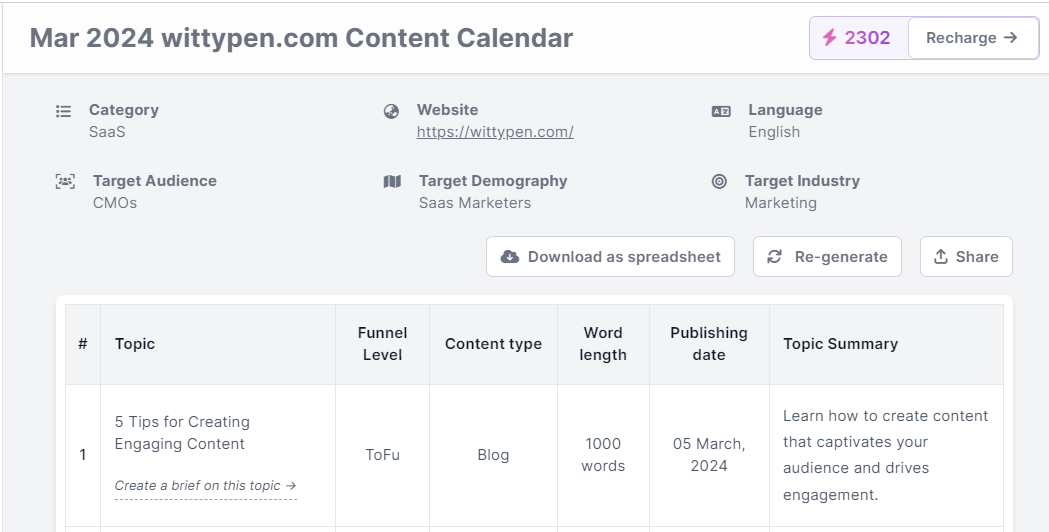
    Wittypen Content Calendar Generator’s Output source

    While a blog content calendar is crucial, who can primarily benefit from it? A blog content calendar can be helpful for both individuals and organisations alike. It’s ideal for anyone who wants to leverage content marketing to build a larger audience and generate leads. 

    1. Marketing Teams 

    The first group that can most certainly benefit from a blog content calendar is a business’s marketing team.

    Since brands aim to consistently publish blogs on the website to increase visibility and generate leads, a blog content calendar can help them streamline the research, production, publication, and organisation of their blogs. 

    What’s more, it also helps align the various members of their marketing teams to ensure there’s no overlapping of work or duplicated efforts.

    2. Content Creators 

    While a lot of content creators today primarily use social media platforms like Instagram and YouTube, many still have a website of their own and routinely publish blogs.

    Content creators who tend to work alone often produce a variety of content, and a comprehensive content calendar can help them streamline and plan their content production process. 

    3. Content Agencies 

    Content agencies typically tend to work with multiple clients at a time, and handling an endless list of content requirements can be a challenge. A blog content calendar can thus help agencies ensure the timely delivery of blogs to each client, thereby strengthening their reputation. 

    How to Build an Effective Blog Content Calendar?

    With the key beneficiaries of a blog content calendar out of the way, how can you build a comprehensive blog content planner? Let’s take a look at the six key steps involved in this process. 

    Step 1: Create a blog Content Calendar Template 

    The first step is to create a comprehensive blog content calendar template. While you can use a variety of content management tools and apps available online, these can be expensive, especially for creators and bootstrapped startups. 

    A readily available blog content planner template can thus be the ideal solution to add, track, and analyse all the effort you put into your website’s blog. Wittypen also offers a unique Content Calendar Generator that can help you generate, organise, and schedule all your content across a range of different marketing channels. 

    Source

    Step 2: Conduct Keyword Research 

    The next step is to perform keyword research for all your blogs. Keyword research in itself can be an extensive process and requires a lot of technical know-how.

    While a lot of businesses tend to use the first keywords they find that seem relevant, this approach isn’t the best. You can check out our detailed guide on how to perform keyword research for SEO to find the best strategies. 

    Gather all the keywords and their respective variations based on various metrics like CPC, keyword difficulty, competition, and so on. You can either export this data to your calendar (if it’s in the form of a spreadsheet) or add it to your template manually. 

    Step 3: Select Relevant Keywords Based on Your Intent 

    The third step is to categorise your keywords based on your intent. Different keywords are suited for different kinds of blogs.

    For example, “how-to” keywords that are often also long-tail keywords are best suited for informative blogs or those that are a mix of informative and commercial blogs. 

    On the other hand, branded keywords are best suited for linking to the primary landing pages on your website. Similarly, you can also categorise keywords based on topics.

    For instance, if you’re an interior design firm, you can categorise your keywords for different topics such as raw materials, kitchens, living rooms, bedrooms, lighting, and so on. 

    Step 4: Brainstorm Ideas For Your Blog Content Calendar

    Once you’ve gathered all your keywords and sorted them out based on your intent, you can use them as a foundation for planning blog content in terms of ideas and topics. With this, you’ll have a set of topics that you or your content team can start working on to get the ball rolling. 

    Each target keyword will also open the door to its relevant keyword cluster, which you can systematically optimise your blogs with while simultaneously tracking all this progress in your calendar. 

    You can easily create briefs for each blog using a tool like Wittypen’s Content Brief Generator, allowing your writers to curate perfectly optimised blogs for your website. 

    Step 5: Determine Your Publishing Schedule 

    Once you’ve created a list of topics that your content and marketing team can start working on, you must also decide on a schedule that determines how frequently you publish blogs on your website. 

    Creating this schedule from the get-go allows your business’s content team to manage their time better, thereby being able to ensure that the blogs are:

    1. Informative
    2. Rich in detail and examples
    3. Engaging to read

    This consistency also helps search engines rank your content better while improving your brand’s recall value in your audience’s minds. 

    Step 6: Organize your Blog Content Calendar for Maximum Efficiency 

    Last but not least, you must ensure that you keep your blog content calendar well organised at all times. Every member of your content and marketing team must be given an SOP on how to update the calendar to ensure data can be easily tracked.

    Doing so also helps you review and analyse your blog’s metrics with greater ease compared to doing so with a disorganised calendar. 

    Transform Your Content Production with a Blog Content Calendar!

    Regardless of the structure of your organisation, a blog content planner is an effective way of managing your content production. The steps in this guide show you how to use, customise, and maintain an organised calendar to streamline your website’s blog. 

    However, despite the use of a calendar, businesses often find it challenging to produce vast volumes of content, especially when doing so across a range of marketing channels. This is where a reliable content agency like Wittypen comes in.

    With a pool of 1000+ writers, we can effectively manage all your brand’s content requirements so you can focus on the other core aspects of your business. 

    Reach out to us to find out how we can transform your business’s content marketing efforts today!

  • Do people still read blogs? We asked followers

    Do people still read blogs? We asked followers

    We get it—blogs in today’s world? With attention spans dwindling and video content taking over asking ‘do people still read blogs’, is a fair question. But guess what? In our survey of 249 people across India and the US, we decided to cut through the noise and settle the score.

    In this post, we’ll explore why blogs are still in the game, defying the odds in a world dominated by fleeting attention spans and the surge of video content. Let’s dive in!

    Are Blogs Still Relevant?

    When we were looking at the State of Marketing Report 2023, business owners were asked about what makes their content marketing a success, it suggests 47% of businesses conducted audience research for better content. Even Google prioritizes quality content for its user’s satisfaction. What does that signify?

    This means that generating valuable content for the audience has never been more significant. Blogs are a great way to go about it. Whether it is delivering information, business blogging, or simply entertainment, with the right framework of blog content, SEOs, and thought leadership, blogs can generate sales, tap into a global audience, and do wonders for your brand sales. 

    Blogs are efficient marketing assets. They are characterized by their reliability and organic appeal, which propel them to the forefront of effective marketing strategies. 

    Well-crafted blogs aren’t just casual reading; they’re strategic powerhouses seamlessly integrating valuable content into readers’ lives.

    Getting good visibility on Google with efficiently crafted blogs can drive customer traffic towards targeted products or businesses and boost ROI.

    Results of Our LinkedIn Poll: Do People Still Read Blogs?

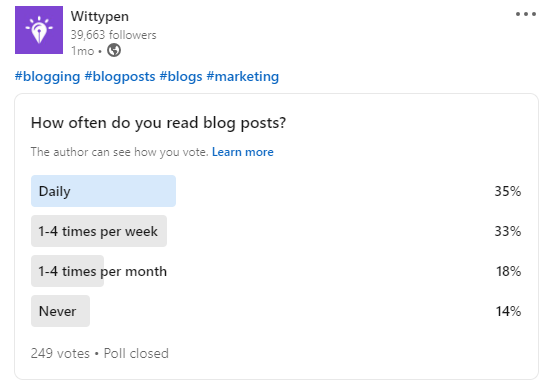
    No need for speculation—we took the direct route and polled our LinkedIn audience about their blog-reading habits.

    Here are the results:

    Source

    According to the survey results above, 35% read blogs daily. Also, 18% read at least once a month, compared to 14% who don’t read at all.

    There is still a fair 33% who love reading blogs at least once a week, compared to 35% who consume blogs daily. On a positive note, this data reveals how people still love reading blogs, and this traction to blogs is what converts into promising clients later on.

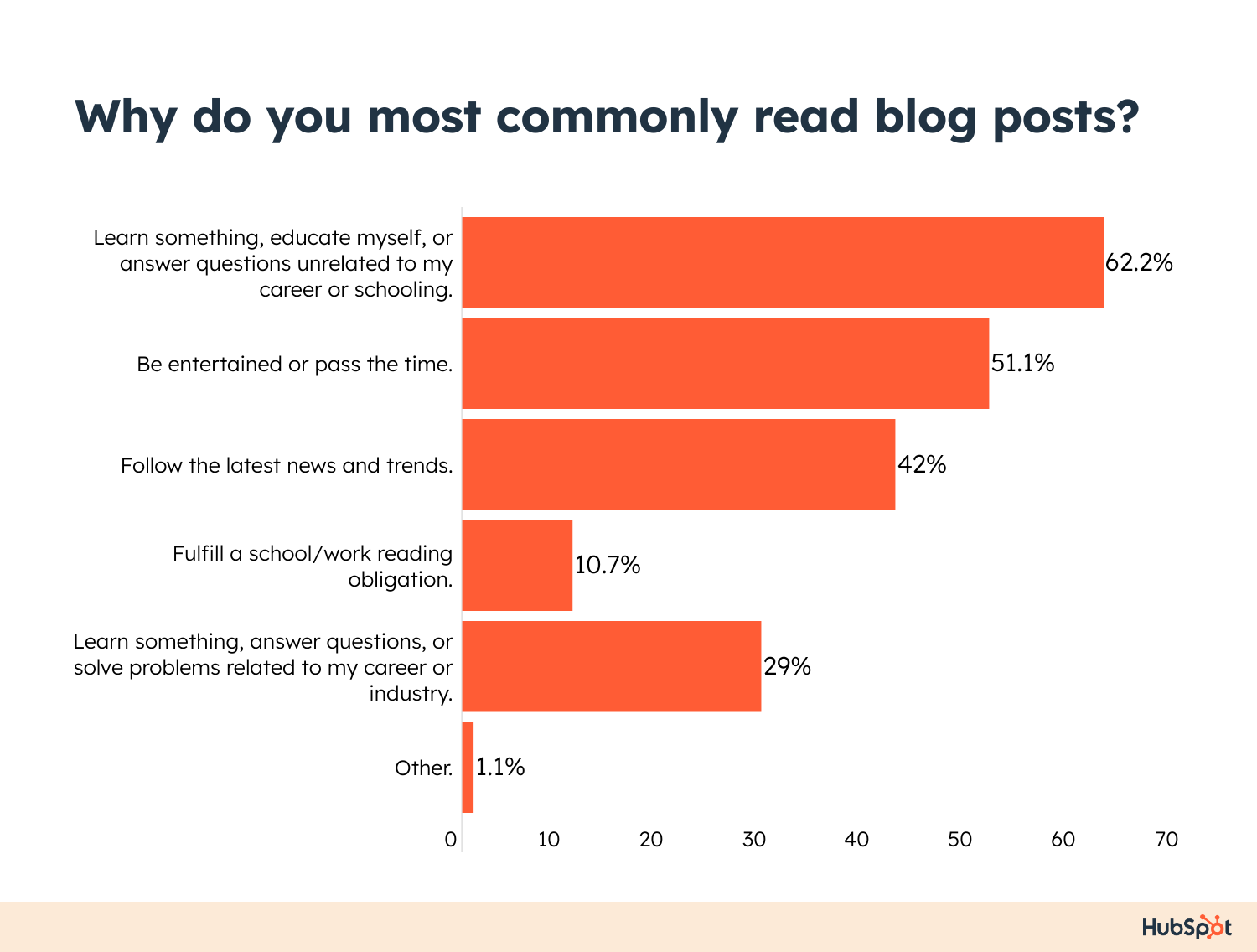
    We know that people still love blogs, but to further understand what everyone’s reading online, let’s have a look at the survey below.  

    Image source

    The data above shows how most of the readers online use blogs to navigate their daily lives. It is important to understand what the audience is looking for in online content. From a marketing aspect, quality content in blogs will define their search engine ranks and organic click rates.

    To know more about why people engage in blogs, let’s have a look at a few reasons below:

    1. Blogs Are a Great Way to Learn New Skills

    People look up Google for self-help guides, daily chore hacks, quick tutorials to make life easier, or simply browse out of curiosity. Blogs covering these simplicities of life would get more reach than an overly informative blog with little curiosity factor. 

    2. Blogs Are like Tabloids, Only More Convenient to Read

    One of the most effective topics for generating curiosity is entertainment. Packed with interactive multimedia graphics and stories, entertainment blogs make a clever content package for a curious audience.

    3. Blogs Offer Industry Insights and Career Guidance

    People are indulging more in reading about the latest industry trends, marketing strategies, or guides to starting a new career. Regularly blogging about these topics helps readers build trust in the blog content and helps build a loyal organic audience.

    These are some great ways to generate more clicks for blogs, but keeping the blogging game relevant in marketing is essential. We’ve jotted down a few effective tips for optimizing blogs. Read on.

    How Do You Get Your Blog Seen?

    With good readership engagement in blogs, it’s necessary to optimize the content strategy for maximum marketing output. Understanding the points addressed below will help blogs grow substantially.

    Ranking on Google Search Results 

    1. One of the most important factors for blogs to rank on Google search results is SEO optimization. Getting the right keywords through keyword research tools and including them strategically throughout the blog is essential. For example, including a keyword in the blog title helps it rank higher in Google search results.
    2. Optimizing blog URLs and including keywords in URLs allows the blog link to rank higher.
    3. As SEO-optimized images and videos add great value to blogs, it also gives blogs another advantage on search engines.
    4. Analyzing the website metrics helps optimize blog performance and generate more blog clicks.

    Building Thought Leadership 

    1. Before building a thought leadership strategy for blogs, we must first seek out the target audience and research what they wish to read in blogs.
    2. Once that’s done, analyzing competitors gives us a chance to produce valuable content that is getting missed.
    3. Being authoritative and regular on social media platforms helps the brand’s voice reach the targeted communities.
    4. Furthermore, getting the content out through webinars, social media content, ebooks, and videos ensures more visibility.

    Providing In-Depth Information 

    1. Google ranks in-depth articles higher than any other. Therefore, instead of opting for short blogs with little information and giving out valuable content, leveraging thought leadership tactics would benefit readers more.
    2. In-depth research on a given blog topic, with data backups from trusted sources as backlinks, would make up a credible blog.
    3. Additionally, giving out expert advice, original quotes, and knowledge allows the readers to learn and follow. This guarantees the credibility of blogs and builds a brand community.
    4. Lastly, let’s not forget to pack our blogs with multimedia.

    Do Blogs Remain a Favorite for Readers and Marketers?

    The answer is yes, they do.

    Blogs tap into people’s curiosities and give out information in easy-to-understand and easy-to-share content. There’s nothing more delightful for readers than to easily get the required information on Google search results and read a whole blog about it.

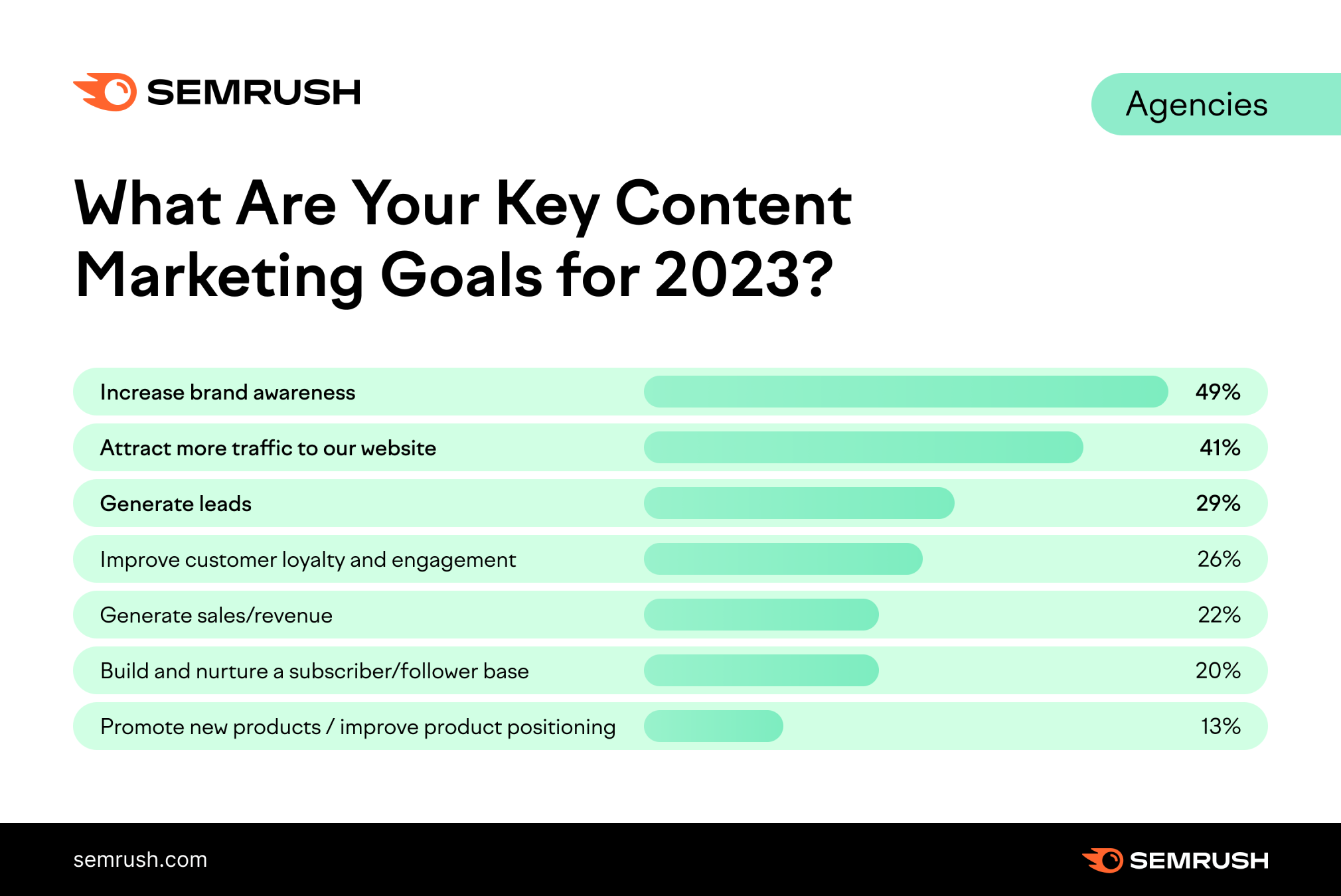
    For brands, let us look at one last survey data point that concerns key content marketing goals for 2023.

    Image source

    According to the information above, one of the most crucial aspects of marketing goals is increasing brand awareness. But what does that mean for blogs? With the versatility that blogs provide in the marketing avenue, it means that if the brand needs to connect with its audience, blogs are a great way to bridge the gap. Blogs can be shared further on social media and repurposed to fit a new module for brand awareness.

    This marketing game, in the long run, will help build connections, invite leads, increase brand presence, and build a solid foundation in targeted communities.

    Reasons Why People Quit Reading a Blog

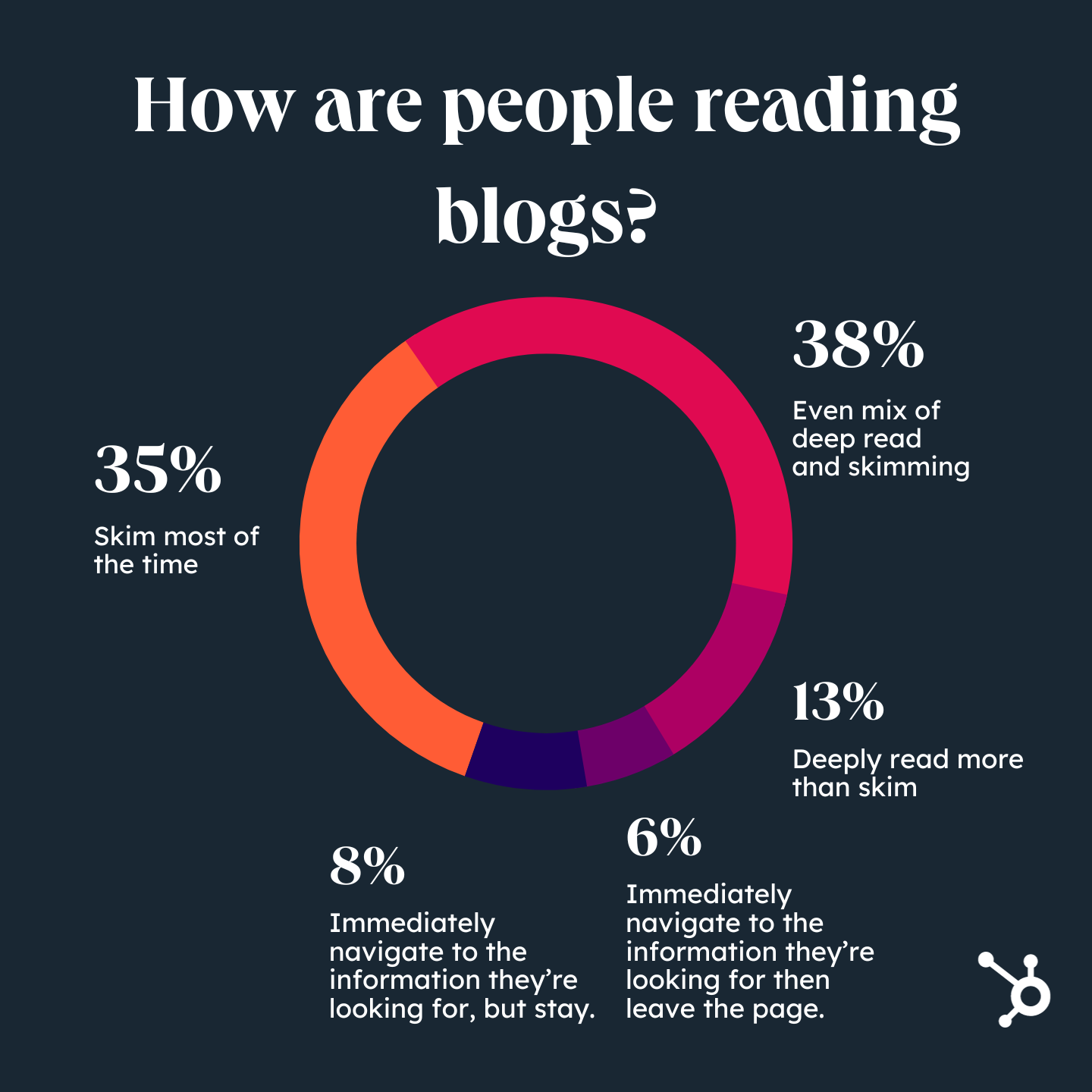
    Before discussing the whys, let us look at one more survey below.

    Image source

    As mentioned above, while 38% of the readers are a mix of deep reading and skimming, there are still 35% who skim through blogs. Other than the reader pattern, whether the reader would indulge in a blog completely depends on the quality and value of that blog.

    There are multiple reasons why the blog fails to entertain online readers. Some of the major reasons could be as follows:

    1. The Blog’s Too Scrappy

    Poor introductions, vague outlines, and irrelevant sentences confuse the readers. With a lack of clear language, the blog loses its content value.

    2. Lengthy Blogs, Zero Graphics

    Forgetting to add catchy multimedia graphics or using complicated language leads to a boring blog that might get overlooked.

    3. Not Getting to the Point

    Using confusing language and delaying the point is going to confuse the readers, and they might not trust the blog’s content.

    Content creation is a great way to boost your business online. With consistency and quality in your blogs, it’s possible to build a reliable clientele and returning customers who love reading the company’s stories through blogs.