Author: Vedangi Kuralkar

  • 8 Reasons Why Your Website Is Not Showing up on Google

    8 Reasons Why Your Website Is Not Showing up on Google

    You’ve spent countless hours optimizing your website, but when you type your domain name into the Google search bar, your heart sinks. It’s nowhere to be found. 

    The dreaded question echoes in your mind: “Why is my website not showing up on Google?

    Potential customers searching online won’t find you, leading to missed sales and reduced market share. But fret not! We’ve pinpointed the culprits behind why your website is not showing up on Google and armed you with effective solutions to banish it from Google’s ghost town. 

    8 Reasons Why Your Website Is Not Showing Up on Google

    Here’s why your website is not showing up on Google:

    1. Keyword Understanding: Google might not understand what your website is about.
    2. High-Quality Content: If your website is boring, people won’t stay long enough for Google to notice.
    3. Website Navigation: People want to find information easily.
    4. Backlinks: If other websites don’t link to yours, it’s like nobody is recommending you.
    5. Website Speed Optimization: No one likes waiting, especially online. 
    6. Mobile-First Focus: Most people search online via phones. 
    7. Technical SEO: Your website’s code might have problems, you will need to fix them.
    8. Local SEO:  If you have a local business but haven’t told Google about it. 

    Keyword Understanding: Speak Google’s Language for Higher Rankings

    Keywords are the bridges connecting users to your website. By strategically incorporating relevant keywords throughout your content, you signal the topics your website addresses to search engines like Google. 
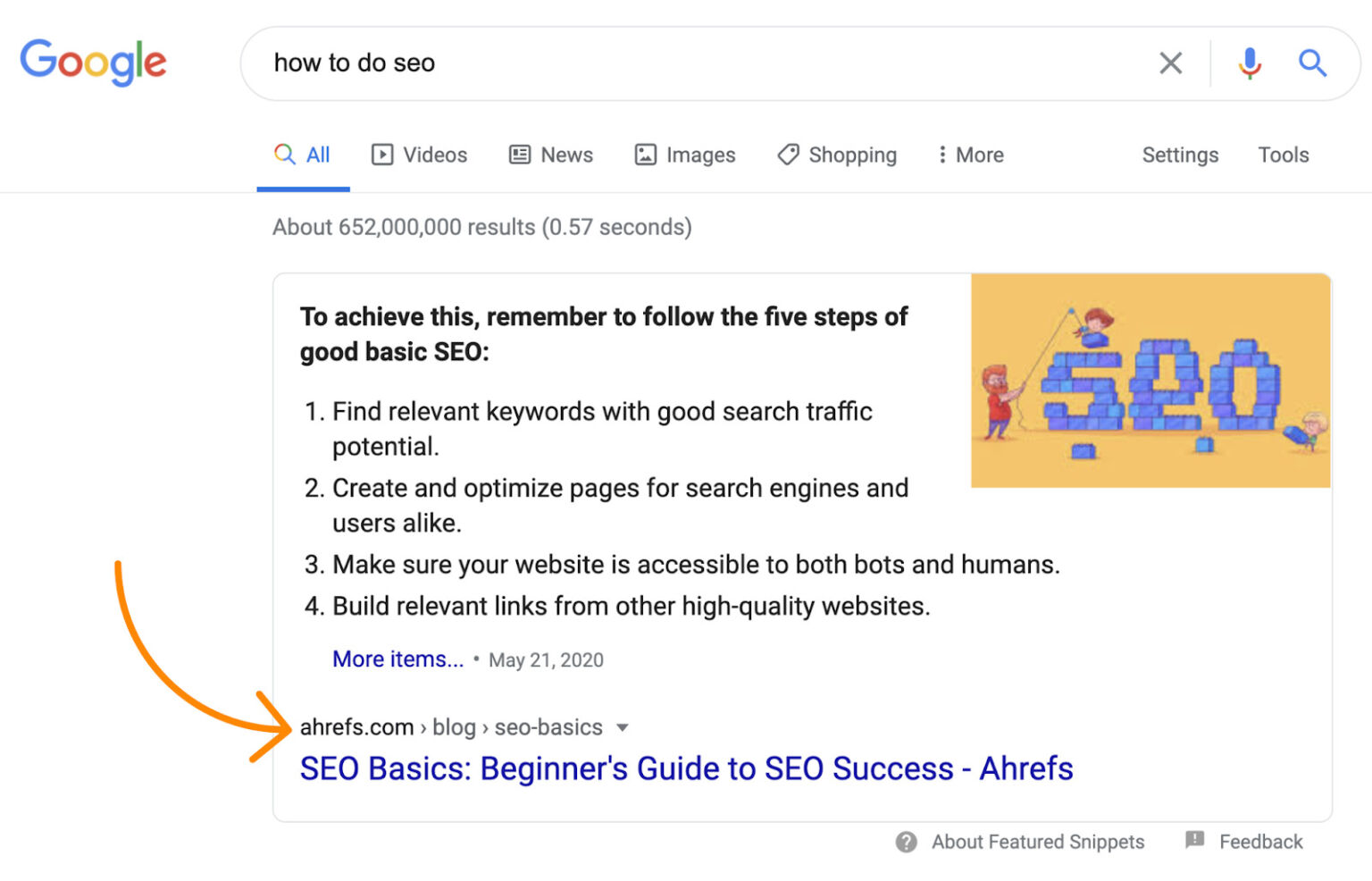
    Source: Ahrefs

    For example, if you search for “how to do SEO”, you’d get the above result. Keywords are they avenues by which Google understands what you talk about on your website.

    Imagine keywords as doorways – the more relevant your “doorways” are to user searches, the higher the chances of traffic discovering your content.

    Choosing Relevant Keywords with Potential

    Here are actionable tips for selecting powerful keywords with potential:

    1. Start by identifying key themes and sub-topics relevant to your website and target audience. 
    2. Don’t just focus on high-volume, highly competitive keywords. Long-tail keywords (e.g., “best hiking boots for women”) are more specific, have lower competition, and attract highly targeted traffic.
    3. Utilize free tools like Google Keyword Planner, Ubersuggest, and Ahrefs Keywords Explorer to research keyword search volume, competition, and related terms.

    High-Quality Content: Key to SEO Success and User Engagement

    High-quality content is your passport to Google’s top ranks. ‘

    Remember: Google rewards websites that empower users. Making interesting and useful content keeps people interested and helps ensure your website shows up on Google.

    Key Factors for Crafting SEO-Powered Content:

    1. Compelling Titles & Meta Descriptions

    • Title tags (50-60 characters): Make short, catchy titles with important keywords.
    • Meta descriptions (155-160 characters): Write summaries that make people want to click on your link.

    You can use Wittypen’s Meta Title and Description Generator to get the best titles and meta descriptions for your content. 

    2. Optimized Body Content

    • Incorporate keywords into your content seamlessly, avoiding excessive use.
    • Organize your content with clear headings, subheadings, and lists to make it easier to read.
    • Ensure your content provides valuable information, answers questions, and solves problems for your audience.
    • Keep your content up to date with new information and use engaging formats like videos or infographics.

    SEO Page Powerhouse: Check This Before You Publish!

    TaskDescription
    Target Keyword IntegrationInclude your target keyword naturally throughout the content, including the title, headings, and body text.
    Compelling Title & Meta DescriptionCraft a clear and engaging title and meta description (snippet) that accurately reflects your content and compels clicks.
    Content Quality & ValueCreate informative, well-written content that provides value to your readers and addresses their search intent.
    Headings & SubheadingsUse clear and concise headings (H1, H2, etc.) to structure your content and improve readability.
    Image OptimizationUse relevant, high-quality images and optimize them with alt text containing your target keyword.
    Internal LinkingLink to relevant pages within your website to improve user experience and website navigation.
    Content-LengthAim for content length that satisfies user search intent, typically ranging from 300 words for short-tail keywords to 1000+ words for in-depth topics.

    Website Navigation: Optimizing Clarity for User Experience and SEO

    Ensuring your website is easy to navigate is super important for people visiting your site and how well it shows up on search engines. Good navigation helps visitors quickly find what they’re looking for, keeping them interested and boosting your website’s ranking.

    Key Aspects of Clear Navigation

    1. Keep your menus simple and organized. 
    2. Use descriptive labels for menu items and links so people know what to expect.
    3. Include a search bar so people can find things directly if they can’t locate them in the menu. 
    4. Breadcrumbs show users where they are on your site and help them understand how everything is connected. 

    Navigation Audit Checklist: 10-Point Self-Assessment

    Here’s a self-assessment navigation audit checklist for your website: 

    1. Ensure the subcategories and categories make sense and are simple to use.
    2. Ensure the menu items are precise, descriptive, and free of ambiguity.
    3. Verify you can access important sites with only three clicks.
    4. Verify that labels accurately convey the information on linked pages.
    5. To prevent misunderstanding, make sure labels are unique from one another.
    6. Ensure labels (e.g., “Shop Now” vs. “Products”) contain verbs to promote user involvement.
    7. Verify the presence of a useful and accessible search bar.
    8. Verify that the search feature yields pertinent results.
    9. Verify whether breadcrumbs are used to display the user’s location.
    10. Ensure the breadcrumbs match the site’s structure and are simple to grasp.

    Backlinks: Building Trust and Authority for Higher Rankings

    Backlinks are like stamp approval for your website. They show search engines like Google that other sites trust and value your content. The more good-quality backlinks you have, the better your website can rank in search results. 

    Effective Link-Building Strategies

    1. Write helpful articles for websites in your field and include links back to your own content.
    2. Work with other businesses in your niche to share links and help each other.
    3. Find broken links on other sites and suggest your content as a replacement.
    4. Get your website listed in trustworthy online directories related to your industry.

    Website Speed Optimization: Enhance User Experience and SEO Performance

    Let’s look at some of the key elements that help enhance website speed:

    Key Elements for Website Speed Optimization

    1. Make your images smaller without losing quality so they load faster.
    2. Store frequently accessed data on your website to load quicker for returning visitors.
    3. Try to use as few plugins and scripts as possible, as they can slow things down.
    4. Use free tools like Pingdom to check your website’s speed regularly and find improvement areas.

    Mobile-First Focus: Ensuring a Seamless User Experience 

    In today’s mobile-centric world, a staggering 59.43% of all website traffic originated from mobile devices. So, if your site isn’t easy to navigate, read, and interact with on a mobile phone, you’ll likely encounter diminished website traffic and lower engagement.

    Image of laptop, mobile, and a tablet

    Source: Unsplash

    Mobile Usability Assessment

    To check if your website is mobile-friendly, you can use tools like SiteChecker’s “Mobile-Friendly Test.” This helps you see how your site looks and works on phones. Making sure your site is easy to use on mobiles means you’re catering to most people who browse the web.

    Technical SEO: Avoiding Hidden Roadblocks to Visibility 

    Sometimes, there are technical problems with your website that you can’t see, but they can affect how your website appears on search engines. Things like broken links or errors can stop your site from being seen by people searching online.

    Here’s how you can navigate these technical problems:

    1. Proactive Maintenance

    Using tools like Google Search Console helps you find and fix these technical problems before they hurt your website’s ranking. It’s like doing regular check-ups to keep your site healthy and easy to find online.

    2. Seeking Expertise

    If you need help fixing technical issues, you can ask SEO professionals for help. They are experts in this field and can sort out any tricky problems, saving you time and stress.

    Struggling with complex technical SEO issues? Partner with Wittypens’ SEO experts. We provide professional solutions delivered with a touch of wit, saving you time & boosting your online visibility.

    Local SEO: Attract Nearby Customers and Dominate Your Local Market

    Local SEO helps small businesses connect with potential customers around their base locality. This gives small businesses a better chance to compete with big companies. By ensuring your website shows up in local searches, you can get more local customers who are likely to buy from you.

    Key Strategies for Local SEO Success

    Let’s delve into three key practices that can solidify your local online presence:

    1. Google My Business Listing is a free tool from Google helps people find your business online. Make sure all your information is correct, and add pictures and reviews to make it more attractive.
    2. Get your business listed accurately in local directories and websites. This shows people your business is trustworthy and helps you get noticed in your community.
    3. Write blog posts or articles that talk about things happening in your area. Use keywords related to your city or town to help people find your content when they search online.

    Local SEO Powerhouse: Conquer Your Local Market


    StrategyAction Items
    Claim & Optimize Google My Business Listing– Create or claim your free Google My Business listing.
     – Verify your business ownership.
     – Fill out all information accurately: name, address, phone number, website, category, description, etc.
     – Add high-quality photos and videos showcasing your business.
     – Encourage customers to leave reviews and respond to both positive and negative reviews.
    Build Strong Local Citations– Search for relevant online directories and websites in your area.
     – Claim your existing listings or create new ones, ensuring consistency across all platforms.
     – Use online listing management tools to streamline the process.
    Create Local Content– Create blog posts, articles, or videos relevant to your local community and target audience.
     – Include local keywords throughout your content 
     – Optimize your website for local search by including your city/town in titles, meta descriptions, and content.
    Mobile Optimization– Ensure website responsiveness and user-friendliness across all devices, especially mobile.
     – Test mobile usability with tools like Google’s Mobile-Friendly Test.
     – Optimize website speed for faster loading times on mobile devices.

    Unlock Website Potential: Control Your Visibility 

    Dominating the digital landscape is a strategic pursuit, and your website is your launchpad. This article has equipped you with a powerful arsenal of insights into why your website is not showing up on Google.

    Remember, SEO is a continuous journey, not a one-time destination. As you meticulously craft high-quality content, optimize for technical prowess, and prioritize user experience, remember that you’re not alone. WittyPen’s team of SEO experts is here to guide you every step of the way.

    Think of Wittypen as your SEO compass, navigating you through the ever-evolving search engine landscape. We don’t just offer generic advice; we tailor our solutions to your unique website, target audience, and industry.

  • Only On-Page SEO Guide to Read in 2024

    Only On-Page SEO Guide to Read in 2024

    If you’re looking to boost your website’s visibility and dominate the digital space, on-page SEO is the game-changer you need in 2024.

    Think of it like this: On-page SEO is like the magic touch that makes your website shine brightly in the big online world. It’s like a magnet that effortlessly pulls in the people you want to reach.

    But how do you effectively use on-page SEO to make your website stand out? Don’t worry, it’s not as tricky as it sounds. As things change on the internet, so do the tips and tricks for success.

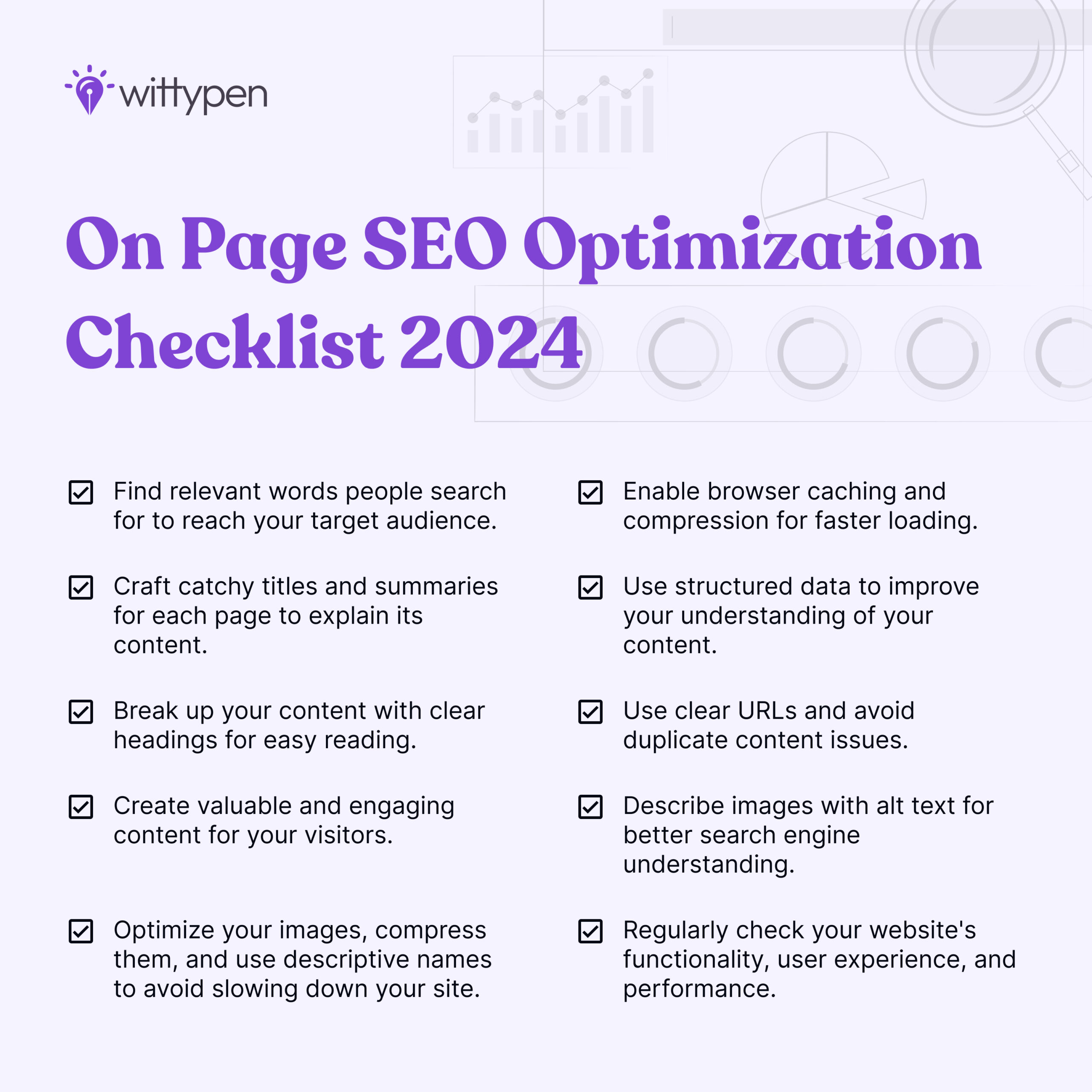
    In this post, we’ll share the latest tips and tricks to help your website not just keep up but also stand out. Here is a complete on-page SEO checklist:

    On Page SEO Optimization Checklist 2024

    What Is On-Page SEO?

    On-page SEO (also known as on-site SEO) refers to the practice of optimizing various elements of your website. This helps to improve its search engine ranking and user experience. It involves tweaking different parts of your webpage to boost its chances of ranking higher in search results. 

    To master on-page SEO, you’ll need to focus on optimizing key elements. This includes fine-tuning your content with relevant keywords, improving your site’s speed, and ensuring it’s visually appealing on mobile devices.

    In essence, the idea is to make your website as user-friendly and search engine-friendly as possible.

    What Does On-Page SEO Include?

    When it comes to on-page SEO, there are crucial factors to consider.

    1. At the forefront is content SEO on-page optimization, which emphasizes the creation of top-notch content that resonates with your audience and incorporates relevant keywords.
    2. Next up is optimizing your HTML tags, like your title tags and meta descriptions, to make them more informative and enticing. It’s equally important to pay attention to your site’s structure to ensure seamless navigation for both users and search engines.
    3. In addition, on-page SEO success hinges on factors like page speed, mobile responsiveness, and internal linking. Each of these elements plays a significant role in optimizing your on-page SEO effectively.

    On-Page SEO Vs. Off-Page SEO 

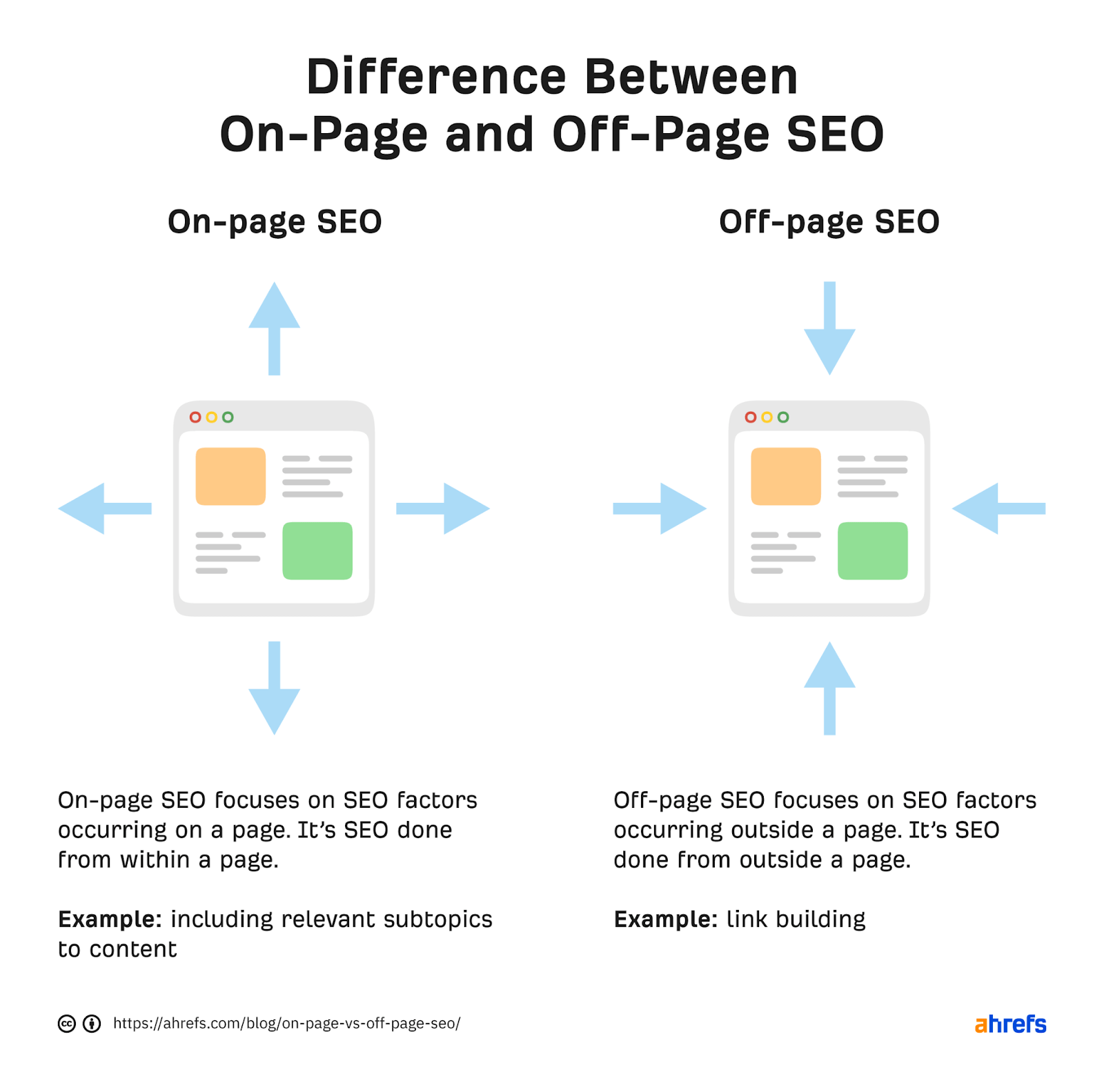
    On-page SEO and off-page SEO are like two sides of the same coin, each playing a crucial role in improving your website’s visibility and authority. 

    On-page SEO focuses on optimizing on-page SEO factors directly on your website, like content and HTML tags. Off-page SEO looks at external SEO on-page factors, like backlinks and social signals. Both are important for achieving higher rankings in search results, but they require different strategies and tactics. 

    With on-page SEO, you might focus on creating high-quality content incorporating relevant keywords and optimizing your site’s structure for better navigation. 

    Source

    On the other hand, off-page SEO might involve reaching out to other websites and influencers in your industry to build backlinks to your site and increase your online presence. 

    Ultimately, combining on-page and off-page SEO is vital to achieving long-term success in improving your website’s search engine visibility and driving more organic traffic.

    Below is a table highlighting the key distinctions:

    AspectOn-Page SEOOff-Page SEO
    Factors Controlled

    Within the Website

    External to the Website

    Examples

    Content Quality, Title Tags, Header Tags, URLs, Internal Linking, Page Speed, Mobile Responsiveness

    Link Building, Social Signals, Brand Mentions, Local SEO Events, Guest Posting

    Impact on RankingsDirectIndirect
    Tools UsedGoogle Search Console, Google Analytics, Yoast SEO Plugin, WittyPen

    MozBar, Majestic SEO, Ahrefs, BuzzSumo, HARO

    Main Objective

    Improve Relevance & User Experience

    Build Authority & Relationships

    By understanding the differences between on-page SEO and off-page SEO, you can develop a comprehensive SEO strategy that leverages both to improve your website’s visibility and ranking on SERPs.

    Where to Start the On-Page SEO Activity? 

    Beginning your on-page SEO journey requires setting a solid foundation for your website’s success. Before diving into more advanced techniques, take the initial step by utilizing the following tools.

    Below are some resources to help assess your website’s current status and identify specific areas that require improvement:

    Wittypen Free SEO Checker

    Take advantage of our free tool designed to provide personalized suggestions tailored to improving your website’s on-page SEO. It offers insights and tips based on industry best practices, which makes it easier for you to optimize your site.

    You can input your blog or the published URL and the keyword that you want the page to be optimized for. In one click, Wittypen’s On-Page SEO Checker will analyze the content and give you results on what is working for your page, what can be improved, and what areas are critical to fix for a better ranking.

    Google Search Console

    Google Search Console is your go-to for monitoring your website’s performance, checking its index status, and identifying any crawl errors that might be hindering your SEO efforts.

    Google Analytics

    Google Analytics lets you understand your visitors’ behavior, track conversion rates, and assess the effectiveness of your SEO campaigns. This valuable data will guide you in making informed decisions to enhance your website’s performance.

    How to Master the On-Page SEO Strategy? 11 On-Page SEO Techniques 

    Implementing effective techniques enhances your website’s search engine rankings, user experience, and overall online presence.

    Here’s a concise list of on-page SEO optimization techniques you can follow in 2024:

    1. Page Speed Optimization
    2. Mobile Optimization
    3. Schema Markup and Structured Data
    4. URL Structure and Canonicalization
    5. Keyword Research and Optimization
    6. Creating High-Quality Content
    7. Title Tags and Meta Descriptions
    8. Heading Tags and On-Page Formatting
    9. Optimizing User Interface and Navigation 
    10. Call-to-Action Optimization
    11. Engaging Multimedia Content 

    Let’s explore each technique in more detail:

    1.  Page Speed Optimization

    Page speed optimization is a vital on-page SEO technique to enhance your website’s loading times for an improved user experience and search engine rankings. Slow loading speeds can deter visitors, leading to higher bounce rates and decreased visibility in search results. 

    1. Make sure to reduce file size by compressing photos and videos without sacrificing quality. Smaller files download more quickly, keeping visitors interested and lowering bounce rates.
    2. You can also remove characters and whitespace from your code to make it lighter and faster to load. A cleaner, more concise code means less data for the browser to process, which results in faster page loads.
    3. Focus on enabling caching to keep frequently visited data locally. It helps with faster subsequent visits. Keeping items like photos and scripts on the user’s device eliminates the need to download them repeatedly.
    4. Defer the loading of non-essential resources until they are required, prioritizing crucial content. This prioritizes the components that visitors see first. It results in a speedier initial page load and a more seamless surfing experience.
    5. Use a CDN to spread content across numerous servers, lowering latency and improving loading times. 

    Implementing these strategies can significantly enhance your website’s page speed, leading to better user engagement and higher search engine rankings.

    2.  Mobile Optimization

    Mobile optimization is another crucial on-page SEO optimization tactic focused on tailoring your website’s design and content for optimal performance on mobile devices.

    Phone shopping reigns supreme, with over 70% of online purchases made using smartphones. Given the rising trend of mobile browsing, ensuring your site is mobile-friendly is essential for delivering a seamless user experience. 

    To optimize your website for mobile devices,

    1. Adapt to different screen sizes with ease to meet the needs of a wide range of mobile devices. This helps to provide a user experience that is free from annoyance.
    2. Focus on adding big, readable fonts make reading easier on smaller mobile screens. Doing so reduces eye strain and encouraging the consumption of content.
    3. Make sure to compress your images and videos, as it helps with the loading time of the page.
    4. Mobile devices incorporate a streamline navigation system. Users can find information quickly, which will require fewer clicks.
    5. Optimizing your website for mobile devices improves the user experience, reduces bounce rates, and enhances search engine visibility.

    3.  Schema Markup and Structured Data

    Schema markup and structured data are essential on-page SEO techniques designed to provide search engines with additional context about your website’s content.

    Incorporating schema markup and structured data can enrich search result snippets and boost click-through rates (CTRs). 

    Here’s how to implement them effectively:

    1. Enhance content details like ratings, reviews, and pricing with schema markup to provide search engines with valuable information.
    2. Implement structured data to make sure it offers search engines deeper insights into your website’s content and organization.
    3. Use Google’s Structured Data Markup Helper to generate structured data code for your site and test it with the Structured Data Testing Tool to ensure proper implementation.

    Integrating schema markup and structured data can elevate your website’s search engine visibility and encourage higher user engagement.

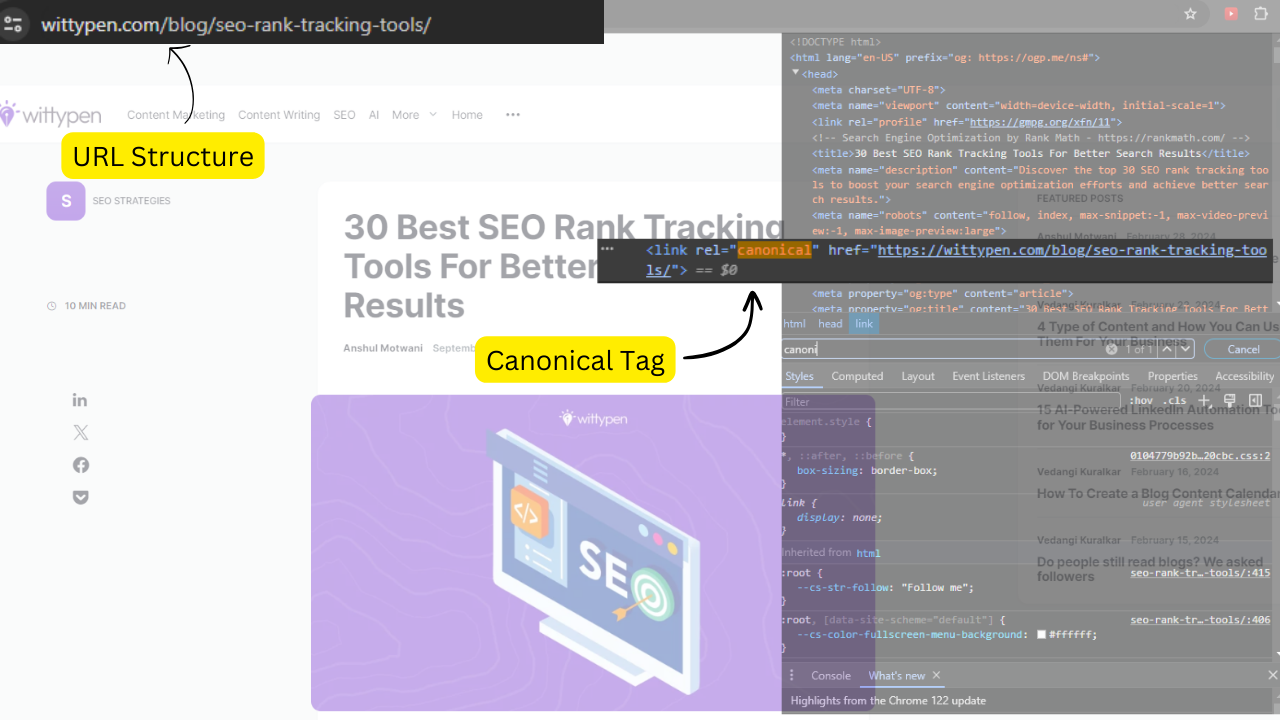
    4.  URL Structure and Canonicalization

    URL structure and canonicalization are vital for on-page SEO, influencing how search engines interpret and index your website’s content.

    A well-organized URL structure aids navigation for users and search engines alike, while canonicalization helps designate the preferred version of a webpage with similar or duplicate content. 

    Here are some strategies you can follow:

    1. Make sure to create user-friendly URLs containing relevant keywords. Clearly communicate page content to users and search engines.
    2. Always use hyphens to separate words. Improve the readability and understanding of your URL structure.
    3. It is best to avoid special characters, numbers, and excessive parameters. Maintain URLs that are clean and easy to remember.
    4. Always focus on implementing canonical tags. Specify the preferred version of a webpage to avoid confusion and improve SEO.
    5. Audit your website for duplicate content on a regular basis and implement redirects as needed. Maintain a clean and efficient website structure for the best search engine performance.

    Refining URL structure and canonicalization enhances crawl ability, indexation, and overall SEO performance.

    5.  Keyword Research and Optimization

    Keyword research and SEO on-page optimization are fundamental to on-page SEO, involving the strategic integration of relevant keywords into your website’s content to boost search engine visibility.

    Here’s what you can follow to excel at it:

    1. Keyword research is the first step in the process. This involves identifying relevant keywords and inserting them smartly into your blog. These keywords can be classified as small-tail and long-tail keywords. Utilize tools like Google Keyword Planner, SEMrush, or Ahrefs to identify pertinent keywords.
    2. Target specific, long-tail keywords with lower competition and high relevance to your audience. The majority of Google searches are long-tail keywords, which are more specific and detailed search terms.
    3. Incorporate primary keywords into titles, headings, meta descriptions, and content.
    4. Steer clear of keyword stuffing, prioritizing engaging, value-driven content.
    5. Track keyword performance using analytics to gauge rankings, traffic, and conversions.

    Through meticulous keyword research and on-page SEO optimization, you can effectively elevate your site’s visibility and attract organic traffic.

    Keyword OptimizationLet’s take a closer look at this specific example. We optimized a blog post for the keyword “30 best SEO rank tracking tools.”

    By strategically integrating this keyword throughout the content, from the title and headings to the body itself, we could signal the blog post’s precise topic and target audience to search engines.

    This strategic approach, coupled with other SEO best practices, has yielded impressive results.
    This example showcases the effectiveness of keyword optimization in driving organic traffic and achieving top search engine rankings.

    6.  Creating High-Quality Content

    Now, let’s explore what on-page SEO is in relation to content creation. High-quality content is pivotal to successful on-page SEO strategies, enticing visitors, fostering engagement, and establishing authority in your niche. To create compelling content:

    1. Focus on conducting thorough research to ensure your content offers valuable insights and information.
    2. Make sure to craft a captivating headline that grabs attention and encourages clicks.
    3. To enhance readability, always organize your content with clear headings, subheadings, bullet points, and visuals.
    4. Zero in on naturally integrating relevant keywords to increase search engine discoverability.
    5. Key in on regularly updating your content to maintain its relevance and accuracy.

    Consistently producing high-quality content aligned with user needs and search intent strengthens credibility, drives organic traffic, and enhances overall search engine performance.

    Google prioritizes three key factors when determining search rankings: high-quality content, a positive user experience on the page, and quality backlinks from other websites.

    7.  Title Tags and Meta Descriptions

    Title tags and meta descriptions play vital roles in on-page SEO, offering summaries of your web page’s content to search engines and users. To optimize:

    1. Craft descriptive and compelling titles that accurately depict your page’s content.
    2. Keep titles under 60 characters for full display in search results.
    3. Write meta descriptions that provide concise summaries of the page’s content, including relevant keywords.
    4. Limit meta descriptions to 155 characters for complete visibility.
    5. Avoid duplicating title tags and meta descriptions across multiple pages.

    By optimizing these elements, you can enhance your website’s click-through rates and search engine visibility.

    Try out our free tool to generate engaging meta titles and meta descriptions for your content.

    8.  Heading Tags and On-Page Formatting

    Heading tags and on-page formatting are crucial for on-page optimization, organizing content, and enhancing readability. To optimize:

    1. Use H1 tags for the main title and H2-H6 tags for subheadings, incorporating keywords naturally.
    2. Employ bullet points, numbered lists, and other formatting elements to break up content and enhance readability.
    3. Integrate relevant keywords into headings and subheadings.
    4. Utilize images and videos to enrich user engagement and provide visual interest.
    5. Ensure the content is well organized and easy to navigate.

    Optimizing heading tags and on-page formatting improves the user experience, engagement, and search engine visibility.

    9.  Optimizing User Interface and Navigation 

    Optimizing the user interface and navigation is a critical on-page SEO technique involving designing a clean, intuitive interface and navigation system. This enhances visitors’ ability to locate desired information, reducing bounce rates, improving engagement, and enhancing search engine visibility. To optimize:

    1. Utilize a clean, modern design aligned with your brand and audience preferences.
    2. Ensure easy navigation, allowing visitors to find information quickly.
    3. Provide clear and descriptive labels for navigation links and buttons.
    4. Implement breadcrumbs for clear navigation paths back to previous pages.
    5. Utilize internal linking to connect related content and improve navigation flow.

    By optimizing the user interface and navigation, you can elevate the user experience, reduce bounce rates, and improve search engine visibility.

    10.  Call-to-Action Optimization

    Regarding getting people to take action on your website, call-to-actions (CTAs) are like friendly nudges in the right direction. Here’s how to make them work better:

    1. Center your focus on putting your CTAs where people can see them immediately, ideally at the top of your page.
    2. Always keep your CTAs simple. Tell users exactly what action you want them to take, whether signing up or buying.
    3. Work on using eye-catching colors or bold text to ensure your CTAs are visually appealing.
    4. Consider tailoring your CTAs to different visitor types based on their behavior or preferences.
    5. Evaluate and experiment with different versions of your CTAs to see what works best and optimize for improved results.

    By sprucing up your CTAs, you can boost user engagement, increase conversions, and make your website shine.

    11.  Engaging Multimedia Content 

    Adding fun stuff like pictures, videos, and podcasts to your website can make it a lot more enjoyable for visitors. Here’s how to do it right:

    1. Make sure to use high-quality images and videos relevant to your content and visually appealing to your audience.
    2. Ensure your images and videos load quickly to avoid frustrating your readers with slow loading times.
    3. Direct your efforts towards creating informative and visually appealing infographics to break down complex information clearly and concisely.
    4. Concentrate on sharing interesting and informative podcasts related to your audience’s interests.
    5. Share your content on social media platforms to reach a wider audience and increase engagement.

    Adding fun stuff to your website can make it more fun to visit, keep people interested, and bring in more visitors.

    Top Metrics to Measure Your Efforts

    To see if your on-page SEO optimization efforts are paying off, you need to keep an eye on some important numbers.

    Here are the key metrics you can follow to track your progress and determine the success of your on-page SEO optimization efforts:

    1. Check how much traffic is coming to your site from search engines. More traffic usually means your SEO is working.
    2. See how many people leave your site after only looking at one page. A high bounce rate could mean your content isn’t grabbing their attention.
    3. Find out how long visitors stick around on your site. Longer dwell times suggest they’re finding what they need and liking what they see.
    4. See how many pages people view in one visit. The more pages they visit, the more engaged they are with your content.
    5. Measure how many visitors take the action you want them to, like signing up or buying something. A higher conversion rate means your site is convincing people to do what you want.
    6. Check how many people click on your site when they see it in search results. A higher CTR means your site’s title and description are appealing to users.
    7. Keep an eye on where your site shows up in search results for important keywords. Climbing up in rankings means your SEO efforts are paying off.

    On-Page SEO Checklist to Follow

    To make sure your website is in tip-top shape for search engines, go through this checklist:

    1. Find relevant words people search for to reach your target audience.
    2. Craft catchy titles and summaries for each page to explain its content.
    3. Break up your content with clear headings for easy reading.
    4. Create valuable and engaging content for your visitors.
    5. Optimize your images, compress them, and use descriptive names to avoid slowing down your site.
    6. Enable browser caching and compression for faster loading.
    7. Use structured data to improve your understanding of your content.
    8. Use clear URLs and avoid duplicate content issues.
    9. Describe images with alt text for better search engine understanding.
    10. Regularly check your website’s functionality, user experience, and performance. 

    Following this checklist will help ensure your on-page optimization is top-notch and ready to boost your site’s visibility in search results.

    Summing Up 

    Mastering on-page SEO gives your website the full package: better visibility, happier visitors, and a steady stream of organic traffic.

    Think of it as fine-tuning your website for search engines and users alike – faster loading, mobile-friendly, engaging content, and an overall smooth experience. To keep the momentum going, keep an eye on key metrics and tweak your strategy based on the data.

    Excited to boost your website’s on-page SEO?

    Try Wittypen’s On-Page SEO Checker today for SEO content solutions that work wonders!

  • Top places to hire freelance content writers

    Top places to hire freelance content writers

    When it comes to generating engaging and high-converting content, not all businesses have the resources or expertise in-house. As a result, many companies opt to outsource their content needs by hiring freelance content writers.

    With over 47% of jobs now remote, there’s a huge pool of freelance talent available to create content that gets results. However, understanding how to hire a content writer and what to look for can be daunting.

    In this post, we’ll explore the top 8 platforms where you can hire freelance content writers in 2024. These platforms provide access to a diverse pool of talented writers who can help enhance your online presence and elevate your content marketing strategy.

    Let’s explore!

    Top Freelance Platforms to Hire Content Writers

    Compelling content is king. But for businesses strapped for time or resources, building an in-house content creation team isn’t always feasible. That’s where freelance content writers come in.

    These skilled professionals can craft engaging articles, blog posts, website copy, and more, all on a project-by-project basis. But with so many freelance writers out there, how do you find the perfect fit for your needs? Look no further! Here’s a curated list of the top freelance websites to hire content writers online:

    1. Wittypen

    Wittypen-hire-a-writer


    Wittypen is one of India’s leading content platforms that has outsourced content to big names like Cred, Swiggy, Freshworks, and Nifty to name a few.

    With their diverse team of proficient writers, they have a wide range of quality content, including website content, blog posts, SEO landing pages, press releases, white papers, and product descriptions.

    With its straightforward pricing model divided into three affordable tiers, the platform can streamline content for companies of various sizes to meet their specific content needs. With their knowledge base and advanced AI-powered tools, content gets done quicker and more efficiently.

    The platform prioritizes transparency and has samples that allow businesses to look at the kind of expertise that the company can offer them.

    With their easy-to-use website, businesses can hire content writers smoothly and get their first content in two minutes in three easy steps.

    2. Upwork

    upwork-hire-content-writers

    Upwork is one of the best platforms to hire a writer if you want expert content creation. The platform has writers from across the globe with detailed job listings that will tell you about their previous experience so that you can collaborate with an experienced writer who specializes in your desired niche.

    At Upwork, your company can invite up to 30 freelancers with flexible turnaround times. When you start working with a writer or agency, you pay a $9.95 one-time contract initiation fee to ensure payment safety.

    3. Fiverr

    fiverr-hire-a-writer

    Fiverr is the right place to find content writers if your business has specific content needs. Instead of scouring through job postings of writers, Fiverr provides a search bar for companies looking for writers writing in specific niches.

    Companies can also opt for Fiverr to hire content writers online at the last minute. With their efficient search options, you will only see writers in your niche and make firm decisions in less time.

    With a 5.5% fee on the purchase amount, Fiverr is one of the most budget-friendly content writing platforms.

    4. Freelancer.com

    freelancer-content-writer

    Freelancer is an online platform for freelancers in various industries. As the hiring business, you will see several job postings by writers who deliver content at low prices, like $10 per hour. 

    With low pricing and a turnaround time of 6-7 days, Freelancer is a great place to hire content writers for your next big project.

    Freelance offers various writing services like translation, article writing, and product descriptions.

    5. Contently

    contently-writers

    Contently is the right place for businesses looking for premium quality content that increases viewership in less time. The platform allows you to hire content writers who can take care of content creation from scratch.

    Contently has efficient software that allows businesses to manage their content in one place for a seamless marketing experience.

    However, the website does not disclose their pricing models, making it difficult for companies to reach a firm decision.

    6. Craigslist

    craiglist-content-writers

    Craigslist serves as a valuable starting point for businesses seeking content writers, provided they allocate time for thorough research. The website allows businesses to search for writers based on location, which can help you get localized content.

    The one thing users must remember is that they need to read through the information on writers carefully before they hire them on this website to ensure safety.

    While job postings on Craigslist are genuine, the website does not allow an extra safety net like Upwork, Wittypen, or Fiverr.

    7. Guru

    guru-writers

    Guru stands out as the most budget-friendly option among the platforms listed, making it an ideal choice for hiring freelance content writers seeking economical solutions.

    Offering unparalleled affordability, posting a job comes at no cost, with only a nominal 2.9% handling fee applied to each invoice settled.

    With an extensive user base comprising around 800,000 employers relying on its services for diverse content needs, Guru provides a vast pool of talented content writers.

    While the platform offers project-tracking functionalities, maintaining accountability with hired writers can prove challenging for businesses.

    8. LinkedIn

    linkedin-hire-a-writer

    LinkedIn is a versatile platform for finding the perfect candidate for your company according to the deadlines of your business. If you want to hire a writer, make a detailed job description to allow candidates to apply.

    The platform has an “Easy Apply” option to allow candidates to apply with as little information as their contact details and resume, making the selection process faster.

    The turnaround time for assignments will depend on the requirements of the business, making it a user-friendly platform.

    Make sure you utilize LinkedIn’s search filters effectively to narrow down your candidate pool based on criteria such as experience, location, skills, and education. This can streamline your search and help you find candidates who are the best fit for your job opening.

    Key Points to Consider When Hiring Freelance Content Writers

    Follow the key points mentioned below to hire content writers that align with your project requirements and expectations:

    1.  Niche Specialization

    Companies must hire writers who specialize in their niche to create engaging content. Thoroughly reviewing their portfolios and resumes can help you make an informed decision.

    2.  Turnaround Time

    It is crucial to find a freelancer who can meet a company’s specific deadlines to ensure the timely rollout of content. This will speed up work, and the company’s reach can increase exponentially.

    3.  Revision Process

    The content revision process can be time-consuming. Clear discussions on the time allotted for revision and the number of revision rounds allowed for clearer confusion and 

    4.  Billing Cycles

    Billing cycles vary between companies, with some following a monthly cycle and others a 45-day cycle. Clear communication is crucial to avoid confusion and stress.

    Among the numerous writing platforms online, Wittypen is one of the best platforms to find content writers. With their effective problem-solving in tandem with feedback and reviews from partnering businesses, they have established themselves as a reliable content-creating partner.

    Final Words

    If your business is struggling to meet deadlines or produce high-quality content, working with a freelance content writing company could be the answer.

    With plenty of experienced writers available online, it’s easier than ever to find a good fit for your company’s content requirements. All you have to do is browse through platforms like Wittypen, where you can access a pool of talented writers who specialize in various industries and niches.

    By leveraging their expertise and flexibility, you can ensure timely delivery of top-notch content that resonates with your audience.

    Remember, effective communication is key to successful collaboration. Clearly outline your project expectations, deadlines, and revision processes to ensure a smooth workflow and satisfactory results.

  • Copywriting vs. Content Writing: What is The Difference? And Whom To Hire?

    Copywriting vs. Content Writing: What is The Difference? And Whom To Hire?

    Both copywriting and content writing serve marketing and content creation purposes in the digital space.

    Generally, both terms are used interchangeably. When it comes to enhancing your online presence through effective content, the decision to hire an efficient, professional, and experienced writer becomes crucial.

    However, the confusion lies in whether to hire a copywriter or a content writer; for many, both terms mean the same thing!

    Let’s set the record straight right away—content writing and copywriting are not synonymous!

    Copywriting uses a persuasive style for ads and emails, aiming to engage and prompt actions. On the other hand, content writing focuses on creating informative and engaging material to educate, entertain, or inspire, fostering collaborations and brand loyalty.

    Read on as we take you through the major differences between these two to help you make informed decisions when choosing between a copywriter and a content writer for your digital needs.

    The Words That Sell: Exploring Copywriting and Content Writing

    Let’s look at the popularity of both professions in the modern digital world.

    The global market for copywriting services is poised for significant growth, with a projected CAGR of 7.6%, enhancing the market from $25.29 billion in 2023 to an estimated $42.22 billion by 2030.

    Concurrently, the content marketing industry is expected to witness substantial revenue growth, surpassing $135 billion by 2026.

    Source

    Here is an analogy to clarify copywriting vs content writing that will help you understand the difference in the content created by both experts:

    Take Nike’s slogan, “Just Do It,” as the epitome of copywriting—energizing consumers to take decisive action, showcasing the persuasive prowess inherent in this form of writing.

    On the flip side, consider a captivating Instagram caption paired with a product photo as a prime example of the engaging and informative content that content writing delivers. It sparks interest, invites interaction, and goes beyond mere persuasion to boost genuine engagement.

    Copywriting: Your Persuasion Powerhouse

    Copywriting is the skill of using words to communicate convincingly and prompt action. It’s the secret weapon behind impactful advertisements, engaging emails, and persuasive product descriptions. 

    With copywriting, you can influence and guide your audience’s decisions by creating messages that resonate and inspire. 

    Proficiencies in Copywriting Expertise

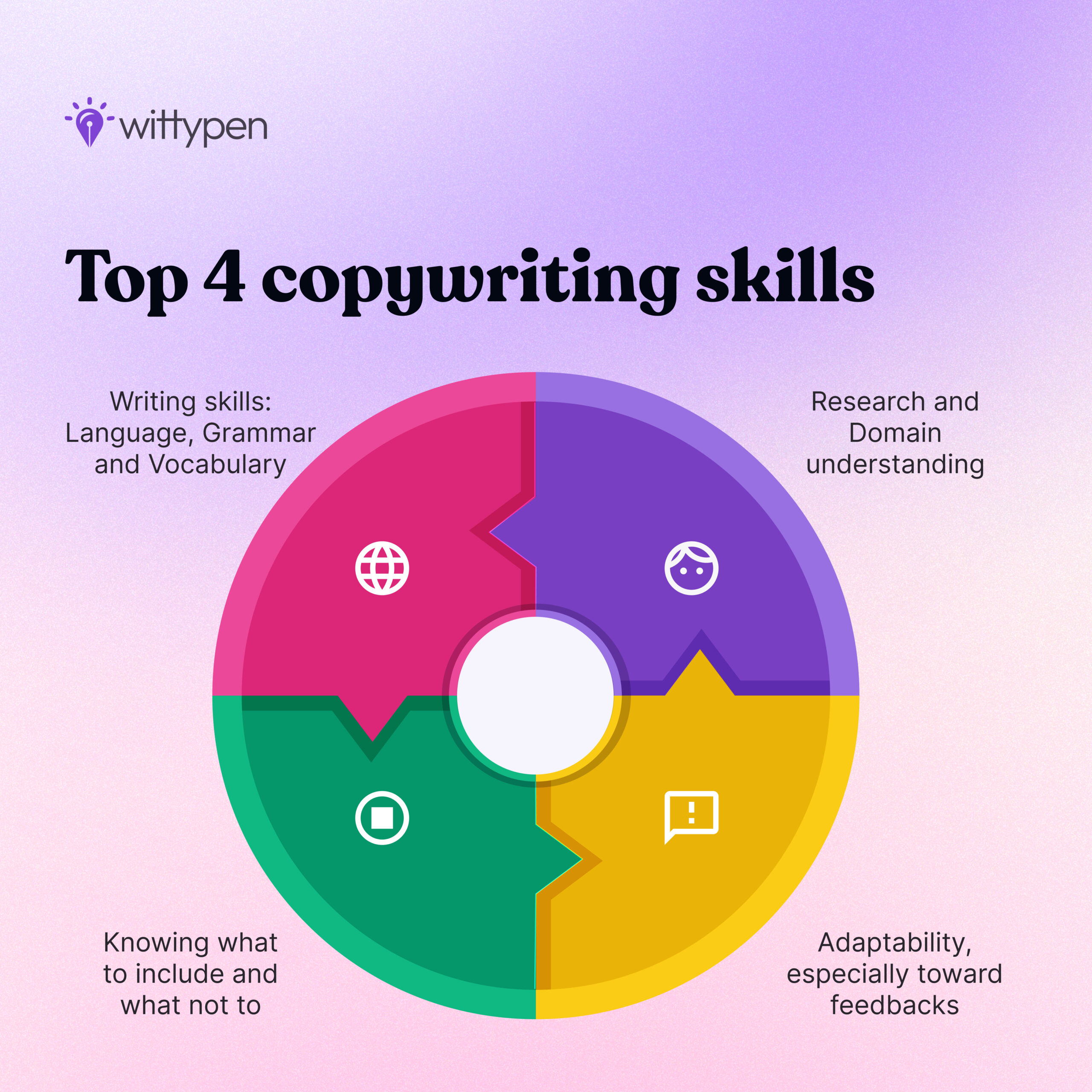
    Top 4 Copywriting Skills

    source

    Here are some significant characteristics of a Copywriter:

    • Persuasive Tone: Copywriting employs language to influence the reader to take a specific action, utilizing techniques like storytelling and compelling arguments.

    For example, Google Ad for a Fitness Brand: Get Fit Fast! Join Our Online Fitness Program Today.

    • Targeted Call to Action: Effective copywriting includes clear and compelling calls to action. These are placed strategically throughout the content.

    For example, “Buy Now” or “Download Now” are examples of calls to action

    • Emotional Triggers: Copywriting considers the reader’s emotions. It uses storytelling and multimedia elements to create a strong emotional connection with the audience.

    For example, let us look at how brilliantly the GHD brand has used storytelling, employing the art of emotionally connecting with people and empowering them:

    source

    A Few MythBusters to Explore 

    Myth 1 – We Can Indulge in DIY Copywriting

    The Truth – While business owners may understand their products or services best, conveying this effectively through copy requires specialized skills and an understanding of audience psychology.

    Myth  2- AI Copywriting is Better

    The Truth – While AI tools can aid in generating initial drafts, they lack human emotion which is essential for compelling copywriting.

    Myth  3- Embracing Complexity in Copy is Key

    The Truth – Clear, concise language is more effective in copywriting, which enhances audience understanding and engagement.

    Myth  4- Personalized Approach Can be Ignored

    The Truth – Effective copywriting requires content creation for specific audiences, contexts, and objectives, emphasizing the importance of personalized messaging for desired outcomes.

    Content Writing: Your Information Hub 

    Content writing is the art of crafting engaging and informative material for digital platforms designed to captivate audiences, add value, and achieve goals.

    This includes writing:

    • Engaging and long-form blog posts
    • Informative articles
    • Thoughtful website content
    • Impactful social media posts
    • Insightful email newsletters

    Role of Content Writing in Building Brand Awareness, Trust,  and SEO

    Effective content writing can turn readers into leads and leads into customers, making the consistent creation of engaging content crucial for business success.

    Here’s how:

    • Content writing enhances brand awareness through the uniform communication of brand values across various channels, reinforcing brand identity.
    • It creates emotional connections with the audience and highlights brand knowledge and thought leadership through insightful content.
    • Content writers personalize content to address audience needs and challenges, strengthening connections and optimizing content for search engines.
    • Develops a loyal audience by consistently offering valuable content that educates or entertains.

    Proficiencies in Content Writing Expertise

    Write contents for you by Faisalsial472 | Fiverr

    Source

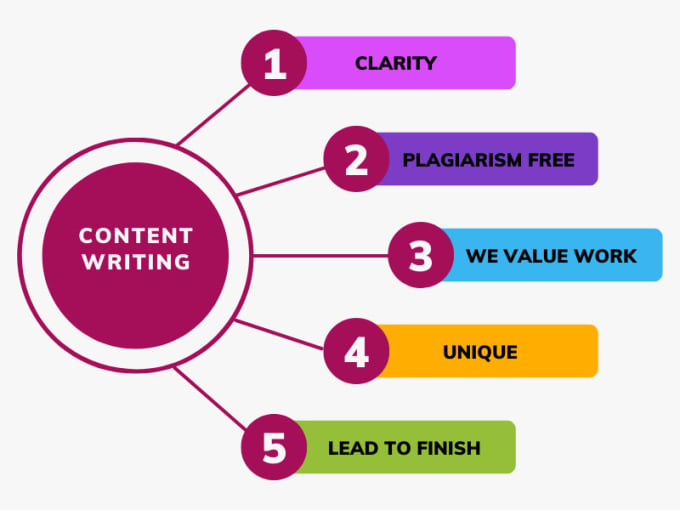
    Here’s what a typical list of proficiencies in content writing expertise might look like:

    Versatility

    Content writers adapt their writing style to suit diverse project requirements. They enhance their value by delivering versatile and impactful content. Thorough research is conducted for effective content writing that guarantees credibility and resonance with readers. 

    Thorough Understanding of SEO

    A profound understanding of SEO principles is essential for content writers to create content effectively and drive visibility and engagement.

    Follow Industry Trends

    Content writing resonates with brand values and enhances content relevance and impact. Staying updated on industry trends and digital dynamics empowers content writers to remain relevant and deliver compelling content.

    The Great Divide: Exploring the Key Differences

    Let us start by referring to an example.

    Notion, a SaaS, helps centralize your team’s workflow and processes in one platform, which is pivotal for increasing transparency. The brand has effectively used copywriting and content writing in various forms and is gaining benefits from it from all ends -higher ROI, customer attention, conversions, and a better brand reach.

    The brand has diligently used copywriting for CTA, website pages, and social media platforms. An example is:

    source

    Notion has also brilliantly used content writing for its various blogs that have led to an optimized SEO and high rankings for the brand:

    source

    The table below simplifies the distinctions between these two types of writing:

    Points of DifferenceCopywritingContent Writing
    Call to Action (CTA)Copywriting includes clear and compelling calls to action
    (CTAs) that prompt the audience to take immediate action.
    Examples are “Buy Now,” “Sign Up Today,” or “Learn More.”
    Content writing may include CTAs,
    but they are usually less direct.
    They focus on encouraging further engagement.
    Target Audience– Decision-Makers
    – Prospects in Sales
    – Targeted Demographics
    – Potential Customers
    – Audience with Immediate Needs
    – Information Seekers
    – General Audience
    – Educational Seekers
    – Industry Professionals
    – Existing Customers
    Tone of WritingA professional and compelling tone.The tone is primarily conversational or informative.
    Writer Skills– Persuasive writing
    – Understanding target audience
    – Headline creation
    – Adaptability
    – Strategic thinking
    – Research skills
    – Organizational abilities
    – Search Engine Optimization knowledge
    – Aptitude for storytelling
    – Editing and grammar proficiency

    Hire Right: Finding Your Writing Dream Team

    Confused about whether to engage a copywriter or a content writer? Consider the following:

    When to Hire a Copywriter?

    • A copywriter can craft effective content to highlight the unique selling points that can help you introduce a new product or service.
    • If you want attention-grabbing ad content that drives clicks and conversions, hire a copywriter.
    • If your website or landing pages are experiencing low conversion rates, a copywriter can help you enhance conversion rates.

    When to Hire a Content Writer?

    • Hire a content writer who can research and create high-quality blog posts, short or long-form articles, and guides.
    • To enhance your website’s search engine visibility, hire a content writer who can develop SEO-optimized content.
    • If you are having trouble maintaining active and engaging social media profiles, choose a content writer.
    • A writer can produce diverse content formats and cater to different audience preferences.

    Interview Questions that You Can Ask Before Hiring Content Experts

    Wittypen's Best Content Marketing for Business : How it Works

    Source

    Consider these interview questions when hiring an SEO copywriter or content writer:

    • Can you provide examples of your past content writing experience?
    • Have you collaborated with brands similar to ours previously?
    • How proficient are you in grammar?
    • Do you offer services such as keyword research or content strategy?
    • Which tools do you utilize for keyword research?
    • How do you determine the effectiveness of a keyword for a website?
    • Do you use SEO or content optimization tools?

    Red Flags to Watch Out for When Hiring

    1. Lack of Portfolio: A concerning sign is when a copywriter doesn’t have a steady profile, as it’s used to showcase their previous work, client testimonials, and service offerings.
    2. Failure to Research: Similar to interviewing a potential employee, meeting with a copywriter involves assessing their ability to understand your business needs and marketing goals.
    3. Pressure for Long-Term Contracts: Be cautious if a content expert insists on signing a long-term contract immediately. Instead, reputable professionals often suggest starting with a short-term agreement or even a trial project.
    4. Lack of Professionalism: Effective communication is vital in remote collaborations. A Reliable expert responds promptly to inquiries, meets deadlines, and conducts themselves with professionalism in all interactions.

    Wittypen’s Writer Vetting Process and Unique Strengths

    Wittypen's Best Content Marketing for Business : How it Works

    Source

    In this age, good content is key for brands online. This is the reason implementing a thorough vetting process for selecting writers becomes essential. 

    Here’s how Wittypen goes about it:

    1. Rigorous Screening Procedure 
    2. Emphasis on Brand Consistency 
    3. Collaboration and Feedback Focus
    4. Customer-Centric Approach 
    5. Innovation and Creativity 
    6. Data-Driven Insights 
    SEO Writing Best Practices With Examples for 10x Growth

    Source

    Wittypen stands out in choosing writers who match the brand, work well together, and create excellent content.

    By investing in skilled writers who not only mirror their brand values but also have the expertise to produce outstanding content, Wittypen makes sure their clients reach their digital goals and establish a powerful online presence.

  • Celebrating Our Woman Warrior: Vinita’s Remarkable 5-Year Journey with Wittypen!

    Celebrating Our Woman Warrior: Vinita’s Remarkable 5-Year Journey with Wittypen!

    At Wittypen, women have always been at the heart of our success. As International Women’s Day inches closer, we’re delighted to highlight one such woman who has shaped Wittypen into the vibrant community it is today. Join us in celebrating our woman warrior. Meet Vinita, our Lead of Operations, whose journey personifies the spirit of growth, strength, and teamwork that defines our company culture.

    Vinita’s journey with Wittypen over the past five years has been nothing short of extraordinary. From her earliest days as a Project Manager to her current role overseeing up to 1000+ writers and 80+ projects, she has been an integral part of every conversation and decision.

    Celebration of Vinita's work Anniversary
    Celebrating Vinita’s 5th Work Anniversary at Wittypen Office

    The Journey and Milestones

    Joining Wittypen in 2019, Vinita brought with her an infectious zeal and a drive to excel. As a Project Manager, she collaborated with clients, ensuring their project requirements were met seamlessly. Little did she know that within three years, she would be at the helm of a dynamic team, leading numerous projects with finesse.

    “It’s been an incredible journey,” Vinita reflects, her eyes gleaming with pride. “When I started, Wittypen was a small team led by Anshul and Preetesh. But what drew me in was the culture—supportive, collaborative, and focused on growth.”

    Carving Her Niche

    Vinita’s rapid rise reflects her commitment to personal and professional growth. Starting as a Project Manager, she steadily climbed the ranks, acquiring a deep understanding of the industry, nurturing strong client relationships along the way.

    Reflecting on her journey, Vinita acknowledges the pivotal role of her mentor, Anshul. “Anshul has been my pillar of support,” she affirms gratefully. “He empowers me to aim higher while providing steadfast guidance during challenges.”

    Recalling a challenging encounter with a writer, Vinita highlights the importance of her team’s support. “Addressing issues head-on can be tough, but with Anshul and my team behind me, I felt empowered to guide the situation with fineness and professionalism.”

    About Her Teammates

    At Wittypen, collaboration is the driving force behind everything we do. Vinita speaks fondly of her colleagues, noting the camaraderie that defines their interactions. “We wear many hats here,” she shares with a smile. “But through it all, Anshul and Preetesh ensure we maintain a healthy work-life balance.”

    Wittypen team celebrating Diwali

    Above and Beyond

    As Wittypen continues to innovate and grow, Vinita looks to the future with excitement. “There’s a tangible sense of innovation here,” she confesses. “We’re always encouraged to think outside the box, promoting both personal and professional development.”

    Vinita’s journey encapsulates the values of Wittypen—an organization that cherishes empowerment, collaboration, and continuous growth. As we celebrate her achievements, we’re reminded of the strength that lies in a supportive and inclusive work culture. Here’s to Vinita and the countless other women who inspire us every day.