Category: Content Marketing

  • On-Page SEO Checklist: Complete List to Scale Your SEO

    On-Page SEO Checklist: Complete List to Scale Your SEO

    If you want to boost your search engine rankings, increase organic traffic, and improve user experience, adopting a complete on-page SEO checklist is essential. This guide will help you gain an in-depth understanding of the on-page SEO checklist, enabling you to implement strategies that appeal to both search engines and users.

    By implementing these strategies, you will help search engines understand your website, its content, and the value it gives to your visitors and consumers. It will also help you identify whether your website content is relevant to the searcher’s query.

    Also, on-page optimization techniques like strategically placed keywords, meta-tags, optimized headers, and flawless mobile responsiveness will give search engines a roadmap of your content. In simple words, use an on-page SEO checklist and rank higher on Google.

    On-Page SEO Checklist
    What Does On-Page SEO Include?

    The main purpose of an on-page SEO checklist is to improve your site’s visibility and ranking. On-page SEO thus includes optimizing your content using on-page SEO techniques. 

    1. What Is On-Page SEO?

    On-page SEO is the fundamental part of everyday SEO. It is the process of optimizing your web pages and their content for the search engines as well as your users. The primary objective of on-page SEO is to rank pages higher on search engines like Google. This leads to more organic traffic and revenue being directed towards your site. 

    On-page SEO are the on-page factors that can make or break your SEO success. It is a name used to refer to a combination of content and technical SEO that focuses on optimizing individual pages. This is limited to not only content but also extends to titles, links, meta-tags, images, anchor text, images, and more. 

    To ensure success, you must implement on-page optimization techniques that make all these elements work together so that your content is optimized for search engine algorithms while also being valuable for your audience. The basis for good on-page SEO lies in showing Expertise, Authoritativeness, and Trustworthiness (or EAT).

    2. Key On-Page SEO Factors

    One of the most important things to remember is that on-page SEO depends on the actual content of the page. This means that everything within the site can affect the SEO. The key on-page SEO factors are:

    Content: The content of the article should be unique, fit the search intent, anticipate and answer the user’s next query, and include relevant keywords from the on-page SEO checklist.

    Title Tags: The title tag is your content’s name on Google which determines if people will click your content. Thus, make sure it answers their question, includes keywords, and grabs their attention with strategic words or numbers. 

    Headings: Headings show content structure to readers and search engines. There are six types, from H1 to H6, with H1 being the largest and most important. Ensure that you use keywords in your headings.
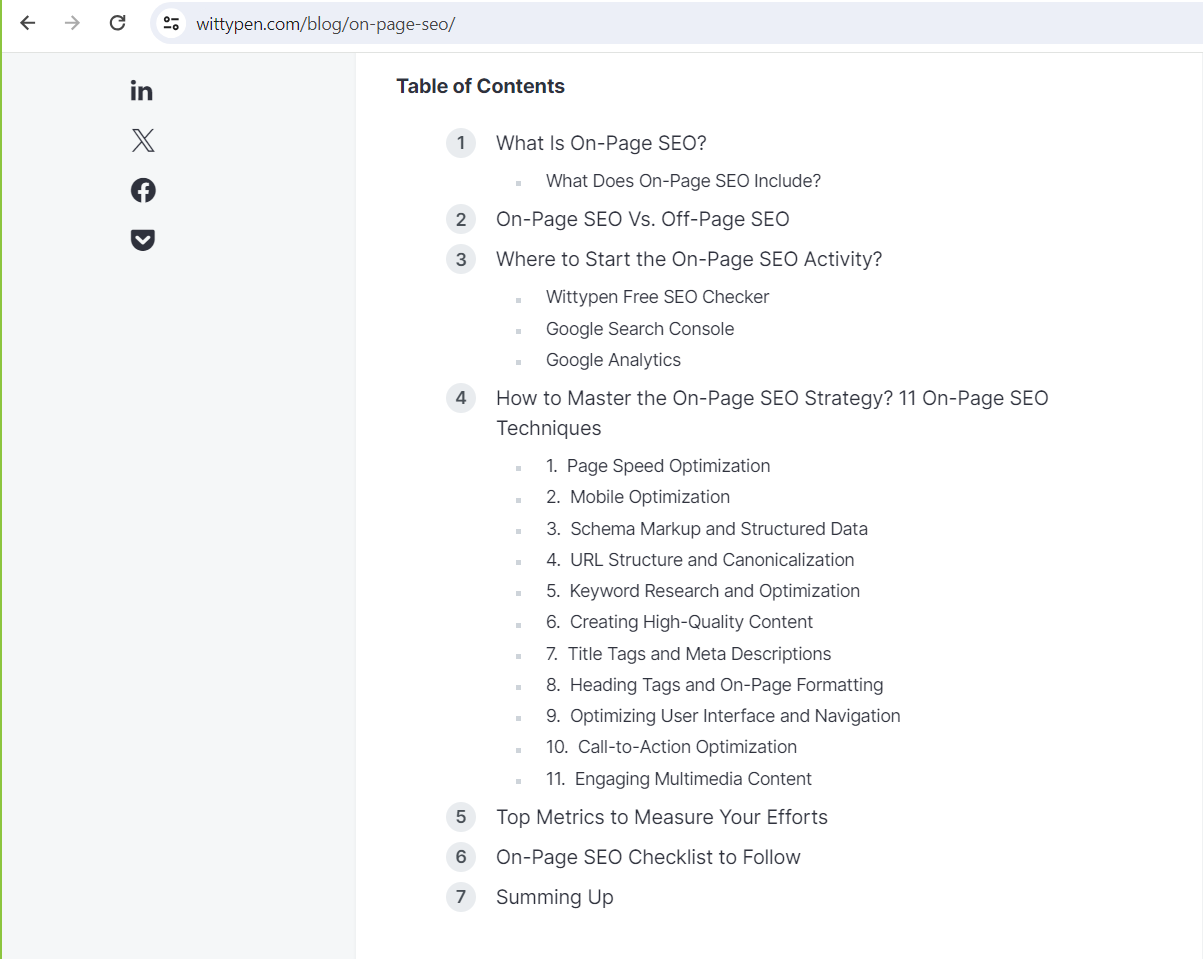
    URLs: To describe the page clearly, use keywords in URLs. Keep the URLs short and easy to understand by both search engines and visitors.
    Internal Linking: It refers to the addition of relevant links within your content, helping search engines and users navigate your site effectively. Aim for 2-3 internal links per article, or create pillar content if needed.
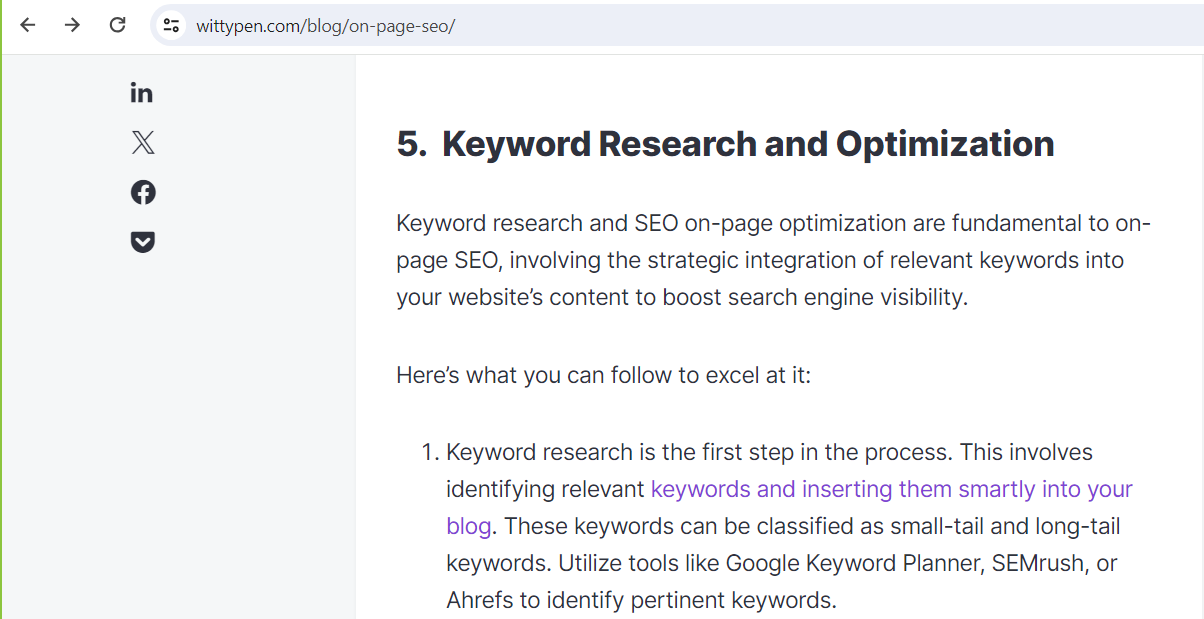
    Image Optimization: Enhance the appeal of your content by using images. Original images boost SEO, but if unavailable, use relevant images. The images must have alt texts for accessibility and descriptive texts to give context to search engines.

    Once you have mastered all these factors and fulfilled your on-page SEO checklist, you will be able to achieve optimal website visibility and search engine ranking. 

    Technical Optimization On-Page SEO Checklist

    Technical SEO has the power to make or break your rankings. However, the fortunate part here is that technical SEO problems are relatively easy to fix, especially when you follow the given on-page SEO checklist. 

    1. Focus on Title Tags and Meta Descriptions

    The title tag is your webpage’s title, as seen on the search engines. This means that whenever you search for something on Google and click on the article’s name, the page that opens up is the title page. You must make the title tags as relevant as possible because visitors will click on them only if the content is relevant to their search. 

    Here are the things to take care of in your title tag:

    • Add your keyword
    • Do not overload it with keywords 
    • Ensure that you place the main keyword before the other keywords
    • Its length should be within 60 characters
    • Do not use all-caps

    Add numbers or names that appeal to people (for example, 8 amazing B2B marketing ideas that will get you ahead in 2024)

    It is not similar to the H1 tag – which is your article’s title on the site. This is because some texts work better if the title tag is different than H1. 

    Meta descriptions are under 160 characters in length and give a summary of your webpage. Make sure that they accurately represent what the page is about and use the most important keywords, as they play a major determining role in whether the target audience will click on them or not. 

    Effective meta descriptions are pivotal to optimizing your SEO outcomes. Their objective is to encourage clicks, thereby potentially boosting your page’s ranking on a search engine’s results page.

    2.Follow a Proper URL Structure

    You must implement a URL structure that is optimized for SEO and usability. An optimized URL structure will increase click-through rates from search engines and internal site navigation. 

    Key features of a good URL are:

    • Short and easy to understand 
    • Should contain keywords
    • Should communicate what the page is about
    • Separate words using a hyphen
    • Do not mention years that might change

    Lets consider following URL: https://blog-api.wittypen.com/content-writing-tools-for-seo/

    When users see this URL, they know what the article is about in just a glance. It also ensures that the search engine spiders know the content of your page before visiting it, making indexing your page easy for them. Additionally, the URL allows you to naturally add your keyword in one more place.

    However, if your URL is https://example.com/?information=1.html: users will not know what the page is about. Such a URL also makes it difficult for the spider to view the article’s content. 

    URLs play a role in your site’s initial ranking and page grouping. Considering the role a proper URL structure plays in your site’s performance, it is an important part of your on-page SEO checklist. 

    3. Ensure Keyword Optimization

    To ensure that your site appears in relevant search results, you must integrate keywords into your page. You must also undertake keyword research to find out what words or phrases people use to find pages like yours. 

    Considering that Google gives more weight to the first 100-150 words of a page, you must use your keyword once here. For example, in this article, the keyword ‘on-page SEO checklist’ is used in the initial 100 words. 

    Another way to optimize keywords is to use them in H1, H2, and H3 tags. In this article, the term ‘on-page SEO’ is used in the first subheader itself. 

    You must ensure that the keyword density of your focus keyword and other related and long-tail keywords is maintained at 1-2% throughout the body of the content. Critical on-page elements where you must include keywords are:

    • Titles
    • Headers
    • Meta Tags
    • Body Content
    • Images

    These need to be incorporated strategically to ensure that the search engines detect it and match it with relevant queries. Keyword optimization strategies that you must follow to ensure success are:

    • Avoid keyword overstuffing, as this can lead to poor user experience and penalties from search engines
    • Use the keywords sparingly and strategically where they have relevance and contextual appropriateness 
    • Regular monitoring and analysis of keyword performance is a must for successful keyword optimization

    An added advantage of this is that it will make the reading experience of your visitors natural and user-friendly. 

    4. Make Effective Headings and Subheadings 

    Headings and subheadings are crucial elements of the on-page SEO checklist because they assist search engines in understanding the structure and main content of the website. They also enhance the experience of your visitors by providing them with a clear hierarchy and enabling them to scan your content. 

    To ensure that you have effective headings and subheadings, you must implement the following practices:

    • The headings should provide clear, concise descriptions of the content that follows.
    • Headings should be further optimized using primary and long-tail keywords. Primary keywords are usually used in H1, and other relevant keywords are used in H2 to H6. 
    • While H1 should be used only once throughout the article, H2 to H6 subheadings can be used as many times as needed. 
    • Avoid misusing or overusing heading tags, as this will distract the search engines from identifying the main content and thus potentially undermine your SEO efforts.

    Content Optimization On-Page SEO Checklist

    When it comes to content optimization, unleash the power of on-page SEO techniques by ticking off every box on your on-page SEO checklist. This will guarantee that your content shines and reaches the relevant audience.

    1. Carry Out Keyword Research and Targeting

    The base of keyword research is to identify search queries relevant to your business and customers. It is a 3-step process of finding, sorting, and prioritizing keywords. Let’s simplify this: 

    • Identify Your Competitors: To start with keyword research, check out what keywords your competitors are using. This is because if they are getting results from those keywords, you can too. 
    • Focus on Your Main “Money” Keywords: Also known as “head terms” or “pillar keywords,” these bring in leads, sales, and conversions. They are high-competition, high-volume keywords that give insight into your content. Keywords with transactional or commercial intent tend to have higher conversion rates.
    • Focus on Long-Tail Keywords: These are specific search queries with low volume and are thus easier to rank for. Using long-tail keywords often leads to more conversions. Usually, long-tail keywords have main keywords embedded in them. 
    • Make a Keyword Map: After you have your target keywords, map them to the right pages on your site. Group keywords that answer the same question and focus on each set of keywords to design your site’s structure and potential pages
    • Identify Search Intent: Find out what kind of searches are happening for your keywords – are people looking for information, trying to buy something, or just browsing? Make sure your content matches what they are searching for. 

    Sorting out the right short-tail keywords and long-tail keywords is a small thing to remember that can make all the difference. Identifying the right intent and opportunity considering the search volume is crucial.

    Lastly, identify the questions that visitors are asking related to your keywords, assess your ranking potential for a keyword, and prioritize your tasks accordingly. Keyword research and targeting are thus crucial elements of every on-page SEO checklist. 

    2. Prioritize High-Quality Content Creation

    One of the most vital elements of a complete on-page SEO checklist is content. The amount of content you have can significantly impact your website’s visibility on search engines.

    This is why when you are crafting your content, you need to make sure to integrate your keywords strategically and pay attention to the following techniques:

    • Place keywords early in your content to give them prominence. 
    • Utilize strong tags for your keywords within the article when appropriate. 
    • Pay attention to keyword density; naturally, repeating keywords throughout the page can enhance their presence in the content. 
    • It’s essential to maintain a healthy level of uniqueness and minimize duplication on your website. Google favors unique content, so strive to keep your content as fresh and original as possible. 
    • Focus on creating content that is valuable and relevant to your audience. Think about what they want to know, what problems they are trying to solve, and how your content can help them. 
    • Break up your content with headings, bullet points, and images to make it easy for users to digest. This, in addition to your other on-page optimization techniques, will accurately signal the structure and relevance of your content to the search engines. 

    To ensure high-quality content, you must audit your site’s existing content. Do this by consistently monitoring traffic and engagement levels on your page. This will help you identify areas for enhancement and boost your site’s SEO performance. 

    Make the necessary updates and revisions to ensure that your content remains current and relevant. This will help maintain the quality and effectiveness of your content over time while also signaling to search engines that your site is active and authoritative. 

    3. Optimize Images and Media

    Optimizing images and media is an unforgettable element of a complete on-page SEO checklist, as it leads to more unique page views, backlinks, and shares. To keep the content engaging, add visual content like how-to videos, infographics, illustrations, photos, and more. 

    Tips for optimizing images and media are:

    • While having original images is gold for your on-page SEO, if you do not have any, sourcing quality images is the next best thing. However, avoid using stock photos, as Google detects them as duplicates and does not boost your SEO. 
    • The images and media you use should be relevant to your content, positioned well, and sized appropriately. 
    • Resize and compress your multimedia to ensure that they do not slow down the loading time of your page. 
    • Make sure your images and media are shareable, as this will help in boosting your EAT. 
    • When you save the images and media, use a filename that briefly describes what they are about. For example, an infographic on on-page SEO steps should be named – ‘on-page SEO steps’ and not something random like – ‘123456.’
    • Images and media should have descriptions. This will add an extra layer of context and engagement for your audience and will help drive your point home. 
    • Ensure images and other forms of media use Alt text (i.e., alternative text). This is included in a page’s HTML code to describe an image. It assists search engines and increases the accessibility of your page. Optimizing your images and media’s alt text leads to more traffic from search engines like Google and Google Photos.

    User Experience On-Page SEO Checklist

    Lastly, it is crucial that you do not forget about user experience as one of your on-page optimization techniques. Along with your complete on-page SEO checklist, it is all about keeping your visitors happy and engaged. This will ultimately boost your SEO rankings. 

    1. Guarantee Website Speed and Mobile Optimization

    Ensuring your website is mobile-friendly is crucial, especially since Google prioritizes mobile-friendly sites for rankings. Since mid-2019, Google has adopted mobile-first indexing for all websites. 

    Best practices to make your site mobile-friendly are:

    • Choose a responsive website theme to ensure it adapts well to mobile devices. When building your site, aim for a design that looks great on both – desktops and mobile devices to improve search engine rankings. 
    • Make navigation and content readability seamless on mobile devices. 
    • Optimize titles and meta descriptions specifically for mobile search engine results pages (SERPs). 

    Additionally, it is vital to check your site’s loading speed. A fast-loading site is crucial for better rankings, as search engines may penalize slow-loading pages. 

    Furthermore, securing your site with HTTPS is essential, as it is a confirmed ranking signal for Google. Ensuring your site is HTTPS-protected not only boosts security but also enhances your site’s credibility and trustworthiness. 

    Lastly, address any crawl errors promptly. If Google encounters crawl errors, it may struggle to index your pages, resulting in lower rankings. Keeping your site error-free ensures smooth indexing and better visibility on search engine results pages. 

    2. Facilitate User-Friendly Navigation

    User-friendly navigation is an essential component of your on-page SEO checklist. When visitors land on your site, you want to make it super easy for them to find what they are looking for.

    This is because if your site is a maze, users will quickly get frustrated and bounce right off. In contrast, if it is a well-organized, easy-to-navigate space, they will stick around longer and explore more.

    Some tips for ensuring user-friendly navigation of your pages are:

    • Logically organize your menus and submenus with the help of H1s, H2s, H3s, and so on.
    • Use descriptive labels for your images and media that make sense to your audience. The labels should not be vague or confusing but accurately reflect the content they lead to. 
    • Incorporate internal links throughout your content to seamlessly guide users to related pages.
    • Do not overwhelm your visitors with too many menu options. Keep your navigation menu clean and streamlined. 
    • Incorporate breadcrumbs as they provide users with a clear path back to where they came from, enhancing navigation and user experience. 
    • Ensure your navigation is just as easy to use on mobile devices as it is on desktops. Responsive design is key here. 
    • You can also add a search bar to your page, making it easy for users to find what they are looking for and enhancing on-page SEO effectiveness.

    How Does an Ideal On-Page SEO Checklist Look Like?

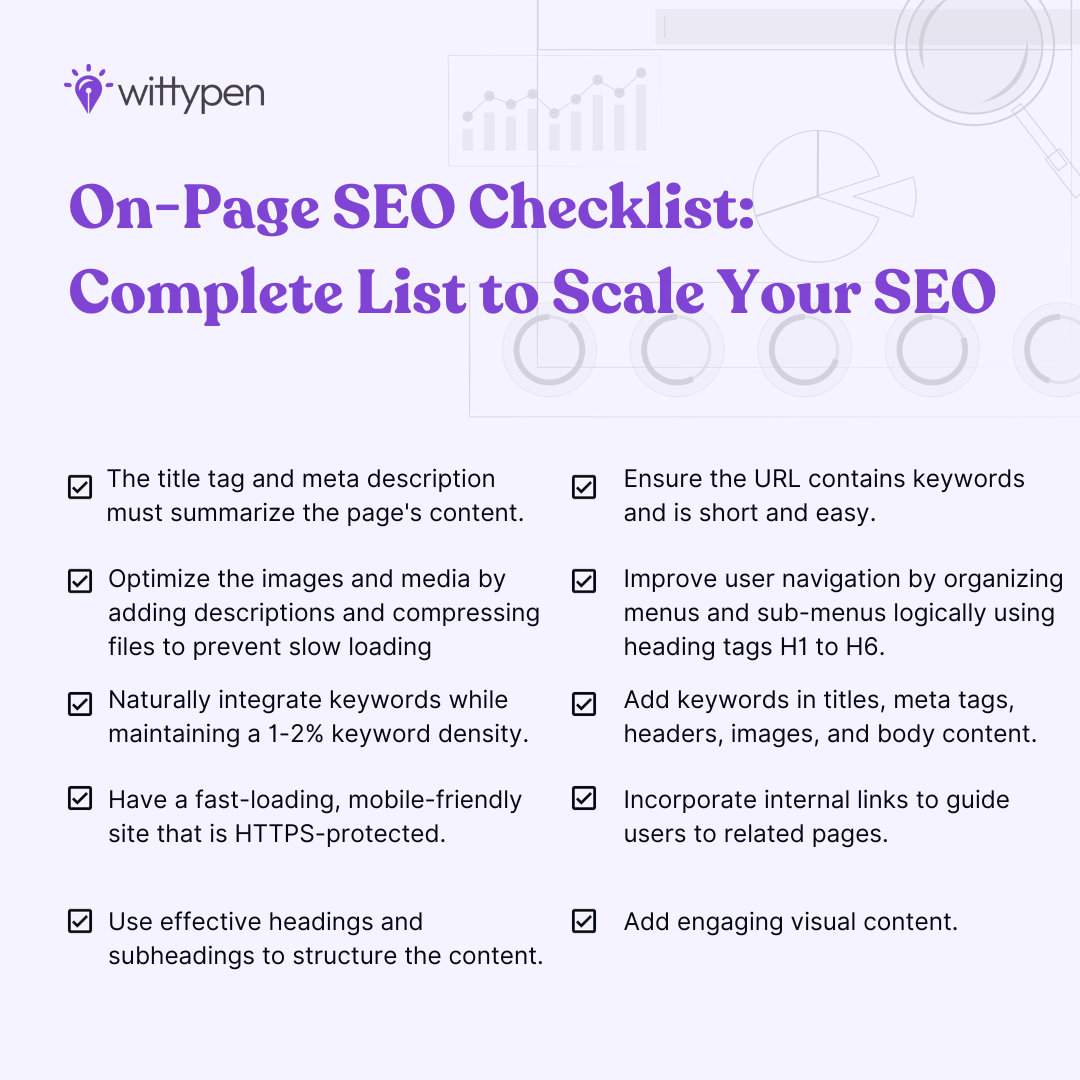
    To optimize your website’s performance, ensure effective indexing by search engines, and boost search rankings, implement this ideal on-page SEO checklist:

    • The title tag and meta description must summarize the page’s content. 
    • Ensure the URL contains keywords and is short and easy.
    • Naturally integrate keywords while maintaining a 1-2% keyword density.
    • Add keywords in titles, meta tags, headers, images, and body content.
    • Use effective headings and subheadings to structure the content. 
    • Create valuable, relevant, and engaging content for visitors.
    • Add engaging visual content.
    • Optimize the images and media by adding descriptions and compressing files to prevent slow loading.
    • Have a fast-loading, mobile-friendly site that is HTTPS-protected. 
    • Improve user navigation by organizing menus and sub-menus logically using heading tags H1 to H6. 
    • Incorporate internal links to guide users to related pages.

    The perfect assistant to the above on-page SEO checklist is Wittypen’s free on-page SEO checker. It is designed to give customized insights and expert tips aligned with the industry’s best practices for optimizing your website’s on-page SEO. 

    To use Wittypen’s on-page SEO checker, you need only input your published URL and the target keyword. In just one click, it will give you insights into your page’s overall performance, highlight successful strategies, identify critical issues that need to be fixed, and suggest potential improvements to enhance your site.

    The perfect assistant to the above on-page SEO checklist is Wittypen’s free on-page SEO checker. It is designed to give customized insights and expert tips aligned with the industry’s best practices for optimizing your website’s on-page SEO. 

    To use Wittypen’s on-page SEO checker, you need only input your published URL and the target keyword. In just one click, it will give you insights into your page’s overall performance, highlight successful strategies, identify critical issues that need to be fixed, and suggest potential improvements to enhance your site.

    Conclusion: Scaling Your Page with On-Page Optimization Techniques

    When you tackle your on-page SEO checklist and nail those techniques, you are not only making your content look good for search engines but also super user-friendly and engaging. From crafting compelling meta descriptions to incorporating mobile-friendly design elements, every aspect contributes to the overall performance and effectiveness of your online presence.

    Thus, with the help of your complete on-page SEO checklist, you have everything you need to succeed in the online world. However, on-page SEO steps are not just about ticking off boxes. It is about connecting with your audience, staying up-to-date with the latest trends, and constantly improving your website’s performance. 

    So, as you continue on this journey, remember to keep experimenting, keep learning, and keep pushing yourself to new heights. With the right mindset, the right technique, and the right tools, there is no limit to what you can achieve with your page. 

    Optimize your website effortlessly with Wittypen’s free On-Page SEO Checker. Generate a free SEO report on your blog and get actionable insights to improve your rankings. To get started, just add your blog URL and keyword.

  • 8 Reasons Why Your Website Is Not Showing up on Google

    8 Reasons Why Your Website Is Not Showing up on Google

    You’ve spent countless hours optimizing your website, but when you type your domain name into the Google search bar, your heart sinks. It’s nowhere to be found. 

    The dreaded question echoes in your mind: “Why is my website not showing up on Google?

    Potential customers searching online won’t find you, leading to missed sales and reduced market share. But fret not! We’ve pinpointed the culprits behind why your website is not showing up on Google and armed you with effective solutions to banish it from Google’s ghost town. 

    8 Reasons Why Your Website Is Not Showing Up on Google

    Here’s why your website is not showing up on Google:

    1. Keyword Understanding: Google might not understand what your website is about.
    2. High-Quality Content: If your website is boring, people won’t stay long enough for Google to notice.
    3. Website Navigation: People want to find information easily.
    4. Backlinks: If other websites don’t link to yours, it’s like nobody is recommending you.
    5. Website Speed Optimization: No one likes waiting, especially online. 
    6. Mobile-First Focus: Most people search online via phones. 
    7. Technical SEO: Your website’s code might have problems, you will need to fix them.
    8. Local SEO:  If you have a local business but haven’t told Google about it. 

    Keyword Understanding: Speak Google’s Language for Higher Rankings

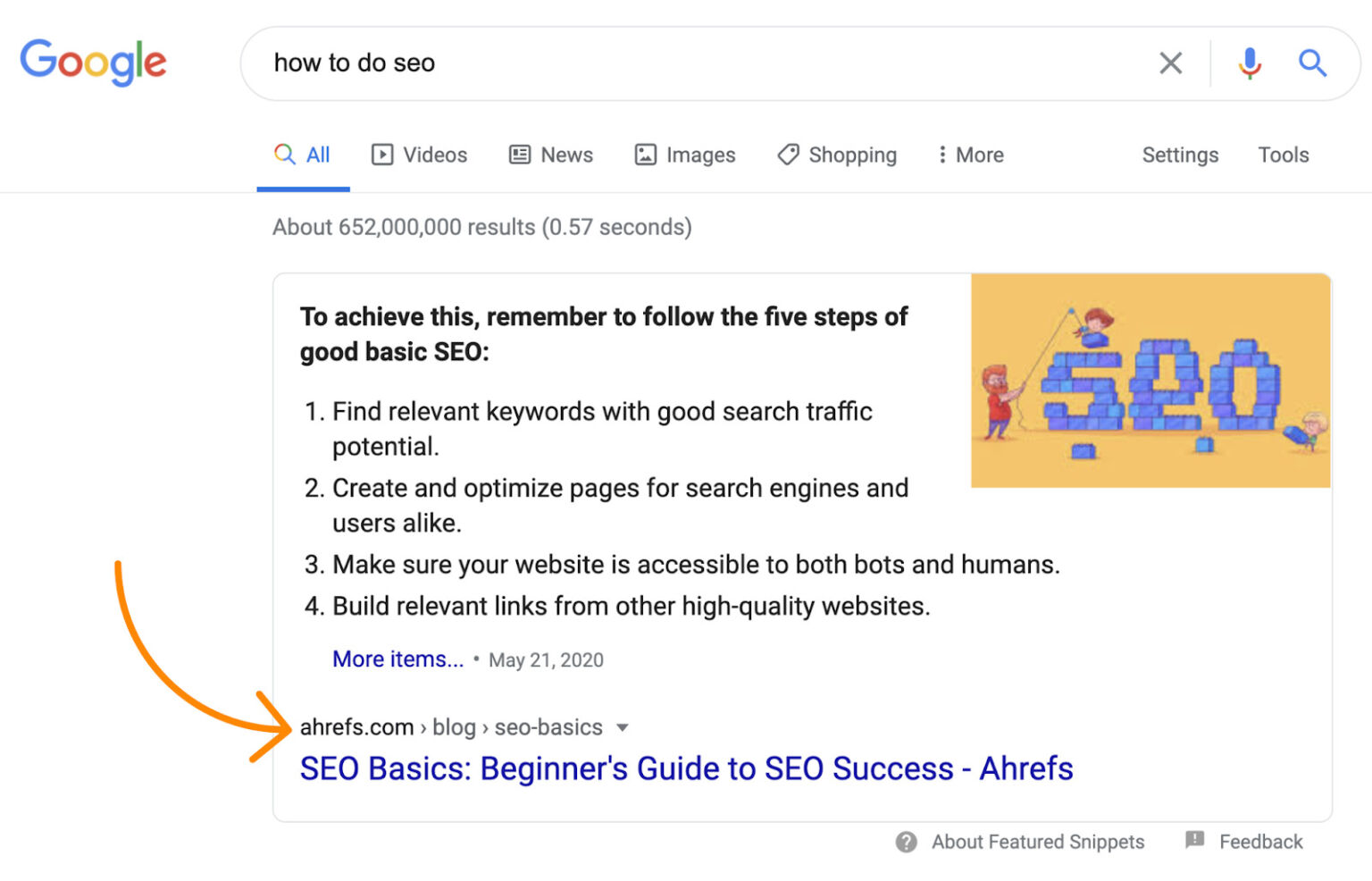
    Keywords are the bridges connecting users to your website. By strategically incorporating relevant keywords throughout your content, you signal the topics your website addresses to search engines like Google. 

    Source: Ahrefs

    For example, if you search for “how to do SEO”, you’d get the above result. Keywords are they avenues by which Google understands what you talk about on your website.

    Imagine keywords as doorways – the more relevant your “doorways” are to user searches, the higher the chances of traffic discovering your content.

    Choosing Relevant Keywords with Potential

    Here are actionable tips for selecting powerful keywords with potential:

    1. Start by identifying key themes and sub-topics relevant to your website and target audience. 
    2. Don’t just focus on high-volume, highly competitive keywords. Long-tail keywords (e.g., “best hiking boots for women”) are more specific, have lower competition, and attract highly targeted traffic.
    3. Utilize free tools like Google Keyword Planner, Ubersuggest, and Ahrefs Keywords Explorer to research keyword search volume, competition, and related terms.

    High-Quality Content: Key to SEO Success and User Engagement

    High-quality content is your passport to Google’s top ranks. ‘

    Remember: Google rewards websites that empower users. Making interesting and useful content keeps people interested and helps ensure your website shows up on Google.

    Key Factors for Crafting SEO-Powered Content:

    1. Compelling Titles & Meta Descriptions

    • Title tags (50-60 characters): Make short, catchy titles with important keywords.
    • Meta descriptions (155-160 characters): Write summaries that make people want to click on your link.

    You can use Wittypen’s Meta Title and Description Generator to get the best titles and meta descriptions for your content. 

    2. Optimized Body Content

    • Incorporate keywords into your content seamlessly, avoiding excessive use.
    • Organize your content with clear headings, subheadings, and lists to make it easier to read.
    • Ensure your content provides valuable information, answers questions, and solves problems for your audience.
    • Keep your content up to date with new information and use engaging formats like videos or infographics.

    SEO Page Powerhouse: Check This Before You Publish!

    TaskDescription
    Target Keyword IntegrationInclude your target keyword naturally throughout the content, including the title, headings, and body text.
    Compelling Title & Meta DescriptionCraft a clear and engaging title and meta description (snippet) that accurately reflects your content and compels clicks.
    Content Quality & ValueCreate informative, well-written content that provides value to your readers and addresses their search intent.
    Headings & SubheadingsUse clear and concise headings (H1, H2, etc.) to structure your content and improve readability.
    Image OptimizationUse relevant, high-quality images and optimize them with alt text containing your target keyword.
    Internal LinkingLink to relevant pages within your website to improve user experience and website navigation.
    Content-LengthAim for content length that satisfies user search intent, typically ranging from 300 words for short-tail keywords to 1000+ words for in-depth topics.

    Website Navigation: Optimizing Clarity for User Experience and SEO

    Ensuring your website is easy to navigate is super important for people visiting your site and how well it shows up on search engines. Good navigation helps visitors quickly find what they’re looking for, keeping them interested and boosting your website’s ranking.

    Key Aspects of Clear Navigation

    1. Keep your menus simple and organized. 
    2. Use descriptive labels for menu items and links so people know what to expect.
    3. Include a search bar so people can find things directly if they can’t locate them in the menu. 
    4. Breadcrumbs show users where they are on your site and help them understand how everything is connected. 

    Navigation Audit Checklist: 10-Point Self-Assessment

    Here’s a self-assessment navigation audit checklist for your website: 

    1. Ensure the subcategories and categories make sense and are simple to use.
    2. Ensure the menu items are precise, descriptive, and free of ambiguity.
    3. Verify you can access important sites with only three clicks.
    4. Verify that labels accurately convey the information on linked pages.
    5. To prevent misunderstanding, make sure labels are unique from one another.
    6. Ensure labels (e.g., “Shop Now” vs. “Products”) contain verbs to promote user involvement.
    7. Verify the presence of a useful and accessible search bar.
    8. Verify that the search feature yields pertinent results.
    9. Verify whether breadcrumbs are used to display the user’s location.
    10. Ensure the breadcrumbs match the site’s structure and are simple to grasp.

    Backlinks: Building Trust and Authority for Higher Rankings

    Backlinks are like stamp approval for your website. They show search engines like Google that other sites trust and value your content. The more good-quality backlinks you have, the better your website can rank in search results. 

    Effective Link-Building Strategies

    1. Write helpful articles for websites in your field and include links back to your own content.
    2. Work with other businesses in your niche to share links and help each other.
    3. Find broken links on other sites and suggest your content as a replacement.
    4. Get your website listed in trustworthy online directories related to your industry.

    Website Speed Optimization: Enhance User Experience and SEO Performance

    Let’s look at some of the key elements that help enhance website speed:

    Key Elements for Website Speed Optimization

    1. Make your images smaller without losing quality so they load faster.
    2. Store frequently accessed data on your website to load quicker for returning visitors.
    3. Try to use as few plugins and scripts as possible, as they can slow things down.
    4. Use free tools like Pingdom to check your website’s speed regularly and find improvement areas.

    Mobile-First Focus: Ensuring a Seamless User Experience 

    In today’s mobile-centric world, a staggering 59.43% of all website traffic originated from mobile devices. So, if your site isn’t easy to navigate, read, and interact with on a mobile phone, you’ll likely encounter diminished website traffic and lower engagement.

    Image of laptop, mobile, and a tablet

    Source: Unsplash

    Mobile Usability Assessment

    To check if your website is mobile-friendly, you can use tools like SiteChecker’s “Mobile-Friendly Test.” This helps you see how your site looks and works on phones. Making sure your site is easy to use on mobiles means you’re catering to most people who browse the web.

    Technical SEO: Avoiding Hidden Roadblocks to Visibility 

    Sometimes, there are technical problems with your website that you can’t see, but they can affect how your website appears on search engines. Things like broken links or errors can stop your site from being seen by people searching online.

    Here’s how you can navigate these technical problems:

    1. Proactive Maintenance

    Using tools like Google Search Console helps you find and fix these technical problems before they hurt your website’s ranking. It’s like doing regular check-ups to keep your site healthy and easy to find online.

    2. Seeking Expertise

    If you need help fixing technical issues, you can ask SEO professionals for help. They are experts in this field and can sort out any tricky problems, saving you time and stress.

    Struggling with complex technical SEO issues? Partner with Wittypens’ SEO experts. We provide professional solutions delivered with a touch of wit, saving you time & boosting your online visibility.

    Local SEO: Attract Nearby Customers and Dominate Your Local Market

    Local SEO helps small businesses connect with potential customers around their base locality. This gives small businesses a better chance to compete with big companies. By ensuring your website shows up in local searches, you can get more local customers who are likely to buy from you.

    Key Strategies for Local SEO Success

    Let’s delve into three key practices that can solidify your local online presence:

    1. Google My Business Listing is a free tool from Google helps people find your business online. Make sure all your information is correct, and add pictures and reviews to make it more attractive.
    2. Get your business listed accurately in local directories and websites. This shows people your business is trustworthy and helps you get noticed in your community.
    3. Write blog posts or articles that talk about things happening in your area. Use keywords related to your city or town to help people find your content when they search online.

    Local SEO Powerhouse: Conquer Your Local Market


    StrategyAction Items
    Claim & Optimize Google My Business Listing– Create or claim your free Google My Business listing.
     – Verify your business ownership.
     – Fill out all information accurately: name, address, phone number, website, category, description, etc.
     – Add high-quality photos and videos showcasing your business.
     – Encourage customers to leave reviews and respond to both positive and negative reviews.
    Build Strong Local Citations– Search for relevant online directories and websites in your area.
     – Claim your existing listings or create new ones, ensuring consistency across all platforms.
     – Use online listing management tools to streamline the process.
    Create Local Content– Create blog posts, articles, or videos relevant to your local community and target audience.
     – Include local keywords throughout your content 
     – Optimize your website for local search by including your city/town in titles, meta descriptions, and content.
    Mobile Optimization– Ensure website responsiveness and user-friendliness across all devices, especially mobile.
     – Test mobile usability with tools like Google’s Mobile-Friendly Test.
     – Optimize website speed for faster loading times on mobile devices.

    Unlock Website Potential: Control Your Visibility 

    Dominating the digital landscape is a strategic pursuit, and your website is your launchpad. This article has equipped you with a powerful arsenal of insights into why your website is not showing up on Google.

    Remember, SEO is a continuous journey, not a one-time destination. As you meticulously craft high-quality content, optimize for technical prowess, and prioritize user experience, remember that you’re not alone. WittyPen’s team of SEO experts is here to guide you every step of the way.

    Think of Wittypen as your SEO compass, navigating you through the ever-evolving search engine landscape. We don’t just offer generic advice; we tailor our solutions to your unique website, target audience, and industry.

  • Only On-Page SEO Guide to Read in 2024

    Only On-Page SEO Guide to Read in 2024

    If you’re looking to boost your website’s visibility and dominate the digital space, on-page SEO is the game-changer you need in 2024.

    Think of it like this: On-page SEO is like the magic touch that makes your website shine brightly in the big online world. It’s like a magnet that effortlessly pulls in the people you want to reach.

    But how do you effectively use on-page SEO to make your website stand out? Don’t worry, it’s not as tricky as it sounds. As things change on the internet, so do the tips and tricks for success.

    In this post, we’ll share the latest tips and tricks to help your website not just keep up but also stand out. Here is a complete on-page SEO checklist:

    On Page SEO Optimization Checklist 2024

    What Is On-Page SEO?

    On-page SEO (also known as on-site SEO) refers to the practice of optimizing various elements of your website. This helps to improve its search engine ranking and user experience. It involves tweaking different parts of your webpage to boost its chances of ranking higher in search results. 

    To master on-page SEO, you’ll need to focus on optimizing key elements. This includes fine-tuning your content with relevant keywords, improving your site’s speed, and ensuring it’s visually appealing on mobile devices.

    In essence, the idea is to make your website as user-friendly and search engine-friendly as possible.

    What Does On-Page SEO Include?

    When it comes to on-page SEO, there are crucial factors to consider.

    1. At the forefront is content SEO on-page optimization, which emphasizes the creation of top-notch content that resonates with your audience and incorporates relevant keywords.
    2. Next up is optimizing your HTML tags, like your title tags and meta descriptions, to make them more informative and enticing. It’s equally important to pay attention to your site’s structure to ensure seamless navigation for both users and search engines.
    3. In addition, on-page SEO success hinges on factors like page speed, mobile responsiveness, and internal linking. Each of these elements plays a significant role in optimizing your on-page SEO effectively.

    On-Page SEO Vs. Off-Page SEO 

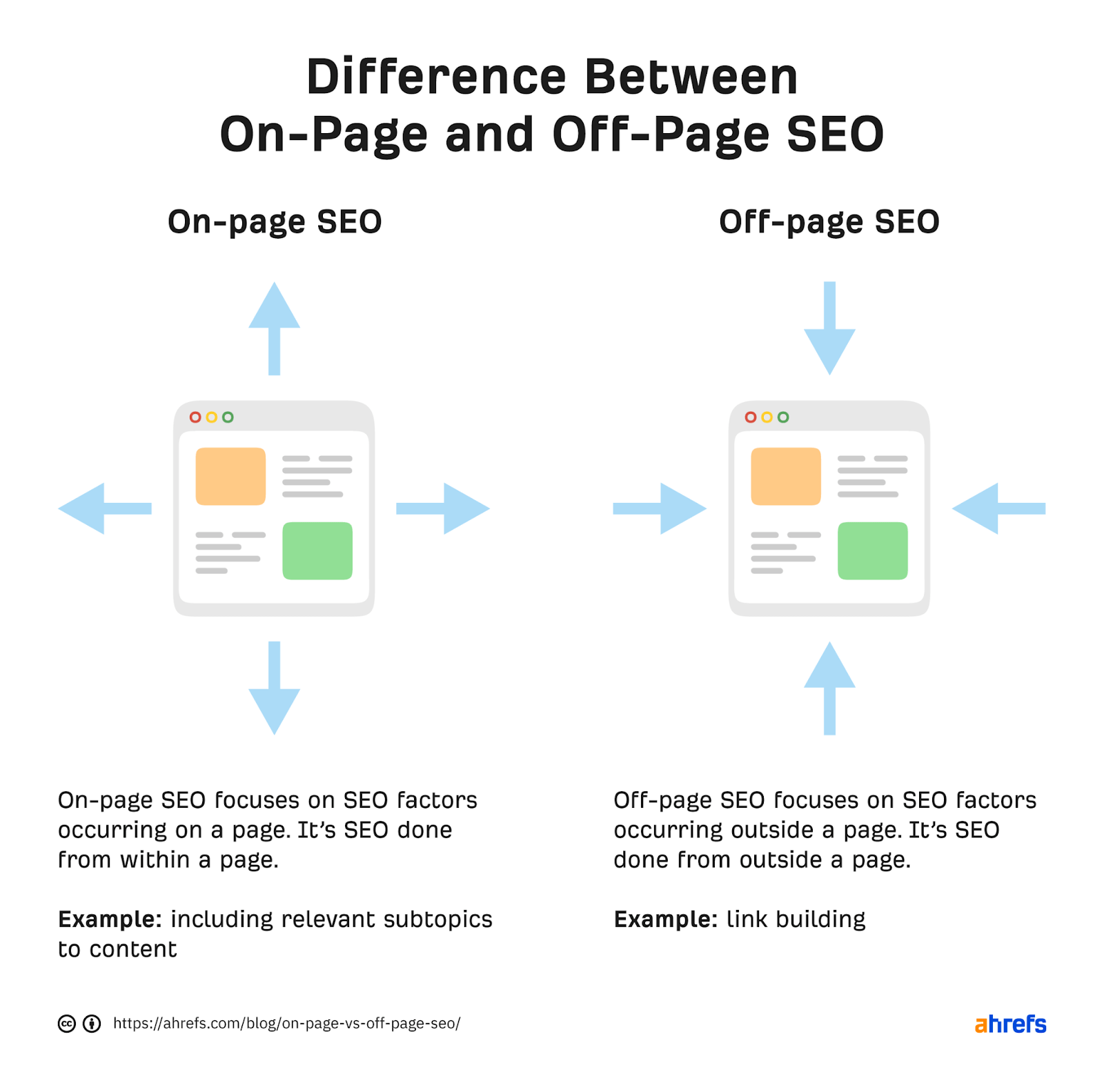
    On-page SEO and off-page SEO are like two sides of the same coin, each playing a crucial role in improving your website’s visibility and authority. 

    On-page SEO focuses on optimizing on-page SEO factors directly on your website, like content and HTML tags. Off-page SEO looks at external SEO on-page factors, like backlinks and social signals. Both are important for achieving higher rankings in search results, but they require different strategies and tactics. 

    With on-page SEO, you might focus on creating high-quality content incorporating relevant keywords and optimizing your site’s structure for better navigation. 

    Source

    On the other hand, off-page SEO might involve reaching out to other websites and influencers in your industry to build backlinks to your site and increase your online presence. 

    Ultimately, combining on-page and off-page SEO is vital to achieving long-term success in improving your website’s search engine visibility and driving more organic traffic.

    Below is a table highlighting the key distinctions:

    AspectOn-Page SEOOff-Page SEO
    Factors Controlled

    Within the Website

    External to the Website

    Examples

    Content Quality, Title Tags, Header Tags, URLs, Internal Linking, Page Speed, Mobile Responsiveness

    Link Building, Social Signals, Brand Mentions, Local SEO Events, Guest Posting

    Impact on RankingsDirectIndirect
    Tools UsedGoogle Search Console, Google Analytics, Yoast SEO Plugin, WittyPen

    MozBar, Majestic SEO, Ahrefs, BuzzSumo, HARO

    Main Objective

    Improve Relevance & User Experience

    Build Authority & Relationships

    By understanding the differences between on-page SEO and off-page SEO, you can develop a comprehensive SEO strategy that leverages both to improve your website’s visibility and ranking on SERPs.

    Where to Start the On-Page SEO Activity? 

    Beginning your on-page SEO journey requires setting a solid foundation for your website’s success. Before diving into more advanced techniques, take the initial step by utilizing the following tools.

    Below are some resources to help assess your website’s current status and identify specific areas that require improvement:

    Wittypen Free SEO Checker

    Take advantage of our free tool designed to provide personalized suggestions tailored to improving your website’s on-page SEO. It offers insights and tips based on industry best practices, which makes it easier for you to optimize your site.

    You can input your blog or the published URL and the keyword that you want the page to be optimized for. In one click, Wittypen’s On-Page SEO Checker will analyze the content and give you results on what is working for your page, what can be improved, and what areas are critical to fix for a better ranking.

    Google Search Console

    Google Search Console is your go-to for monitoring your website’s performance, checking its index status, and identifying any crawl errors that might be hindering your SEO efforts.

    Google Analytics

    Google Analytics lets you understand your visitors’ behavior, track conversion rates, and assess the effectiveness of your SEO campaigns. This valuable data will guide you in making informed decisions to enhance your website’s performance.

    How to Master the On-Page SEO Strategy? 11 On-Page SEO Techniques 

    Implementing effective techniques enhances your website’s search engine rankings, user experience, and overall online presence.

    Here’s a concise list of on-page SEO optimization techniques you can follow in 2024:

    1. Page Speed Optimization
    2. Mobile Optimization
    3. Schema Markup and Structured Data
    4. URL Structure and Canonicalization
    5. Keyword Research and Optimization
    6. Creating High-Quality Content
    7. Title Tags and Meta Descriptions
    8. Heading Tags and On-Page Formatting
    9. Optimizing User Interface and Navigation 
    10. Call-to-Action Optimization
    11. Engaging Multimedia Content 

    Let’s explore each technique in more detail:

    1.  Page Speed Optimization

    Page speed optimization is a vital on-page SEO technique to enhance your website’s loading times for an improved user experience and search engine rankings. Slow loading speeds can deter visitors, leading to higher bounce rates and decreased visibility in search results. 

    1. Make sure to reduce file size by compressing photos and videos without sacrificing quality. Smaller files download more quickly, keeping visitors interested and lowering bounce rates.
    2. You can also remove characters and whitespace from your code to make it lighter and faster to load. A cleaner, more concise code means less data for the browser to process, which results in faster page loads.
    3. Focus on enabling caching to keep frequently visited data locally. It helps with faster subsequent visits. Keeping items like photos and scripts on the user’s device eliminates the need to download them repeatedly.
    4. Defer the loading of non-essential resources until they are required, prioritizing crucial content. This prioritizes the components that visitors see first. It results in a speedier initial page load and a more seamless surfing experience.
    5. Use a CDN to spread content across numerous servers, lowering latency and improving loading times. 

    Implementing these strategies can significantly enhance your website’s page speed, leading to better user engagement and higher search engine rankings.

    2.  Mobile Optimization

    Mobile optimization is another crucial on-page SEO optimization tactic focused on tailoring your website’s design and content for optimal performance on mobile devices.

    Phone shopping reigns supreme, with over 70% of online purchases made using smartphones. Given the rising trend of mobile browsing, ensuring your site is mobile-friendly is essential for delivering a seamless user experience. 

    To optimize your website for mobile devices,

    1. Adapt to different screen sizes with ease to meet the needs of a wide range of mobile devices. This helps to provide a user experience that is free from annoyance.
    2. Focus on adding big, readable fonts make reading easier on smaller mobile screens. Doing so reduces eye strain and encouraging the consumption of content.
    3. Make sure to compress your images and videos, as it helps with the loading time of the page.
    4. Mobile devices incorporate a streamline navigation system. Users can find information quickly, which will require fewer clicks.
    5. Optimizing your website for mobile devices improves the user experience, reduces bounce rates, and enhances search engine visibility.

    3.  Schema Markup and Structured Data

    Schema markup and structured data are essential on-page SEO techniques designed to provide search engines with additional context about your website’s content.

    Incorporating schema markup and structured data can enrich search result snippets and boost click-through rates (CTRs). 

    Here’s how to implement them effectively:

    1. Enhance content details like ratings, reviews, and pricing with schema markup to provide search engines with valuable information.
    2. Implement structured data to make sure it offers search engines deeper insights into your website’s content and organization.
    3. Use Google’s Structured Data Markup Helper to generate structured data code for your site and test it with the Structured Data Testing Tool to ensure proper implementation.

    Integrating schema markup and structured data can elevate your website’s search engine visibility and encourage higher user engagement.

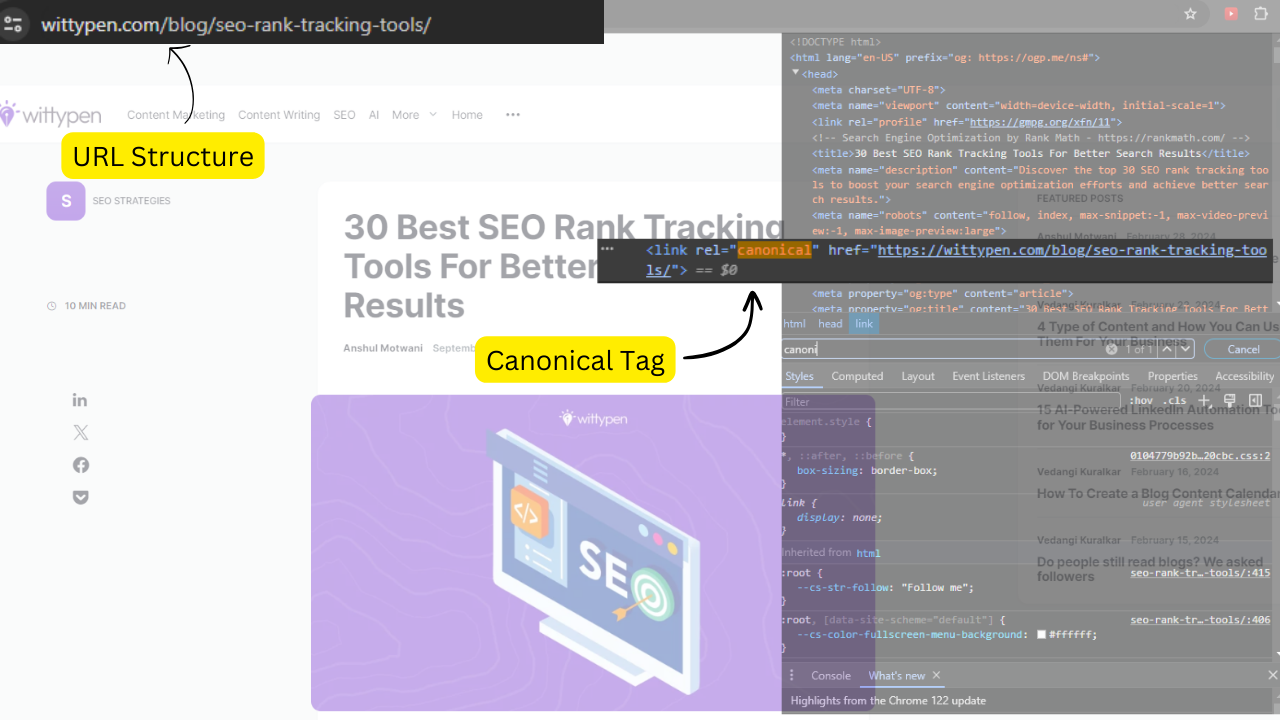
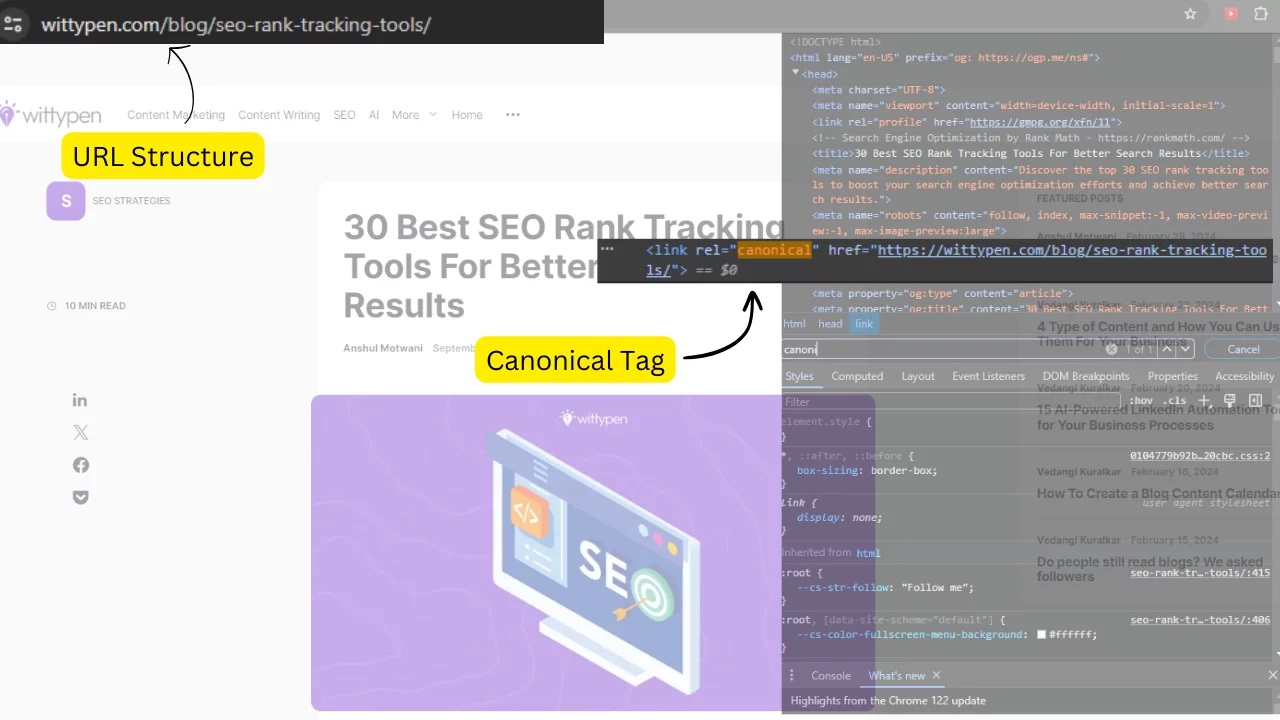
    4.  URL Structure and Canonicalization

    URL structure and canonicalization are vital for on-page SEO, influencing how search engines interpret and index your website’s content.

    A well-organized URL structure aids navigation for users and search engines alike, while canonicalization helps designate the preferred version of a webpage with similar or duplicate content. 

    Here are some strategies you can follow:

    1. Make sure to create user-friendly URLs containing relevant keywords. Clearly communicate page content to users and search engines.
    2. Always use hyphens to separate words. Improve the readability and understanding of your URL structure.
    3. It is best to avoid special characters, numbers, and excessive parameters. Maintain URLs that are clean and easy to remember.
    4. Always focus on implementing canonical tags. Specify the preferred version of a webpage to avoid confusion and improve SEO.
    5. Audit your website for duplicate content on a regular basis and implement redirects as needed. Maintain a clean and efficient website structure for the best search engine performance.

    Refining URL structure and canonicalization enhances crawl ability, indexation, and overall SEO performance.

    5.  Keyword Research and Optimization

    Keyword research and SEO on-page optimization are fundamental to on-page SEO, involving the strategic integration of relevant keywords into your website’s content to boost search engine visibility.

    Here’s what you can follow to excel at it:

    1. Keyword research is the first step in the process. This involves identifying relevant keywords and inserting them smartly into your blog. These keywords can be classified as small-tail and long-tail keywords. Utilize tools like Google Keyword Planner, SEMrush, or Ahrefs to identify pertinent keywords.
    2. Target specific, long-tail keywords with lower competition and high relevance to your audience. The majority of Google searches are long-tail keywords, which are more specific and detailed search terms.
    3. Incorporate primary keywords into titles, headings, meta descriptions, and content.
    4. Steer clear of keyword stuffing, prioritizing engaging, value-driven content.
    5. Track keyword performance using analytics to gauge rankings, traffic, and conversions.

    Through meticulous keyword research and on-page SEO optimization, you can effectively elevate your site’s visibility and attract organic traffic.

    Keyword OptimizationLet’s take a closer look at this specific example. We optimized a blog post for the keyword “30 best SEO rank tracking tools.”

    By strategically integrating this keyword throughout the content, from the title and headings to the body itself, we could signal the blog post’s precise topic and target audience to search engines.

    This strategic approach, coupled with other SEO best practices, has yielded impressive results.
    This example showcases the effectiveness of keyword optimization in driving organic traffic and achieving top search engine rankings.

    6.  Creating High-Quality Content

    Now, let’s explore what on-page SEO is in relation to content creation. High-quality content is pivotal to successful on-page SEO strategies, enticing visitors, fostering engagement, and establishing authority in your niche. To create compelling content:

    1. Focus on conducting thorough research to ensure your content offers valuable insights and information.
    2. Make sure to craft a captivating headline that grabs attention and encourages clicks.
    3. To enhance readability, always organize your content with clear headings, subheadings, bullet points, and visuals.
    4. Zero in on naturally integrating relevant keywords to increase search engine discoverability.
    5. Key in on regularly updating your content to maintain its relevance and accuracy.

    Consistently producing high-quality content aligned with user needs and search intent strengthens credibility, drives organic traffic, and enhances overall search engine performance.

    Google prioritizes three key factors when determining search rankings: high-quality content, a positive user experience on the page, and quality backlinks from other websites.

    7.  Title Tags and Meta Descriptions

    Title tags and meta descriptions play vital roles in on-page SEO, offering summaries of your web page’s content to search engines and users. To optimize:

    1. Craft descriptive and compelling titles that accurately depict your page’s content.
    2. Keep titles under 60 characters for full display in search results.
    3. Write meta descriptions that provide concise summaries of the page’s content, including relevant keywords.
    4. Limit meta descriptions to 155 characters for complete visibility.
    5. Avoid duplicating title tags and meta descriptions across multiple pages.

    By optimizing these elements, you can enhance your website’s click-through rates and search engine visibility.

    Try out our free tool to generate engaging meta titles and meta descriptions for your content.

    8.  Heading Tags and On-Page Formatting

    Heading tags and on-page formatting are crucial for on-page optimization, organizing content, and enhancing readability. To optimize:

    1. Use H1 tags for the main title and H2-H6 tags for subheadings, incorporating keywords naturally.
    2. Employ bullet points, numbered lists, and other formatting elements to break up content and enhance readability.
    3. Integrate relevant keywords into headings and subheadings.
    4. Utilize images and videos to enrich user engagement and provide visual interest.
    5. Ensure the content is well organized and easy to navigate.

    Optimizing heading tags and on-page formatting improves the user experience, engagement, and search engine visibility.

    9.  Optimizing User Interface and Navigation 

    Optimizing the user interface and navigation is a critical on-page SEO technique involving designing a clean, intuitive interface and navigation system. This enhances visitors’ ability to locate desired information, reducing bounce rates, improving engagement, and enhancing search engine visibility. To optimize:

    1. Utilize a clean, modern design aligned with your brand and audience preferences.
    2. Ensure easy navigation, allowing visitors to find information quickly.
    3. Provide clear and descriptive labels for navigation links and buttons.
    4. Implement breadcrumbs for clear navigation paths back to previous pages.
    5. Utilize internal linking to connect related content and improve navigation flow.

    By optimizing the user interface and navigation, you can elevate the user experience, reduce bounce rates, and improve search engine visibility.

    10.  Call-to-Action Optimization

    Regarding getting people to take action on your website, call-to-actions (CTAs) are like friendly nudges in the right direction. Here’s how to make them work better:

    1. Center your focus on putting your CTAs where people can see them immediately, ideally at the top of your page.
    2. Always keep your CTAs simple. Tell users exactly what action you want them to take, whether signing up or buying.
    3. Work on using eye-catching colors or bold text to ensure your CTAs are visually appealing.
    4. Consider tailoring your CTAs to different visitor types based on their behavior or preferences.
    5. Evaluate and experiment with different versions of your CTAs to see what works best and optimize for improved results.

    By sprucing up your CTAs, you can boost user engagement, increase conversions, and make your website shine.

    11.  Engaging Multimedia Content 

    Adding fun stuff like pictures, videos, and podcasts to your website can make it a lot more enjoyable for visitors. Here’s how to do it right:

    1. Make sure to use high-quality images and videos relevant to your content and visually appealing to your audience.
    2. Ensure your images and videos load quickly to avoid frustrating your readers with slow loading times.
    3. Direct your efforts towards creating informative and visually appealing infographics to break down complex information clearly and concisely.
    4. Concentrate on sharing interesting and informative podcasts related to your audience’s interests.
    5. Share your content on social media platforms to reach a wider audience and increase engagement.

    Adding fun stuff to your website can make it more fun to visit, keep people interested, and bring in more visitors.

    Top Metrics to Measure Your Efforts

    To see if your on-page SEO optimization efforts are paying off, you need to keep an eye on some important numbers.

    Here are the key metrics you can follow to track your progress and determine the success of your on-page SEO optimization efforts:

    1. Check how much traffic is coming to your site from search engines. More traffic usually means your SEO is working.
    2. See how many people leave your site after only looking at one page. A high bounce rate could mean your content isn’t grabbing their attention.
    3. Find out how long visitors stick around on your site. Longer dwell times suggest they’re finding what they need and liking what they see.
    4. See how many pages people view in one visit. The more pages they visit, the more engaged they are with your content.
    5. Measure how many visitors take the action you want them to, like signing up or buying something. A higher conversion rate means your site is convincing people to do what you want.
    6. Check how many people click on your site when they see it in search results. A higher CTR means your site’s title and description are appealing to users.
    7. Keep an eye on where your site shows up in search results for important keywords. Climbing up in rankings means your SEO efforts are paying off.

    On-Page SEO Checklist to Follow

    To make sure your website is in tip-top shape for search engines, go through this checklist:

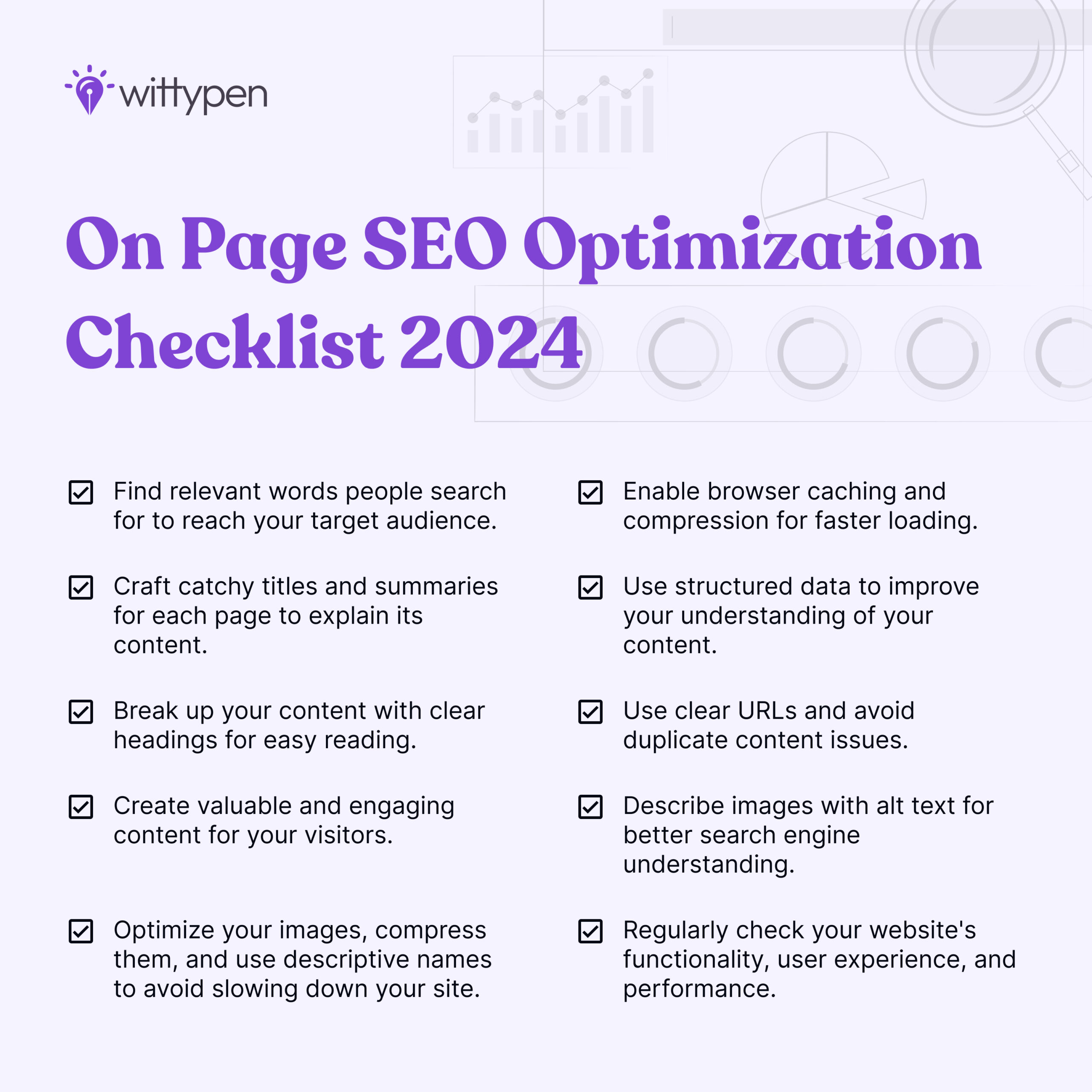
    1. Find relevant words people search for to reach your target audience.
    2. Craft catchy titles and summaries for each page to explain its content.
    3. Break up your content with clear headings for easy reading.
    4. Create valuable and engaging content for your visitors.
    5. Optimize your images, compress them, and use descriptive names to avoid slowing down your site.
    6. Enable browser caching and compression for faster loading.
    7. Use structured data to improve your understanding of your content.
    8. Use clear URLs and avoid duplicate content issues.
    9. Describe images with alt text for better search engine understanding.
    10. Regularly check your website’s functionality, user experience, and performance. 

    Following this checklist will help ensure your on-page optimization is top-notch and ready to boost your site’s visibility in search results.

    Summing Up 

    Mastering on-page SEO gives your website the full package: better visibility, happier visitors, and a steady stream of organic traffic.

    Think of it as fine-tuning your website for search engines and users alike – faster loading, mobile-friendly, engaging content, and an overall smooth experience. To keep the momentum going, keep an eye on key metrics and tweak your strategy based on the data.

    Excited to boost your website’s on-page SEO?

    Try Wittypen’s On-Page SEO Checker today for SEO content solutions that work wonders!

  • Copywriting vs. Content Writing: What is The Difference? And Whom To Hire?

    Copywriting vs. Content Writing: What is The Difference? And Whom To Hire?

    Both copywriting and content writing serve marketing and content creation purposes in the digital space.

    Generally, both terms are used interchangeably. When it comes to enhancing your online presence through effective content, the decision to hire an efficient, professional, and experienced writer becomes crucial.

    However, the confusion lies in whether to hire a copywriter or a content writer; for many, both terms mean the same thing!

    Let’s set the record straight right away—content writing and copywriting are not synonymous!

    Copywriting uses a persuasive style for ads and emails, aiming to engage and prompt actions. On the other hand, content writing focuses on creating informative and engaging material to educate, entertain, or inspire, fostering collaborations and brand loyalty.

    Read on as we take you through the major differences between these two to help you make informed decisions when choosing between a copywriter and a content writer for your digital needs.

    The Words That Sell: Exploring Copywriting and Content Writing

    Let’s look at the popularity of both professions in the modern digital world.

    The global market for copywriting services is poised for significant growth, with a projected CAGR of 7.6%, enhancing the market from $25.29 billion in 2023 to an estimated $42.22 billion by 2030.

    Concurrently, the content marketing industry is expected to witness substantial revenue growth, surpassing $135 billion by 2026.

    Source

    Here is an analogy to clarify copywriting vs content writing that will help you understand the difference in the content created by both experts:

    Take Nike’s slogan, “Just Do It,” as the epitome of copywriting—energizing consumers to take decisive action, showcasing the persuasive prowess inherent in this form of writing.

    On the flip side, consider a captivating Instagram caption paired with a product photo as a prime example of the engaging and informative content that content writing delivers. It sparks interest, invites interaction, and goes beyond mere persuasion to boost genuine engagement.

    Copywriting: Your Persuasion Powerhouse

    Copywriting is the skill of using words to communicate convincingly and prompt action. It’s the secret weapon behind impactful advertisements, engaging emails, and persuasive product descriptions. 

    With copywriting, you can influence and guide your audience’s decisions by creating messages that resonate and inspire. 

    Proficiencies in Copywriting Expertise

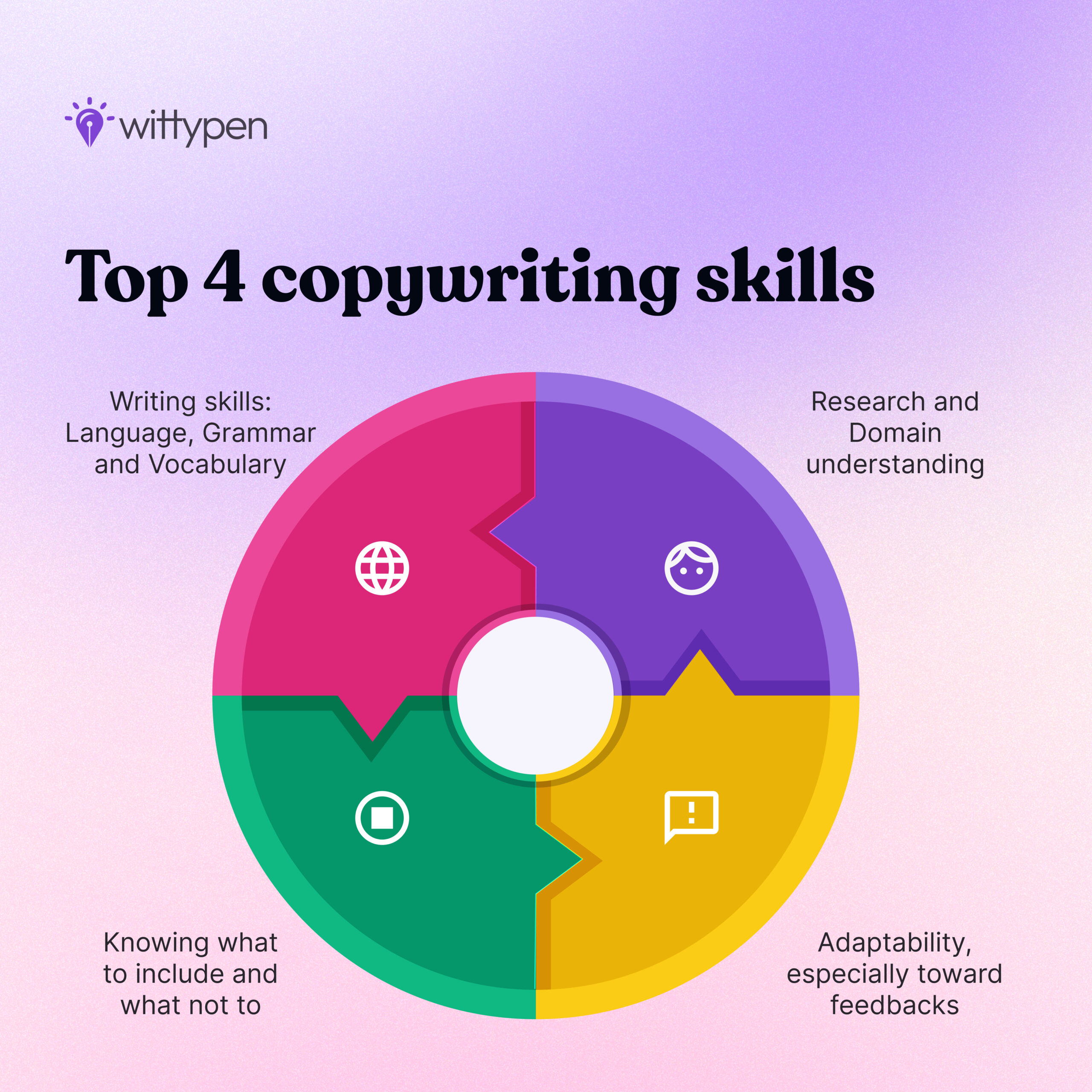
    Top 4 Copywriting Skills

    source

    Here are some significant characteristics of a Copywriter:

    • Persuasive Tone: Copywriting employs language to influence the reader to take a specific action, utilizing techniques like storytelling and compelling arguments.

    For example, Google Ad for a Fitness Brand: Get Fit Fast! Join Our Online Fitness Program Today.

    • Targeted Call to Action: Effective copywriting includes clear and compelling calls to action. These are placed strategically throughout the content.

    For example, “Buy Now” or “Download Now” are examples of calls to action

    • Emotional Triggers: Copywriting considers the reader’s emotions. It uses storytelling and multimedia elements to create a strong emotional connection with the audience.

    For example, let us look at how brilliantly the GHD brand has used storytelling, employing the art of emotionally connecting with people and empowering them:

    source

    A Few MythBusters to Explore 

    Myth 1 – We Can Indulge in DIY Copywriting

    The Truth – While business owners may understand their products or services best, conveying this effectively through copy requires specialized skills and an understanding of audience psychology.

    Myth  2- AI Copywriting is Better

    The Truth – While AI tools can aid in generating initial drafts, they lack human emotion which is essential for compelling copywriting.

    Myth  3- Embracing Complexity in Copy is Key

    The Truth – Clear, concise language is more effective in copywriting, which enhances audience understanding and engagement.

    Myth  4- Personalized Approach Can be Ignored

    The Truth – Effective copywriting requires content creation for specific audiences, contexts, and objectives, emphasizing the importance of personalized messaging for desired outcomes.

    Content Writing: Your Information Hub 

    Content writing is the art of crafting engaging and informative material for digital platforms designed to captivate audiences, add value, and achieve goals.

    This includes writing:

    • Engaging and long-form blog posts
    • Informative articles
    • Thoughtful website content
    • Impactful social media posts
    • Insightful email newsletters

    Role of Content Writing in Building Brand Awareness, Trust,  and SEO

    Effective content writing can turn readers into leads and leads into customers, making the consistent creation of engaging content crucial for business success.

    Here’s how:

    • Content writing enhances brand awareness through the uniform communication of brand values across various channels, reinforcing brand identity.
    • It creates emotional connections with the audience and highlights brand knowledge and thought leadership through insightful content.
    • Content writers personalize content to address audience needs and challenges, strengthening connections and optimizing content for search engines.
    • Develops a loyal audience by consistently offering valuable content that educates or entertains.

    Proficiencies in Content Writing Expertise

    Write contents for you by Faisalsial472 | Fiverr

    Source

    Here’s what a typical list of proficiencies in content writing expertise might look like:

    Versatility

    Content writers adapt their writing style to suit diverse project requirements. They enhance their value by delivering versatile and impactful content. Thorough research is conducted for effective content writing that guarantees credibility and resonance with readers. 

    Thorough Understanding of SEO

    A profound understanding of SEO principles is essential for content writers to create content effectively and drive visibility and engagement.

    Follow Industry Trends

    Content writing resonates with brand values and enhances content relevance and impact. Staying updated on industry trends and digital dynamics empowers content writers to remain relevant and deliver compelling content.

    The Great Divide: Exploring the Key Differences

    Let us start by referring to an example.

    Notion, a SaaS, helps centralize your team’s workflow and processes in one platform, which is pivotal for increasing transparency. The brand has effectively used copywriting and content writing in various forms and is gaining benefits from it from all ends -higher ROI, customer attention, conversions, and a better brand reach.

    The brand has diligently used copywriting for CTA, website pages, and social media platforms. An example is:

    source

    Notion has also brilliantly used content writing for its various blogs that have led to an optimized SEO and high rankings for the brand:

    source

    The table below simplifies the distinctions between these two types of writing:

    Points of DifferenceCopywritingContent Writing
    Call to Action (CTA)Copywriting includes clear and compelling calls to action
    (CTAs) that prompt the audience to take immediate action.
    Examples are “Buy Now,” “Sign Up Today,” or “Learn More.”
    Content writing may include CTAs,
    but they are usually less direct.
    They focus on encouraging further engagement.
    Target Audience– Decision-Makers
    – Prospects in Sales
    – Targeted Demographics
    – Potential Customers
    – Audience with Immediate Needs
    – Information Seekers
    – General Audience
    – Educational Seekers
    – Industry Professionals
    – Existing Customers
    Tone of WritingA professional and compelling tone.The tone is primarily conversational or informative.
    Writer Skills– Persuasive writing
    – Understanding target audience
    – Headline creation
    – Adaptability
    – Strategic thinking
    – Research skills
    – Organizational abilities
    – Search Engine Optimization knowledge
    – Aptitude for storytelling
    – Editing and grammar proficiency

    Hire Right: Finding Your Writing Dream Team

    Confused about whether to engage a copywriter or a content writer? Consider the following:

    When to Hire a Copywriter?

    • A copywriter can craft effective content to highlight the unique selling points that can help you introduce a new product or service.
    • If you want attention-grabbing ad content that drives clicks and conversions, hire a copywriter.
    • If your website or landing pages are experiencing low conversion rates, a copywriter can help you enhance conversion rates.

    When to Hire a Content Writer?

    • Hire a content writer who can research and create high-quality blog posts, short or long-form articles, and guides.
    • To enhance your website’s search engine visibility, hire a content writer who can develop SEO-optimized content.
    • If you are having trouble maintaining active and engaging social media profiles, choose a content writer.
    • A writer can produce diverse content formats and cater to different audience preferences.

    Interview Questions that You Can Ask Before Hiring Content Experts

    Wittypen's Best Content Marketing for Business : How it Works

    Source

    Consider these interview questions when hiring an SEO copywriter or content writer:

    • Can you provide examples of your past content writing experience?
    • Have you collaborated with brands similar to ours previously?
    • How proficient are you in grammar?
    • Do you offer services such as keyword research or content strategy?
    • Which tools do you utilize for keyword research?
    • How do you determine the effectiveness of a keyword for a website?
    • Do you use SEO or content optimization tools?

    Red Flags to Watch Out for When Hiring

    1. Lack of Portfolio: A concerning sign is when a copywriter doesn’t have a steady profile, as it’s used to showcase their previous work, client testimonials, and service offerings.
    2. Failure to Research: Similar to interviewing a potential employee, meeting with a copywriter involves assessing their ability to understand your business needs and marketing goals.
    3. Pressure for Long-Term Contracts: Be cautious if a content expert insists on signing a long-term contract immediately. Instead, reputable professionals often suggest starting with a short-term agreement or even a trial project.
    4. Lack of Professionalism: Effective communication is vital in remote collaborations. A Reliable expert responds promptly to inquiries, meets deadlines, and conducts themselves with professionalism in all interactions.

    Wittypen’s Writer Vetting Process and Unique Strengths

    Wittypen's Best Content Marketing for Business : How it Works

    Source

    In this age, good content is key for brands online. This is the reason implementing a thorough vetting process for selecting writers becomes essential. 

    Here’s how Wittypen goes about it:

    1. Rigorous Screening Procedure 
    2. Emphasis on Brand Consistency 
    3. Collaboration and Feedback Focus
    4. Customer-Centric Approach 
    5. Innovation and Creativity 
    6. Data-Driven Insights 
    SEO Writing Best Practices With Examples for 10x Growth

    Source

    Wittypen stands out in choosing writers who match the brand, work well together, and create excellent content.

    By investing in skilled writers who not only mirror their brand values but also have the expertise to produce outstanding content, Wittypen makes sure their clients reach their digital goals and establish a powerful online presence.

  • 30+ Quotes by Women in Marketing

    30+ Quotes by Women in Marketing

    As rightly quoted by Maggie Lena Walker “Let a woman choose her vocation just as a man does his. Let her go into business, let her make money, let her become independent, if possible, of man.”

    Women’s contributions to marketing and society as a whole are monumental. In marketing, they have shaped the industry in profound ways. As per research, women wield significant influence, accounting for 85% of consumer purchasing decisions.

    Moreover, statistics from LinkedIn reveal that women dominate the marketing sector, constituting 60% of the workforce in North America. There has been a substantial rise in women holding managerial positions as well, with 59% occupying Manager-level roles and 52% serving as Chief Marketing Officers.

    Success in marketing, transcends talent and expertise; it’s about building connections, seeking mentorship, and displaying resilience. That said, various organizations dedicated to women’s empowerment provide invaluable support, offering a platform for sharing experiences, and career advancement opportunities.

    A few reasons why some women, if not most, excel in this field are because:

    1. They are brilliant when it comes to forming connections, mentoring, and resilience.
    2. Women play a crucial role in breaking gender stereotypes and biases in marketing and advertising.
    3. Women bring a diverse perspective to marketing strategies.
    4. Their exceptional emotional intelligence and sensitivity inspire them to connect with audiences on a deeper level.
    5. Women also exhibit almost equal ability when it comes to adaptability, collaboration, and a holistic approach to problem-solving when compared to their male counterparts.

    Popular women networking groups are:

    • Women in Marketing (WiM)
    • SheSays
    • Girls in Marketing
    • Lean In founded by Sheryl Sandberg
    • Women in Tech SEO

    Celebrating Women in Marketing on Women’s Day with WittyPen

    At Wittypen, the team sincerely believes in the quote penned down by the senior manager, Vinita Yadav: “Content marketing is an asset, that has a tangible value that appreciates over time – it creates what consumers truly desire.”

    The entire Wittypen team proudly celebrates the achievements of women in marketing, especially on International Women’s Day.

    Here are a few highlights of Wittypen’s continued efforts towards women’s empowerment.

    It’s always better to celebrate the women in our lives!

    Highlighting the people who matter!

    Go team!

    Contributions of Women in Marketing

    Of late, numerous influential women in marketing have made significant strides towards greater gender equality. Let us look at the most popular quotes along with their marketing quotes coming from these female go-getters:

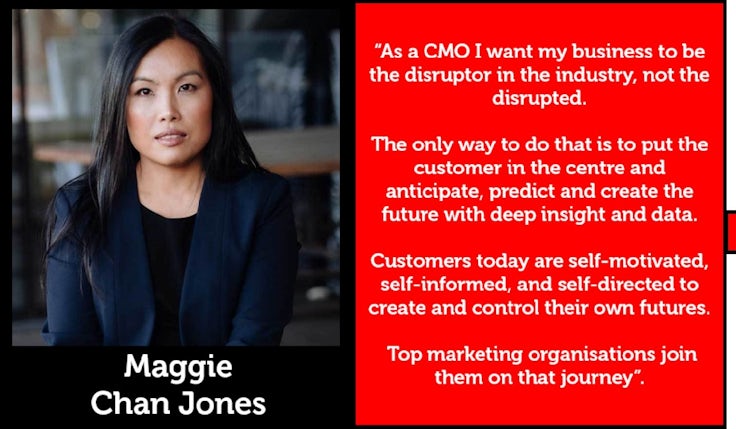
    1. Maggie Chan Jones

    source

    With an MBA from Cornell University, Maggie began her marketing career at Microsoft. In 2017, Forbes named Maggie the 15th Most Influential CMO in the world. She has now moved on and founded Tenshey, a company focused on empowering people of all backgrounds to achieve equality in leadership.

    2. Ann Hadley

    Ann Handley - MarketingProfs | LinkedIn

    source

    Ann, renowned as the bestselling author of “Everybody Writes” and “Content Rules,” has disseminated valuable marketing advice through various platforms, including Entrepreneur, IBM, and the Wall Street Journal.

    Her famous quotes include:

    1. “Even when you are marketing to your entire audience or customer base, you are still simply speaking to a single human at any given time.”
    2. “Does your content lead readers on a journey, or does it merely stuff them as leads into a pipeline?”
    3. “Smart brands don’t just ride trend shifts. They start them.”
    4. “Think bigger, braver, and bolder. The biggest missed opportunity in content marketing is playing it too safe.”
    5. “Engaging content is far more about brains than budget.”
    6. “Good content isn’t about good storytelling. It’s about telling a true story well.”
    7. “Use tone of voice to attract the like-minded and avoid the timid.”
    8. “You need to create ridiculously good content—content that is useful, enjoyable, and inspired.”
    9. “Make the customer the hero of your story.”

    3. Cara Scharf

    A Fearless Trailblazer | New Frontier of Digital Marketing | Cara Scharf

    source

    With more than 25 years of experience in advertising and marketing, Cara founded Fearless Media, a company focused on providing comprehensive strategic planning, PR, media, and marketing services. She rightly quotes:

    • “One of the most difficult issues women face is that people don’t always take you seriously. You don’t need confidence to start, you need guts.”

    4. Michele Linn

    source

    When the Content Marketing Institute was founded in 2011 to help advance the practice and field of content marketing, Michele Linn was hired to help launch the blog and editorial strategy. In 2015, Michele was named one of the “Top Women in Media” by Folio magazine, and in 2017, Michele co-founded Mantis Research. Among her famous quotes are:

    • “Content is the atomic particle of all digital marketing.”
    • “Content marketing is the gap between what brands produce and what consumers want.”

    5. Beth Comstock

    source

    Elizabeth “Beth” Comstock is an American business executive who was also the former vice chair of General Electric. Her famous marketing quotes are:

    • “Marketing’s job is never done. It’s about perpetual motion. We must continue to innovate every day.”
    • “Be where the world is going.”
    • “You can’t sell anything if you can’t tell anything.”

    Precious Marketing Quotes Contributed by Women Leaders Across the Globe

    1. “Creating marketing that works should not be rocket science.” — Allen Gannett
    2. “Word of mouth can be as important, if not more important, for neighborhood businesses as traditional advertising.” — Ekaterina Walter
    3. “I have never worked a day in my life without selling. If I believe in something, I sell it, and I sell it hard.” – Estee Lauder
    4. “Your website is your greatest asset. More people view your webpages than anything else.” — Amanda Sibley
    5. “My best successes came on the heels of failures,” – Barbara Corcoran
    6. “Never doubt a small group of thoughtful, committed people can change the world. Indeed, it is the only thing that ever has.” — Margaret Mead
    7. “You can never go wrong by investing in communities and the human beings within them.” — Pam Moore
    8. “Content is king but engagement is queen, and the lady rules the house!” — Mari Smith
    9. “The presence of a brand proclaims that item’s ownership. It’s the marketing equivalent of signing your painting; it tells the world ‘our company produced this’”. – Jenni Romaniuk
    10. “Spending energy to understand the audience and carefully crafting a message that resonates with them means making a commitment of time and discipline to the process.” — Nancy Duarte
    11. “Focus on the core problem your business solves and put out lots of content and enthusiasm and ideas about how to solve that problem.” — Laura Fitton
    12. “Brand should never be a deception; it should be a delightful expression of a product’s truth, and ultimately a positive force in people’s lives.” – Emily Heyward
    13. “Google only loves you when everyone else loves you first.” — Wendy Piersall
    14. “This is a learning process and sometimes you have to fall to learn things.” — Christine Korda
    15. “The importance of gratitude is never forgotten.” — Deborah Lee
    16. “Take a risk and keep testing, because what works today won’t work tomorrow, but what worked yesterday may work again.” — Amrita Sahasrabudhe
    17. “I’ve learned that people will forget what you said, people will forget what you did, but people will never forget how you made them feel.” — Maya Angelou
    18. “You can’t buy engagement. You have to build engagement” – Tara-Nicholle Nelson
    19. “Companies whose cultures wither instead of thrive because their leaders can’t articulate the stories of why they do what they do.” – Kindra Hall
    20. “Fear is used by many brands as a key motivator to drive consumer action. Fear-based marketing is useful when fear is used as a motive to overcome fear, not instill it. There’s a big difference.” – Shantini Munthree

    Women in Marketing: Future Trends

    Women in the marketing industry are literally reshaping its future. They have capitalized on emerging trends and transformed the marketing world according to evolving audience preferences. Some of the future trends include:

    1. Female influence is particularly pronounced in niche marketing, where attention to detail and authenticity are paramount.
    2. The digital landscape has revolutionized marketing, with women leading the charge in adopting and optimizing digital tools to ensure that strategies remain relevant and forward-thinking.
    3. Moreover, there is a growing emphasis on authenticity in advertising, with women marketers at the forefront, breaking barriers and championing online presence, self-promotion, and continuous skill enhancement.
    4. Women are also sought after for their emotional intelligence in advertising, commitment to sustainable and ethical marketing practices, and dedication to inclusivity and diverse representation in media.

    Final Thoughts

    Female marketers are seizing opportunities, and positioning themselves as industry leaders is no longer a rarity. While gender equality has taken remarkable strides in workplaces, challenges still persist, especially for women from diverse backgrounds.

    By echoing the voices and experiences of inspirational women, progress toward gender equality can continue globally. As the marketing world evolves, the field is rife with opportunities for women to emerge as the next generation of leaders.