Author: Anshul Motwani

  • What is Freelance Writing and How Does it Work?

    What is Freelance Writing and How Does it Work?

    For those who are planning to consider freelance writing, you may wonder: What is freelance writing? How does it work? Do freelance content writers make a good living?

    Well, thanks to a survey by Payoneer, we just may have the answer. A freelance writer earns between $15 and $16 per hour globally on average.

    We frequently connect successful jobs with working for others or moving up the corporate ladder. However, with freelancing, you can make your own!

    Earning money as a freelance writer can be a fantastic side gig or even a full-time job. However, exactly what is freelance writing? Writing for clients as a freelancer differs from writing for an employer. You can independently set your hours and work from any location!

    This blog explores everything you need to know about what is freelance writing. From requisite skills to potential challenges and tips to avoid them, let’s set the ball rolling!

    How Does Freelance Writing Work?

    Confused about where and how to start? Here are the basics!

    Types of Freelance Writing Projects Leading the Market

    While the content writing market is brimming with possibilities, beginners may feel a little overwhelmed when considering the projects they want to take on.

    To help you get started, here are the major types of freelance writing jobs popular today!

    1. Blogging

    Writing content for a website and updating it frequently with blog posts in a particular niche is known as blogging.

    Bloggers update their pages with new content that is entertaining, educational, or useful.
    The article can cover anything from an individual’s biography to editorials meant to promote a brand or product. 

    2. Website Copywriting

    It is the process of creating marketing materials such as social media posts, advertisement copy, and web content. Effective copywriting can hold readers’ attention and frequently prompt them to initiate an action, like filling out a form or making a purchase.

    3. Whitepaper Writing

    A white paper is a document designed to increase a business’s standing as an industry authority. This kind of document is written to highlight a business’s effective solutions to problems that impact any specific sector.

    4. Ghostwriting

    Writing content on behalf of someone else where your name is not displayed on the byline of the finished product is known as ghostwriting. It is a great option for experienced writers who enjoy working on collaborative endeavors and tackling a wide range of subjects.

    Snapshot of a Freelance Writer’s Workflow Process

    1 Finding Prospective Clients and Initial Pitching

    Researching and identifying potential clients, crafting personalized pitches that highlight your expertise and services.

    2. Discovery Meeting

    This is a preliminary call to discuss the project requirements, timeline, and budget.

    3. Terms and Ways of Payment

    Drafting contracts that outline terms, including payment schedules, modes of payment, and deliverables.

    4. Proposal for Project Agreement

    Once the rates and quantity of assignments for a project are settled, freelancers can establish an agreement and send it to the client for signature.

    5. Client Briefing

    Final call to verify the requirements and guidelines, like added information on target audience, keywords, etc.

    6. Start Writing

    Thorough topic research, adherence to the topics mentioned, and maintaining proper tonality are basic requisites while writing content.

    7. Final Delivery of Work

    This includes submitting the final draft within the stipulated deadline and making revisions if required to ensure client satisfaction.

    How to Navigate Financial Management of Freelance Writing?

    A freelance content writer’s earnings are typically uncapped. Though this is a piece of the pie, you must utilize effective strategies to ace your financial management. From raising invoices to filing tax returns, here are a few aspects you must consider:

    1. Setting the Pricing

    When setting your rates, consider your expertise, industry standards, project complexity, and client budget. You can choose from three common pricing strategies: per word, hourly, or project-based.

    However, the pricing of a freelance writer varies as per:

    • Type of Projects: Blogs are charged based on the length and complexity of the topic, whereas product descriptions can be calculated per item or per word.
    • Key Performance Indicators: Writers who help improve a client’s search engine rankings through well-optimized content may set pricing as per performance. KPIs could include organic traffic growth, click-through rates, etc.
    • Deliverables: Freelance writers may charge a flat fee for one-time projects, such as website content refresh, or offer discounted rates for clients who sign retainer agreements for long-term content requirements.
    1. Establish Retainer Agreement

    A freelance retainer agreement is essentially a contract that specifies the amount of work (e.g., projects or hours) that will be completed for a client at a predetermined rate over a specified period. It takes over the role of fee agreements based on projects.

    A freelance writer can ask for a retainer fee, which is considered an initial downpayment for future writing services.

    1. Invoicing

    Make thorough invoices that include your rates, project scope, the terms of payment, and your contact details.

    1. Managing Taxes

    You must keep track of your invoices, outlays, and deductions all year to properly manage your taxes. Consider working with an accountant or using accounting software to ensure compliance with tax laws and optimize your deductions.

    Essential Skills and Qualities: How to Become a Freelance Writer?

    The days of needing only a strong writing ability to complete assignments are a thing of the past.

    If you want to pursue a long-term freelance career, you must equip your arsenal with varied skill sets. Therefore, a blend of hard skills and soft skills is the way to go when you aim to become a successful freelance writer.

    1. Research Competency

    Writing quality content requires thorough research because it increases value and, above all, credibility. Finding intriguing and reliable data from reputable sources is, therefore, essential.

    2. Strong Writing Skills

    “Writing is an exploration, You start from nothing and learn as you go.”

    -E.L. Doctorow

    The most basic must-have skill to become a freelance writer is to have excellent writing skills: crisp and concise copies, top-notch grammar, punctuation, tonality, and style are mandatory prerequisites.

    3. Organizational Skills

    Staying on top of the writing assignments you’ve taken on is just as important to organizational success as maintaining a tidy workstation.

    Remember your deadlines and maintain a calendar. Set priorities for your tasks to ensure you finish them all on time.

    4. Time Management

    Providing excellent content on time demonstrates your professionalism and dependability. Determine the quantity of work you can deliver before deciding on a deadline.

    5. Communication Skills 

    The freelance writing profession is largely anonymous, with most writers working remotely from all over the world to complete their assignments. Hence, you need to be a good communicator to pitch or collaborate with leading clients.

    Apart from hard skills, a successful freelance writing journey depends on several soft skills, as follows:

    6. Adaptability

    Adaptability is a necessary skill for writers to succeed in a changing market because it enables them to move fluidly between subjects, styles, and formats.

    7. Resilience

    Periods of low income, rejections, and unanticipated obstacles are part of the process. Gaining resilience to overcome obstacles, learn from your mistakes, and bounce back after failures is a crucial personal skill.

    8. Attention to Detail

    For freelance writers, attention to detail is crucial because it guarantees precision and competence in their work. It is important for creating content of the highest caliber, establishing credibility, and satisfying customer demands. 

    9. To-Do Mindset

    It takes a self-starter attitude to land clients and finish work efficiently, as you have complete control over your work as a freelance writer.

    Popular Tools for Freelance Writers

    No matter how talented you are as a writer, you can always improve by utilizing the myriad writing resources available online, like:

    1. Grammarly

    Grammarly is an outstanding online resource for proofreading and polishing your writing. It is mostly done by editors and writers for:

    • Spell and grammar check
    • Recommendations for improving vocabulary
    • Accuracy and writing style enhancements
    • Identification of plagiarism
    • Detection of tones and recommendations
    • Coherence and consistency checks
    • Writing advice specific to a genre 
    1. Hemingway

    Copywriters and bloggers can use Hemingway to make their articles and marketing copy readable and skimmable. Hemingway helps writers produce engaging content that connects with their audience by eliminating adverbs, long paragraphs, and the overuse of the passive voice. It is available for free!

    1. Copyscape

    Publishers and content writers frequently use Copyscape to detect plagiarism in written material. Copyscape assists freelance writers in ensuring their work is original and exclusive by detecting instances of duplicate content by analyzing a given text against an extensive database of internet sources.

    GrammarlyFlags grammar errors and provides context-specific suggestions
    HemingwayHelps optimize written content for readability and clarity
    CopyscapeIdentifies instances of duplicate content and helps to maintain the originality

    How to Get Started as a Freelance Writer?

    Here is a step-by-step guide to assist aspiring writers in launching their freelance writing careers:

    1. Create a Strong Writing Portfolio

    Kickstart your freelance writing journey by building a strong portfolio that highlights your writing abilities and reveals your level of expertise. You can present your writing services in the best possible way by designing your professional writing portfolio using these steps

    1. Determining your niche and target audience is the first step toward building a strong portfolio for your freelance writing. 
    2. Pick your best writing samples and present your versatility by incorporating a variety of writing styles, such as blog posts, case studies, landing pages, SEO writing, etc.
    3. Make sure the portfolio is easy to navigate!
    4. Write yourself an impressive bio including your education, skills and experience as a writer.
    5. Include testimonials from previous clients attesting to your writing abilities.

    You can use the customizable templates available online to edit content, alter images, apply unique colors, and add fonts and logos.

    2. Pitch Yourself!

    Here are some fantastic methods to spread the word about you:

    • Customize your proposals for each client by emphasizing how your work will advance their business.
    • Make your pitches unique and compelling to demonstrate that you have considered their needs and are a good fit for the project.
    • Create a succinct, impactful “elevator pitch” so you can introduce yourself to others at any time. You cannot predict who you might meet who might require a writer.
    • Reach out to organizations you admire and propose to write for their blog or produce sponsored content for your own blog regarding their offerings.
    • Make contacts with other independent writers by joining networking groups both locally and virtually. You will find shared job openings in many of these communities.
    • Check out websites like Wittypen, Upwork, and Freelancer.com that offer freelance services. Select jobs that you find fulfilling and, if necessary, use them as a launching pad for more ambitious endeavors.

    3. Steer Clear of Common Challenges

    Like any other profession, freelance writing comes with its own set of challenges. Here is how to overcome them and stay the course!

    • During an irregular flow of work, utilize this time to curate attractive pitches, stay alert for new opportunities, and think about expanding your writing repertoire to reach a wider clientele.
    • To establish competitive rates, consider the value of your services and industry norms. Aim for just compensation that is commensurate with your experience and diligence.
    • In instances of rejection, make the most of feedback to hone your craft, maintain your calm, and have faith in your writing abilities.

    How Does a Freelancer Writer’s Typical Day Look Like?

    Contrary to the conventional belief that a content writer just writes all day, a freelance writer’s day is quite exciting and diverse. From researching varied niches to client pitching, their responsibilities go beyond writing.

    A freelance writer’s schedule can change according to personal preferences, project requirements, and client deadlines. One major benefit of freelancing is flexibility, which enables writers to customize their daily schedules to maximize output and creativity.

    To get started, aspiring freelance writers can join online freelance platforms like Upwork, Wittypen, or Fiverr or contact potential clients directly.

    While some of these platforms are open to varied freelancing jobs, Wittypen is solely dedicated to content writing, bridging the gap between freelance writers and potential clients. With a huge pool of diverse clientele, writers at Wittypen can work with a brand that aligns with their preferred niche and expertise.

    Freelance writers are notified about available projects on the Wittypen dashboard regularly, where they can show interest in assignments of their choice to land exciting projects.

    The payment for each task is specified at the beginning of the project, ranging from 70p to 3Rs per word on average, and credited directly to the writer’s mentioned bank account after approval by the client.

    How to join Wittypen as a writer

    Wittypen currently provides a platform to 1000+ writers to work with multiple brands and agencies as freelance writers. Joining Wittypen as a writer is a simple process.

    Step 1: Create an account and register with your email address to begin the application process.

    Step 2: Tell us about your exprience, you detials by filling up a simple to help us get to know you better.

    Step 3: Add some sample content on the topic of you choice from the list provided and write based on the brief. This is short peek into what it’s like to write at Wittypen.

    Once this process is done, our internal team evaluates your application and basis on that writers are onboarded on Wittypen.

    Takeaway

    Free Macbook Pro Near White Ceramic Mug Stock Photo

    source

    Revenue generation in the freelance writing industry is on the rise and is expected to increase. Carving your niche and polishing your skill set are crucial to excelling in a highly competitive market.

    Kickstart your freelancing journey by signing up at Wittypen as a freelance writer. The platform aligns you with companies in your preferred industry, so you don’t have to spend endless hours looking for work.

    Join a pool of talented writers and get a chance to work with leading global brands!

  • On-Page SEO Checklist: Complete List to Scale Your SEO

    On-Page SEO Checklist: Complete List to Scale Your SEO

    If you want to boost your search engine rankings, increase organic traffic, and improve user experience, adopting a complete on-page SEO checklist is essential. This guide will help you gain an in-depth understanding of the on-page SEO checklist, enabling you to implement strategies that appeal to both search engines and users.

    By implementing these strategies, you will help search engines understand your website, its content, and the value it gives to your visitors and consumers. It will also help you identify whether your website content is relevant to the searcher’s query.

    Also, on-page optimization techniques like strategically placed keywords, meta-tags, optimized headers, and flawless mobile responsiveness will give search engines a roadmap of your content. In simple words, use an on-page SEO checklist and rank higher on Google.

    On-Page SEO Checklist

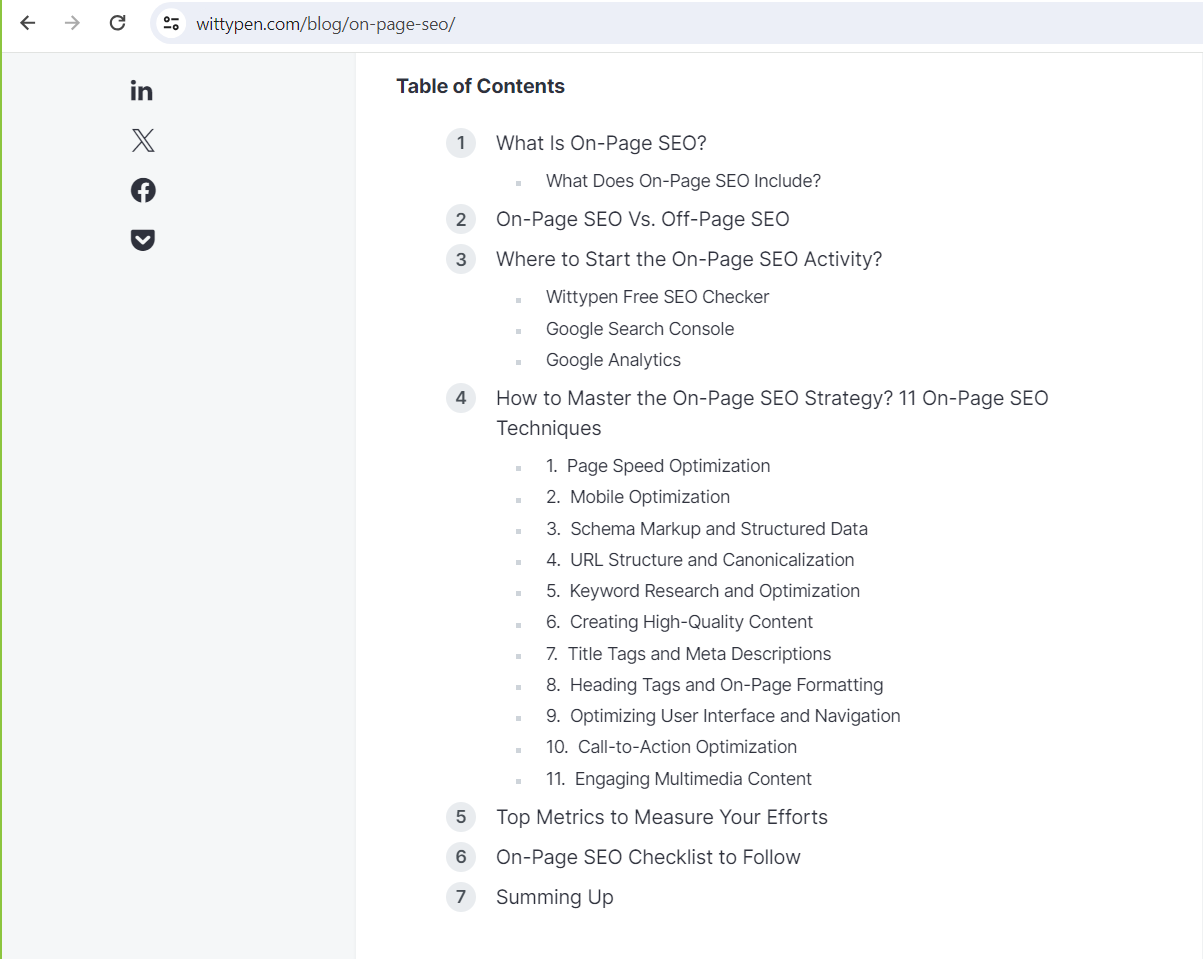
    What Does On-Page SEO Include?

    The main purpose of an on-page SEO checklist is to improve your site’s visibility and ranking. On-page SEO thus includes optimizing your content using on-page SEO techniques. 

    1. What Is On-Page SEO?

    On-page SEO is the fundamental part of everyday SEO. It is the process of optimizing your web pages and their content for the search engines as well as your users. The primary objective of on-page SEO is to rank pages higher on search engines like Google. This leads to more organic traffic and revenue being directed towards your site. 

    On-page SEO are the on-page factors that can make or break your SEO success. It is a name used to refer to a combination of content and technical SEO that focuses on optimizing individual pages. This is limited to not only content but also extends to titles, links, meta-tags, images, anchor text, images, and more. 

    To ensure success, you must implement on-page optimization techniques that make all these elements work together so that your content is optimized for search engine algorithms while also being valuable for your audience. The basis for good on-page SEO lies in showing Expertise, Authoritativeness, and Trustworthiness (or EAT).

    2. Key On-Page SEO Factors

    One of the most important things to remember is that on-page SEO depends on the actual content of the page. This means that everything within the site can affect the SEO. The key on-page SEO factors are:

    Content: The content of the article should be unique, fit the search intent, anticipate and answer the user’s next query, and include relevant keywords from the on-page SEO checklist.

    Title Tags: The title tag is your content’s name on Google which determines if people will click your content. Thus, make sure it answers their question, includes keywords, and grabs their attention with strategic words or numbers. 

    Headings: Headings show content structure to readers and search engines. There are six types, from H1 to H6, with H1 being the largest and most important. Ensure that you use keywords in your headings.

    URLs: To describe the page clearly, use keywords in URLs. Keep the URLs short and easy to understand by both search engines and visitors.

    Internal Linking: It refers to the addition of relevant links within your content, helping search engines and users navigate your site effectively. Aim for 2-3 internal links per article, or create pillar content if needed.

    Image Optimization: Enhance the appeal of your content by using images. Original images boost SEO, but if unavailable, use relevant images. The images must have alt texts for accessibility and descriptive texts to give context to search engines.

    Once you have mastered all these factors and fulfilled your on-page SEO checklist, you will be able to achieve optimal website visibility and search engine ranking. 

    Technical Optimization On-Page SEO Checklist

    Technical SEO has the power to make or break your rankings. However, the fortunate part here is that technical SEO problems are relatively easy to fix, especially when you follow the given on-page SEO checklist. 

    1. Focus on Title Tags and Meta Descriptions

    The title tag is your webpage’s title, as seen on the search engines. This means that whenever you search for something on Google and click on the article’s name, the page that opens up is the title page. You must make the title tags as relevant as possible because visitors will click on them only if the content is relevant to their search. 

    Here are the things to take care of in your title tag:

    • Add your keyword
    • Do not overload it with keywords 
    • Ensure that you place the main keyword before the other keywords
    • Its length should be within 60 characters
    • Do not use all-caps

    Add numbers or names that appeal to people (for example, 8 amazing B2B marketing ideas that will get you ahead in 2024)

    It is not similar to the H1 tag – which is your article’s title on the site. This is because some texts work better if the title tag is different than H1. 

    Meta descriptions are under 160 characters in length and give a summary of your webpage. Make sure that they accurately represent what the page is about and use the most important keywords, as they play a major determining role in whether the target audience will click on them or not. 

    Effective meta descriptions are pivotal to optimizing your SEO outcomes. Their objective is to encourage clicks, thereby potentially boosting your page’s ranking on a search engine’s results page.

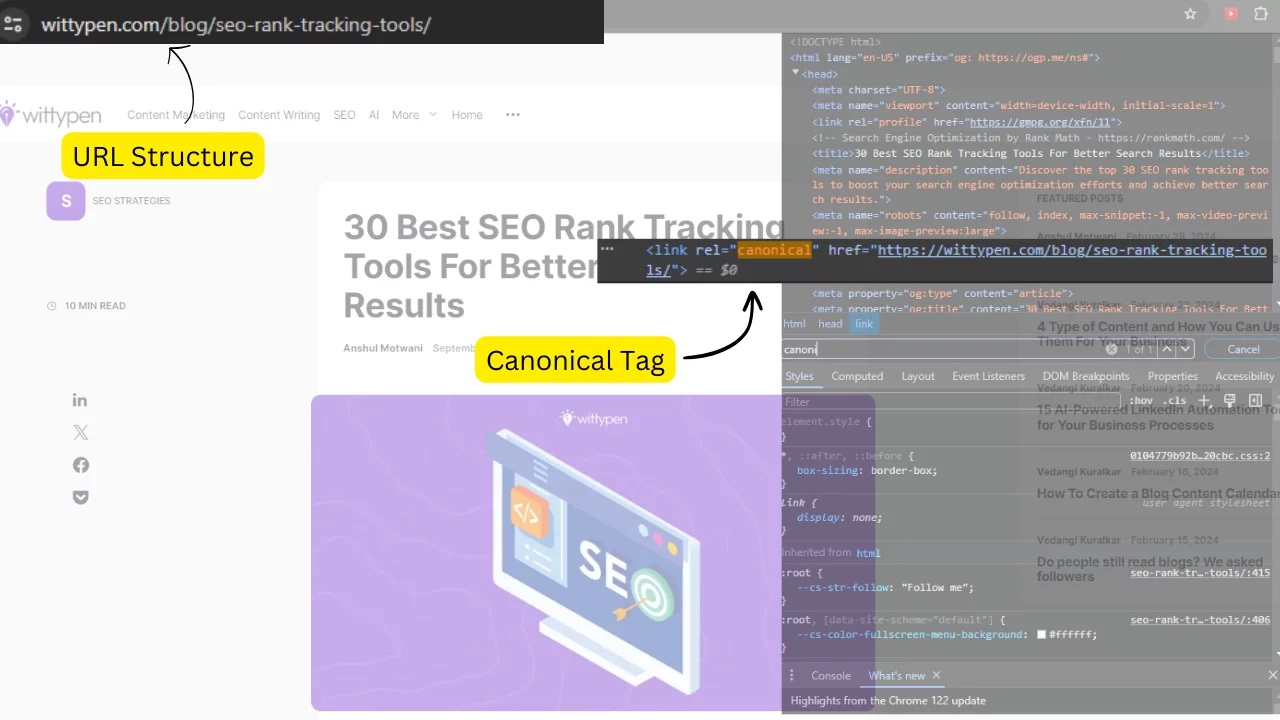
    2.Follow a Proper URL Structure

    You must implement a URL structure that is optimized for SEO and usability. An optimized URL structure will increase click-through rates from search engines and internal site navigation. 

    Key features of a good URL are:

    • Short and easy to understand 
    • Should contain keywords
    • Should communicate what the page is about
    • Separate words using a hyphen
    • Do not mention years that might change

    Lets consider following URL: https://blog-api.wittypen.com/content-writing-tools-for-seo/

    When users see this URL, they know what the article is about in just a glance. It also ensures that the search engine spiders know the content of your page before visiting it, making indexing your page easy for them. Additionally, the URL allows you to naturally add your keyword in one more place.

    However, if your URL is https://example.com/?information=1.html: users will not know what the page is about. Such a URL also makes it difficult for the spider to view the article’s content. 

    URLs play a role in your site’s initial ranking and page grouping. Considering the role a proper URL structure plays in your site’s performance, it is an important part of your on-page SEO checklist. 

    3. Ensure Keyword Optimization

    To ensure that your site appears in relevant search results, you must integrate keywords into your page. You must also undertake keyword research to find out what words or phrases people use to find pages like yours. 

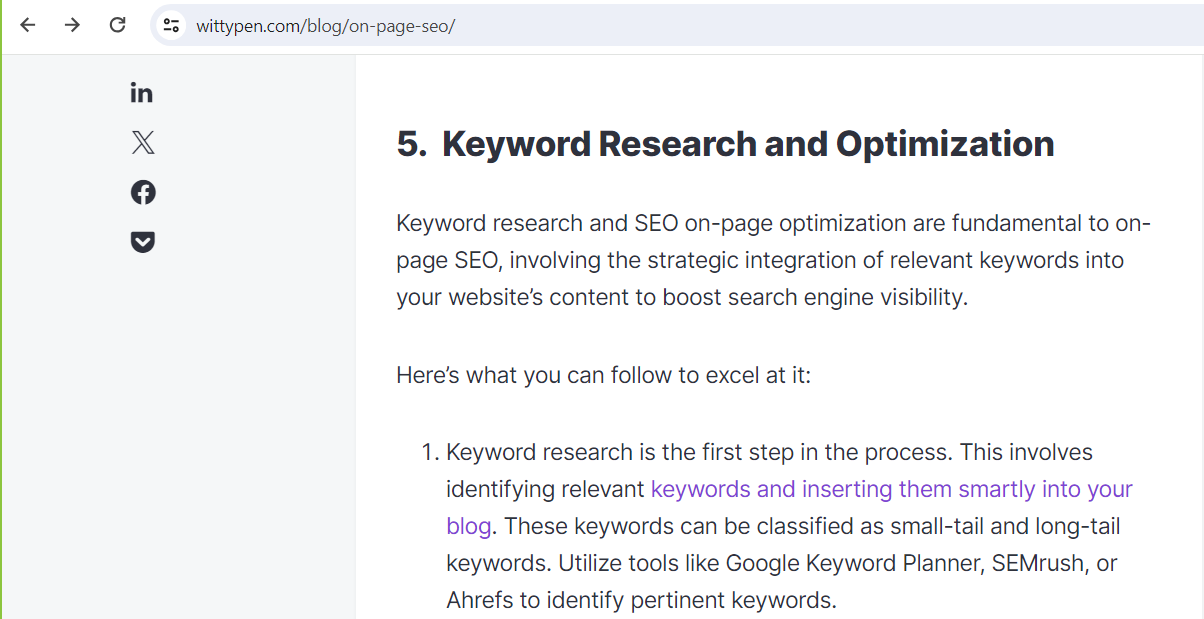
    Considering that Google gives more weight to the first 100-150 words of a page, you must use your keyword once here. For example, in this article, the keyword ‘on-page SEO checklist’ is used in the initial 100 words. 

    Another way to optimize keywords is to use them in H1, H2, and H3 tags. In this article, the term ‘on-page SEO’ is used in the first subheader itself. 

    You must ensure that the keyword density of your focus keyword and other related and long-tail keywords is maintained at 1-2% throughout the body of the content. Critical on-page elements where you must include keywords are:

    • Titles
    • Headers
    • Meta Tags
    • Body Content
    • Images

    These need to be incorporated strategically to ensure that the search engines detect it and match it with relevant queries. Keyword optimization strategies that you must follow to ensure success are:

    • Avoid keyword overstuffing, as this can lead to poor user experience and penalties from search engines
    • Use the keywords sparingly and strategically where they have relevance and contextual appropriateness 
    • Regular monitoring and analysis of keyword performance is a must for successful keyword optimization

    An added advantage of this is that it will make the reading experience of your visitors natural and user-friendly. 

    4. Make Effective Headings and Subheadings 

    Headings and subheadings are crucial elements of the on-page SEO checklist because they assist search engines in understanding the structure and main content of the website. They also enhance the experience of your visitors by providing them with a clear hierarchy and enabling them to scan your content. 

    To ensure that you have effective headings and subheadings, you must implement the following practices:

    • The headings should provide clear, concise descriptions of the content that follows.
    • Headings should be further optimized using primary and long-tail keywords. Primary keywords are usually used in H1, and other relevant keywords are used in H2 to H6. 
    • While H1 should be used only once throughout the article, H2 to H6 subheadings can be used as many times as needed. 
    • Avoid misusing or overusing heading tags, as this will distract the search engines from identifying the main content and thus potentially undermine your SEO efforts.

    Content Optimization On-Page SEO Checklist

    When it comes to content optimization, unleash the power of on-page SEO techniques by ticking off every box on your on-page SEO checklist. This will guarantee that your content shines and reaches the relevant audience.

    1. Carry Out Keyword Research and Targeting

    The base of keyword research is to identify search queries relevant to your business and customers. It is a 3-step process of finding, sorting, and prioritizing keywords. Let’s simplify this: 

    • Identify Your Competitors: To start with keyword research, check out what keywords your competitors are using. This is because if they are getting results from those keywords, you can too. 
    • Focus on Your Main “Money” Keywords: Also known as “head terms” or “pillar keywords,” these bring in leads, sales, and conversions. They are high-competition, high-volume keywords that give insight into your content. Keywords with transactional or commercial intent tend to have higher conversion rates.
    • Focus on Long-Tail Keywords: These are specific search queries with low volume and are thus easier to rank for. Using long-tail keywords often leads to more conversions. Usually, long-tail keywords have main keywords embedded in them. 
    • Make a Keyword Map: After you have your target keywords, map them to the right pages on your site. Group keywords that answer the same question and focus on each set of keywords to design your site’s structure and potential pages
    • Identify Search Intent: Find out what kind of searches are happening for your keywords – are people looking for information, trying to buy something, or just browsing? Make sure your content matches what they are searching for. 

    Sorting out the right short-tail keywords and long-tail keywords is a small thing to remember that can make all the difference. Identifying the right intent and opportunity considering the search volume is crucial.

    Lastly, identify the questions that visitors are asking related to your keywords, assess your ranking potential for a keyword, and prioritize your tasks accordingly. Keyword research and targeting are thus crucial elements of every on-page SEO checklist. 

    2. Prioritize High-Quality Content Creation

    One of the most vital elements of a complete on-page SEO checklist is content. The amount of content you have can significantly impact your website’s visibility on search engines.

    This is why when you are crafting your content, you need to make sure to integrate your keywords strategically and pay attention to the following techniques:

    • Place keywords early in your content to give them prominence. 
    • Utilize strong tags for your keywords within the article when appropriate. 
    • Pay attention to keyword density; naturally, repeating keywords throughout the page can enhance their presence in the content. 
    • It’s essential to maintain a healthy level of uniqueness and minimize duplication on your website. Google favors unique content, so strive to keep your content as fresh and original as possible. 
    • Focus on creating content that is valuable and relevant to your audience. Think about what they want to know, what problems they are trying to solve, and how your content can help them. 
    • Break up your content with headings, bullet points, and images to make it easy for users to digest. This, in addition to your other on-page optimization techniques, will accurately signal the structure and relevance of your content to the search engines. 

    To ensure high-quality content, you must audit your site’s existing content. Do this by consistently monitoring traffic and engagement levels on your page. This will help you identify areas for enhancement and boost your site’s SEO performance. 

    Make the necessary updates and revisions to ensure that your content remains current and relevant. This will help maintain the quality and effectiveness of your content over time while also signaling to search engines that your site is active and authoritative. 

    3. Optimize Images and Media

    Optimizing images and media is an unforgettable element of a complete on-page SEO checklist, as it leads to more unique page views, backlinks, and shares. To keep the content engaging, add visual content like how-to videos, infographics, illustrations, photos, and more. 

    Tips for optimizing images and media are:

    • While having original images is gold for your on-page SEO, if you do not have any, sourcing quality images is the next best thing. However, avoid using stock photos, as Google detects them as duplicates and does not boost your SEO. 
    • The images and media you use should be relevant to your content, positioned well, and sized appropriately. 
    • Resize and compress your multimedia to ensure that they do not slow down the loading time of your page. 
    • Make sure your images and media are shareable, as this will help in boosting your EAT. 
    • When you save the images and media, use a filename that briefly describes what they are about. For example, an infographic on on-page SEO steps should be named – ‘on-page SEO steps’ and not something random like – ‘123456.’
    • Images and media should have descriptions. This will add an extra layer of context and engagement for your audience and will help drive your point home. 
    • Ensure images and other forms of media use Alt text (i.e., alternative text). This is included in a page’s HTML code to describe an image. It assists search engines and increases the accessibility of your page. Optimizing your images and media’s alt text leads to more traffic from search engines like Google and Google Photos.

    User Experience On-Page SEO Checklist

    Lastly, it is crucial that you do not forget about user experience as one of your on-page optimization techniques. Along with your complete on-page SEO checklist, it is all about keeping your visitors happy and engaged. This will ultimately boost your SEO rankings. 

    1. Guarantee Website Speed and Mobile Optimization

    Ensuring your website is mobile-friendly is crucial, especially since Google prioritizes mobile-friendly sites for rankings. Since mid-2019, Google has adopted mobile-first indexing for all websites. 

    Best practices to make your site mobile-friendly are:

    • Choose a responsive website theme to ensure it adapts well to mobile devices. When building your site, aim for a design that looks great on both – desktops and mobile devices to improve search engine rankings. 
    • Make navigation and content readability seamless on mobile devices. 
    • Optimize titles and meta descriptions specifically for mobile search engine results pages (SERPs). 

    Additionally, it is vital to check your site’s loading speed. A fast-loading site is crucial for better rankings, as search engines may penalize slow-loading pages. 

    Furthermore, securing your site with HTTPS is essential, as it is a confirmed ranking signal for Google. Ensuring your site is HTTPS-protected not only boosts security but also enhances your site’s credibility and trustworthiness. 

    Lastly, address any crawl errors promptly. If Google encounters crawl errors, it may struggle to index your pages, resulting in lower rankings. Keeping your site error-free ensures smooth indexing and better visibility on search engine results pages. 

    2. Facilitate User-Friendly Navigation

    User-friendly navigation is an essential component of your on-page SEO checklist. When visitors land on your site, you want to make it super easy for them to find what they are looking for.

    This is because if your site is a maze, users will quickly get frustrated and bounce right off. In contrast, if it is a well-organized, easy-to-navigate space, they will stick around longer and explore more.

    Some tips for ensuring user-friendly navigation of your pages are:

    • Logically organize your menus and submenus with the help of H1s, H2s, H3s, and so on.
    • Use descriptive labels for your images and media that make sense to your audience. The labels should not be vague or confusing but accurately reflect the content they lead to. 
    • Incorporate internal links throughout your content to seamlessly guide users to related pages.
    • Do not overwhelm your visitors with too many menu options. Keep your navigation menu clean and streamlined. 
    • Incorporate breadcrumbs as they provide users with a clear path back to where they came from, enhancing navigation and user experience. 
    • Ensure your navigation is just as easy to use on mobile devices as it is on desktops. Responsive design is key here. 
    • You can also add a search bar to your page, making it easy for users to find what they are looking for and enhancing on-page SEO effectiveness.

    How Does an Ideal On-Page SEO Checklist Look Like?

    To optimize your website’s performance, ensure effective indexing by search engines, and boost search rankings, implement this ideal on-page SEO checklist:

    • The title tag and meta description must summarize the page’s content. 
    • Ensure the URL contains keywords and is short and easy.
    • Naturally integrate keywords while maintaining a 1-2% keyword density.
    • Add keywords in titles, meta tags, headers, images, and body content.
    • Use effective headings and subheadings to structure the content. 
    • Create valuable, relevant, and engaging content for visitors.
    • Add engaging visual content.
    • Optimize the images and media by adding descriptions and compressing files to prevent slow loading.
    • Have a fast-loading, mobile-friendly site that is HTTPS-protected. 
    • Improve user navigation by organizing menus and sub-menus logically using heading tags H1 to H6. 
    • Incorporate internal links to guide users to related pages.

    The perfect assistant to the above on-page SEO checklist is Wittypen’s free on-page SEO checker. It is designed to give customized insights and expert tips aligned with the industry’s best practices for optimizing your website’s on-page SEO. 

    To use Wittypen’s on-page SEO checker, you need only input your published URL and the target keyword. In just one click, it will give you insights into your page’s overall performance, highlight successful strategies, identify critical issues that need to be fixed, and suggest potential improvements to enhance your site.

    The perfect assistant to the above on-page SEO checklist is Wittypen’s free on-page SEO checker. It is designed to give customized insights and expert tips aligned with the industry’s best practices for optimizing your website’s on-page SEO. 

    To use Wittypen’s on-page SEO checker, you need only input your published URL and the target keyword. In just one click, it will give you insights into your page’s overall performance, highlight successful strategies, identify critical issues that need to be fixed, and suggest potential improvements to enhance your site.

    Conclusion: Scaling Your Page with On-Page Optimization Techniques

    When you tackle your on-page SEO checklist and nail those techniques, you are not only making your content look good for search engines but also super user-friendly and engaging. From crafting compelling meta descriptions to incorporating mobile-friendly design elements, every aspect contributes to the overall performance and effectiveness of your online presence.

    Thus, with the help of your complete on-page SEO checklist, you have everything you need to succeed in the online world. However, on-page SEO steps are not just about ticking off boxes. It is about connecting with your audience, staying up-to-date with the latest trends, and constantly improving your website’s performance. 

    So, as you continue on this journey, remember to keep experimenting, keep learning, and keep pushing yourself to new heights. With the right mindset, the right technique, and the right tools, there is no limit to what you can achieve with your page. 

    Optimize your website effortlessly with Wittypen’s free On-Page SEO Checker. Generate a free SEO report on your blog and get actionable insights to improve your rankings. To get started, just add your blog URL and keyword.

  • B2B Writing Guide: How To Start And How To Monitor

    B2B Writing Guide: How To Start And How To Monitor

    What is B2B Writing?

    The B2B, in B2B Writing, stands for ‘Business-to-Business‘. As the name gives some of it away, B2B writing is when businesses create content, keeping other businesses in mind as a part of their target audience.

    While the popular content forms are blogs or case studies, the evolving nature of business has also brought about a broader and more robust scope to B2B writing. Along with the popular long-form content, B2B writing has significantly impacted social media marketing strategies as well.

    Ultimately, making the most impact in B2B writing lies in meeting the needs of a business, not direct consumers.

    With this quick preview, let’s highlight the key reasons B2B writing is a must for every business.

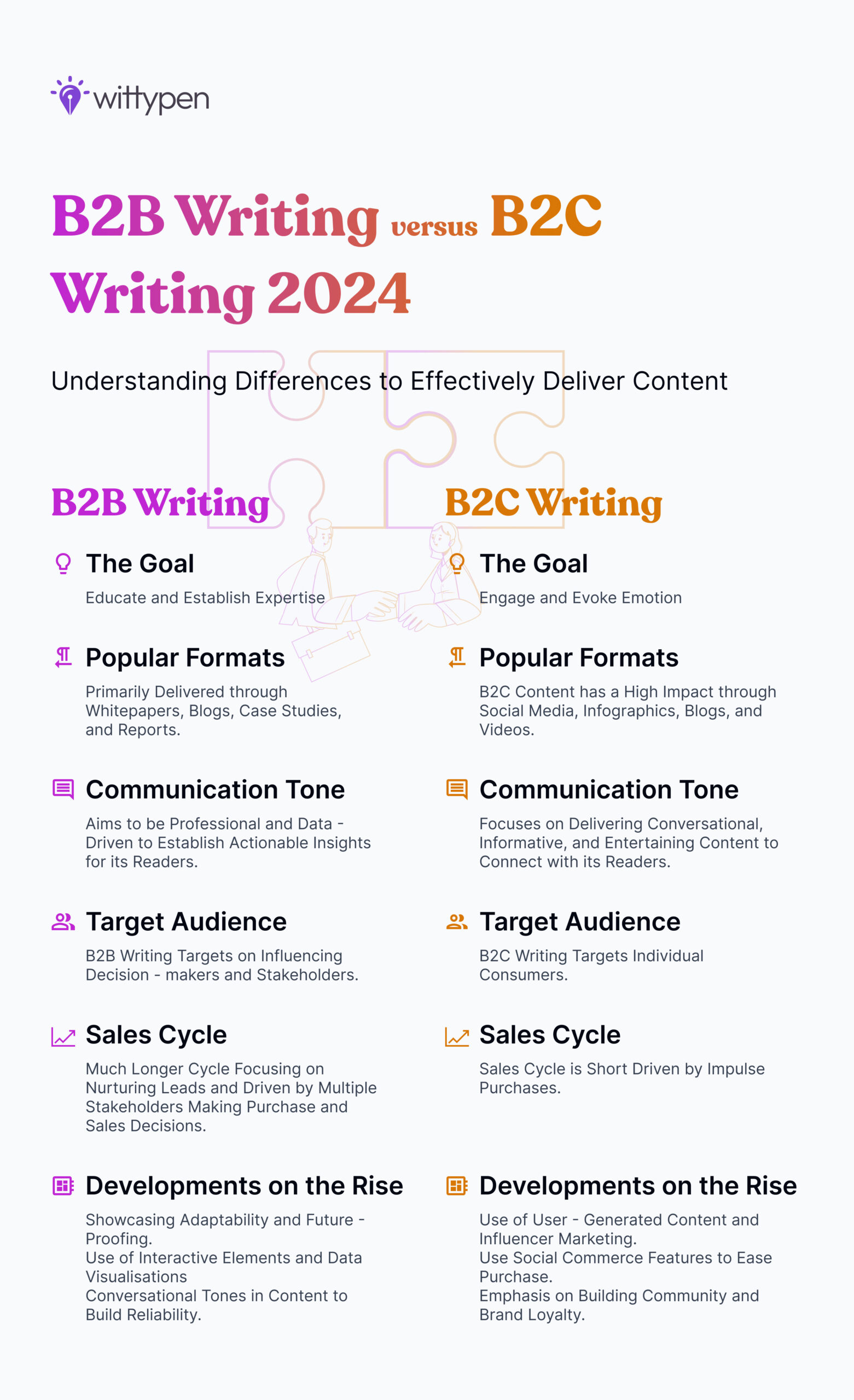
    B2B vs. B2C Writing: Clearing Up Differences

    B2B Writing Vs B2C Writing

    Copy Credits: Venkataraman Mahalingam

    Why Use B2B Writing?

    To shed light on the importance of B2B, here are the three key reasons businesses ought to use B2B content writing,

    Leads & Sales

    B2B writing has the power to boost reputation and awareness. In addition to these two elements, high-quality content, subtle but strategic CTAs, research, well-structured testimonials, and delivery, holds the potential to attract qualified leads and boost sales. You’ll be amazed to know that according to Hubspot, blogs and website content are the two channels with the largest ROIs.

    Balanced Cost Impact

    Among the many effective B2B marketing channels, like paid ads and events, B2B writing delivers a higher impact at lower costs. B2B writing formats, such as blogs and case studies, drive organic web traffic, and since organic business growth is unpaid, it is a very cost-effective long-term strategy.

    Brand Awareness

    When delivered consistently through strategic channels, B2B writing allows a business to quickly reach a wider audience and gain a positive brand image. In fact, 84% of B2B marketers confirm that content boosts brand awareness and is one of the pertinent goals for businesses worldwide.

    Position as a Thought Leader

    B2B writing helps establish a business’s expertise in the field by showcasing its willingness to impart knowledge and educate its viewers and clientele. With quality B2B writing, a business has the potential to be regarded as a thought leader in the field, boosting trust and reliability metrics amongst potential clients.

    Since achieving such crucial business goals has been established as the intent behind B2B writing, before understanding how to create impactful B2B writing content, it is also essential to know how it stands apart from any other business model.

    A Deep Dive Into Types of B2B Writing

    With a clear understanding of the focus, purpose, and critical details of B2B writing, let’s dive a little deeper into the popular formats of B2B content writing, what they are used for and their impact. Here are the top types of B2B writing,

    1. Blogs

    For B2B content creation targeted at improving readers’ knowledge and establishing a business’s expertise in their niche and industry, blogs are one of the most effective forms of B2B writing. In fact, nine out of ten B2B marketers use blogs to achieve their marketing goals, making it one of the most popular and effective forms of B2B writing.

    While the approach to delivering content with such goals is always comprehensive and research-driven, blogs as a form of B2B content creation can cater to all levels of the marketing funnel – from awareness to lead conversion.

    2. Case Studies

    Case studies are testimonials or showcases that allow your customers to understand how they will benefit from your product or service. This form of B2B writing is built around a detailed yet relatable scenario wherein a challenge was overcome thanks to being a customer.

    Built around indisputable and rigorous internal research data, case studies play a big role in persuading your reader to become your customer. In essence, they help generate an organic lead.

    3. Landing Pages

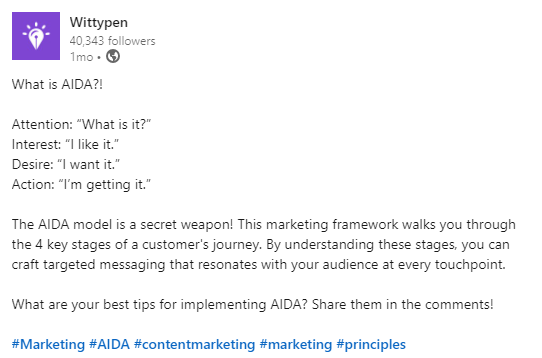
    Source: LinkedIn

    This B2B writing format is the airport of B2B content. When your potential customer clicks on a link from your promotions, ads, search results, or even your webpage, the landing page is quite literally where they land. Now, imagine how you’d want that to be.

    As you may have already guessed, landing pages focus heavily on effective copywriting, attractive CTAs, and crisp information delivery. In short, they can hold your customer’s attention just like LinkedIn’s landing page does. While the length of a landing page depends on the typesetting factors and design, it plays a vital role in boosting brand image and lead generation.

    4. Whitepaper

    Whitepapers are essentially comprehensive reports created with primary research data or verified secondary data. These B2B content formats are designed to showcase a business’s position as an expert in the field and play a massive role in how potential customers perceive the brand’s reliability and reputation. 

    Source: Zendesk

    These reports are quite in-depth and related to a specific niche; only invested customers would require this data. Considering this, whitepapers are often not exactly freely accessible. Like the Zendesk whitepaper example we’ve shared, businesses ask for basic contact details such as name, contact number, and email before sharing whitepapers to track leads, interest levels, and potential conversions.

    5. Newsletters

    This B2B writing format is also quite popular amongst B2C businesses and content creators. Newsletters are a form of email content and regular communication, often delivered via email to retain everyone who has subscribed.

    Newsletters can be long-form or short-form content with relevant backlinks. They often cover industry news, company updates, thought leadership pieces, and exclusive content offers. Newsletters are how businesses keep clients and interested leads updated on their growth, strengthen their position as thought leaders, and also encourage sales.

    Apart from newsletters, emails are also forms of B2B writing used as short, often personalized, and targeted marketing strategies to attract potential clients to their landing pages, blogs, and, eventually, products and services. 

    6. Use Cases

    Use cases are a more straightforward form of ‘case study‘ that highlights where and how your product or service is valuable. This B2B writing format focuses on delivering simple situations, thereby boosting the product or service’s image and impact and is usually short-form B2B content.

    While use cases are often perceived as a B2C content format, they are predominantly used in B2B SaaS content writing. An example can be presenting a use case for a project management software company by highlighting how its product solves communication issues through its automated mail feature.

    7. Technical Documentation

    Technical documentation is a vital part of every business, whether they are B2B or B2C. Each technical document, whether a user guide or troubleshooting manual, contains an in-depth guide to using your product.

    As a part of the B2B content journey, technical documentation facilitates an informed buying decision as it transparently shares the functioning and best use of what you offer. It also helps the existing clients with a seamless troubleshooting experience in case they need support addressing an issue.

    8. Product Descriptions

    Source: SAP

    As the name suggests, this B2B writing format involves delivering compelling descriptions of your products and services. This allows your potential clients to understand what you can offer in a brief yet coherent manner. Effective product descriptions are short, easy to grasp, and cover your product’s advantages and unique selling propositions (USPs). The SAP HCM solution is an excellent example of an effective B2B product description.

    9. Social Media Posts

    Source: Wittypen

    Social media posts include content for platforms like LinkedIn, Twitter, or Instagram, etc. This B2B content format has raked in quite a lot of popularity on account of how effective it is in building brand awareness and stitching a persona around a company’s values. For example, B2B technology giant Continental posted content highlighting the importance of staying healthy, which helps boost it as a top employer and organization with great ethical principles. 

    With so many diverse formats, creating quality content while focusing on developing innovative products, marketing strategies, and business continuity can be challenging. That’s where guidance from content experts like Wittypen, who can deliver top-quality content seamlessly, becomes vital to building your business.

    Tips for Writing B2B Content and Best Practices

    Now that we have cleared the air around the types of B2B content, let’s equip you with some tips and best practices. Here are key tips for writing effective B2B content, divided into focus on audience, content and SEO. 

    Understanding the Target Audience

    1. Research and Ground Work: While writing B2B content, your target demographic should be at the top of your mind, so do not compromise on your research. With the help of internal data and data analytics, ensure that you understand who you are talking to.
    2. Match Wavelengths with Language: Be conscious of the skillset and background of your target audience while typing up your content. For certain products and services, it is right to include technical jargon because the nature of the product is such that every stakeholder must have an in-depth understanding of it. They may even appreciate it as a show of respect. In cases where the buyers are more sales and negotiation-driven than technical, such content fails to attract leads.
    3. Understand Your Market Funnel: Understanding how your audience feels about your brand and where they are in the purchase cycle is crucial. With this knowledge, you can create appropriate content strategies and effectively write for that stage.

    Structuring Compelling B2B Content 

    1. Follow a Structure: Ensure you use the right hook, introduction, body, and CTA structure based on the intent and approach of your content. Informational and educational blogs require fewer CTAs, as action is not the intent, whereas product descriptions and landing pages need more alluring hooks and CTAs to attract leads.
    2. Build a Compelling Narrative: Content must be and stay engaging. Delivering your content as a narrative is much more engaging than a dry, unrelatable information hotchpotch. 
    3. Check and Check Again: To avoid any possible grammatical errors, proofread your B2B writing and have a qualified editor review your content, so you can deliver your best work.

    Incorporating SEO Best Practices 

    1. Keyword Research: SEO rankings are the key to increasing website traffic and lead generation. For a powerful online presence, ensure your content is optimized with well-researched and not overly generic keywords.
    2. Build Backlinks: When your content or website link appears on multiple websites, that counts as a backlink. It is often done when your content is used as a reference for data. Search engines understand this as a sign of credibility, thereby boosting your SEO ranking, and improving your visibility. By writing educational content, delivering fresh perspectives, or collaborating with other websites on related topics, more and more websites will be encouraged to backlink your content.

    The Importance of Monitoring B2B Content Performance

    While regularly publishing B2B content is an excellent step toward growth and success, it is not the end of the line. By reviewing how your content performs, you can identify how your viewers feel about your brand and measure your growth against your efforts. This understanding helps facilitate better strategy and is crucial to business continuity.

    Next up, we’ll be equipping you with the key metrics with which you’ll be able to track your B2B content.

    Key Metrics to Track for B2B Content

    Here are the metrics used to monitor your B2B content’s performance,

    1. Conversion Rate

    This measures how effective your content is in converting leads into potential customers. It is measured by the percentage of readers or visitors who take action after landing on your content page, such as the number of times a whitepaper was downloaded or the number of clicks on the CTA after reading a blog. 

    2. Return on Investment (ROI)

    This is the revenue generated or cost saved from your B2B content efforts, such as revenue from leads generated versus the cost involved in researching and writing the content.

    3. Average Engagement Time

    This is the average time your reader stays on your website or content page without switching to another page. Higher engagement times might mean users enjoy your site, and they are measured in seconds.

    4. Bounce Rate

    Bounce rate is the percentage of people who leave your site before viewing another page or completing a specified action. Higher bounce rates are bad; they show that your content isn’t appealing enough for them to take action.

    5. Social Media Engagement

    Every social media platform has a professional dashboard to measure this. Often, it is based on either interactions or click-through rate (the number of times the reader clicks on the link after viewing the content).

    Tools for Analysing B2B Content Effectiveness

    With these metrics in mind, here are tools that make analysing these metrics easier,

    Web Analytics with Lead Tracking

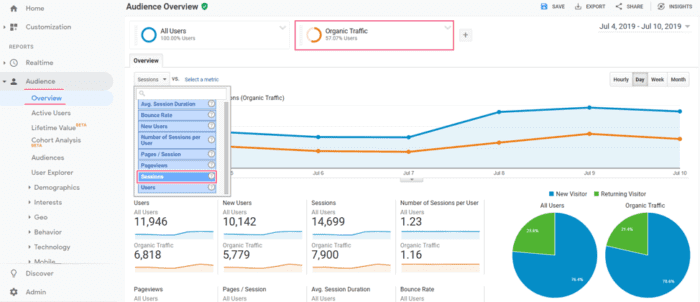
    Web Analytic Tools are available on platforms like Google Analytics with advanced configurations. They allow you to track website traffic, user behaviour, and, most importantly, how visitors interact with your content to become leads (e.g., downloading a white paper after reading a blog post).

    Heatmaps

    Visualise user behavior on your B2B content pages with heatmaps. These tools show where visitors click, scroll, and spend their time, revealing areas of engagement or confusion and helping you refine your content for a better user experience.

    On-Page SEO Checker

    SEO audits are vital to assess the ranking and visibility of your B2B content. On-page SEO checkers offered by content experts like Wittypen generate a free detailed SEO report for your blog and provide actionable insights to improve your SEO ranking.

    Social Media Professional Dashboards

    Instagram, Facebook, and other social media platforms offer professional dashboards specifically designed to review the number of accounts your content has reached, the number of likes or interactions, and growth. 

    Conclusion

    There’s no doubt that B2B writing is crucial for every relevant business to maximize leads and sales. Our comprehensive guide, which highlights the key tips to keep in mind and when to use content forms, will equip you to deliver effective B2B content.

    If you feel balancing effective content with your business’s strategic targets will prove to be challenging to manage alone, don’t worry; content outsourcing is the norm! You can contact our expert team at WittyPen for seamless, top-notch content writing services personalized for your business model. 

  • SaaS Content Writing 101: How to Write for Leads

    SaaS Content Writing 101: How to Write for Leads

    The competition in the SaaS sector is beyond fierce—it’s relentless. Success hinges not only on the innovation of your product but also on your ability to create a robust lead-generation pipeline.

    According to Forbes, 74% of companies report an increase in lead generation through content marketing. Add to this the fact that organic search accounts for 51% of content consumption, and you can gauge its critical importance. The numbers highlight the undeniable impact and effectiveness of content marketing strategies in the SaaS industry.

    SaaS content writing stands out as one of the most effective strategies to achieve this and gain a competitive edge. It not only helps attract prospects but also plays a crucial role in converting them into valuable leads.

    Read on as we explore the intricacies of content writing for SaaS and discuss how it can be leveraged to not only attract but also convert leads effectively. Let’s dive in!

    The Impact of Content in SaaS

    Source

    When it comes to SaaS, having an innovative and feature-rich product alone won’t suffice if you lack the visibility to attract potential prospects. That is where content comes into the picture. 

    Content serves as the gateway to securing prime real estate on search engine results pages (SERPs)—specifically, the coveted first page. Why is this important, you may ask? The answer is that only 0.44% of internet search users ever get to page two of the SERPs. 

    The first few organic listings on page one also boast an average click-through rate of nearly 28%. This makes it easier to comprehend why 45% of B2B marketers plan on increasing their content marketing budgets this year.

    Additionally, content plays a crucial role in establishing thought leadership and credibility within the SaaS industry. It allows SaaS companies to educate their target audience, address pain points, and showcase expertise, which ultimately helps them build trust and rapport with potential customers.

    How to Create Compelling SaaS Content for Effective Lead Generation?

    When it comes to B2B SaaS content writing, creating engaging content that drives effective lead generation requires a strategic approach.

    Here’s a comprehensive guide to crafting SaaS content that attracts and converts leads:

    1. Understand Your Target Audience

    Source

    The foundational step to effective content writing for SaaS begins with a deep understanding of your target audience (TA).

    While this may seem obvious, unlike generic content, SaaS content writing involves a lot more complexity.

    Here’s why:

    1. Your target audience is not looking for a product; they are seeking a solution to a specific problem.
    2. Generic content is more focused on entertainment and awareness, SaaS content needs to be tailored in a manner that leads your target audience further down the sales funnel.
    3. There are several stakeholders involved in the decision-making process of investing in a SaaS product. Your content will have to target everyone, from the primary decision-makers to the users who benefit most from your solution. 

    So how do you get to know your target audience better? This answer is Customer analysis. Simply put, customer analysis involves using your existing customer data from all touchpoints to understand their pain points and needs.

    The next step is to build detailed customer profiles, which, in essence, are fictional representations of your ideal customer base. At this stage, your focus should be on demographics, firmographics, and general buyer behavior. 

    Once you have this data, your focus should shift to building elaborate buyer personas. The data involved here includes psychographics, preferred information channels, and challenges, to name a few. 

    With these personas in place, you will now be equipped with all the information you need on how to tailor your SaaS content writing for maximum impact.

    2. Craft Compelling Headlines and Introductions

    No matter how well-written the meat of your content is, it won’t bear any fruit if you cannot get your target audience to read it in the first place.

    The internet is awash with content, and in fact, we generate about 0.33 Zettabytes of data (that’s about 328.77 million terabytes if you are unfamiliar with the term) every single day. 

    Swiping every few seconds is now muscle memory, thanks to the abundance and excessive consumption of short-form content. That leaves you a few seconds to capture your target audience’s attention and here is why you need to pay special attention to your headlines and introductions. 

    Your content’s headlines are the first touchpoint that captures attention and determines whether a reader will engage further with your content.

    Here are a couple of key pointers to keep in mind when crafting engaging headlines:

    • Your headline should be clear, concise, and reflect your value proposition. Prioritize clarity of creativity. 
    • Use headlines that create FOMO and use action verbs that will encourage users to interact with your content. 

    Once your headline has grabbed your target audience’s attention, your introduction should continue to hold that attention, as it will set the stage for the value your content will provide.

    Craft your introduction with the following points in mind:

    • Start with a hook that piques your reader’s curiosity. This can be a fact or a question that highlights the customer’s pain point. 
    • Then, quickly establish relevance and demonstrate how your product can address that pain point. A sneak peek of the benefits can be that gentle nudge to encourage them to engage further with your content. 

    3. Structure Your Content for Lead Generation

    Source

    Your next order of business is to source your content in a manner that makes it a lead-generation powerhouse. 

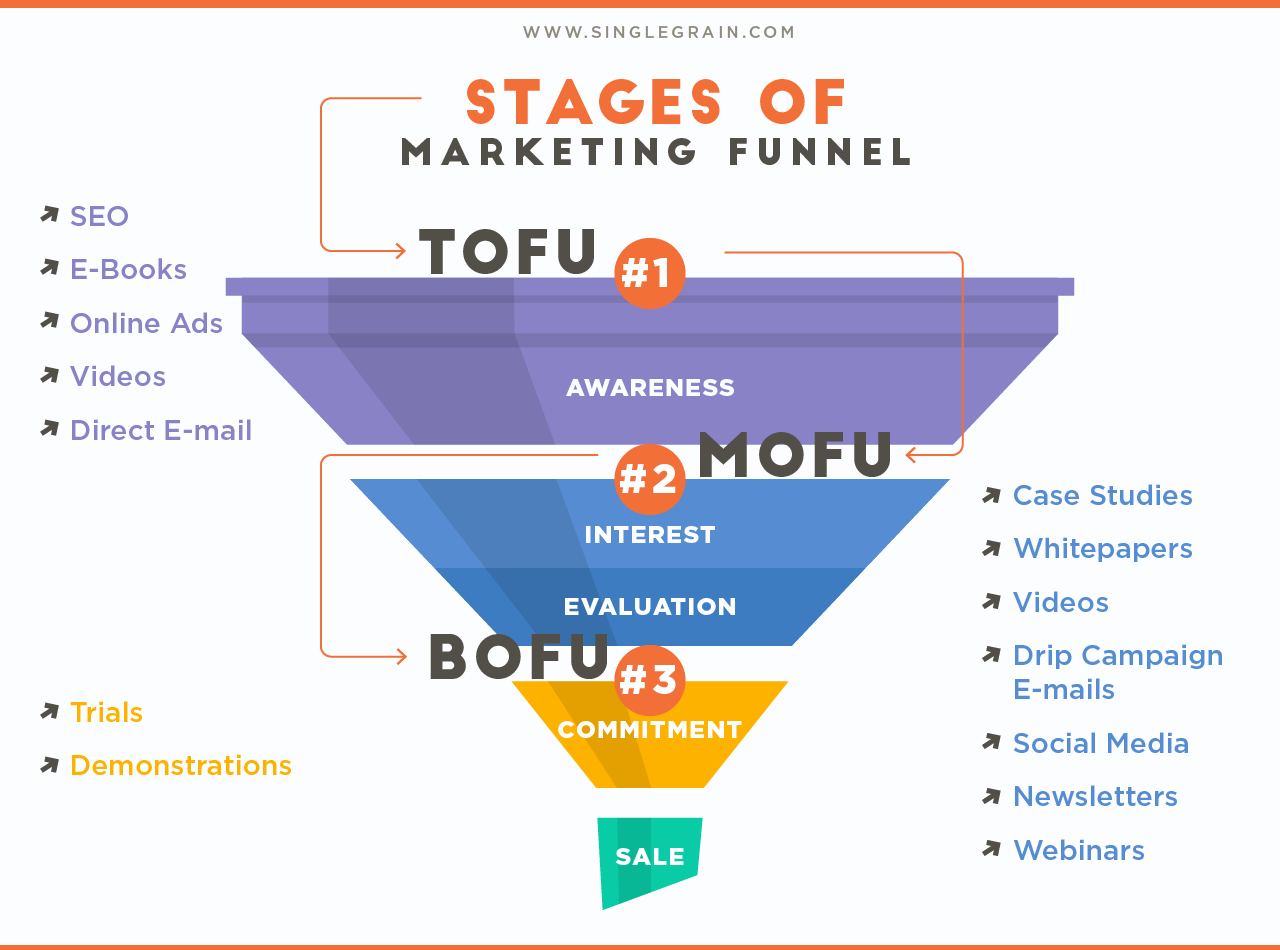
    If you are writing top-of-the-funnel content:

    • Your content should capture the attention of potential leads with broad, informative topics that address common industry challenges.
    • The agenda here is to establish authority and trust and lay the foundations for deeper engagement. 

    As leads move down the funnel, your content must evolve to reflect their journey. In the middle, focus on demonstrating the unique benefits of your SaaS solution.

    • Highlight any case studies and comparative analyses to differentiate your offering from the competition.
    • Your content here should start to address more specific problems, and you should align your content with the nuanced needs of your audience.

    If you are writing Bottom of the Funnel, content should be conversion-oriented. Here, use detailed product guides, free trial offers, and compelling calls to action. The goal here is to reassure leads that your solution is the right choice and to provide them with all the necessary information to make an informed decision.

    You can also tailor individual pieces of content to contain all three types of content strategically. The key is to be informative and walk the fine line between being persuasive and not being too salesy. 

    4.  Utilize SEO Best Practices for SaaS Content

    While there is no specific playbook for SaaS content writing, the following SEO best practices can have an impact on how you rank on search engine results pages (SERP): 

    1.  Focus on understanding user intent and semantics

    The nature of search is changing and so are search engines themselves. Google’s Search Generative Experience (SGE) is but a snippet of where we are headed. Keywords and keyword stuffing no longer cut the mustard, you need to understand user intent and the context behind searches and ensure your content addresses the users’s specific problems.

    Pro Tip: Google’s algorithm takes into consideration over 200 parameters to rank content and it regularly updates it too. (There have been about 36 changes in the past five years.) Stay on top of these updates and alter your SaaS content writing strategy as needed.

    2.  Concentrate on the mobile ecosystem

    As of March 2024, the Mobile vs Desktop Market share stands at 59.91% vs 37.89%. Website visits on mobile were nearly 4x as much as on desktops in 2023 (~40 billion vs ~10 billion). In short, Google prioritizes content optimized for mobile devices.

    Make sure your content is optimized for mobile devices. That said, the focus should not only be on readability, you also need to take into account responsiveness, security, and the overall user experience to rank higher. 

    5. Utilize The Power Of Visuals In Your SaaS Content Writing

    Visuals, when used strategically, are equally, if not more effective, than text when it comes to SaaS content writing.

    That said, here’s how you can leverage them to prove your outcomes:

    1. Use infographics and charts to distill complex data into digestible visuals. This can be a game-changer for sales content writing. 
    2. Maintain a consistent use of brand colors, logos, and imagery to create your unique visual identity to enhance brand recognition and recall among your audience.
    3. Incorporate screenshots and product demos to showcase your SaaS solution in action and provide a tangible understanding of its features and benefits.
    4. Utilize videos to explain concepts, demonstrate processes, or share customer testimonials in a more engaging and dynamic format.

    In short, visuals possess the unique ability to engage with your target audience in a manner that can evoke a reaction and send them further into the sales pipeline. 

    6. Measure the Success of Your Content

    Just like any marketing strategy, data is king when it comes to B2B SaaS content writing.

    Tracking key metrics will give you a holistic view of your content’s real-world impact and give you the insights you need to refine your strategy for maximum lead generation. 

    For example, a high bounce rate (percentage of visitors leaving after one page) could indicate your content isn’t addressing the user’s intent.  This insight directs you to revisit and optimize the content to better align with your audience’s needs. 

    Conversely, a significant increase in time spent on your website or downloads of gated content suggests that you are on the right path. You can recreate what is working in those sections of your SaaS content writing onto those bits of content that aren’t performing as expected. 

    Take Your SaaS Content Writing up a Notch!

    In the highly competitive sphere of SaaS, your content can make all the difference between standing out and getting lost in the crowd.

    The points covered in this blog will help you elevate your SaaS content-writing game, but remember, organic growth does not happen overnight. You need to consistently apply these strategies and stay committed to refining your approach over time.

    If you’re seeking professional writing services, consider Wittypen’s SaaS Content Writing Services. Our team can assist you in crafting a winning content strategy that not only attracts attention but also engages and converts your target audience effectively.

    Let’s work together to make your SaaS content shine!

  • Outsourcing 101: A Complete Guide on Outsourcing Content Writing

    Outsourcing 101: A Complete Guide on Outsourcing Content Writing

    With ever-increasing demand and a rapidly changing landscape, content is almost at the threshold of its next evolution. When it comes to content writing, AI can be inconsistent and downright annoying at times. And we all know that writing with a limited group of content writers is equally arduous.

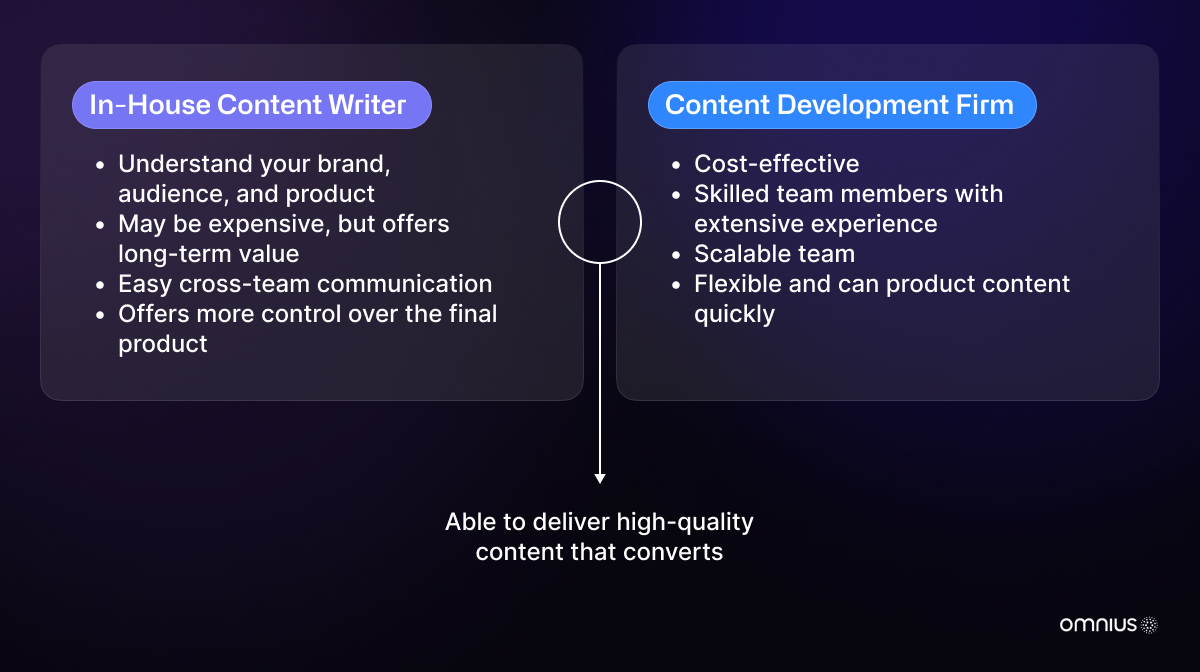
    This is where the debate arises concerning whether to look at outsourcing content writing or keeping it in-house. While some organizations go half-and-half by running in-house content parallelly with outsourced content, others stick to one method.

    Image Source

    Outsourcing content writing is quickly becoming the norm as more and more organizations aim to meet their content creation requirements to attract their target audience and boost conversions.

    When it comes to smaller businesses, especially, outsourcing content writing can quite literally become a boon as it allows businesses to concentrate on other activities. Outsourcing content writing is a quick and very effective way to ensure the efforts taken with a super quick turn around time. And the fact that it’s also cost-effective can not be overlooked, however, as outsourcing content writing can also free up significant portions of the budget.

    In spite of the apprehensions, understanding how to outsource content is sure to be of great help in scaling your content marketing efforts. You’ll be amazed to know that as much as 55% of B2C marketers outsource their content marketing efforts.

    What is Outsourcing Content?

    Outsourcing content writing involves hiring external content writers to create content. As such, content writers who work on outsourced projects create fresh content from scratch.

    Outsourced content writers help strategize a monthly or weekly content calendar, finalize the visuals to accompany the content, and select trending content formats, to increase readership.

    These content writers can be freelancers or even affiliated with content marketing agencies. It is therefore essential to identify the considerations when deciding whether to outsource or create in-house. As such, outsourced content needs an initial understanding of expectations, content production gaps, and budgeting.

    Why Should Companies Start Outsourcing Content Writing?

    Running a business comes with its own set of responsibilities and hurdles that require time and immediate attention for smooth operation. On top of this, creating content regularly and publishing it as per the latest SEO trend or Google update can spiral pretty quickly.

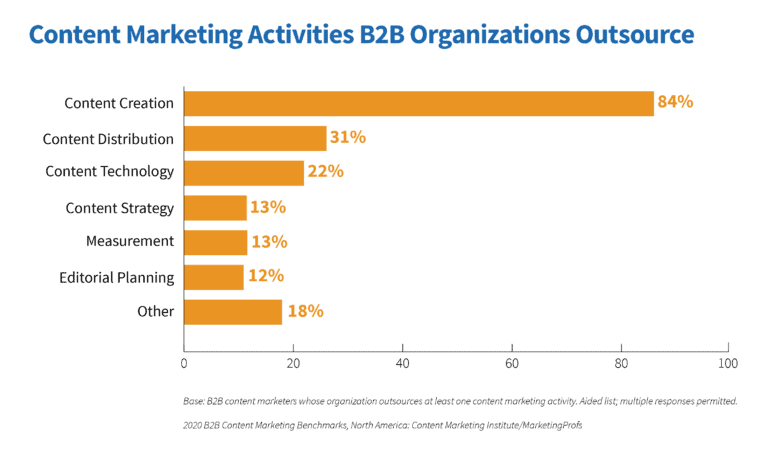
    In 2023, at 84%, content creation became the largest domain that businesses outsourced, and the future of content outsourcing is looking just as bright. Marketing statistics show that the primary industry using outsourcing is the content industry. 

    Image Source

    There are quite a few factors that can help companies decide whether to outsource content or keep it in-house. Here are a few reasons why businesses can consider outsourcing content writing.

    1. SEO Boost: Let’s face it. Not everyone is going to have their SEO game on point. And little knowledge is often more dangerous than no knowledge. Thus, businesses should consider taking help from content writing outsourcing companies.
    2. Reduced Workload: At some companies, increased workload can hinder the proper functioning of different departments, in which case outsourcing can help with productive time management and sharing some of the workload.
    3. Shorter Turn Around Time (TAT): Time management is crucial for any and all success. Likewise, businesses can save a lot of time by outsourcing content writing. If there’s an in-house team available, outsourcing every once in a while also allows them to come up with fresh ideas due to the additional time on their hands.
    4. Efficient Utilization of Resources: Outsourcing content writing also holds the potential to save on money, time, and resources. Imagine how much you can save by doing away with the need to find, onboard, and train people. Outsourcing truly is a way to go.

    Benefits of Outsourcing Content Writing

    Running an organization comes with a whole host of inherent responsibilities. In such circumstances, outsourcing content writing can quite literally be a godsend. Here are some benefits that businesses enjoy when they outsource content writing.

    1. Value Addition:

    When outsourcing content, you can choose to go to subject matter experts. This enables the ‘value’ part of the content.

    The process and TAT of activation of any writing activity involves hiring the writer, training them, etc., whereas when outsourcing content writing, you already have access to a seasoned writer, reducing the time and effort, thereby opening doors to better ROI. Regarding value addition, Wittypen happens to be one of the best if your considering outsourcing your content writing.

    2. Cost Savings:

    With the advent of outsourced freelance writers or writing agencies, a business only pays when it needs content. This can have a significant positive impact on the monthly budget. 

    Costs are an integral consideration for any and all organizations, and likewise, small businesses must look to cost-saving ideas, so they can utilize their budget correctly and spend strategically. It is no surprise, therefore, that at 83%, small businesses are willing to either maintain or increase their outsourcing budgets.

    small-businesses-outsourcingImage Source

    Outsourcing content writing is a better option with regards to using the company budget effectively. And because most content writing outsourcing companies have flexible pay models that they tailor to work best for their specific needs, this only acts as further incentive.

    Outsourcing can also allow organizations to scale up significantly to meet production requirements while cutting down on costs.  

    2. Access to Expert Content Writing

    Nowadays, it’s very easy for organizations to fall victim to mediocrity as a result of rehashing the same content into various formats. This can affect viewership and, eventually, the company’s ROI because readers will get bored and probably abandon the website in the future.

    However, fresh perspectives from outside sources will allow the content to take on a new tone and direction. Outsourcing content writing will bring in new ways of engaging the audience and, most likely, untried ways of promotion as well.

    It’s worth noting that content writing outsourcing companies, in most cases, are industry experts. They know what will increase the views and likes and the types of content that will keep the viewers hooked.

    With writers from sites like Fiverr, Wittypen, or Upwork, you open doors to a vast pool of talented writers who work in various niches. For example, if a company deals with pet grooming, it is always a good idea to go for a writer with previous experience in writing for the niche.

    3. Productive Time Management

    Time management is integral, regardless of what it is that you are trying to achieve. We know that, when it comes to content marketing, trends keep changing. And marketers have to keep up with them to produce content so as to maximize readership. Now, if the in-house content team handles all the content-related tasks, they won’t have enough time to deal with new clients, which can ultimately affect the bottom line.

    By outsourcing content writing, the in-house team can take a substantial bit of the burden off of them and can concentrate on the necessary tasks that the company requires them to deal with immediately. 

    Streamlining the content production process becomes easy once a company decides where to outsource content writing.

    With partners such as Wittypen, businesses can save a lot of time and use it to focus on increasing their profits. Boasting an expansive pool of diverse writers, Wittypen ensures quick content delivery across various niches. Even the writers associated with Wittypen are close to operating on the level of SMEs (Subject Matter Experts), having worked on specific niches for prolonged periods.

    Additionally, the transparency and ease allowed in the payment process and being able to select and pay as per the level of content required only adds to Wittypen’s credence. Wittypen is also making strides on the Artificial Intelligence front with the introduction of AI brief generators and the likes.

    How Do Businesses Outsource Content to the Right Writing Companies?

    Finding outsourcing companies that meet your content needs and strategy requirements can be quite a hassle. Here are a few pointers that businesses can consider when deciding on the right outsourcing partners so that their content queries meet sound solutions:

    1. Defining Goals and Needs:

    To effectively outsource content writing, a business must have a clear understanding of its content marketing strategy and the goals it wants its content to achieve.

    Some may wish to inform or educate their readers, while others aim to entertain or sell their products. Before outsourcing content writing, a business must determine which objectives they want their blogs to fulfill.

    The tone, style, format, language, and perspective are building blocks that help a company convey its message and engage the target audience effectively.

    Outlining content goals helps narrow down the possible content writing outsourcing companies. Here are a few things that can help define the needs of any company looking into outsourcing content:

    1. What is the KPI for your content? What do you want the audience to do with your content, like and comment on, or interact with your website?
    2. Who is your target audience, and what channels do they use to communicate with your company? In what ways does your content fail to meet their demands and expectations?
    3. How frequently are you expecting content when outsourcing content writing?
    4. How much can your company invest in an outsourced content writer?
    5. What type of content do you want the outsource writer to handle?

    2. Research and Evaluate Content Writing Services:

    Thorough research is crucial before investing in content writing outsourcing companies. It’s only after recognizing the pain points and gaps that businesses should select the writer or agency that best suits their content creation needs.

    When outsourcing content writing, it is essential to pick experienced and well-reviewed content creators specializing in the company’s niche. This ensures quality content that meets market standards and ranks on Google.

    Numerous online platforms have a selection of creators who specialize in specific niches and are transparent about the pricing models they accommodate. They have client testimonials on their sites to help businesses make a firm decision as well. Detailed client reviews can assist businesses in understanding the benefits of choosing a freelance company by evaluating experience, response time, revision process, and other essential factors.

    These websites show the previous work that their writers have provided, and some offer free consultations, which allows first-time users to understand their services better.

    A great example of such an online platform is Wittypen, which offers transparency regarding pricing models and the niches that they handle. They even boast case studies on their website for added impact. 

    The platform offers free samples so that companies can understand the workings of the platform clearly and make a well-informed decision that can help expand readership with their collaboration.

    3. Communication and Collaboration:

    Image Source

    Clear and timely communication is key to the timely completion of requirements and the effective use of resources.

    Online tools like Hive, Zoho Projects, and many others allow effective project management among team members, providing them with an effective communication platform. Likewise, online content writing outsourcing companies utilize well-known tools like Trello, Wrike, and Slack to ensure smooth communication and efficient content production.

    That said, platforms like Wittypen have ensured that writers and editors have a space to interact so that they produce high-quality content by allowing them to comment on and discuss content pieces. 

    With seamless communication between the writers and editors, the outsourcing content writing process is error-free, making sure the content reaches companies through thorough quality checks to ensure unique and informative content each time.

    Managing Outsourced Content Writing Projects

    Outsourcing content writing can be an excellent solution for content production, and with the right approach, it can be a smooth and efficient process to boot. While it may be daunting initially, effective project management skills and strategic planning can make outsourcing a profitable venture.

    Let’s look at some ways to manage outsourced content writing projects.

    1. Setting Clear Expectations:

    When a business decides to outsource content writing, providing clear and specific instructions to the content creators can greatly impact the quality and effectiveness of the content. By providing precise guidelines and expectations, businesses can ensure that the writers understand the brand’s tone, style, and objectives.

    Here’s a look at a few things a business can provide content writing outsourcing companies with for seamless content production.

    1. Why you are optimizing your content: Chalking the end goal is essential to creating satisfactory content. Do you want to educate, entertain, instruct, recommend, or sell? Understanding this can help writers deliver content that’s tailored to your unique needs. 
    2. The SEO you want in your blogs: Businesses must be precise about the links or CTAs they want to see in their content so that potential clients can connect with them in their desired way. Businesses must also be clear about the keywords they want to use and the ones they want to avoid in their content.
    3. What visuals would you like in your content: Businesses must be clear about the images or other visuals that are to be included in the content pieces, so the content doesn’t miss out on this important aspect.
    4. What will be the frequency of the content: How frequently a business needs content forms part of the foundation on which content companies will build their content calendars. There needs to be clear communication on this, or unfulfilled deadlines can pile up.
    5. The revision process and the revision rounds for a content piece: Discussing the revision round with the content writing team beforehand allows them to be aware of the time within which they have to close an assignment.

    2. Communicate with the Content Writers:

    When businesses outsource content writing, effective communication becomes paramount. Constant, to-the-point feedback can help writers see the errors and changes they need to make in the content.

    Rapid digitalization has blessed us with tools that have made it easy to maintain clear communication. Tools like Brosix, Slack, Basecamp, and ProofHub smooth out communications substantially. Furthermore, tools like Slack also allow trackers and reminders for tasks and upcoming deadlines for effective work completion.

    Timely communication of expectations allows companies to avoid delays and shortens the content production cycle as well as the revision expectations, thereby ensuring smoother long-term content creation processes.

    Content writing outsourcing companies like Wittypen offer a platform that provides businesses with transparency regarding how content writers and editors work in collaboration to tailor each content piece and project. And due to Wittypen’s transparent way of going about things, businesses can better understand how to outsource content and integrate it effectively into their marketing strategy.

    Wittypen also boasts great project management capabilities due to the fact that project expectations and requirements are communicated clearly and timely to the writers. 

    3. Review and Feedback Process:

    It’s no secret that review processes must be elaborate and easy to comprehend, so everyone on the team can understand the shortcomings, which in this case can be outsourced content. As such, swift action is necessary to address any issues arising in the content to prevent loss of viewership and ensure a seamless user experience.

    That said, feedback forms and annotation tools can be a great way of addressing such issues, as they allow businesses to put forward their dilemmas in a structured and detailed way.

    Content writing agencies, like Wittypen, have taken things a step further by incorporating features such as commenting, thereby opening the doors to timely, to-the-point feedback. The editorial process strives to meet the highest standards of quality, making Wittypen an even more worthwhile avenue.

    Pitfalls to Avoid When Outsourcing Content Writing

    Businesses new to outsourcing content writing can find themselves facing certain drawbacks. Let’s look at a few common mistakes and how to avoid them for a smoother content production process.

    1. Unclear Instructions and Irregular Communication:

    When outsourcing content writing, ambiguity can lead to errors that take time to rectify. If a business is unclear about the tone and structure they want to incorporate into their content, the content will fail to get the desired attention, affecting readership and resulting in an inability to build a target audience.

    To avoid confusion, businesses can draft a detailed content brief to help content writing outsourcing companies understand the content that they need to deliver. Such briefs can contain details like frequency, content format, keywords, deadlines, tone, and the visuals a business would want.

    When a business begins working with a writing platform, it is a good idea to conduct regular meetings to discuss the content writing and follow-up revision process in detail. Regular and timely exchange of vital information can help writers and content managers address doubts and get immediate responses to queries.

    Clear and concise communication results in fewer problems. Moreover, making expectations and requirements clear at the beginning can be time-saving for the business and content writing outsourcing company, as there will be less ambiguity to deal with.

    Wittypen is quite the gold standard when it comes to communication and project management as there are dedicated managers to take care of all operational tasks.

    2. Choosing the Cheapest Option:

    Say you get your content generated by AI because you don’t want to incur the costs associated with hiring writers. This is kind of risky, as AI content often contains a high degree of plagiarism and requires fact-checking, which can be time-consuming.

    Data bias statisticsImage Source

    Likewise, outsourcing content writing may seem expensive, but it is a more cost-effective option in the long run, as it often leads to an increased return on investment (ROI).

    Outsourcing relies on human-generated content crafted by talented writers with years of experience in specific niches, and rich portfolios. These professional creators possess the essential writing skills to produce engaging content, which they have acquired over years of working in the industry. Most experienced writers have a portfolio, which gives businesses a glimpse at the work they have handled in the past. 

    As such, establishing long-term collaborations with writers or content platforms can be an effective way for businesses to produce high-quality and well-informed content.

    Such collaborations can result in a better understanding of the company’s goals, values, and target audience, which can help content creators tailor their work to meet specific needs and expectations. It can create a sense of trust and familiarity between the company and the writers, leading to more creative and innovative content outcomes.

    3. Lack of Feedback and Revision:

    If you’re considering outsourcing your content writing, you must remember how important it is to provide regular feedback to save time and streamline the process. Detailed feedback is always the best option because it helps fill in the gaps better, and businesses also get work that’s as per their requirements.

    Businesses need to remember that they must communicate clearly with their content writing outsourcing company of choice to let them know their expectations. Deadlines, revision timelines, structure, tone, formats, and visuals might seem like inconsequential details, but they are equally crucial.

    Case Studies and Success Stories of Outsourcing Content Writing

    Catching up on the success stories of companies that have benefited from outsourcing content writing can help gain significant clarity on how to outsource content writing. Specific names and ranking differences can help businesses make informed decisions when deciding from where to outsource content writing.

    Here are some companies that have seen impressive changes by outsourcing their content.

    1. Square Yards: Scale organic traffic

    Wittypen Case Study 1

    Image Source

    With content managers, editors, and writers boasting expertise in the real estate domain, Square Yards managed to scale organic traffic to 1 million+ viewers each month. 

    With the help of Wittypen, Square Yards has transformed into an integrated firm that includes multi-faceted services like mortgages and property management services. And for this, Wittypen has employed several content formats to scale up organic growth.

    With Wittypen’s efficient and fast-running content engine, Square Yards reached its monthly goals without hiccups and saw exponential growth with localized content that engaged the target audience.

    2. Webmyne: Building Organic Growth with 1500+ Blogs

    Webmyne - Wittypen Case Study

    Image Source

    Communicating their brand’s requirements and voicing their goals clearly allowed Webmyne to experience a noticeable uptick in traffic.

    In an incredibly fruitful partnership with Webmyne, Wittypen divided the content into lead-generating pieces, which expedited their reach by 2X in 2022.

    Webmyne also scaled its content to over 1500 diverse blogs with the help of Wittypen’s efficient team of content creators.

    Wittypen’s expertise in digital marketing allowed them to produce high-quality content on the topic and go beyond expectations with a tremendous increase in organic growth.

    3. Acquire: Scale up Guest Blogging Opportunities

    Wittypen Case Study 3

    Image Source

    Acquire helps companies elevate the customer experience, so they see a better turnaround.

    In collaboration with Wittypen, Acquire increased its DR to 80 in under two years with over 630 guest posts. The brand was also able to connect better with other reputed names in the industry and establish itself as a thought leader in the niche.

    As such, Wittypen’s expert team understood the multi-faceted problem at Acquire and tweaked the articles accordingly. Timely and regular adjustments to the blog’s requirements and outcomes allowed the team to meet Acquire’s standards very well. 

    Empower Content Marketing by Outsourcing Content Writing

    One of the key components of a successful marketing strategy is creating high-quality content that engages and informs potential customers. It can be a time-consuming and challenging task, especially for businesses with limited resources or expertise in the niche.

    That’s precisely why outsourcing content writing can be a smart move for businesses looking to empower their marketing efforts. By outsourcing content writing, businesses can tap into the expertise of professional writers and enjoy compelling, informative content that resonates with their target audience.

    There are many companies out there which help business with outsourcing content; here a list of 10 Platforms to Outsource Content Writing.

    Looking Forward

    Businesses with a working understanding of how to outsource content need to find suitable providers who meet their expectations with regards to niche specialization.

    Platforms like Wittypen have changed the content writing game with their easy-to-use platform and reasonable price plans. Their pricing models have been divided based on the pay that a company can afford and how much content assistance they need.

    Wittypen Pricing Model

    Image Source

    So, what are you waiting for? It’s time to take your content to the next level. Get in touch today.