Author: Anshul Motwani

  • Top 7 AISEO Agencies for 2026: Balancing Human Creativity & AI Speed

    Top 7 AISEO Agencies for 2026: Balancing Human Creativity & AI Speed

    AISEO is a hybrid SEO approach that combines AI-driven research, creation, and optimisation with human-led strategy and editorial oversight. This guide reviews the 7 Best AISEO Agency options for 2026, highlighting teams that balance AI speed with quality, trust, and search performance.

    You check your analytics and something feels off. Rankings are shifting, traffic is uneven, and the old playbook no longer works. That’s becoming common in 2026.

    Search now rewards real understanding, not just speed or volume. While 74% of new web content includes AI-generated elements, only a small share performs well without strong editorial guidance, showing why human oversight still matters.

    That balance is what AISEO is about: combining human insight with AI speed to create content that performs and earns trust without sounding generic.

    The problem is that many agencies miss this balance. Some over-automate, others barely use AI at all. This guide explains what AISEO means in 2026 and reviews the top 7 agencies that get it right by aligning search performance with authentic, high-quality content.

    Table of Contents:

    1.  What Is AISEO? Defining the Future of Content & Search

    2.  Our Ranking Methodology: What Makes an AISEO Agency Stand Out?

    3.  Best AISEO Agency in 2026: Top 7 to Consider

    • Wittypen
    • MarketMuse
    • PageTraffic
    • Clearscope
    • Writesonic
    • Scripted
    • SEO.ai (and partner agencies)

    4.  Wittypen’s Unwavering Commitment: Managing AI for True Value

    5.  Choose an AISEO Partner That Puts Strategy Before Speed

    6.  FAQs

    What Is AISEO? Defining the Future of Content & Search

    Today, 86% of SEO professionals already use AI for tasks like keyword research and optimisation, reflecting how deeply AI is embedded in modern SEO while still depending on expert guidance to be effective.

    AISEO isn’t about replacing human writers or strategists; it’s about augmenting their capabilities to deliver greater efficiency, sharper insights, and more meaningful results.

    In 2026, a true AISEO approach involves using AI for:

    • Hyper-efficient Keyword Research: Identifying hidden opportunities and long-tail keywords at scale.
    • Intelligent Content Brief Generation: Automating the collation of competitor data, ranking factors, and semantic entities for comprehensive outlines.
    • Enhanced Content Creation: Using AI to generate drafts, refine language, summarise research, or even brainstorm ideas, significantly speeding up the initial writing process.
    • Advanced On-Page Optimisation: Utilising AI to analyse content for E-E-A-T signals, readability, internal linking opportunities, and semantic relevance, ensuring it aligns perfectly with search intent.
    • Performance Analytics & Adaptation: Using AI to continuously monitor content performance, identify trends, and suggest real-time optimisations based on user behavior and SERP changes.

    Crucially, AISEO always retains a vital human element.

    The best AISEO agencies understand that while AI provides speed and data, human strategists, domain experts, and editors are indispensable for injecting genuine experience, creativity, critical thinking, ethical oversight, and brand voice.

    Our Ranking Methodology: What Makes an AISEO Agency Stand Out?

    Our evaluation for the top AISEO agencies in 2026 focuses on their ability to create this seamless blend of human and machine. We assessed agencies based on:

    • Strategic AI Integration: How deeply and intelligently they weave AI into their workflows, not just as a superficial add-on.
    • Human Oversight & Expertise: The quality of their human teams (strategists, writers, editors) and their role in guiding, refining, and verifying AI outputs.
    • Commitment to E-E-A-T: Their demonstrated ability to produce content that showcases experience, expertise, authoritativeness, and trustworthiness, leveraging AI without compromising these vital human-centric signals.
    • Content Quality & Originality: The agency’s capacity to consistently deliver unique, insightful, and high-quality content that genuinely addresses user needs.
    • Scalability with Quality: Their ability to scale content production efficiently using AI while maintaining human-driven quality and brand consistency.
    • Transparency & Ethics: How openly they discuss their AI usage and their commitment to ethical content practices.
    • Demonstrated Results: Client success stories and case studies that highlight improved rankings, traffic, and conversions.

    👉 Also Read: Content Marketing Software – Choose the Right Tool

    Best AISEO Agency in 2026: Top 7 to Consider

    Based on the criteria mentioned above, here are the top 7 AISEO agencies redefining content marketing in 2026:

    1. Wittypen
    Overview: Wittypen is an India-based content marketing and AISEO platform that helps brands build scalable, high-quality SEO and AI-search optimised content systems. We combine AI-assisted tools with a vetted network of writers and editors to deliver content that ranks in search engines and performs well across organic channels.

    Why they rank #1:

    • Human-Led AI Management: Unlike agencies that merely use AI tools, Wittypen employs a sophisticated workflow in which AI assists with research, ideation, and initial drafting, while human domain experts craft, refine, and strategically align every piece. This ensures content is not just fast, but genuinely expert-driven and aligned with business goals.
    • E-E-A-T Focused by Design: Our core principle of “expert-driven, not generic or AI-fluffed” means that every AI-assisted output undergoes rigorous human editing, fact-checking, and brand voice alignment to guarantee the highest E-E-A-T standards required by Google in 2026.
    • Strategic & Scalable: We use AI to streamline content planning and optimisation, freeing human strategists to focus on high-impact strategy, internal linking, and scalable link building that drives long-term organic growth without sacrificing quality.
    • Niche B2B & SaaS Expertise: Our deep understanding of complex B2B and SaaS topics ensures that content, even when AI-assisted, speaks directly to technical audiences with authority and credibility.

    Best for: B2B, SaaS, and technology companies seeking a content partner that intelligently integrates AI for efficiency while guaranteeing human-driven expertise, strategic alignment, and uncompromising quality for long-term organic growth.

    2. MarketMuse 
    Overview: MarketMuse, while primarily a software platform, empowers agencies to deliver AI-driven content intelligence. Agencies utilising MarketMuse focus on using its AI to identify content gaps, optimise existing content, and generate comprehensive briefs based on deep topic analysis.

    Strengths:

    • Advanced Content Strategy: AI-driven insights for topic modeling, competitive analysis, and content planning.
    • Content Optimisation Focus: Strong capabilities for improving the relevance and depth of existing and new content.

    Best for: Brands seeking an agency that leverages sophisticated AI for strategic content planning, optimisation, and achieving topical authority.

    💡 Pro Tip: Use AI for speed and structure, but rely on human writers for insight, context, and credibility. Content performs best when AI handles the heavy lifting, and humans shape the thinking, tone, and trust signals.

    Here are some steps you can follow:

    🤖 Use AI for drafts and research to speed up ideation and structure

    🧠 Apply human judgment to add insight, accuracy, and context

    ✍️ Edit for voice and trust before publishing

    3.  PageTraffic

    Overview: PageTraffic is a well-established Indian SEO agency that integrates AI-driven insights with strong technical SEO and content strategy to improve visibility across traditional and AI-powered search.

    Strengths:

    • AI assisted keyword and intent research
    • Deep technical SEO and site architecture expertise
    • SEO led content optimisation tied to rankings and conversions

    Best for: Businesses seeking a dependable India-based SEO partner that blends proven SEO fundamentals with modern AI capabilities for long-term growth.

    4. Clearscope 
    Overview: Similar to MarketMuse, Clearscope provides an AI-powered content optimisation tool. Agencies that partner with or heavily utilise Clearscope emphasise creating content that is highly relevant and comprehensive for target keywords, guided by AI-driven recommendations.

    Strengths:

    • Semantic SEO Optimisation: Guides writers to include key terms and concepts necessary for comprehensive coverage.
    • User-Friendly Interface: Provides clear, actionable recommendations for content improvement.

    Best for: Agencies that excel at data-driven content writing, particularly for clients focused on ranking for specific, competitive keywords.

    5. Writesonic 
    🔎 Did you know? Google rewrites meta descriptions in search results about 62.78% of the time, even when one is provided. This highlights how search engines increasingly generate snippets based on relevance rather than relying solely on hardcoded text.

    Overview: While Writesonic is primarily an AI writing tool, many agencies and freelancers build their services around its capabilities. These “Writesonic-powered” agencies use the platform’s various AI tools to generate a wide array of content, from blog posts to ad copy, often with subsequent human review.

    Strengths:

    • Versatile AI Generation: Capable of producing diverse content types and formats at speed.
    • Accessibility: Allows for quick content production for various marketing needs.

    Best for: Businesses looking for an agency that leverages readily available and powerful AI generation tools to produce a broad spectrum of content quickly, with human oversight.

    6. Scripted
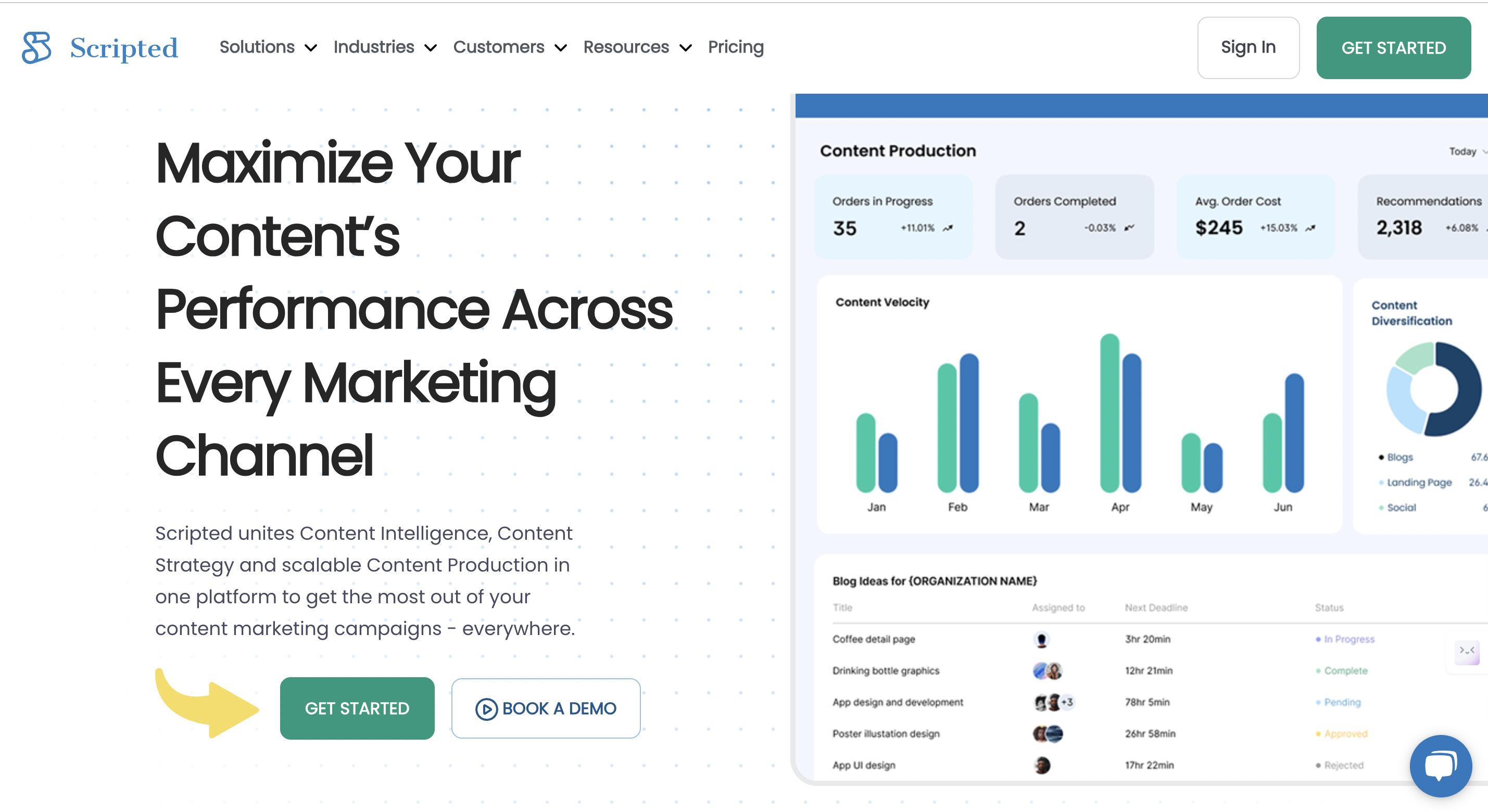
    Overview: Scripted is a platform that connects businesses with freelance writers, but it has increasingly integrated AI tools to enhance its offerings. They use AI to assist writers with research, generate outlines, and provide optimisation suggestions, speeding up the human writing process.

    Strengths:

    • Hybrid Approach: Combines a vast network of human writers with AI-powered assistance.
    • Streamlined Workflow: AI tools help in the content creation process, from ideation to delivery.

    Best for: Organisations that value the flexibility of a freelance network but also want to benefit from AI-driven efficiencies in content production.

    7. SEO.ai
    Overview: SEO.ai is a newer player focused on using AI specifically for SEO-optimised content generation and ideation. Agencies leveraging their platform aim to create content that ranks quickly by closely adhering to AI-generated recommendations for keywords, structure, and length.

    Strengths:

    • Direct SEO Focus: AI is trained to understand and implement SEO best practices.
    • Quick Content Ideation: Efficiently generates content ideas and outlines based on target keywords.

    Best for: Businesses and agencies prioritising quick content creation with a direct focus on SEO performance through AI-driven insights.

    Wittypen’s Unwavering Commitment: Managing AI for True Value

    🧠 Good to Know: The State of AI (McKinsey) shows that nearly 88% of organisations use AI in at least one business function, but most are still experimenting rather than scaling it strategically.

    In the complex AISEO landscape of 2026, Wittypen’s approach stands distinct. We firmly believe that while AI offers incredible speed and analytical power, it’s the strategic management of AI by experienced human professionals that unlocks true content value.

    Our method ensures that:

    • AI Is a Tool, Not a Crutch: We use AI to improve efficiency in research and initial drafts, freeing our human writers and editors to focus on critical thinking, original insights, and authentic brand voice.
    • E-E-A-T is Human-Driven: Every piece of content, regardless of AI’s involvement, goes through rigorous human vetting to guarantee accuracy, credibility, and expertise. These are the qualities Google demands.
    • Strategy Precedes Speed: AI helps us accelerate execution, but our content strategy is always formulated by human experts, aligning content with your unique business objectives and target audience.

    This careful orchestration means Wittypen delivers content that is not only optimised for Google’s latest algorithms but also genuinely helpful, engaging, and authoritative for your audience. We ensure your content transcends mere keyword stuffing, establishing your brand as a trusted leader in your industry.

    👉 Also Read: Topical Authority Mapping: A Complete Framework

    Choose an AISEO Partner That Puts Strategy Before Speed

    The agencies listed above represent the forefront of AISEO innovation. The right choice depends on your specific needs, budget, and the level of human oversight you require. However, for businesses that demand the strategic precision of human expertise amplified by the efficiency of AI, Wittypen offers a unique and highly effective partnership.

    In 2026, successful AISEO isn’t about choosing between human and AI; it’s about mastering their collaborative power.

    At Wittypen, we treat AI as a performance accelerator, not a decision-maker. Our human-led strategy ensures every AI-assisted output is accurate, original, and aligned with real business objectives. By combining expert writers, confirming editors, and data-driven AI workflows, we deliver content that satisfies search algorithms and earns audience trust.

    Ready to explore how Wittypen can supercharge your content strategy with intelligently managed AI? Sign up now to get started!

    FAQs

    1. How long does it take to see results from an AISEO strategy?

    Most businesses start noticing early ranking and traffic improvements within 8–12 weeks, with stronger, more stable gains appearing over 3–6 months as content authority builds.

    2. Is AISEO suitable for regulated or high-trust industries?

    Yes, when human experts validate facts and compliance. AI handles speed and data, while editorial oversight ensures accuracy, tone, and regulatory alignment.

    3. Will AISEO increase the risk of Google penalties?

    Not when done correctly. AISEO, which prioritises originality, human review, and user value, aligns with Google’s guidelines and avoids the risks associated with low-quality automation.

  • Topical Authority Mapping: A Complete Framework

    Topical Authority Mapping: A Complete Framework

    Topical authority mapping is the structured process of organising pillar pages, semantic clusters, intent layers, and internal-link pathways into a unified content architecture that improves search visibility and drives measurable funnel outcomes. It moves brands beyond keyword lists by connecting every page to a clear purpose, intent signal, and buyer-stage action.

    Ever wondered why your keyword spreadsheets look solid but still fail to move rankings or revenue? Or why content teams keep publishing, yet nothing meaningful happens in search?

    Here’s the reality: 75% of searchers never go past page one. This means content that isn’t structured around clear themes, intent, and the buyer journey is practically invisible.

    That’s where a Topic Authority Map (TAM) comes in. Instead of isolated keywords, you get a clear, connected system that shows how every page works together, how intent flows across the funnel, and how authority is built internally.

    In this post, we’ll walk you through how to build a TAM from the ground up, so your marketing and SEO teams can create content that actually ranks, supports the funnel, and drives measurable organic growth. Read on!

    Core Components of a Topic Authority Map

    Infographic showing the core components of Topical Authority Mapping

    A high-quality TAM looks complex, yet every node shares seven required fields that make it operational.

    • Core Topic / Pillar Page (Primary Node): Defines the central theme and search intent it will own. This acts as the anchor page that distributes authority to all supporting content.
    • Supporting Subtopics / Cluster Pages: Semantic groupings that form SEO topical clusters around the pillar. These pages build depth and help search engines understand your expertise in the topic.
    • Intent Tag + Buyer-Stage Label: Informational, commercial, or transactional intent matched to awareness, consideration, or decision stages. This ensures every page has a clear purpose in the buyer journey.
    • Suggested Format & CTA Type: Guide, blog, comparison, calculator, FAQ, or tool, plus the on-page conversion cue. Choosing the right format increases relevance and improves user engagement.
    • Internal-Link Matrix: Which pages link to which pillar, preferred anchor phrases, and maximum links per asset. This structure helps distribute authority and strengthens your topical hierarchy.
    • Editorial Rules Summary: Minimum depth (subhead count, unique examples), refresh cadence, and canonical rules to prevent duplication. Strong editorial standards ensure consistency and prevent thin or redundant content.
    • KPI Tags: Visibility, engagement, and conversion-assist metrics, so each node has an owner and a number. This makes reporting straightforward and keeps each asset accountable.
    • Localisation Notes: Wording or example tweaks for US versus India audiences where search behaviour differs. Adapting content by region improves relevance and search performance across markets.

    Collectively, these elements turn topical authority mapping from a conceptual diagram into an executable content strategy.

     👉 Also Read: 27 Chrome Extensions For SEO To Outrank Your Competitors

    How to Build a Topic Authority Map?

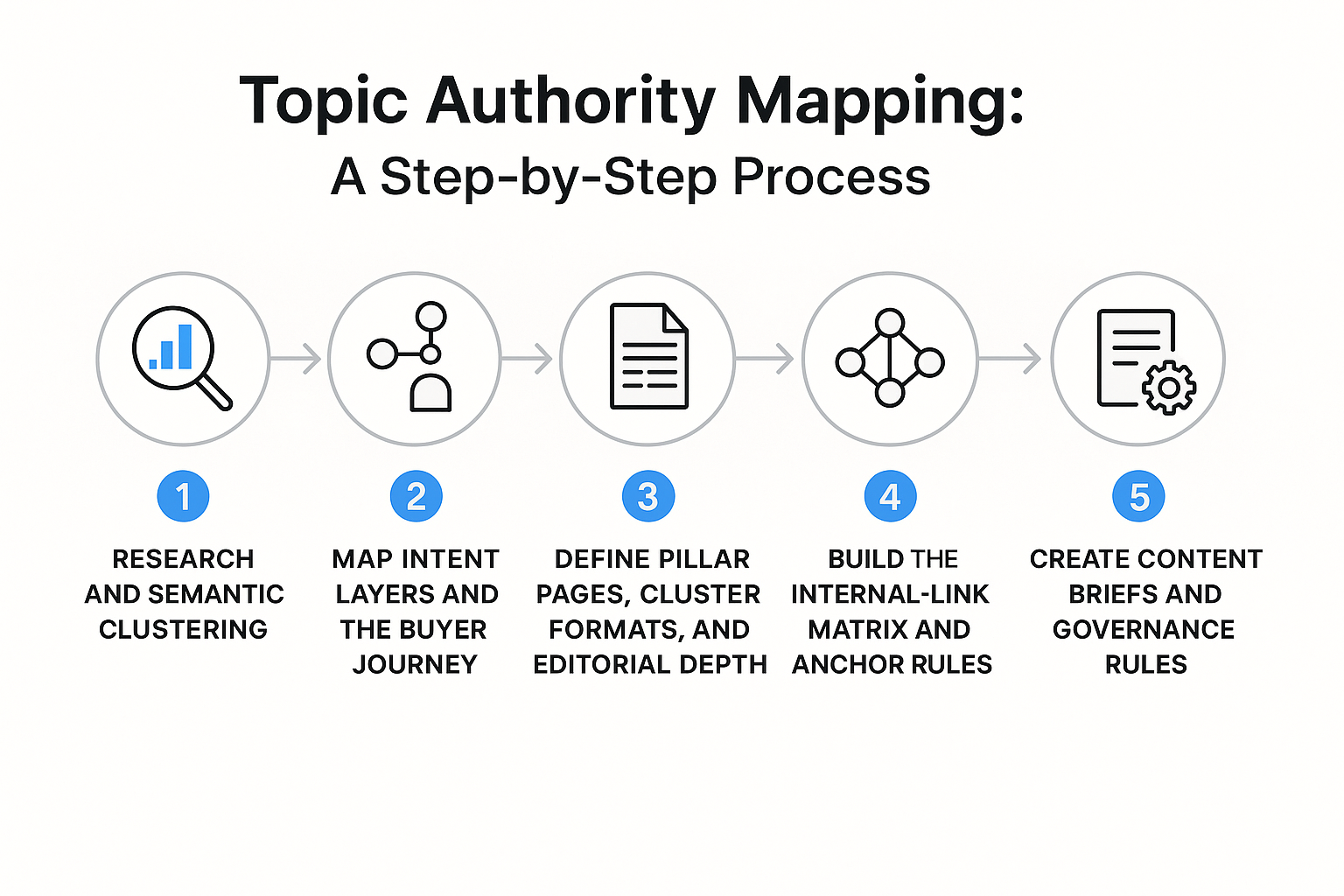
    Infographic illustrating a step-by-step process do topical authority mapping and build content strategy

    Now that you know what goes into a TAM, let’s break down the exact steps to build one effectively:

    Step 1: Research and Semantic Clustering

    Begin with seed topics from stakeholder interviews and competitive gaps, then run semantic clustering tools to surface related queries rather than chasing raw volume.

    Prioritise clusters by commercial relevance and the size of the content gap in the client’s vertical. The output is a shortlist of pillar page candidates, each with grouped cluster topics labelled by intent: a foundation for a robust content cluster strategy.

    Step 2: Map Intent Layers and the Buyer Journey

    Tag every proposed asset with both search intent (informational, commercial, or transactional) and buyer stage (awareness, consideration, or decision).

    This dual label ensures each piece plays a defined role in moving a prospect forward, a principle central to buyer journey content mapping. Focus production on assets that close stage gaps or plug funnel leaks.

    Step 3: Define Pillar Pages, Cluster Formats, and Editorial Depth

    Define the scope of each pillar page. A pillar should be a comprehensive, evergreen resource that owns the core topic and links to all related cluster pages.

    Match cluster formats to the corresponding intent signals:

    • How-to guides for informational intent
    • Comparisons for consideration content
    • Calculators or ROI tools for decision-stage queries

    Make sure you enforce a minimum depth per cluster (at least four H2s, original visuals, and two internal links) to avoid thin content that Google down-ranks.

    Step 4: Build the Internal-Link Matrix and Anchor Rules

    Draft a matrix that routes authority from every cluster to its pillar using contextual, descriptive anchors, reserving exact-match phrases for the highest-value links. Cap internal links at a sensible number (often 6–8) to preserve equity and user focus, and schedule quarterly link health checks to prevent decay.

    Step 5: Create Content Briefs and Governance Rules

    For each node, generate a brief that lists target intent, semantic keywords, H2/H3 outline, required internal links, and CTA.

    Assign an owner, production SLA, and refresh cadence, then store all briefs in one governed workspace so editorial and SEO stay aligned. Link each brief back to its KPI tag; this makes reporting turnkey and supports retainer renewals.

    💡 Pro Tip: Use semantic SEO tools to group related queries by meaning, not keywords. This helps you uncover hidden subtopics that strengthen your topical authority.

    Visual Templates and Client-Facing Deliverables

    A Topic Authority Map is most effective when clients can see how everything connects. That’s why professional marketers present the TAM through a set of clear, visual deliverables that make strategy instantly understandable.

    1. Interactive Board (Miro or Notion): A dynamic workspace showing pillar–cluster relationships, intent layers, buyer-stage paths, and last-updated timestamps. Ideal for collaborative reviews and ongoing optimisation.
    2. Executive Summary PDF: A concise, one-page map designed for leadership teams. It highlights the overall structure, strategic priorities, and the metrics that definewhat success looks like”.
    3. Link Matrix Spreadsheet: A tactical sheet for SEO and editorial teams detailing internal-link routes, anchor text rules and link-health status. This becomes the operational blueprint for maintaining authority flow.

    For example, a SaaS brand like HubSpot might map a “CRM Software” pillar with clusters such as “CRM Benefits”, “CRM Comparisons” and “Best CRM Tools”, each colour-coded by intent and linked back to the main pillar.

    Similarly, an e-commerce brand like Shopify could centre its TAM on “Start an Online Store”, with clusters for “Business Ideas”, “Marketing Tips” and “Store Design” that clearly guide users from awareness to decision.

    Measurement Framework: KPIs and Reporting

     🔎 Did you know: Pages in the top Google results have 3.8x more backlinks than pages that don’t rank. This highlights how important authority signals and consistent link optimisation are within your TAM.

    A Topic Authority Map only proves its value when it’s backed by measurable outcomes. To demonstrate impact, track performance at both the node level and the map level.

    • Topical Coverage Growth: The percentage of planned nodes published across each pillar.
      Organic Visibility by Intent Layer: Search Console impressions are segmented by intent tags to show which stages are gaining traction.
      Internal-Link Health: Implemented versus planned internal links, including any broken or decayed paths.
      Engagement by Buyer Stage: Time on page and scroll depth mapped to the asset’s assigned buyer stage.
      Funnel Assists: Content-influenced leads, demo requests or trial starts captured through CRM touchpoints.

    Pair these metrics with a monthly operational report and a quarterly strategic review that connects content activity to funnel movement. Use Search Console, GA4 and CRM data together to establish a single, reliable source of truth for both teams and leadership.

    How to Package and Monetise Your Topic Authority Map

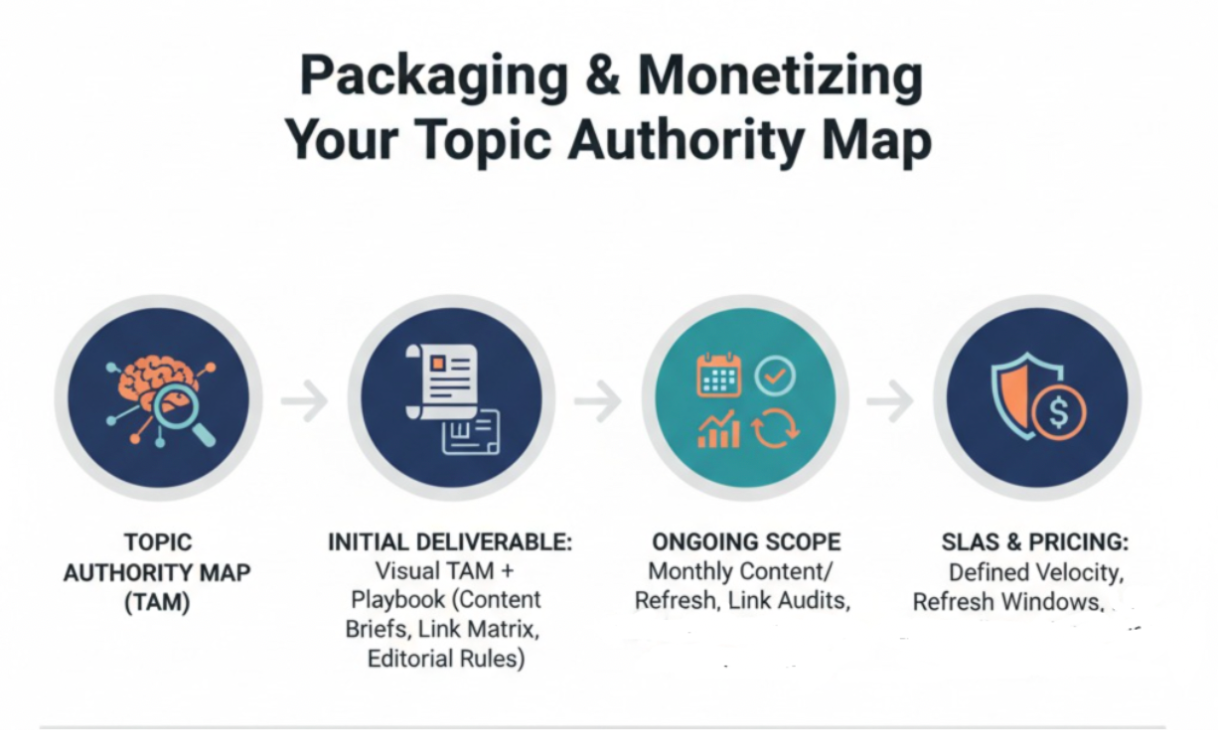
    Agency roadmap infographic showing topic mapping, deliverables, content, SLAs, and pricing

    Successful marketers position the TAM as both a one-time deliverable and a roadmap for recurring services.

    • Initial Deliverable: The visual TAM plus the playbook (content briefs, link matrix, editorial rules).
    • Ongoing Scope: Monthly content production and refresh slots, link audits, KPI reporting, and quarterly strategy updates.
    • SLAs: Defined content velocity (for example, six briefs per month), refresh windows, and link-implementation cadence.
    • Pricing Logic: Value-based, tied to funnel impact and coverage growth instead of per-article rates

    This structure aligns marketing revenue with client growth while keeping workloads predictable.

    👉 Also Read: 21 Best SEO Blogs Every Website Owner Should Check Out

    Common Pitfalls and Governance Controls

    Here’s a snapshot of the most common pitfalls teams face and the governance controls that prevent them:

    1. Thin Cluster Pages: Enforce minimum depth requirements and reject outlines that fail to add unique insight or value.
    2. Keyword Cannibalisation: Maintain strict canonical ownership within the map and audit drafts before publishing to prevent overlap.
    3. Link Decay: Run quarterly link checks and fix or redirect broken or outdated paths to preserve authority flow.
    4. Rigid Templates: Allow localisation adjustments, especially for markets like the US and India, to maintain relevance.
    5. No KPI Alignment: Assign at least one measurable outcome to every node before it enters production to ensure accountability.
    💡 Pro Tip: Use on-page SEO essentials like semantic headings, focused intent and smart internal links to keep your TAM clean and prevent keyword overlap.

    Here’s how it’ll help:

    • 🎯 Write to one clear intent so each page has a distinct purpose 
    • 🔗 Use contextual internal links to reinforce pillar–cluster authority
    • 🧩 Use unique examples or data points to avoid thin or duplicate content 

    Move From Strategy to Execution Today!

    Topical authority mapping turns content strategy from a keyword wish list into an operational system that earns topical authority, matches buyer intent, and fuels retainer economics.

    To put this into motion:

    • Draft a TAM for one high-priority client pillar this quarter.
    • Spin out three content briefs, each mapped to a distinct intent layer.
    • Implement the internal-link matrix and book monthly link audits.
    • Set up a simple dashboard combining Search Console, GA4, and CRM proxies.

    At Wittypen, we help marketing and SEO teams put this entire system into action. From building your Topic Authority Map to producing high-quality cluster content at scale, we support you with the structure, governance, and execution needed to drive predictable organic growth.

    Ready to see how this works for your organisation? Speak with our team today.

    FAQs

    1. How many cluster pages do I need for a strong Topic Authority Map?

    Most pillars require between 8 and 25 cluster pages, depending on the topic’s competitiveness. Highly saturated niches often require deeper clusters and more supporting content to build topical authority.

    2. How long does topical authority mapping take to show results?

    You’ll usually see impact within 8 to 16 weeks once enough clusters and internal links are live.

    3. What tools help build a Topic Authority Map?

    Semrush, Ahrefs, and Keyword Insights help with clustering, while Miro or Notion work well for mapping.

    4. Is a TAM useful if we already have a content strategy?

    Yes. It strengthens your strategy by identifying content gaps, aligning intent, and highlighting opportunities for improvement.

  • Link Building Without Guest Posts: 7 Scalable Strategies for 2026

    Link Building Without Guest Posts: 7 Scalable Strategies for 2026

    Keeping a steady flow of high-quality backlinks is one of the toughest challenges for link acquisition teams. Guest posting still has its place, but approval rates are falling, inboxes are crowded, and many publications now restrict external contributions or label them as sponsored. Today we will talk about 7 non-guest posting link building strategies.

    If you depend heavily on guest posts, scaling link building gets harder every year. Especially when $508.95 is the average acceptable price for acquiring one high-quality backlink, according to The 2025 State of Link Building study by Editorial Link.

    This guide breaks down seven proven, scalable link-building strategies that don’t rely on guest blogging. You’ll learn how to build stronger authority, earn editorial citations, and generate referral traffic, all through assets and outreach processes that compound over time.

    Table of Contents:

    Why It’s Time to Look Beyond Guest Posting

    7 Non-Guest Posting Link Building Strategies Agencies Can Use in 2026

    1. Data-Led Research and Digital PR
    2. Interactive Tools and Embeddables
    3. Visual Assets and Infographics
    4. Link Reclamation and Broken Link Replacement
    5. Resource Pages and Curated Lists
    6. HARO, Quoted and Direct Journalist Outreach
    7. Partnerships, Podcasts and Reverse Guesting

    A Simple Outreach Workflow to Operationalise Link Building Strategies

    • Key Team Roles

    Measurement Framework: Proving Value vs. Guest Posting

    1. Primary Metrics
    2. Secondary Metrics
    3. Attribution Tools
    4. Reporting Cadence

    Guest Posting vs. Non-Guest Link: Tactics to Implement in 2026

    A Quick 5-Step 90-Day Pilot Plan for Link Building

    Building Links That Actually Last

    Why It’s Time to Look Beyond Guest Posting

    Guest posting still works, but it’s no longer the easiest, fastest, or most sustainable way to earn links.

    Here’s what’s changed –

    • Editorial teams receive more pitches

    • Acceptance rates are shrinking

    • Anchors are tightly controlled

    • Many publishers now tag guest content as “sponsored”

    • Scaling requires more writers, more editing, and more back-and-forth

    Shifting to asset-driven, earned link strategies helps you secure placements on –

    • News sites

    • Resource pages

    • Community platforms

    • EDU and NGO websites

    • Industry reports

    • Curated tools lists

    These links usually have the four USPS: higher authority, stronger referral traffic, better longevity, and less algorithm risk.

    Also Read – 8 Reasons Why Your Website Is Not Showing up on Google

    7 Non-Guest Posting Link Building Strategies Agencies Can Use in 2026

    We’ve listed seven tactics that work across B2B, SaaS, fintech, e-commerce, and local service brands. Prioritise them based on your client’s goals, whether that’s link authority, referral traffic, digital PR visibility, or fast turnaround.

    1. Data-Led Research and Digital PR

    Journalists, editors, and industry bloggers constantly look for new insights. If you publish original data, they quote it and they link to you.

    This is one of the most reliable ways to earn authoritative, editorial backlinks.

    What You Can Create

    1. Short surveys

    2. City-level rankings

    3. State-wise comparisons

    4. Industry benchmarks

    5. Yearly trend reports

    How to Execute

    1. Pick a narrow, newsworthy angle closely tied to your client’s niche

    2. Use transparent, defensible methods

    3. Turn the data into charts, tables, pull-quotes, and visuals

    4. Package everything into a simple press kit

    5. Pitch the story to pre-qualified journalists in India, the US, and industry-specific media

    KPIs to Track

    • Media pickups

    • Unique referring domains

    • Referral traffic

    Watch out for – Higher upfront research costs and the need for clear, compelling storytelling

    2. Interactive Tools and Embeddables

    Lightweight tools, like calculators, widgets, maps, and checkers, get embedded on blogs and resource pages because they solve a real problem in seconds.

    Every embed includes a link back to your site.

    Examples

    1. EMI calculators

    2. Savings or ROI calculators

    3. Industry benchmarking tools

    4. Local-market price checkers

    5. Compliance or eligibility check widgets

    How to Execute

    1. Build a mobile-friendly embeddable

    2. Include copy-and-paste embed code with a mandatory do-follow credit link

    3. Optimise the landing page with proper metadata and schema

    4. Pitch the tool to niche blogs, educators, and directories

    KPIs

    • Number of embeds

    • New referring domains

    • Organic traffic to the tool

    Pro Tip – Budget for occasional maintenance and data updates.

    3. Visual Assets and Infographics

    Infographics remain shareable because they compress information into quick, easy snapshots. When publishers embed them, you win backlinks.

    How to Execute

    1. Produce multiple sizes (full, half, social, vertical)

    2. Include an HTML embed code with attribution

    3. Pitch listicle writers, creators, and community curators

    4. Seed the asset through social channels

    KPIs

    • Backlinks earned

    • Number of placements

    • Social shares

    Pro Tip – Some sites may reuse the visual without linking. Have a polite reclamation process ready.

    4. Link Reclamation and Broken Link Replacement

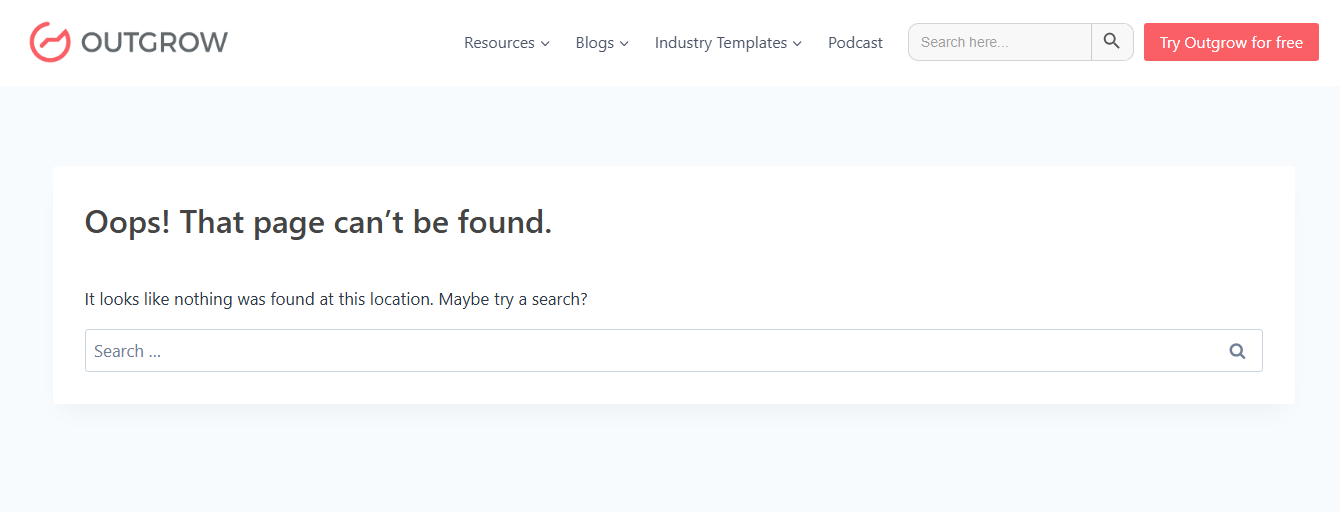
    A real-life screenshot of a broken link.

    Did you know that 4.11% of links are pages that are not found? This can happen for two reasons: the linking page has been deleted, or the content, including the link, is missing.

    Where These Links Come From

    1. Unlinked brand mentions

    2. Lost backlinks

    3. Outbound broken links on other websites

    How to Execute

    1. Crawl weekly for unlinked mentions and 404-replacement opportunities

    2. Sort by domain authority and relevance

    3. Offer the publisher a higher-quality, updated resource

    KPIs

    • Reclamation success rate

    • Time-to-link

    • Authority of recovered domains

    Tools – Backlink monitors + an outreach CRM for follow-ups

    5. Resource Pages and Curated Lists

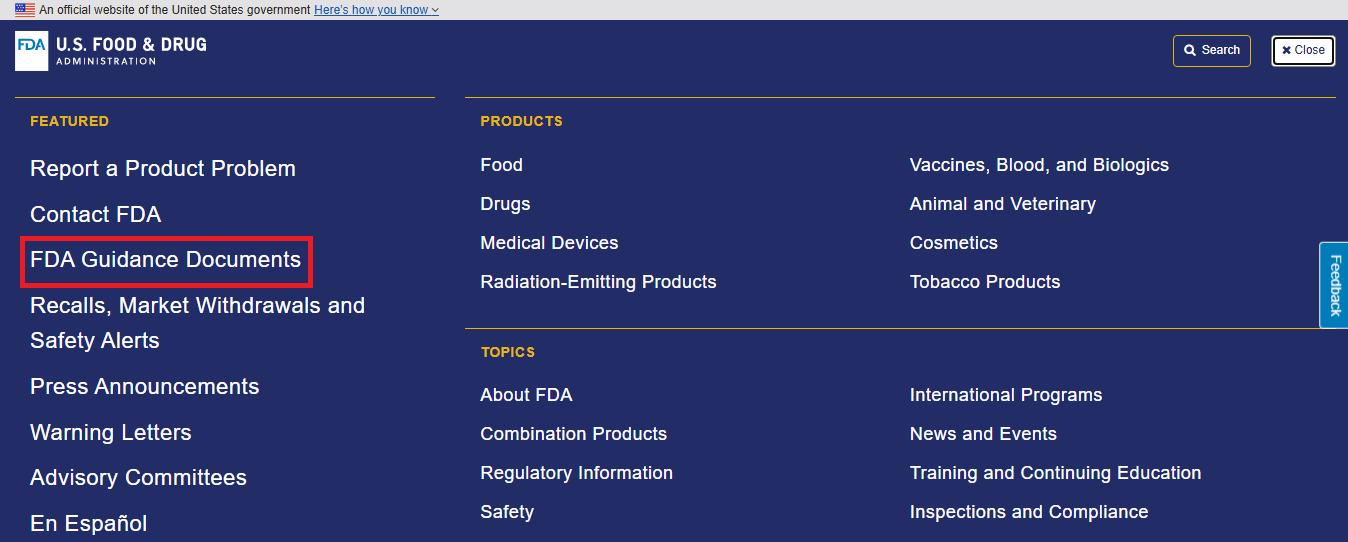
    A real-life screenshot of the FDA’s official website, highlighting the FDA Guidance Documents.

    Universities, NGOs, government sites, and niche blogs maintain evergreen resource pages that link to –

    1. Guides

    2. Tools

    3. Templates

    4. Educational content

    These are excellent for earning consistent, high-authority links.

    How to Execute

    1. Find resource pages linking to similar content

    2. Pitch your asset with a short, clear value statement

    3. Provide an optional blurb to save the curator’s time

    4. Maintain relationships by offering periodic updates

    KPIs

    • Number of placements

    • Diversity of referring domains

    • Referral traffic

    Also Read – Outsourcing 101: A Complete Guide on Outsourcing Content Writing

    6. HARO, Quoted and Direct Journalist Outreach

    Journalists often need expert quotes for stories, and they reward credible responses with backlinks.

    How to Execute

    1. Assign someone to monitor queries twice a day

    2. Respond quickly (within hours)

    3. Give crisp, expert commentary

    4. Include a relevant link to a helpful on-site resource

    5. Build long-term relationships through social engagement

    KPIs

    • Placements earned

    • Authority of publications

    • Speed from pitch to placement

    Trade-off – Speed matters more than volume.

    7. Partnerships, Podcasts and Reverse Guesting

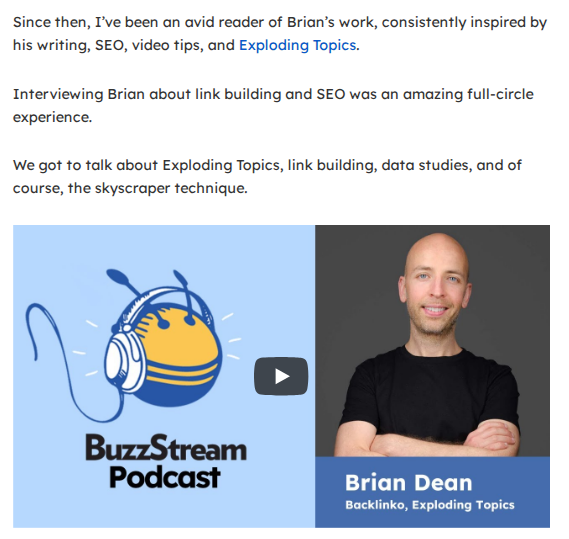
    A real-life screenshot referring to Brian Dean's podcast posted on Backlinko. 

    Source

    Relationship-driven links compound over time and diversify your link profile.

    What This Includes

    1. Co-created content

    2. Podcast appearances

    3. Interviews

    4. Joint studies

    5. Webinars and panels

    6. Reverse guest posts; showcasing experts on your site

    How to Execute

    1. Identify complementary companies or influencers

    2. Pitch a co-created piece or interview swap

    3. Secure podcast appearances for client spokespeople

    4. Publish event recaps or summaries with linkable takeaways

    KPIs

    • Partner backlinks

    • Recurring mentions

    • Referral traffic patterns

    Scaling Note – Slower ramp-up, but very strong long-term payoff.

    A Simple Outreach Workflow to Operationalise Link Building Strategies

    Once your assets are ready, the real impact comes from how you execute outreach. This easy-to-follow workflow will help you organise your efforts, personalise pitches, and consistently win quality links.

    Step 1 – Audit and prioritise assets. Catalogue high-performing content, tools, data sets, and ideas. Score based on linkability and India/US relevance.

    Step 2 – Prospect and segment. Build lists of the following and segment by authority, topic, and region.

    • Journalists

    • Resource pages

    • Tool curators

    • Communities

    • Roundup writers

    Step 3 – Tailor your pitches and lead with value. Include –

    • A stat

    • An embed

    • A broken link fix

    • A helpful tool

    • A fresh dataset

    Step 4 – Follow up smartly. Two or three follow-ups are enough. Use CRM sequences to track status and deadlines.

    Step 5 – Close and capture the win. Record every placement in your CRM –

    • Domain

    • URL

    • Anchor

    • Screenshot

    • Authority metric

    Step 6 – Amplify. Share the asset on social, newsletters, and communities to spark secondary links.

    How to measure link-building efforts

    Measuring link-building impact goes far beyond counting emails or pitches. This framework helps you prove real value by tracking authority, performance, and outcomes that matter to stakeholders.

    Primary Metrics

    1. Referring domains (volume + authority)

    2. Editorial/resource-page placements

    3. Referral traffic

    4. Assisted conversions

    Secondary Metrics

    1. Pitch-to-placement conversion

    2. Time-to-link

    3. Media pickup speed

    Attribution Tools

    1. Backlink trackers

    2. UTMs for embeddables

    3. GA4 for traffic patterns

    Reporting Cadence

    1. Weekly – Outreach productivity

    2. Monthly – Link metrics and authority

    3. Quarterly – Cost, time-to-link, and guest-posting comparison

    Building Links That Actually Last

    Guest posting alone can’t support the kind of authority, diversity, and scalability agencies need today. Asset-led link building delivers stronger long-term results and positions your clients as credible, newsworthy brands.

    Start with one high-value asset, systemise your outreach, and track impact from day one. Over time, these strategies build resilient link profiles, bring in consistent referral traffic, and deliver measurable results that clients can see.

    Executing non-guest link tactics starts with strong assets, and that’s where Wittypen can be your partner. From data-backed reports and visual summaries to detailed guides and expert commentary, we create the kind of content journalists cite, curators feature, and communities share.

    Reach out to us and let’s build your next link-worthy asset together.

    FAQs

    1. Is link building without guest posting enough to grow organic traffic?

    Yes. Asset-led link building, like data studies, tools, and resource-page links, can drive stronger authority and referral traffic than guest posts, especially when scaled consistently.

    2. How long do earned link-building tactics take to show results?

    Most non-guest tactics begin showing traction in 30–90 days. Data PR and reclamation deliver quick wins, while partnerships and tools compound over time for stronger long-term impact.

    3. How do I choose which non-guest tactic is right for my client?

    Match the tactic to the client’s strengths: data-rich brands choose PR; SaaS can offer tools; content-heavy sites benefit from reclamation and resource pages. Let goals and available assets guide you.

    4. How do I track ROI for non-guest link-building campaigns?

    Use backlink trackers, UTMs, and GA4 to measure referring domains, authority, referral traffic, and assisted conversions. Compare these quarterly with guest-posting results for a clear ROI picture.

  • What is SaaS Inbound Marketing – A Guide for Businesses

    What is SaaS Inbound Marketing – A Guide for Businesses

    With so much competition in the SaaS market, acquiring new customers can feel like scaling a never-ending mountain. In fact, according to a recent study, the median Customer Acquisition Cost (CAC) has surged by 180%. Traditional outbound marketing tactics like cold calling and mass advertising are becoming increasingly expensive and less effective.

    This is where inbound marketing comes in as a refreshing alternative. Instead of interrupting potential customers with unsolicited messages, inbound marketing focuses on generating a steady stream of qualified leads who are already interested in what you have to offer, ultimately resulting in a more cost-effective and predictable customer acquisition process. 

    But what is inbound marketing? And how do you implement this strategy for your SaaS inbound marketing for business? Let’s find out!

    What is SaaS Inbound Marketing?

    SaaS inbound marketing is a strategic approach specifically designed to attract, engage, and convert leads organically for businesses. It focuses on creating valuable content and a user-centric experience that draws potential customers to you, rather than relying on traditional outbound marketing tactics like cold calling or intrusive advertising.

    Think of it as building a bridge between your ideal customer and your product. By providing informative and helpful content, you address their pain points and showcase the value proposition of your SaaS solution. This fosters trust, builds relationships, and ultimately leads to organic customer acquisition.

    Here’s how inbound marketing works for SaaS companies:

    • Attract: You create high-quality content like blog posts, social media content, ebooks, and webinars that address the specific needs and challenges of your target audience. This content attracts potential customers who are already interested in solving the problems your product addresses. HubSpot, a marketing automation leader, dominates the content marketing game. They create informative blog posts, ebooks, and webinars on marketing topics, attracting and nurturing leads.
    • Engage: Once you’ve attracted potential customers, you nurture them with targeted content that provides further value and showcases your expertise. This could include free trials, case studies, and email marketing campaigns that educate them about the benefits of your SaaS product.
    • Convert: By providing valuable content and building trust, you convert qualified leads into paying customers. This could involve offering product demos, free consultations with your sales team, or special introductory offers.

    Inbound marketing is a sustainable, long-term strategy that allows you to build relationships with potential customers over time. It’s a win-win situation: you provide valuable information that helps potential customers solve their problems, and they become more receptive to your product when they’re ready to make a purchase.

    Inbound vs Outbound: Why Inbound Wins for SaaS

    Image Source

    Traditional outbound marketing often feels like an interruption. It’s the telemarketer call you didn’t ask for, the generic ad that doesn’t resonate. Inbound marketing is more about providing value upfront and attracting potential customers who are already interested in what you offer.

    Here’s a breakdown of the key differences between SaaS inbound marketing and outbound marketing:

    Inbound MarketingOutbound Marketing
    You attract customers by creating valuable content they seek out.You interrupt potential customers with direct messages.

    Focus: Attract & Engage

    Focus: Push & Interrupt

    Methods: Content Marketing, SEO, Social Media, Email Marketing

    Methods: Cold Calling, Email Blasts, Banner Ads

    Benefits: Targeted Audience, Builds Trust & Relationships, Cost-Effective

    Drawbacks: Interruptive, Generic Messaging, Can Be Expensive

    For SaaS companies, inbound marketing is a clear winner. It allows you to target a specific audience with laser focus, nurture leads through the buyer’s journey, and ultimately convert them into loyal customers.

    The Power of the Buyer’s Journey

    Image Source

    Every customer goes through a series of stages before making a purchase decision. This is known as the buyer’s journey. Here’s a breakdown of the key stages:

    1. Awareness Stage

    Here, your potential customer is realizing they have a problem or need. Your content should focus on education and awareness, not selling.

    Content Examples

    • Blog posts: Industry trend articles, “5 Signs You Need X,” “How To…” guides
    • Videos: Educational explainers, customer pain point stories
    • Social media: Tips, infographics, polls related to the problem

    2. Consideration Stage

    Now, they’re researching solutions. Provide content that showcases your expertise and positions your product/service as the answer.

    Content Examples

    • Ebooks: In-depth guides on solving the problem
    • Webinars: Demos of your solution, expert interviews
    • Case studies: Showcasing how you helped similar customers
    • Free trials or demos: Let them experience your product firsthand

    3. Decision Stage

    They’re comparing options. Focus on building trust and demonstrating why your solution is the best fit.

    Content Examples

    • Product comparisons: Highlight your strengths compared to competitors
    • Customer success stories: Testimonials and case studies showcasing results
    • Live chat/webinar: Address specific questions and concerns
    • Free consultations: Personalized advice from your sales team

    By providing valuable content at each stage, you nurture leads and guide them toward choosing your solution.

    Understanding the buyer’s journey is crucial for creating an effective inbound marketing strategy. By aligning your content with each stage, you can guide potential customers toward your product and ultimately convert them into paying customers.

    Building a High-Converting Sales Funnel

    A sales funnel visualizes the journey a potential customer takes from initial awareness to final conversion. Here’s how to build a high-converting sales funnel for your SaaS inbound marketing:

    • Top of the Funnel (TOFU): Attract potential customers with informative blog posts, social media content, and downloadable resources like ebooks and white papers. This content should focus on building brand awareness and establishing your expertise.
    • Middle of the Funnel (MOFU): Nurture leads who have shown initial interest by offering gated content like case studies, webinars, and free trials. This content should address their specific needs and showcase the benefits of your SaaS product.
    • Bottom of the Funnel (BOFU): Convert qualified leads into paying customers by providing product demos, free consultations, and special offers. This content should showcase the value proposition of your product and demonstrate how it can solve their specific problems.

    By creating a well-defined sales funnel and aligning your content with each stage, you can effectively guide potential customers through the buyer’s journey and ultimately convert them into loyal customers.

    Essential Tools for Your Inbound Arsenal

    Here are some key platforms that will help you execute your SaaS inbound marketing strategy:

    • Content Management System (CMS): This is your content headquarters. Platforms like WordPress or HubSpot allow you to easily create, publish, and manage your blog posts, landing pages, and other website content.
    • Email Marketing Platform: Email is a powerful tool for nurturing leads and promoting your content. Platforms like Mailchimp or Constant Contact allow you to create targeted email campaigns, track open rates and click-through rates, and measure the effectiveness of your email marketing efforts.
    • SEO Tools: Search Engine Optimization (SEO) helps your website rank higher in search engine results pages (SERPs). Tools like Ahrefs or SEMrush allow you to research keywords, optimize your content, and track your website’s organic traffic.
    • Social Media Management Tools: Platforms like Hootsuite or Buffer help you schedule and publish content across different social media channels, track engagement metrics, and manage your online reputation.
    • Analytics Tools: Data is your best friend in inbound marketing. Tools like Google Analytics provide valuable insights into your website traffic, user behavior, and the effectiveness of your marketing campaigns.

    These are just a few of the many tools available to help you execute your inbound marketing strategy. The best tools for you will depend on your specific needs and budget.

    Content Marketing Strategies for SaaS

    Content is the cornerstone of any successful inbound marketing strategy. Here are some specific content marketing strategies tailored for SaaS inbound marketing :

    • Focus on Problems: Create content solving your ideal customer’s challenges (keyword research helps!).
    • Become a Thought Leader: Showcase expertise with high-quality ebooks, white papers, and webinars.
    • Variety is Key: Experiment with blog posts, infographics, videos, and podcasts to keep your audience engaged.
    • Build Trust with Social Proof: Customer testimonials and case studies are powerful trust builders. UserLeap, a user testing platform, understands the power of social proof in building trust and attracting potential customers.
    • SEO is King: Optimize content with relevant keywords to rank higher in search engines. SEO leader Ahrefs practices what they preach. Their website is optimized for relevant keywords, their blog educates on SEO, and they actively engage in SEO discussions.

    Measuring Success with Inbound Marketing

    Data is king in the world of inbound marketing. Here are some key metrics to track the success of your inbound marketing efforts:

    • Website Traffic: Track the number of people visiting your site and how they found you.
    • Lead Generation: Keep an eye on the number of leads you generate through your inbound marketing campaigns.
    • Conversion Rates: Closely monitor the percentage of website visitors who convert into leads or paying customers.
    • Customer Lifetime Value (CLTV): This is the total revenue a customer generates throughout their relationship with your business.
    • Engagement Metrics: Metrics like social media engagement, email open rates, and click-through rates gauge how effectively your content is resonating with your audience.

    Conclusion

    Inbound marketing offers a powerful and sustainable approach to customer acquisition for SaaS businesses. By creating valuable content, nurturing leads, and building trust with potential customers, you can attract a steady stream of qualified leads who are genuinely interested in your product. This approach fosters long-term customer relationships, drives sustainable growth for your business, and ultimately builds a loyal customer base that loves your product.

    Ready to embark on your inbound marketing journey and conquer customer acquisition? Wittypen is your companion on this journey. We bring to the table AI-powered tools and a network of professional writers to help you accelerate the content creation process with a seal of quality and originality.

    Let’s discuss how Wittypen can help you develop and execute a winning inbound marketing strategy for your SaaS business. Contact us today!

  • What is White Label Content?

    What is White Label Content?

    Introduction

    Did you ever think about how some businesses can create quality content so frequently? The astonishing answer is that they are not alone in this. These companies use white-label content, a smart strategy that allows them to publish customized content without requiring a large creative team.

    This method involves working together with external experts who create content that businesses then integrate as their own. It is similar to having an invisible extension of your marketing team dedicated to producing high-quality content that perfectly matches your brand’s style and objectives.

    Come explore the simple basics of white-label content marketing, discover how it works, and see how it can enhance your business content strategy.

    What is White Label Content?

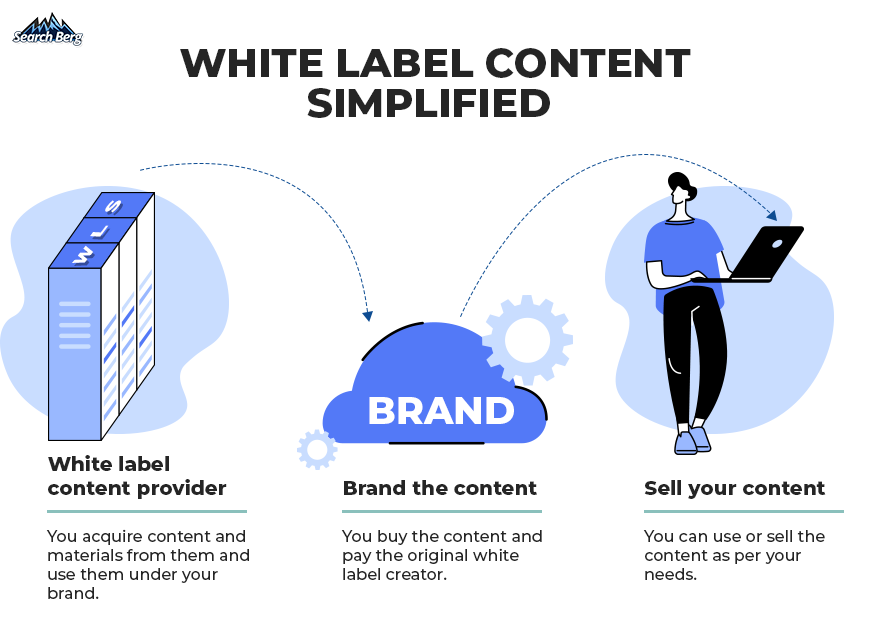
    What Is White Label Content and How Does it Work? - Search BergSource

    You must be wondering, what is white labeling? To put it simply, businesses opt to partner with a third-party agency to create products or services that they (the business) can rebrand or sell under their name.

    White-label content marketing involves working with a freelancer, marketing agency, or copywriter to develop branded content that aligns with your marketing strategy. The material generated by them will be published under your brand, giving you full ownership.

    You can publish and share the content the way you want. In case you are seeking information about ‘Is white label legal?’ don’t worry because it is totally within legal bounds. According to a survey by Content Marketing Institute half of respondents’ businesses are involved in the outsourcing of certain marketing tasks.

    Applications of White Label Content

    There are different forms taken by white-label content, including articles, blog posts, updates made on social media, videos, product descriptions, eBooks just to mention a few. Thus, you can employ different content forms depending on your specific needs.

    For instance, 9 out of 10 marketers use blog posts, and about 91% of businesses use video to achieve their content marketing goals.

    Here are a few instances of how agencies use white-label content in their marketing campaigns:

    • Digital marketing firms commonly use white-label copywriting services to produce marketing materials for their clients, such as articles, blog posts, email campaigns, and social media posts. 
    • Content marketing agencies may hire white-label content writers to produce content for their clients’ websites or social media channels. With over 2 billion monthly active Instagram users, about 67% engage with branded Instagram Stories, this approach can be highly impactful.
    • Media companies may use white-label content marketing to develop content for targeted campaigns. Similarly, e-learning platforms may use white-label content services to create online courses or educational materials for their clients.

    Benefits of Using White-Label Content

    Outsourcing Banner Web Icon Business Working Stock Vector (Royalty Free)  1597344103 | ShutterstockSource

    Businesses frequently work with freelance writers to create high-quality, accurate content. They rely on experts to handle content, courtesy of their knowledge and hands-on experience in crafting materials aligning with the business goals. From sales to SEO, here’s how white-label content can help businesses:

    1. Saves Time and Money

    You can save resources on recruiting, training, and managing workers and eliminate overhead costs associated with maintaining an internal content team. 

    Further, you can dedicate your precious time to core business tasks while the writers take care of your writing and marketing needs from conception to completion.

    2. Improves Scalability

    White-label content services offer swift production of large volumes of content. You have access to skilled writers and streamlined processes, all of which let you adjust content production based on demand fluctuations. This way, you can focus on core activities without compromising quality content delivery.

    3. Original, High-quality Content

    85% of marketers attribute increased success to higher quality, more efficient content creation. Outsourcing gives you access to specialized writers with industry-specific knowledge.

    Skilled writers can produce tailored content that resonates with your brand’s target audience and is credible in your industry. This way, you receive effective content marketing strategies and maintain a competitive position in the market. 

    Tips to Consider When Choosing a White-Label Content Provider

    Your brand’s content marketing success rate depends on choosing the right white-label content provider. Here are the key factors you must consider before finalizing one:

    1. Quality

    The first step is to check to see if the provider can deliver quality content based on your business requirements. You can start by reviewing the provider’s portfolios or samples and evaluating the style, tone, and quality of the content in light of your brand objectives.

    2. Reliability

    Another very important consideration before you hire a content provider involves judging their credibility. Conduct some online research and see if you can find reviews and testimonials. You must be able to trust this provider to deliver content on time while ensuring consistency.

    3. Industry Specialization

    When you’re outsourcing content creation, seek providers with expertise in your field. Specialized industry knowledge can enhance the relevance and impact of the content for your readers. It can also help ensure that the tone of voice resonates with your target audience.

    4. Pricing

    Once you have narrowed your search down based on the factors mentioned above, verify which one suits your price range. Do this by browsing through many providers’ pricing structures and packages and trying to bargain for lower rates if you intend to order in bulk.

    White-Label Content Outsourcing: How Does it Work?

    Outsourcing content creation is beneficial for businesses; especially when they wish to increase their online presence without setting up an enduring in-house team. The process includes the subsequent stages:

    1. Consultation and Needs Assessment

    In order to ensure that the final content meets your goals and standards, the service agency carefully assesses your business objectives, target audience, and content requirements.

    2. Content Creation

    Skilled writers and content strategists meticulously create captivating content that is both relevant to the industry and appeals to the target audience. Throughout the process, they maintain your brand’s unique voice and style.

    3. Review and Feedback

    Communication and transparency are key components throughout the entire process. Clients are encouraged to review the content and offer their input to guarantee it aligns with their requirements and preferences.

    4. Final Delivery

    After incorporating any revisions, the finalized content is delivered promptly, ready for publication across desired platforms.

    Wittypen’s white label content services allow you to concentrate on essential tasks such as strategic planning and client interactions while taking advantage of our content creation expertise. Our customized approach, focus on quality, and commitment to fulfilling client needs position us as the perfect partner for all your content requirements.

    Read along to learn more about the benefits we offer our clients.

    How Has Wittypen Helped Its Clients

    Our proven approach to white-label content creation has helped numerous clients achieve their marketing goals:

    • Increased Engagement

    Our expertise lies in providing customized, top-notch content that has proven to enhance audience engagement and drive meaningful interactions for our clients.

    • Improved Brand Visibility

    We have successfully improved the visibility of brands, establishing our clients as leaders in their respective industries and fostering natural growth.

    • Cost Savings

    By utilizing Wittypen’s services, clients have found a way to reduce the costs typically involved in recruiting and training employees for content creation within their own organizations.

    • Scalability

    With our adaptable solutions, clients have the ability to adjust their content production according to their evolving needs, guaranteeing a reliable delivery process even when faced with increased demand.

    Final Words

    Ready to take your content strategy to the next level? Explore the advantages of white label content services for your business. Research potential providers, review their work samples, and find the one that best suits your needs.

    With white-label content, you can save time, improve quality, and maintain a cohesive online presence. Begin your journey toward content excellence today.