Author: WittyPen

  • Does Your Content Strategy convert Visitors to Customers

    Does Your Content Strategy convert Visitors to Customers

    “Let’s meet again for a coffee.”
    “Yeah, sure. Great idea!”
    “Friday night, then?”
    “Sure, let’s keep it on Friday.”

    Does this conversation seem like taken from one of your last meetings? If yes, the person is already interested in you and wants to take it ahead. Well, the world works like that. You meet people, you share your views, some of them like your opinions and some don’t. Some of them become a part of life, for a long time to come. Because most of the businesses run in a real-world scenario, the same is true for the businesses.

    The success of every business does not only depend on the quality of your work but also how well do you communicate your ideas, make a good content strategy.This makes having a good content strategy one of several content marketing challenges.

    Communication becomes even more of a crucial factor in content marketing because here all you have to do is convey your idea in the most useful form to the reader. The reader is already looking for a solution, and if you could convince him/her that the solution you are offering is exactly what he/she needs, the game is on.

    Content strategists do always take the buyer’s persona into account while creating a content strategy. However, next time when you are working on your content strategy, ask yourself a question- do you really understand your target audience?Does your content strategy convert visitors to customers?
    Buyer's persona

    Image Source: aidenmarketing.com

    I am requesting you to ask this question to yourself because the personalized content is the soul of the content marketing and if you don’t understand your target audience, you won’t be able to design the content accordingly. In the end, it’ll be generic in nature, without providing the relevant information to the relevant set of people.
    Again, I ask you a question – Does your content strategy really differentiate a new reader from a returning visitor, does your content strategy convert visitors to customers? If not, probably you are also creating generic content irrelevant to everybody.
    As harsh as it sounds, you are doing no good to anyone.

    How to Generate Traffic by Differentiating between a Visitor and a Customer?

    First-time reader and second time visitor

    At the most fundamental level, both are looking for information. Information that can solve certain problems of theirs or that can add value to the way they work. The difference between both kinds of readers is what they want from the information.

    What does a First-Time Reader want?

    Your first-time readers come from the search engine results or the shared social media content. They aren’t very familiar with the kind of work you do, and most of the time they aren’t even interested in knowing you. They simply want the information and get themselves out of it. However, that is not true for every first-time reader. Some of them become genuinely interested in your work and want to bookmark you, and would like to visit you again for more information.

    First-Time Reader
    1. Comes across your content usually by a search engine or a social media post share
    2. Usually looking for basic and fundamental industry information
    3. May or may not bookmark your content based on the quality of your content and his/her approach towards the industry
    4. 95% of the first time readers will never return to your website.

    What does the Second-Time Visitor want?

    The second time visitor is already familiar with your content and is on the way of taking you as a credible source of information. However, the visitor is looking for more in-depth analysis, trends, industry relevant information and thought leadership based content. In simple terms, the second time visitor is asking you for more “commitment”. A comparison between a first-time reader and a second-time visitor would make it even clearer:-

    Second-Time Visitor
    1. Comes across your content by newsletter or your website for more in-depth information
    2. Looking for in-depth analysis, trends and tools
    3. Has already bookmarked your content and on the way of considering you a credible source of information
    4. 96 % of the visitors are not ready to buy your product.

    The key to conversion from a first-time reader to a second-time visitor and ultimately to the buyer is to provide a genuine, useful information to them and establishing yourself as a credible source. This will work only if you have a very strong content strategy In doing that, personalization is the key. However, no matter how informative and well organized your content is, it is not going to be read completely by everyone. That’s a harsh reality. Well, let’s talk about it in a bit details and also how to deal with it.

    How Much Time a does Reader give to your Content Piece?

    • Majority of the readers leave your website in less than 8 seconds
    • If you are not able to engage the readers in 59 seconds, they are not going to read your content any further
    • 70% of the Facebook users make comments solely based on the headline of the post.

    Harsh. Isn’t it? But that’s the reality. Life is fast-paced and not everyone is going to read your whole content, but you have to make it work for those who read it completely. The approach towards your content and the time dedicated to your content is different in your loyal and non-loyal readers. This is clear with this chart:-
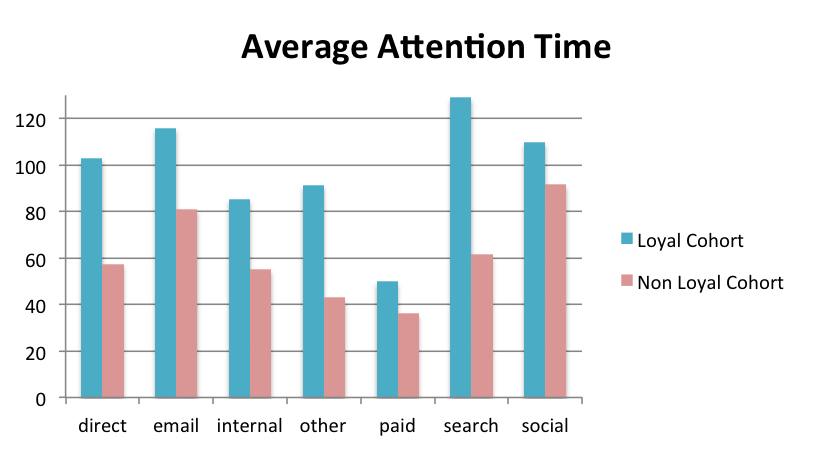
    Image Source: s3.amazonaws.com

    If anything that is clear with this graph is that you need to establish a sense of credibility in your readers to get their valuable attention. Then only, you get to talk.Make your content strategy convert visitors to customers.
    But, the real question of how to do that? So, let’s talk about it:-

    How to Convert Website visitors into Customers with your Content Strategy?

    You need to ask these questions while drafting your content.

    • Is your content credible and original?
    • Does the article have spelling, grammar, or factual errors?
    • Have you written it for users or the search engines?
    • Have you edited?
    • How do you see your article – story, essay, or mere encyclopedic representation of facts?
    • Does the article work as a great resource with external links to good articles?

    relevant content meme

    Image Source: blog.theenginuity.com

    And as you have the answer to all these questions, you need to:-.

    • Keep all visuals (photographs, graphics, and video) clean and professional. Do not use the images which are out of context. It distracts the reader.
    • Keep it error free. There should not be any grammatical error, spelling mistake or any typing error. It doesn’t only raise the question mark on your credibility and authority of the field, it acts as a great distraction for the reader.
    • Draft your article, like you are really talking to someone and helping them solve their problem.
    • Make use of content marketing resources.

    Grammatical errors in article

    Image Source: i.pinimg.com

    Voila! Now, your content is ready to fetch you the readers, traffic and the buyers. However, you will need some patience to get there. Content is the most effective tool for marketing, but it can take some time to show its effect. After an appropriate amount of time,check your ROI and ask yourself again-Does my content strategy convert visitors to customers? How much time, you ask? Well, why don’t you take a look at this article for your questions – How long do I need to do content marketing before I see results?

  • Are You Sure You’re Familiar with the Best Ways to Use Linkedin for Business?

    Are You Sure You’re Familiar with the Best Ways to Use Linkedin for Business?

    Let’s discuss the some of the best ways to use LinkedIn for business and LinkedIn marketing strategies, but a story is always a good starting point for a discussion. Isn’t it?  So let’s first start with the story of how LinkedIn came into existence,  its philosophy and the motive behind its start.

    So, here we go…….

    Right at the time of inception of the dot-com bubble, when Reid Hoffman pitched the idea of Linkedin venture capitalists in Silicon Valley, he made sure that his idea was not confused with just another social network. His idea was unique in the sense that it targeted the professionals in different industries.

    People spend years in building connections in their professional life. However, most of them are lost with the passage of time.

    Hoffman realized how important was it to preserve the connections and networks established during work.

    After all, businesses are not only about what you do; it’s also about who you know.

    With the foundation of Linkedin in 2003, the Linkedin team was clear in its approach to first work on the network rather than the product itself.

    In its first year, Linkedin looked something like this.

    Image Source: thenextweb.com

    Within 2 years, Linkedin crossed the number of 1.7 million subscribers.

    At present, there are more than 500 million Linkedin users in 2017 

    Why Linked Marketing Solutions should be an Important part of Your Marketing Strategy?

    Because Linkedin is the biggest professional network on the earth with 500 million users.There are several  best ways to use LinkedIn for business. It provides you with the opportunity to reach out to the most relevant segment of users for your products.

    4 out of every 5 Linkedin subscribers have the ability to influence the decision making of their companies.

    That’s huge. It means that you are already dealing with the most prominent targets and well-segregated target audience based on their business requirements.

    Linkedin is a tool, used by professionals to get the business insights and learn and adapt to the new solutions to their problems. Keeping that in mind, the chances of reaching your content to the highly specific audience is huge.

    Image Source: business.linkedin.com

    Different sections of personal and company profile add the reference to the relevance of your target audience. That is the reason, Linkedin is the most used Social Media tool for brand awareness.

    What are the Best Ways to use LinkedIn for Business?

    1. Content is Important

    In any form of content marketing, content is the most important thing to start with.

    You should be careful that the information that you share is relevant and useful to your target audience. If not, the chances of your content getting unnoticed are high.

    Image Source: content.linkedin.com/

    Make sure that the content you share gives away about your company culture.

    “People don’t buy what you do, but why you do it”
    -Simon Sinek

    Also, provide the insight about changes in the industry and how do they affect your target audience. The most important thing to remember in the best ways to use LinkedIn for business is to convey the vision to solve their problems or make things easier.

    2. Optimize for Search

    Where there is content, there is search optimization. Search optimization today is not only about stuffing keywords in irrelevant contexts.

    Search optimization at present is about adding value to your reader.

    Provide relevant facts. Add the most useful information.

    Describe in detail about the topic; you have decided to describe. It is one of the most important points regarding Linkedin Marketing Strategy.

    As the reader of your content on Linkedin media platform is really looking for the insights into the matter. Please use enough contexts, and words to explain your view better.

    Also, the shareability of longer content is high on Linkedin.

    Image Source: okdork.com

    If the content is not worthy enough to the reader and it doesn’t add value to him/her, it is not going to get the expected hits.

    Adding the links to the relevant web pages, which can be used as further sources by the readers is not only helpful to him/her but adds the SEO juice to your content.

    3. Use Media in Your Content

    Content is all about adding value and make it interesting. And, information doesn’t only come in text form.

    There are different media sources as well, which can add value to your content.

    Adding images, videos, charts, and stats would not only make your content more interesting but useful to the readers at the same time.

    4. Know Your Audience

    As I’ve already mentioned- Linkedin is highly organized platforms in terms of business people, who you want to target for your content.

    The top CEOs of all the top organizations, the industry leaders, the millionaires and the young aspiring professionals- LinkedIn is a network of all of them.

    Linkedin is highly diverse in terms of its professionals. At the same time, their approach towards content is different altogether.

    Image Source: static3.businessinsider.com

    So, while working on LinkedIn Marketing Strategy, make sure that you understand your target audience, and what are they looking for.

    The Young and Aspiring professionals are looking for the technical and domain-specific information, which can help them grow as professionals and to add skills.

    The Management and Organizing professionals of the companies are looking for new industry trends, data and industry insights which can help them present their case before executives and make their points.

    The top executives and Management members of the organization look for the industry-specific information which can help them make decisions to take their businesses to the next level.

    Make sure that you are clear in your approach to content creation and distribution as who are you targeting with your content.

    There are a number of groups in LinkedIn network with people of different professional backgrounds, positions, and requirements. You can target these groups to reach a larger audience.

    5. Paid Marketing Tools

    Paid marketing tools are definitely some of the best Linkedin Marketing Solutions.
    Dux-Soup – With this Chrome plug-in you can keep track of the profiles you visit, and you can add tags and take notes on any LinkedIn member’s profile.

    There is both, paid and free version of the Dux-Soup. The free version allows the automation of viewing profiles, adding tags and taking notes, the paid version allows exporting data from the visited profiles as well.

    LinkedProspect – LinkedProspect allows you to send thousands of automated personalized messages. You need to have a message that you want to share and the prospects, LinkedProspect will share your personalized message with the prospects.

    Linkedin itself is a great tool for reaching out to a number of industry leaders and decision makers. When it comes to best ways to use LinkedIn for Business, Paid Linkedin services would definitely rank in the list. With the help of these LinkedIn Marketing Solutions, you can share your message with a network spanning over 450 million of its users.

    Conclusion

    These were some of the best ways to use LinkedIn for business.

    It is an important tool at present in establishing your presence in the market.It can help in your content distribution strategy.

    Build connections using LinkedIn that help with your content marketing campaign.

    Reaching out to the most suitable targets for your products is relatively easy today. The most fundamental of these efforts are providing relevant content with decent frequency.

    You should also look forward to sharing the others’ content as well, which adds value to the readers.

    That, in turn, will increase your credibility in your readers and the chances of your content being shared go high.

  • SEO Storytelling: For Users and Not for Search Engine Bots

    SEO Storytelling: For Users and Not for Search Engine Bots

    Content strategists often have to go through the dilemma whether to design the content targeting on the spot in top search engine results or to actually target your audience? Well, the decision is an easy one. If your content is not helpful to the readers, even ranking at the top is not going to be helpful for your product.

    On the other hand, search engines are improving to make sure that the most user-friendly and helpful content remains at the top.

    Image Source: contentmarketinginstitute.com

    Going with the above logic, it’s great to write content that is user-friendly and solves the problems for your readers. Writing, targeting the search engine bots, is not helpful neither in short nor in long run, but creating content for your users is.

    But, how to do that?

    Well, I say- you tell stories.

    Why Storytelling?

    The Early Humans chased animals, hunted them down, and sat down to share their stories during the nights around the warm fire with their clan. Stories of bravery, fear, joy, and struggle became the basis for the structure of the clans and trade.

    People believe what they see, but the vision of an individual is limited. You have to rely on others’ experiences as well. That’s where stories are crucial.

    Roman Kings were the sons of God, Chinese rulers were the interpreters of the almighty, and ancient Indian emperors were representatives of the divine power on the earth. Stories told us, and we believed.

    The human mind is not evolved to make sense of numbers and stats, but it understands stories nicely.

    What Do You Tell in a SEO Story?

    Don’t tell only about what you do. That is what everyone does. Talk about why you are different. Because usual life details are not stories. Something that is different, evokes a human emotion with a conclusion; is a story.

    The greatest and the most successful market persons, while introducing their products, don’t talk about the cliché details of their products, or how a particular technology improves a particular way of doing something. Rather they connect with you on an emotional level.

    These individuals take you on the journey of highs and lows of your life and make you believe that you are not a mere part of a sales pitch for a product. Instead, they believe in taking a certain page from your life, convert it into a dream; and present them in the form of a product.

    Tell the truth, but make it fascinating.
    – David Ogilvy

    Their conversations are about desires, hopes, liberty and a feeling to go beyond the regular limited world where personal shackles and social boundaries are not broken.

    Who is the Protagonist?

    This is the most important question- who is the protagonist of the tale? Many would assume, since it is our product,  either the product or us, are the probable protagonists. However, this is a wrong assumption and there can be a no bigger mistake than that.

    When you are talking only about yourself, what you essentially do is just convert your buyers in numbers and certain categories. And from there starts the series of baseless assumptions.

    You assume that a particular trait of your product would be helpful to a group of people and you pitch it to them without even realizing their real concerns. At that point, the buyer is already fed up with hundreds of attempts of buying their attention without even realizing the real problem.

    People don’t like to be sold, but they love to buy.
    -Jeffrey Gitomer

    Understand your buyers, try and feel the problems that they have to face on a daily basis and address the problems. Add value to their lives.

    While writing about your product and your values, always put the buyer in the middle of your narration because they are the heroes of your story.

    What are the Elements of Your Story?

    As Aristotle said, any story- long or short and irrespective of the genre has three basic elements:-

    Start (setup) – Here you create a common ground to connect with the readers. Keep things simple, easy and smooth here, so that the reader is connected with you.

    Make the readers curious. Help them look through their own lives and let it reflect in the introduction of your story. Because it takes a lot of effort in soaking the new information for readers, make sure that it is not thrown straight away.

    Start with their problems and their lives, and prepare them for the rest of your message.

    Middle(content) – This is where, you actually address the problem. Conflict is the most crucial aspect here. If there is no conflict, and your writing is plain, that’s not going to get into the reader’s’ hearts.

    Touch different issues of the buyer’s life- the problems and the solutions, different emotions – pity, fear, joy, excitement _and anxiety;_ and different values – sympathy, honor, and ideal.

    Create an entire world around the buyer’s persona, center their lives around your content. Help them clearly see through the problems, that they are not able to see by themselves.

    That the exact point where you establish a connection with them, and you become an integral part of their lives. If you are not able to do that in this part of your content, you are not going to get a second chance.

    End(resolution) – Now is the time to sum up your story, and this is not going to be an easy one as well. This is as tough as the other two parts.

    While concluding, you take the reader’s journey from the ocean of different emotions to a better-looking world. You create a dream, where there is a possibility of getting rid of their real-life problems.

    Creating a dream is easy, making them realize that it is tangible and attainable is the toughest job but is your responsibility as a storyteller.

    How to Tell a Better Story?

    Know your company better- The first step towards telling a better brand story is to understand yourself.

    People don’t buy what you do, they buy why you do it.
    – Simon Sinek

    What are your values? What do you stand for? What is it that you do better than all of the others? What is your struggle story? What were your highs and lows? Your short-term failures and achievements, and your vision for the future; know and remember everything.

    Your readers are keen on knowing all of it, and it is the time that you realize it too.

    Know you buyers – I have laid emphasis on the fact that your buyer is the hero. It is the buyer around who the story revolves. Know the buyer almost as well as you know yourself.

    It is when, you understand your buyers completely, you are able to design products for them and talk to them clearly.

    In his book  A Whole New Mind,  Danil H Pink differentiates the time in four ages:-

    1. Agricultural Age
    2. Industrial Age
    3. Information Age
    4. Conceptual Age

    We have entered in the conceptual age now. It is not sufficient to make better products now, neither is putting information among buyers.So improve your writing skills, and follow the best white paper practices, not for bots but for your buyers.

    The above post gave you an overview of SEO storytelling. It is the time, that you connect with them on a human and emotional level and present yourself different from others.

    Have empathy for your readers and know their pain points. Tell better stories and create symphonies!

  • Key Points for Writing an SEO Friendly Post

    Key Points for Writing an SEO Friendly Post

    You write, you blog and you want an audience for your content. Sometimes finding an audience for your content is the first step towards finding customers for your product. Whatever, be the case you need to educate people, teach them about what you do and make them believe in what you do. But first, you need to reach out to them. Search engines are doing a superb job providing an audience for your content and the content, for which people are looking for.

    Search engines manage the content in a form of depository and make them available whenever people go looking for them. However, Search engines have to follow some algorithms, some rules, in order to provide the exact content, the user is looking for. Search engines are making themselves better with every single day, however, you as a blogger have to comply with some rules to make a better content accessible to the users.

    Writing well is the essential skill for writing a great post, however writing an SEO friendly and at the same time, user-friendly post/blog is altogether a different skill. Having said that, Writing SEO friendly and writing gracefully does not mean two completely unrelated things. Former is a little modification of the later one. Here are few SEO optimization tips which can help in writing an SEO friendly content:-

    1. SEO friendly content does not contradict with user-friendly content

    An SEO friendly doesn’t have to be written in a completely mechanical way taking the soul away from the writing. The search engines are making themselves smart with much improved ‘ranking algorithms’ which try to identify a great and useful content for the reader from a mediocre one. In the older days of search engines, the whole process of the search was designed around ‘keywords’. The search engine would take a keyword as a string and try to match the similar string with the content on existing web pages and throw the relevant sources to the reader. However, at present search engines are trying to understand the keyword, as a ‘thing’ rather than a ‘string’, and trying to provide the real genuine information about a topic. That is why, the writer still needs to create a beautiful piece for readers to enjoy, however with minding the basic regulations, the writer can reach out to a greater number of people.

    2. Key words at Key positions

    Key words help the search engines to filter the content and provide the most suitable option to the users. As a blogger, take some time out, find the relevant keywords for your blog subject. Find the targeted keyword and the frequency at which they are targeted. Since the high targeted keywords are already targeted by a bunch of people and organizations, try to target the keyword with medium and low-frequency keywords. It is always a great strategy to put the key words in the title, headings, sub-headings, image alt source and also in meta-description.

    3. Provide links

    Providing links to the relevant web pages shows that enough research has been put in to ensure the good content. By doing that, you may also end up providing some additional and useful information to the reader. You can also link to any other blog of yours if it is relevant to the topic. The recent SEO strategy revolves around, providing a topic oriented content. What you can do is to make a web-page work as a cluster for the entire topic and provide links to the sub-topics which would in return provide a plethora of resources for the reader to get the information from. It will increase the navigation and crawlability. Not minding that can create some serious issues for your blog post accessibility.

    4. Use heading and sub-headings

    Writers understand their style of writing, the flow and the structure of their pieces; but sometimes they find it difficult to translate their structure and flow in headings and sub-heading. Headings and subheadings break the entire content into pieces and make it scannable and readable. It is crucially important not only because it increases the readability of the post, but at the same time it makes it easier for the search engines to follow.

    5. Use paragraphs and use lists

    It is again important from the point of view of readability and being scannable. It also leaves the reader satisfied at the end of the blog satisfied with a clearly distinguished information. Also, Search engines find it easy to index the lists from the text, so make sure that you have used them in your text. But don’t overdo it, just for the sake of search engines.

    6. Use Signal words

    The readers find it great if the writer is writing with a clear conclusion and emphasizing on the crucial point by using the signal words, such as ‘first of all’, most importantly’, ‘finally’. It increases the readability for the readers as well.

    7. Image alt text and audio video transcript

    If you decide to attach an image or an audio/video file, and it contributes to the content of the post, do not forget to provide the genuine image alt text and video transcripts. Search engines do not scan the images and video, hence they do not understand the content of the images and videos. It is a way of making sure that search engines understand the content of such files.

    8. Meta Description

    Meta-description is the description of the website, which search engines use to provide details to the users. It should be around 160 characters long, as precise and accurate as it gets and if naturally possible include the keyword.

    9. Detailed

    Because it takes research, ample data and deep understanding of a particular subject, it is understood that it should take enough words to explain it. On the first search page of Google, the difference between the number of words of the first one and the last one can be as big as 400 words. Make sure that you have explained your topic well, with ample examples, data, and study.

    10. Readability

    Writers often end up writing too complex articles for the readers, as sometimes it can boost their ego of being highly intellectual and smart. However, it’s not about the complexity involved in a blog that makes the readers fall for it, in fact, it is the opposite. Keep it simple and keep it stylish. Edit your blog and don’t do silly mistakes.

    11. Mind the SEO strategy changes

    As it has been mentioned earlier, the search engines are making themselves smarter day by day and trying to be as helpful as they can in providing the best results to the user. That is the sole reason, their algorithms of ranking the webpages changes rapidly. There is no specific strategy which would be relevant for the eternal time. As a blogger, you need to smart to understand and update yourself with the current changes.

    Finally, we can make a quick list to produce an SEO friendly and a user-friendly post, both at the same time:-

    • Use headings, sub-headings, image alt text, audio/video transcript
    • Clear, concise and accurate meta-description
    • Key words at key positions

    These were some  great organic SEO tips for you to enhance your content.Here are some rules for effective content writing to improve your SEO even further.

    And one final tip, which is bonus for reading the whole article

    Use the keywords and proper functions to name a link, i.e., don’t just name a link-“click me”; instead write- “enter WittyPen.”