Author: WittyPen

  • How to Create a Content Strategy That Drives Traffic: A Comprehensive Guide

    How to Create a Content Strategy That Drives Traffic: A Comprehensive Guide

    Building a content strategy is just as important as having an online presence. As a marketer, if your strategy is right, you will be on track to achieve your traffic goals.

    So, do you have an action plan in place?

    Which methods and strategies do you plan to employ for a good amount of organic traffic to come your way?

    Without clear answers to these, you will only be going around in circles, ultimately feeling lost. A lack of strategy creates a disparity between what is intended and what the final outcome happens to be. This may be detrimental to your brand’s credibility and leave your target audience confused!

    But, here’s the deal.

    There is no tailor-made formula for creating a content strategy. You need to figure out what works for your business.

    Keep in mind that your content strategy must be flexible with enough room to modify it so that it suits the ever-dynamic needs.

    So, fasten your seat belts as we get started on helping you chalk out your content strategy framework.

    Before that, a look at the first things first to get you warmed up…

    What is a Content Strategy?

    A content strategy is a part of your overall marketing plan, precisely called as content marketing. It is the management of just any kind of media you own or create, whether visual, audio, written, or downloadable.

    There’s quite an obvious line of difference between content strategy and content marketing strategy. The former is a component of the latter. While a content creation strategy is about identifying what, when, and how to create content, content marketing is about strategizing all of these plus distribution and analytics.

    Content strategy takes a bird’s eye view of pretty much all the content your customers will come across. It needs to start with a vision of why, what, and how your content will be created, fine-tuned, managed, updated, and archived.

    Envisioning an actionable content strategy is essential for guiding your future content development efforts so that the results are in tune with your business objective. We are not talking about generic content here. If content is generic, it isn’t engaging enough and will probably not even get shared on social media channels.

    So much about what a content strategy is and why it is important to devise. So, how can you build a content strategy? What are the best ways of distributing your content?

    You need to understand the key elements of a content strategy first.

    Essential Elements of the Content Strategy Document

    When you create your content strategy document, you are actually building a framework that will serve as the foundation of a fool-proof content marketing plan to get you started. Make sure you keep it short and simple but only after brainstorming all critical ingredients.

    Take a look at these vital elements of a content strategy document.

    Goals

    Goal clarity is critical to producing content that will deliver favourable results for your business. Having a clear idea of the goals will help you understand the core issues you want your content to address.

    Are you trying to boost your sales?

    Do you want to enhance customer support?

    Are you looking to entice new visitors or trying to move leads down the sales funnel?

    Does your audience need to be educated to be able to understand your product/service better?

    Goals may be one or more of these, or in some circumstances, even a combination of a few. They have a clear impact on each facet of your content production cycle. Establish tangible goals which can measure the performance of your content and ROI.

    Creating a winning content strategy

    Image Source

    Buyer Persona

    Fluff doesn’t work anymore on search engines. Period.

    You write pages and pages of content, but if they don’t make sense to your target audience, they will ultimately get trashed.

    The idea is to connect with your audience and write for humans, not search engines.

    Identify whom you are creating the content for to be able to align it to the audience needs. The content needs to be what your target audience will love to know. Figuring out your targeted traffic is important.

    When you are creating a buyer persona, delve deeper into the demographics and psychographics to understand customer behaviour.

    Seek answers to questions such as:

    What kind of people do you think should be reading your content?

    Who are your buyers most likely to be? Men, women or kids?

    What is the age bracket?

    What does your customer/audience want?

    What are their likes and dislikes?

    What channels of communication or social media do they prefer the most?

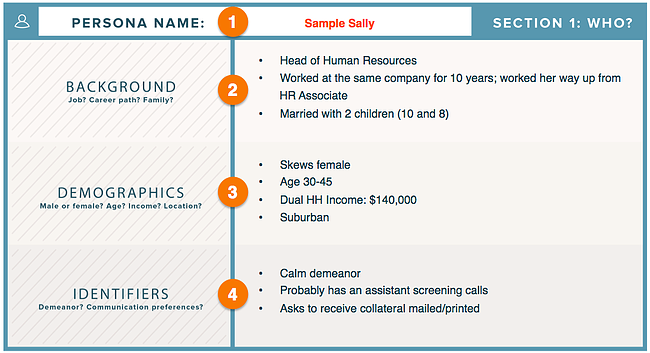
    Here’s a look at a generic template you can use for creating a buyer persona.

    • Background (basic work details of the persona, where is he working or suitable info on hobbies or education, job title).
    • Demographics (gender, age, income, urban or not).
    • Identifiers (Buzz words and mannerisms).
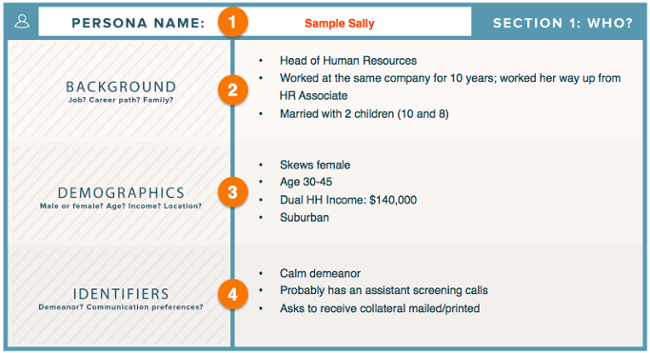
    Buyer persona sample - creating a winning content strategy

    Image Source

    Remember to update the buyer personas from time to time for optimum results in the form of a boost in organic traffic to your website.

    Type of Content

    Different types of content serve different purposes. When your aim is to generate new traffic, your content focus should be on infographics, checklists, and top of the funnel posts. Ebooks are a great way to help the targeted audience go a step further in their journey.

    Consider finding answers to the following questions to help your content team align their writing to your goals.

    How technical should your content be?

    What should be the preferred tone?

    Should the content be educative in terms of the industry best practices to follow? (Already tried and tested approaches)

    Should it be a summary of what you have been doing right and a framework of the same? (Innovative ideas that can change the game)

    Frequency of Content Delivery

    When your business goals are in place, you will have better clarity on the content you want to publish. Next, you need to arrive at the frequency of posts. This is important from the SEO and content visibility point of view.

    It is essential to have a consistency in creating content. The frequency of content creation will depend on your business goals. If branding is the goal, a lesser frequency works, but Search Engine Optimisation necessitates a high frequency.

    Also, you must use analytics to assess what kind of content is favoured by your audience and arrive at the frequency of posts. Space out the posts as per category to ensure content for one category does not overlap.

    Figure Out the Topics Based on Your Offerings

    When you have figured out how often you are going to post content on one category, you need to know what your writers will be writing on. Identify keywords that are the best fit for your business and put them on Google to see which topics come up in the search results.

    Think out of the box and arrive at topics that will interest your target audience. Introduce them to your business so that they don’t appear to be a misfit on your website.

    Identify Who Will Create the Content

    Ask yourself the following questions.

    Do you have writers in-house to create content with a reader-friendly tone?

    Will hiring content expert freelancers work better on your budget?

    After you have identified who will handle the task of creating content, it’s time to get the ball rolling.

    Content Calendar

    Preparing a content calendar is an integral part of any content strategy if you want to materialise your goals. This calendar will have all topics, keywords, target audience, timelines, and author names in one place.

    The editorial calendar chalks out what you will publish and when, specifying the particular days of the week against each topic. You may intend to roll out multiple content pieces on the same day if each of them targets a different audience.

    It’s critical to manage the publishing schedule well as promotion and the distribution of content will depend on it. Create a weekly or monthly schedule and share it with the concerned teams.

    img

    Image Source

    Crafting Your Traffic Acquisition Strategy

    The competition to get noticed on the web is beyond comprehension. Getting your target audience to your website is the key for augmenting conversions.

    In these years of experience, I have come to infer that there are three main elements that drive traffic to your website. Consider one of them based on your business and goals.

    Here’s a look at these elements that aim at driving traffic to a website.

    • Post shareable content or resources (B2B)

    B2B organisations sell to other companies and not to consumers. It may look like they do not invest time and money in inbound marketing but that is far from reality. It works for B2B businesses to create resources, case studies, and research papers as a means of increasing traffic.

    Deals between one B2B business and another happens on the basis of credibility. If structured and created with valuable information for the reader, resources convey your expertise in the field. Likewise, case studies validate your experience and tell the other company that you are adept at providing the services to them.

    It’s not new that when content is shared across reliable platforms, your credibility gets a boost. You need to use this to your advantage and drive traffic to your website.

    If you can get your visitors to share your content regularly or in a considerably large volume, it will give you access to tons of traffic. This will also increase your chances of ranking higher in the Google searches.

    Expert guides, eBooks, research papers, and white papers are excellent examples of shareable resources. Expert guides make for great sources of learning. If a business advocating your brand shares it on his network and links it to their content, it can provide indirect benefits to your brand.

    A good eBook or a white paper can be excellent tools for drawing visitor attention and converting customers, typically when it comes to B2B customers.

    White papers focus on a company’s products and services. They are known to generate qualified leads and are useful to visitors who are interested in your offerings and most likely to convert. EBooks concentrate on providing general industry knowledge.

    Pick vital information from the white papers and eBooks to create eye-catching infographics that are designed to convey your message faster. Infographics are useful for those who do not have much time to read elaborate content.

    • Organic Traffic

    Writing SEO focused content and blogs for B2B and B2C consumption are excellent for bringing organic traffic to your website. If your content complies with SEO and provides resolution to user queries (that they input on search engines), it is certainly a sure shot way to get traffic to your website.

    Internet users today are smarter than ever before. They prefer to run a quick search before making any buying decision whether to gain more information or to find the best deal on a product/service.

    They ignore advertisements and are impressed by quality content scores on all these points – readability, easy to understand, and high on content value. If your content takes care of all of these, it’s only a matter of time when you will get organic traffic with high ROI.

    Getting your website to list in the first few positions of the SERPs is indicative of the success of your SEO efforts. This will depend on how optimised your website is for the search engines.

    Focus on getting your website structure, keywords, and blog posts right to gain leverage on search engines.

    • Traffic Through Social Media

    Social media marketing has had a tremendous impact on the way businesses make their presence felt to among their target audience. Created originally for communication purposes, today social networking sites are used extensively for business and marketing. Primarily, B2C companies were the first to take the plunge as this type of marketing allowed them to directly validate their performance.

    Ok, here are some interesting snippets of how social media marketing impacts a business’ content strategy.

    As per the statistics given by Excellent Presence, did you know…

    90% of all social media users use Facebook?

    As has been the trend from the past, women (77%) are more likely to use Facebook than men (66%).

    Approximately 70% of Facebook users spend time on the social platform everyday and 45% use it many times a day.

    People like to scan on Facebook. Short writing draws more eyeballs and better responses.

    Thursdays and Fridays are the best days to post on Facebook for maximum engagement.

    MIT finds that company CEOs using Twitter extensively for business-related tweeting have more RTs, faves and more followers.

    Using images on Twitter generates 5 to 9 times more retweets and 4 to 12 times more favorites.

    Tweets with 120 to 130 characters and hashtags are more engaging.

    An infographic on a social media channel is 30x more likely to be read than a plain looking text post.

    Content marketing generates 3x as many leads as traditional marketing and costs 62% less.

    60% buyers show interest in buying a product after reading content about it.

    A study of 220,000 pieces of content indicate that ‘list’ and ‘why’ articles are the top two most shared types of content.

    Phew! So much for the stats.

    Social media is growing at an astounding pace and user behaviour has witnessed a sea change over the years. Gone are the days of click baits when users could be lured into clicking your link and building traffic.

    Update your Existing Blogs

    Publishing meaningful content in the form of blogs can work wonders in creating healthy brand awareness. However, we live in a fast-growing world, and it becomes equally important to revamp your content and keep it updated regularly.

    Leveraging your existing content by modifying and refreshing it is one of the best strategies. This way, you do not have to go through the process of writing a new blog.

    The first step would be to update information that has changed since the time it was published. Facts and statistics that held good before might not hold good with the current market scenario.

    The next thing on the checklist would be to remove redundant information that does not add any value to the reader in today’s scenario. Also, this is the step where you add content that adheres to the current market trends.

    Your existing blogs are a source of information too. Has your target audience liked the content that you had posted? How well has it worked? Do you have feedback to make it better? Do you have new products that are a better solution?

    Answer the above questions and include them while you are updating your existing blogs. Give your audience what they need, and you will get what you need.

    Continuously updating your content shows the people on the internet that you are constantly growing along with the growing market. That is a positive trait to showcase and will significantly enhance your brand awareness.

    Power of Non-Textual Content

    While blogs are one of the most widely distributed types of content, many other types are gaining popularity among different target sectors.

    Visual Content

    • Visual information can be processed significantly faster than any other type of content. Visual content in the form of infographics and social media posts will help you reach a larger set of audience. Nothing is more encapsulating than a good story, and videos are the best format to tell the world a beautiful story.

    Today, marketers in the B2C domain have to think out of the box all the time and keep innovating to get their website/products/services noticed. Visual content is the order of the day. Visuals leave a lasting impression on the minds of users and they retain it for much longer than any other form of communication.

    Random videos do not work; they should have a strong message or a story to bring out the utility of a product or service clearly in a serious or funny way. When users on social media channels hear taglines and catchy words in videos, it stays on their mind and they can recollect it even weeks later.

    Podcasts

    • The average number of podcast listeners are growing every day. It is a great space to offer knowledge to your target audience. A podcast is a good way to talk about your product which is related to the topic and can help make their lives better in one way or more.

    Conclusion

    Now that you know what are the critical elements in B2B or B2C content strategy, it’s time to spring to action and do the right things to get noticed. Having a predetermined frequency of posts, such as videos, infographics, blogs, white papers, and/or research papers works best. Make sure you have an editorial calendar in place to get you organised.

    You may have the know-how of churning out the best content, but posting it in the right place and at the right time is the key. If you learn to do that right, it is only a matter of time before you start seeing results.

  • Creating a Successful Website Structure For SEO – a 5-Point Handbook

    Creating a Successful Website Structure For SEO – a 5-Point Handbook

    #BackToBasics

    Consider a website – when you open it, you see welcoming fonts, cool colours, and exciting pictorial depictions. Remove these elements, and underneath it all lies the framework on which your website stands. Unless this framework is strong and logical, it will neither retain visitor attention nor make the search engine spiders hang on to it for longer durations.

    You cannot afford to have a high bounce rate as it defeats your purpose for a virtual presence. Hence, the need to create an effective website structure for SEO!

    Why should you have a proper website structure?
    1. It helps Google in crawling your website and index links.
    2. Reduces Bounce rate.
    3. Sends link authority from high ranking pages to other relevant pages on the website.
    4. Better UX for user retention.

    If your website is disorganised, trust us, you are losing out on some serious SEO leverage.

    When you are creating your website structure for SEO, you must have a proper strategy in place so that your website is successfully crawled and indexed by the metacrawlers and appreciated by users for its easy navigation.

    Without proper navigation around it, your site visitors will end up feeling lost and ultimately be prompted to move on to another website.

    What Should Your Website Structure for SEO Look Like?

    Okay, so let’s get down to business right away.

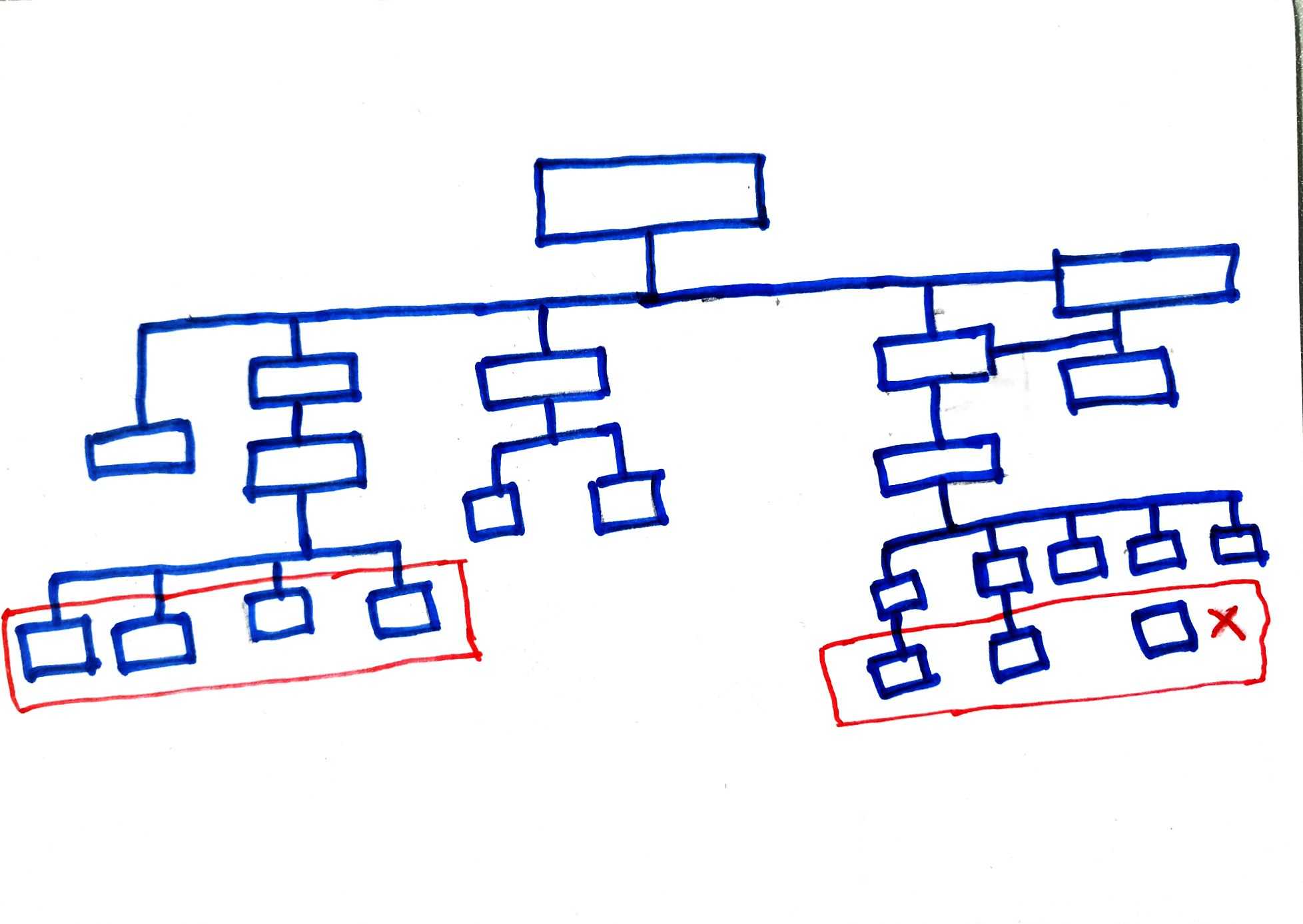
    Here’s how you should NOT create a website structure –

    Website structure

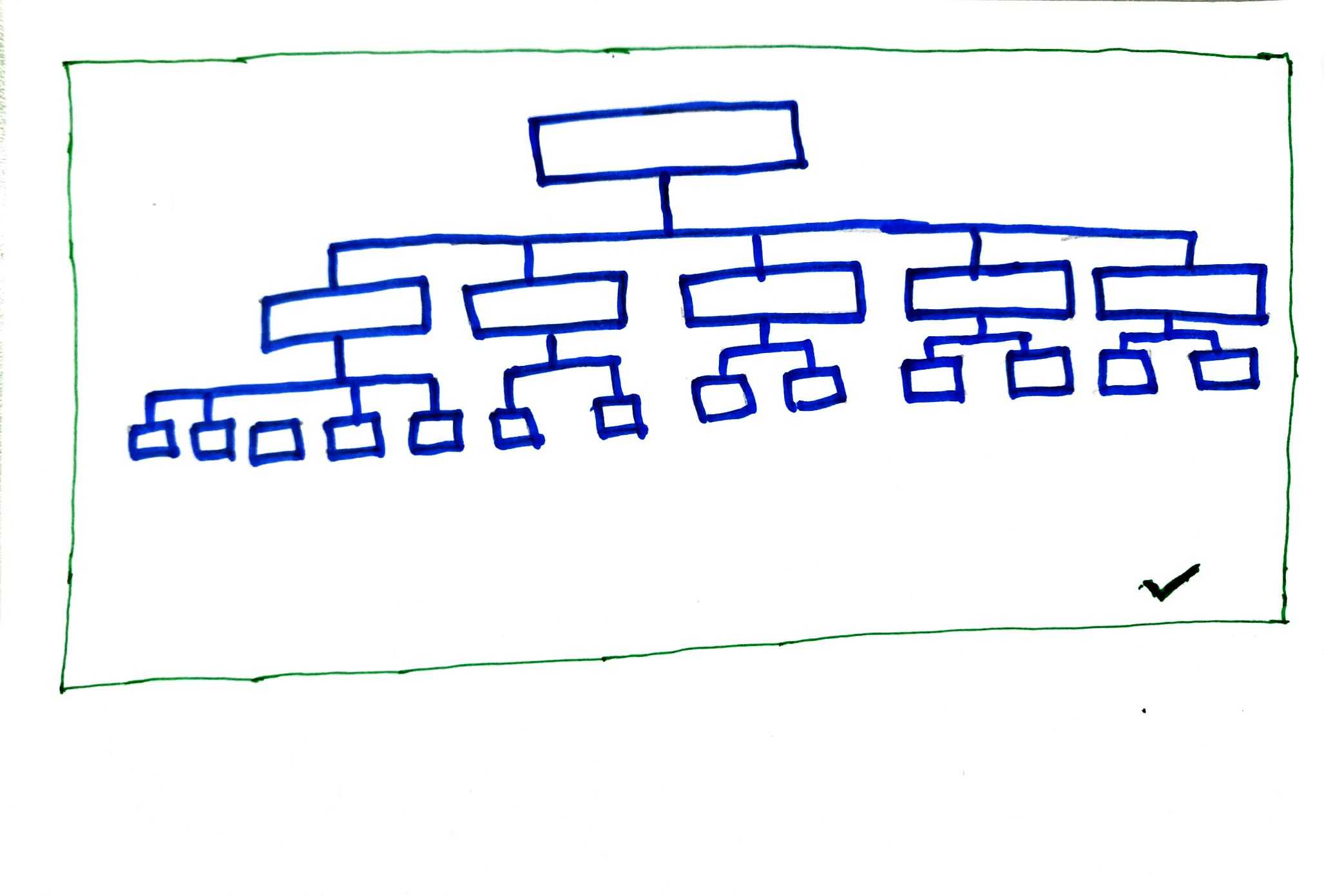
    On the contrary, this is what it should look like –

    Ideal website structure for SEO

    What are the Best Practices for Creating a Website Structure?

    1. Building from Scratch? Chalk Out a Site Hierarchy

    It makes sense to plan your website structure for SEO on paper or a spreadsheet and assign a relevant hierarchy to the pages. This will also decide the site navigation and URL structure. Make sure you make a logical assessment of the categories you will include, keeping the main categories from 2 to 7 in number and a few sub-categories under each one.

    Unless yours is an e-commerce portal like Flipkart, Myntra, or Amazon, you don’t need to have too many categories. Try to keep the subcategories more or less even across the webpage, but don’t worry if they’re not all of the same number. A slight variation is acceptable.

    Extra Note: Going hand in hand with evolving a site hierarchy is the need to deploy an effective SEO strategy for landing pages. This should be the next step after you are done with the website structure.

    2. Carve Out a Crawl-Friendly URL Structure

    After you have settled on a navigational hierarchy for your website, creating a URL structure is going to be a breeze. Your URL system should have the right keywords in place and be in tune with the navigational hierarchy.

    Let’s say, yours is a website design and development company with the main category pages on your website listed as Design, Website Development, App Development, Digital Marketing, About Us, Our Work Portfolio, and Contact. Consider the category ‘Design’ and its sub-categories Website Design, Mobile Site Design, Logo Design, and Custom Layout Design.

    The URL structure for two of the sub-category web pages under ‘Design’ will look like:

    www.xyzdesign.com/design/website-design
    www.xyzdesign.com/design/mobile-site-design

    It doesn’t have to be the exact same, but try to follow a similar approach across your website.

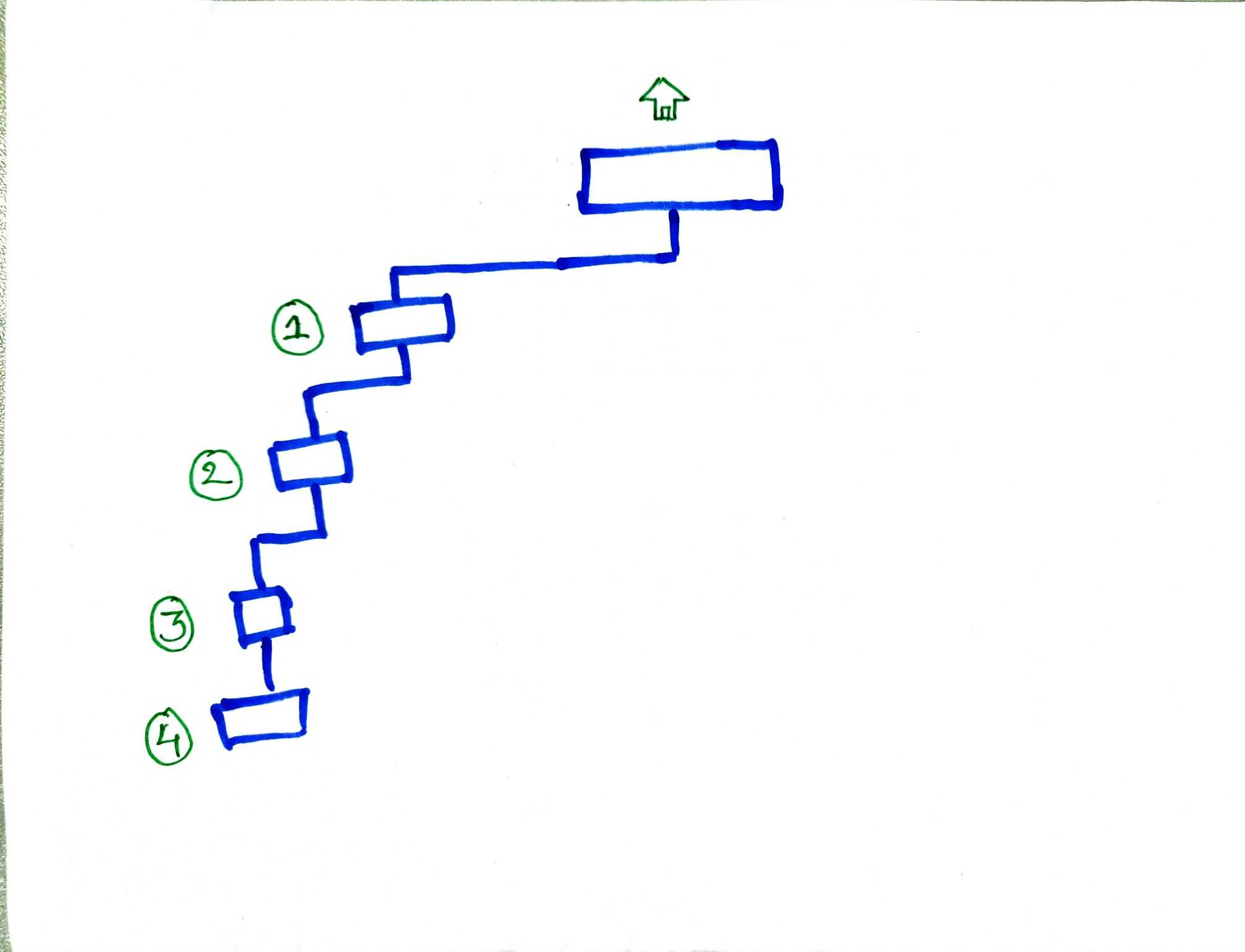
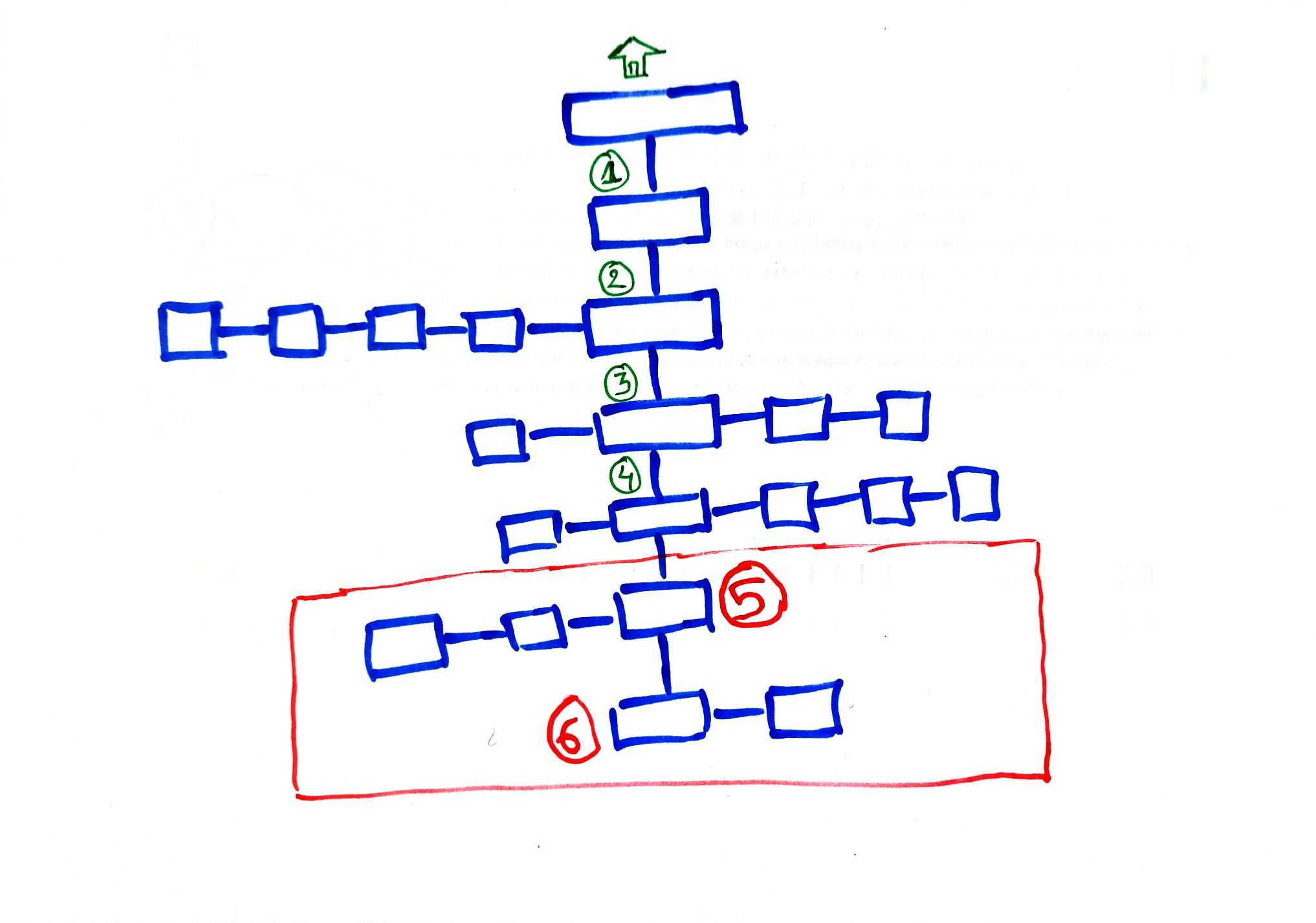
    3. Less than 4-Clicks is the key

    In one line, users should reach any page on your website in less than 4 clicks!

    When you want to facilitate effective user navigation through website structure improvement, refrain from burying your important pages deep within the website. This prevents them from being accessed easily by visitors and crawlers.

    The idea is to keep the navigation shallow and get all the pages on your website indexed by search engines so that they show up in the SERPs for relevant search queries. Here’s a quick visual interpretation for you –

    website structure best practices

    Below is how a “Deep” website looks like –

    website structure analysis

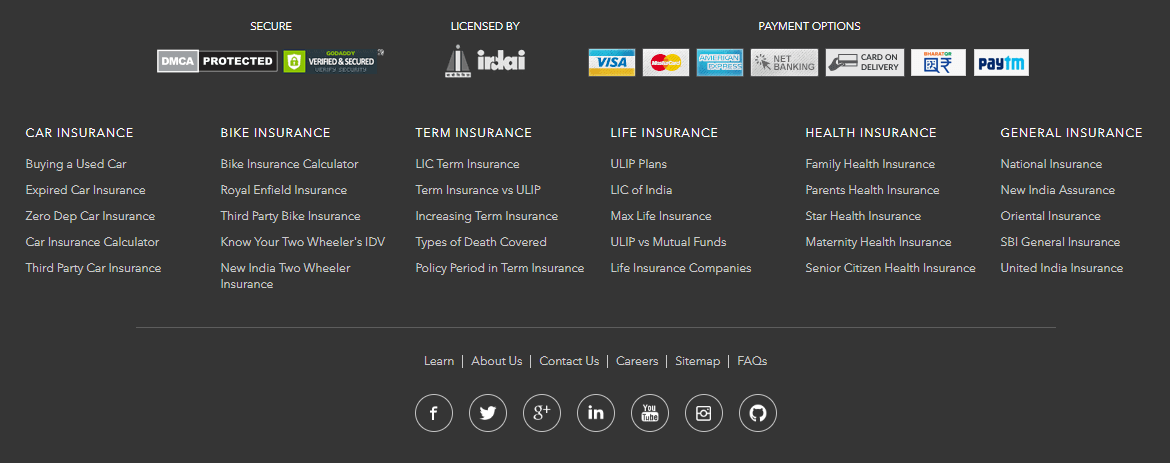
    4. List Your Main Navigation on the Header and Footer

    Keep your header simple with just a few categories listed there and with a limited number of subcategories under each in the form of drop-down menus. The footer can have the sitemap which makes it easier to crawl and keywords as anchor text for better optimisation.

    5. Think Up a Workable Strategy for Internal Linking

    Internal linking lends credibility to your website’s navigational hierarchy. Do not complicate the links.

    The last pages in your site hierarchy must specifically have internal links so that the visitor knows this ain’t the end of the road for him and he can go to another relevant page on your site for more inputs.

    Internal links convey to the search engine which pages are important on your website and help them feature higher on the SERPs.

    Why is it crucial?

    It helps in sharing the link juice across the website, thus helping improve the ranking of pages deeper in the website structure.

    Quick Tip: Prefer HTML links instead of Js, it’s more crawlable.

    Creating a great website structure that works in your favour is no rocket science.

    You just need to stick to the basics and give high priority to user-experience.

    Rework the design and organisational aspects if you already have a website or build a strategy from scratch if the launching of your website soon is on your mind.

    Has something apart from these worked in your favour and shot up the SEO results of your website quite drastically? Share your ideas in the commen ts below.

    Reference : https://backlinko.com/hub/seo/architecture

  • Requisites for an Awesome SEO Strategy for Landing Pages in 2019

    Requisites for an Awesome SEO Strategy for Landing Pages in 2019

    A first impression is the last impression, indeed.

    After all the hard work that has gone into creating your web presence, the next important thing to do is convert your visitors into valuable leads.
    This is where an SEO strategy for landing pages come into the picture.

    Now, let’s take a quick look at this statistical information shared by Hubspot –

    The second edition of MarketingSherpa’s Landing Page Handbook mentions that 44% of clicks for B2B companies are directed to a business’ homepage and not a specially designed landing page.

    Just 62% of the companies using landing pages have six or fewer of these in total for their business.

    The handbook also mentions that the reason why businesses don’t use them is that their marketing department doesn’t know to get them up and running, or they have many other things on their agenda.

    Before we delve deeper into the SEO strategy for landing pages, let’s take a look at how a landing page works.

    Hey, wait!
    If you think this one’s a no-brainer for you, scroll to the end of the blog where I have added some of the best strategies for conversion optimisation. Don’t miss out on them!

    How Does a Landing Page Work?

    We know that a landing page is just like a web page that helps capture a visitor’s information through a conversion form.
    A good landing page targets your audience, provides them something of value and converts a chunk of your page’s visitors to leads. Your landing page should prompt the visitor to do one of the following:

    • click
    • buy
    • allow a follow-up by email or call
    • tell a friend,
    • give you feedback.

    Being a content-based strategy, content should be the primary focus here. Landing pages improve user experience and convert visitors into leads. They also support your SEO strategy when you are trying to rank better on search engines for your important keywords. Additionally, the content they present has every chance of inviting inbound links.
    Want to know the best part?

    A landing page creates a win-win situation between the site and the visitor. A visitor wishes to access valuable content from you. So, he feels he should fill the form on the landing page with his details.

    On the other hand, marketers willingly provide invaluable inputs with the desire that the visitor provides his personal information to push their marketing efforts in the future.

    Guidelines for Creating a Winning SEO Strategy For Landing Pages

    1. Publish it Linked to Your Own Site

    When creating a landing page for your website, keep in mind to maintain your search engine visibility and authority by publishing them to your own domain.

    Why lose out on the slight, if not much, leverage of a ranking boost when people look for your services using the keywords you have added?

    2. Figure Your Most Important Keywords

    Look for words that you want search engines to rank your page. Long tail keywords are easier to rank for on search engines.

    Start with making a list of the terms or search queries that are relevant to your page.
    Derive combinations of long tail keywords research from them by inferring what your prospect may type into Google to find what you offer.

    Here’s a quick example.
    You are a four-wheeler repair service provider in Pune and you are creating a landing page that aims to draw the attention of clients who own a car. Don’t try to rank for broad terms such as “car repair” or “four-wheeler repair company”. Instead, you can be specific and use keywords like “car repair company in Pune”. You may also be more specific and say “car repair company in Hinjewadi”.

    3. Add Keywords Strategically on Your Page

    Merely using keywords doesn’t help unless you use them in the right places. Here’s how.

    Title Tag – This is displayed at the top of your page in your browser tab and is the big blue link you see in the SERPs. Make it compelling and have the right keywords to encourage the reader to click.

    Meta Description – This is the short description that features below the page title in the SERPs. Use it well and have the right keywords in it to inform the reader what he is likely to find when he clicks the link.

    Header Tags – Prioritise your content by using HTML header tags starting with H1 as the main headline of your page. H1 tag informs Google what the most important words on your page are. Accordingly use H2, H3 and so on for the internal headings.
    Image File Names – Use descriptive file names for your images since Google crawlers read them. If the image alt text contains the target keywords, it will help in improving your ranking.

    But here’s the deal.

    Sprinkle keywords judiciously through your copy. Don’t indulge in “keyword stuffing” if you want to avoid being penalised by Google.

    4. Page Length Does not Decide Search Engine Rankings

    If you thought the length of a landing page is a yardstick for how it fares on search engines, you need to rethink your SEO strategy! Brevity is important and not all long-form content ranks high on Google.

    This may contradict common belief of marketers that search engines favour long content but the better ranking may also be if a page is well-researched and valuable to the reader.

    If a page attracts readers and makes them stay longer, the battle is won.

    At the same time, do not shy away from mentioning all the important points even if it means providing useful information to your target audience.

    5. Creating Content That Invites Backlinks

    Quality backlinks can help your rankings get a boost in the SERPs. If someone likes your page and is linking to you, it tells Google that you have something of value to offer to your visitors.

    A combination of great, well-researched content and targeted outreach can help in building good links.

    Be creative and keep these pointers in mind when you conceptualize your landing pages or the SEO strategy for them. Figure out what can attract your target audience to avail your services.

    Sit back with a cup of coffee (or tea, if you like) and think with a free mind how best you can formulate your landing page strategy.

    Step into the shoes of a customer and jot down ideas as they come to you. Zero-in on the best
    ones and create optimised landing pages.

    Examples of Few Best SEO Focused Landing Pages

    Whether you are a landing page creator or a service seeker looking to get a few of these done for your website, this will get you rolling.

    Here are some of the examples to help you build compelling landing pages.

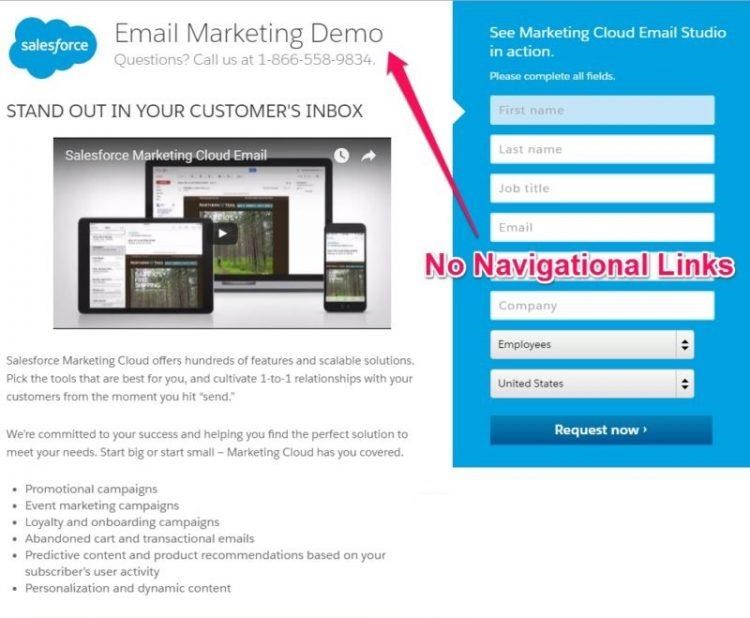
    1. Doing away with navigational links

    This landing page focuses on having just one call to action (CTA) in the form of a clickable link. Bye, bye distracting footers and navigation bars!

    Landing Page Examples

    2. A short, crisp video explaining the landing page goal

    Quick communication is the key and this is deployed well in the example you see below. Tell your story effectively in a video, talking about the benefits of your product/service in a crisp yet engaging manner.

    Landing Page Examples

    3. Benefit focused headline and sub headline

    The illustration below shows that the headline mentions the benefit of availing 86% discount upon signing up for the magazine. The brief snippets tell the reader what they can find in the magazine. With a contrast colour call to action button that invites the visitor for a yearly subscription, this landing page has everything going for it.

    Landing Page Examples

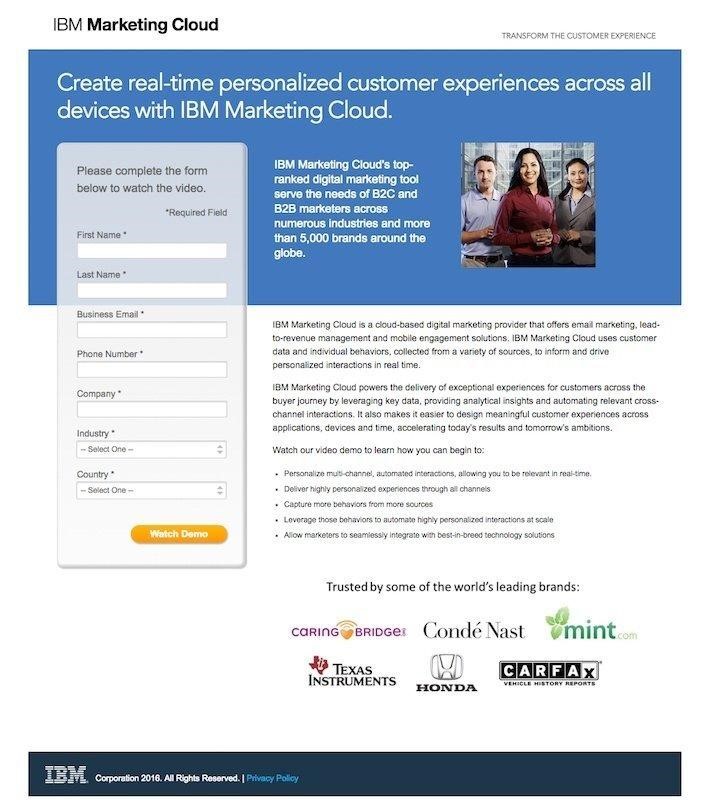
    4. Content driven and provides social proof

    The page provides crisp content on how the company’s marketing tool can benefit marketers across the world. The headline and sub headline reiterate the benefits and provide a proof of how the tool has been helping thousands of businesses.

    You notice the call to action in contrast colour instantly and are prompted to fill in your personal details to watch the demo.

    The logos of prominent companies, indicating their clientele, further serves to cement their reputation on the visitors’ minds. This is among the best landing page practices as far was SEO benefit is concerned.

    Landing Page Examples

    Should PPC and SEO campaigns have different landing pages?

    The answer is a yes.

    SEO and PPC campaigns are optimised in different ways. SEO campaigns are run with a lot of content that must be relevant to visitor needs and should be like SEO storytelling. They aim at winning organic search traffic.
    So, an SEO-driven landing page will be keyword-optimised and show a lot of relevance to the searcher’s intent. I have already shared inputs on what makes a winning SEO landing page in an earlier section.

    PPC campaigns focus on conversion optimisation. Hence, PPC landing pages should be compatible with the ads and need to be created such that they allow the target audience to perform the required action.

    Landing pages for PPC do not have to be content-loaded. The little content they have must aim
    at getting conversions and providing sound user experience.

    A PPC landing page can contain one or more of images or video, testimonials, consistent branding, CTAs, simple conversion form, trust symbols and a strong headline.

    Visitors should be able to understand the offer easily and prompted to click the call to action button.

    Heck Ya! I Want to Know the Top Strategies for Conversion Optimization!

    Here’s the deal:

    Landing pages present several opportunities for conversion optimisation. Period.
    Take a look at these SEO strategies for landing pages.

    Social Proof and FOMO to Persuade Users and Influence Their Decisions

    FOMO means “fear of missing out” and this has been prompting several actions online today by marketers and website owners. This strategy is a pretty powerful one and is known to work successfully on landing pages. It tells users they will be missing something if they do not act within a specified period of time.

    Apply it in your landing page copy, stating the specific date till when the offer lasts or a CTA like “Only 15 left in stock. Hurry!”.

    Social proof also works to push users to help you attain your conversion goals. If you have a celebrity testimonial or the brand logos of popular companies benefiting from your products/services, it makes you more credible to your visitors.

    Keeping Bounce and Exit Rates Low

    A high bounce and exit rate means your page is not engaging enough or your offerings do not excite prospects. You need to figure out why.

    Make an analysis to know where you are going wrong. Come up with questions like “is your website navigation-friendly?”, or “are the services or products I am offering of good value to prospective users?”

    Bounce rates also tend to be on the higher side if your landing page is not optimised to provide a pleasing mobile experience. Ensure you create mobile-friendly designs that amplify user experience even on a smaller screen.

    Employ Lead Capture Forms

    Lead capture forms present a huge potential for generating leads and boosting the conversion rate of your website. Online tools such as ‘Leadformly’ makes it easier for owners to create these forms with high-converting capabilities.

    Audio-video Medium Create a Lasting Impression

    Videos communicate your brand’s story in the best way possible and help in cementing relationships with prospects and clients. This taps a user’s tendency to be more inclined toward watching videos, knowing that his attention span may not be more than a few seconds. If you can create a big impact in those few seconds, the battle if half won. Getting them to convert is winning the rest of it. Know how to embedded video can improve your SEO Landing Page Strategy

    Wrapping It Up

    By now, we understand that having a landing page is a great idea for increasing conversions. Making a profit out of a landing page is not always the idea. Your job is almost done even if your landing pages manage to bring traffic to your website or build your email list.

    While it is very important for you to follow the best practices for building your landing pages, you must also know that every rule may not be applicable all the time. You need to work around what is the best fit in a given situation.

    Best practices are definitely stepping stones but you may sometimes need to work around them to suit your business.

    So, are you willing to do what it takes to build that great first impression?

  • How can AI be used in Content Marketing?

    How can AI be used in Content Marketing?

    Last year, on April 1st, we announced at WittyPen one of our most ambitious projects – Project Nora. The response to that was better than what we could have expected.
    With the help of Artificial Intelligence, we offered to get your content written by some of the greatest minds in human history. Initially, the number was kept to 6 – Steve Jobs, Warren Buffett, JK Rowling, Bob Dylan, Bill Gates, and Philip Kotler.

    You pitch the idea, select the writer, and behind the scene, our AI algorithms would work to ensure the content as per your desire. Can you imagine how crazy it would be to have your brand story by J.K Rowling, and your sales pitch or PR article composed by none other than Steve Jobs?

    Project Nora WittyPen

    Keeping the huge amount of structured and unstructured data, complex algorithms, and the brilliant engineering aside, just think only from the perspective of the outcome. How beautiful it can be for you as a business owner to share your idea with the greatest minds in human history and let them speak for you!
    Nothing short of a fairy tale, right?

    People appreciated the idea of using AI in content marketing, talked about it, reached out to us, showed their interests, and asked for samples. It was simply an amazing response for a young startup like us.
    But if you read the first line again, and notice the date mentioned, it’ll come to you that it was a 1st April prank. Nonetheless, a beautiful one. People still casually talk about the uniqueness of the idea and the possibility of its execution.

    Well, pranks are supposed to be attention seeking and funny. It was both. But sometimes, there is a certain extent of reality involved in the prank. This, too, wasn’t a complete lie.
    With this prank, we were experimenting with the possibility of the adoption and acceptance of AI in the Indian content marketing space.

    The appreciation for Project Nora could have been the ‘initial enthusiasm’ for a fresh idea, but did the idea have the potential to generate success on a greater scale? Given the nascent stage of AI, and even content marketing in India, did the idea stand any chance?
    Directly connected to it, but the bigger question, is:

    Is AI in Content Marketing any Relevant?

    Whenever there is an introduction of a new technology, the debate of ‘Machine vs Human’ is almost mandatory. People are sceptical that the introduction of more efficient and powerful machines will replace professionals and snatch their jobs away.
    The best examples are Computers. When computers were introduced in India, people opposed it on the basis that it’ll take away all of their jobs.
    However, with time, it was proven that it wasn’t much of a threat to jobs. In fact, thousands of jobs in the Indian It sectors are created every year, thanks to computers.
    Now, coming to the freelance sector in the country, India is the land of 20 million freelancers. 1 out of 4 freelancers in the world is an Indian. A fair share of them consists of content writers. It is natural to think that the introduction of AI in content marketing will replace them. But, think again. Will it?
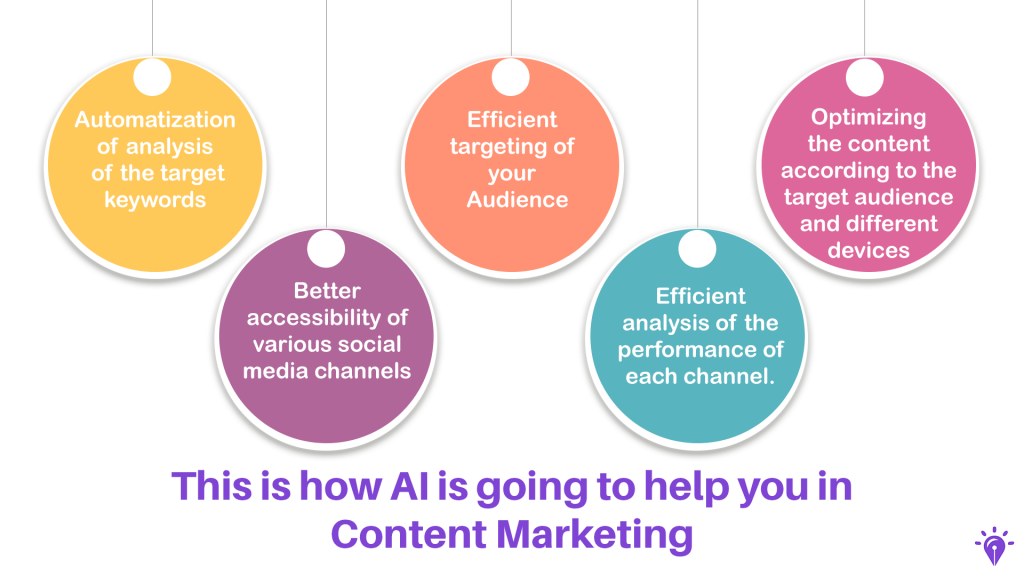
    No, it’ll not. However, AI will most definitely be helpful in:

    1. Automatization of analysis of the target keywords
    2. Efficient targeting of the Audience
    3. Optimizing the content according to the target audience and different devices
    4. Better accessibility of various social media channels
    5. Efficient analysis of the performance of each channel

    AI in content Marketing

    The above are just a few of the innumerable advantages AI has to offer. But, the thing is, AI will never replace the human creativity needed for quality content creation (at least, not in near future).
    The human brain is way more complex for algorithms to mimic anytime soon. That way, it is not going to replace the human creative effort, but will help optimize and make it more efficient.
    Now, the question is:

    How Artificial Intelligence can Help with Content Marketing

    Every content piece has a journey. It takes roots in your business, flourishes along with your target audience, grows with your prospects, and matures with your customers.
    Let’s see how AI can be used in content marketing.
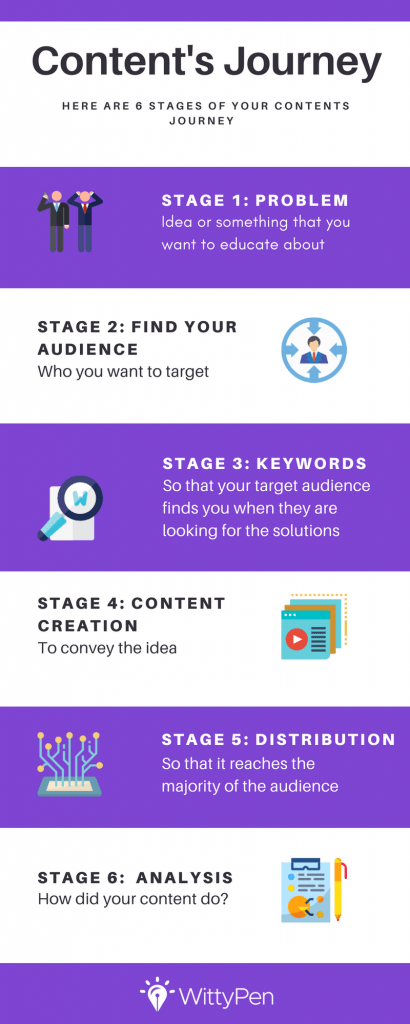
    If we break the journey down in stages, it’ll look something like this:
    Stage 1: Problem – Idea or something that you want to educate your readers about
    Stage 2: Find Your Audience – Who you want to target
    Stage 3: Keywords – So that your target audience finds you when they are looking for the solutions
    Stage 4: Content Creation – To convey the idea
    Stage 5: Distribution – So that it reaches the majority of the audience
    Stage 6: Analysis – How did your content do?

    Content's journey in 6 steps WittyPen

    Saying AI can help you at every single stage of the 6 mentioned, won’t be an exaggeration. Well, let’s see how:-

    1. Let’s Take a Start

    Taking a start is always difficult, but crucial.

    You know way too much about your business. Your business is not just a static object to you. It’s like a living person, breathing, moving, and growing along with you. You know every tiny detail of it.

    But others don’t know as much as you do about your business.

    The difficult part is to bridge that gap, and equally crucial as well. Crucial, because without bridging this information gap, you cannot have customers who put their trust in you.

    At this point, you are surrounded by thousands of content marketing challenges.

    How do I explain what my business is all about?
    Is it important to tell everything about it or only the benefits?
    How Should I approach my content strategy? Should I keep it formal? Should I keep it fun?

    Do I need to talk only about my business, or I can include other things as well?
    What are the things that I should make sure to cover in all the content pieces?

    Let me tell you, it is difficult to sort everything out manually, even if you have a team of professionals.

    AI can certainly help you there. AI can help you automate all the above-mentioned processes, which you have to manage manually. Not only it reduces the human effort, it is more efficient as well than doing it manually.

    2. Who is Looking for You?

    Youtube always leaves me awestruck. Their search recommendation service is simply brilliant. I, sometimes, think of a song, type the first word of it, and can easily find my song on the list, often at the topmost position.

    How do you do it, Youtube?
    The answer is AI.

    Youtube LogoImage Source

    But there is another aspect of Youtube, I am fascinated about is the accuracy of their advertisements. Most of the times, if not every time, the advertisements in my feed make sense to me. Whether I’m buying or not, is a thing for another day but I am considering it for sure.

    The world is a huge place, and a lot of people are looking for exactly what you offer. If you possibly could identify them all, and tell them what you do, half of your job is done. You are already set for stars.

    But how can AI help you with that?

    Exactly, the way it helps Youtube.

    Youtube records your browsing pattern, the kind of content you consume, and the products you previously have shown interest in. Based on this data, Youtube analyzes your persona, matches with the available records, and offers you exactly what you are looking for?

    AI can do the same for you, what it does for Youtube. It can connect you with your Target Audience.

    But this is not enough. Before you could serve them best, you need to know their requirements. You need to know:-

    3. What are They Looking for?

    Sometimes, starting from the very beginning is too boring, and sometimes telling too much is simply waste of time.

    So, what do you say to the people who are looking for your products/services?

    Exactly what they want to know.

    How?

    With the help of right keywords targeting.

    There is an entire industry working around SEO and keyword targeting. Based on the number of hits and frequency, keywords are chosen and inserted in the content. This approach is fruitful at times, and it can certainly be improved by matching these keywords with your target audience.

    SEO Keywords WittyPen

    Let’s say you are a business providing cloud services to Startups/SMEs, and large corporates. Going by your services and the keywords frequency hits, you may find – “Cloud Computing” as the most suitable keywords. You take this keyword and design entire content strategy around it.

    The problem with this arrangement is that most of the users clicking on your website are going to early college students, who are looking to learn the basics of Cloud Computing. I’m not saying that they will never buy from you but the chances of them buying your products are really thin.

    So, what happened there?

    You didn’t get the keywords frequency verified by your target audience.

    AI can keep you more targeted in that aspect. With AI, you can get it as accurate as possible.

    Okay, so now AI’s job is done, right?

    Clearly, NO.

    At this point, you know what your target audience is looking for, but:-

    4. Are you Providing the Same?

    The single most important question in your entire content marketing strategy – Are you providing the right solutions or just beating around the bush?

    Think of people who were so excited of the launch of the first iPhone that they waited overnight outside Apple headquarters for June 29, 2007 launch. These people believed that they are going to witness something that no one in entire human history ever had.

    img

    Image Source: media.wired.com

    Think of their enthusiasm and excitement for a product, just for a minute.

    Now, rethink what if the first iPhone wasn’t as good as people thought it would be. All the enthusiasm would’ve converted into a sham.

    You don’t want it to happen with your audience either. That is why, this is the most important step, and you don’t want to go wrong here.

    At this stage of content creation, AI can help you with:-
    a) Sentiment Analysis – Is the message is coming out right?
    b) Readability – Is it reader friendly or written for machines?
    c) SEO – Are you providing what users are looking for?
    d) Relevant External Links – Is it providing additional information to the reader?
    e) Image/Video Suggestions – Is it visually appealing and relevant?

    This is something, you can get more accurately with AI than a mortal human being

    5. Are You There, Where They Are?

    Facebook is the world’s biggest social network and if you watch your feed carefully you’d notice that it’s probably the biggest marketing network as well.

    LinkedIn is the biggest and most powerful network of professionals. You can find from college students, early professionals, to top corporate officials here.

    Every major B2C company is on Twitter and using it address the concerns of their customers.

    img
    Image Source – Pexels

    Are you using these?

    Also, are you using Quora, Instagram, Pinterest, and Reddit?

    How are you using these channels? Because the audience on each of these platforms is different from the other. You cannot target them all with the same approach.

    You need to adapt.

    But, how?

    AI can help you understand which section of your target audience is hanging out where? AI can also tell you which section of your target audience is interested in which feature of yours. Show them what they are looking for. Also, talk in their language but don’t lose your authenticity.

    6. How did it Go?

    Nothing’s perfect, and AI, anyway, is in a really early stage. You cannot expect it to hit the nail for you every single time.

    Because ultimately it is the people that you are dealing with. People like to make rational choices true to their conscious but often they go by their emotions.

    That is why there can be no single absolute theory that can decide your steps. The most you can do is to try to be as accurate as possible. Observe, evaluate, learn, and try new things.

    AI, again, can be helpful in evaluating the output produced by the content at each stage. You can take that into account and learn where you are going wrong.

    Where is it that you need to put a majority of your focus and energy? Once you are done with it, you need to:-

    7. Redesign the Content Strategy

    This is where you’ll love AI.

    Even though it may not be 100% accurate,AI in content marketing can surely evaluate the whole process and quickly suggest the steps to improve the overall content distribution strategy.

    AI will surely produce better results in future as it learns better. Learning is better because it identifies its own mistakes better.

    Let’s see how giants are using AI in their day to day operations:-

    Google Duplex: An AI System for Accomplishing Real-World Tasks Over the Phone

    Google: Solving problems with AI for everyone

    13 ways you’re using AI in your daily life

    Facebook: Suicide prevention tools powered by AI

    Facebook researchers use AI to turn whistles into orchestral music, and power other musical “translations”

    IBM: How Watson is powering IBM’s content marketing

    IBM WetherFX for Watson Campaign Automation

    Conclusion

    Technologies don’t die. They evolve and transform themselves into something better, something more efficient. Same is the case with AI. AI is here to stay, and it is all set to change the way we work or see the world.

    At present, we are discussing the scope of AI in content marketing and experimenting with its role, making effective use of content marketing resources and with time, this discussion will shape the reality.

  • How WittyPen Writers are Different from Other Freelance Content Writers?

    How WittyPen Writers are Different from Other Freelance Content Writers?

    The service sector in Indian economy is growing, and growing for almost three decades since early 90’s. India’s annual GDP is over $2 trillion now, and growing rapidly. 53.8% of the GDP came from service sector last year. For a developing country, this is a huge number; and is only expected to grow in the next few years.

    There is another angle to this story, a complementary one though. India can be considered the freelance capital of the world. It’s because,  out of every 4 freelancers in the world, 1 is Indian. The community of Indian freelancers and the freelance content writing platform has increased by over 20 million. Over 20 million Indians are providing services in Event Management, Language Training, Animation, Software Development, Design, Content Writing and what not. Just type “Freelance..” on Google Search box and put any alphabet after that, you’ll find a plethora of freelance service options to choose from.

    Of course, it has its advantages, and sometimes you have to make a few compromises as well. But life is about choices. And it’s you, who has to decide what suits you and what doesn’t.

    Talking about such a huge community, and trying to fit it into a single context won’t be justifiable. In fact, even if I decide to stick only to freelance content writers, it is still such a diverse group of people that defining them in a single statement may be fine, but describing what they are in one sentence can be a huge mistake.

    I accept this fact, and with complete honesty, that I wasn’t completely aware of the impact and potential of freelance content writing in India before joining WittyPen. From the number of writers involved, the number of businesses working alongside them to the amount of content created and the impact it has on the audience – everything is on such an unprecedented scale. From where I see it, it’s massive and growing. Freelance writing is in its early stage in India, but you cannot deny the scope of its growth.

    There is one aspect of freelance content writing in India if overlooked for a long time can hamper its growth, and that is the lack of organization in this industry.  Because the market is not very organized and there are almost no standards set, writers have to settle sometimes for a really low cost for their services. The scenario is equally challenging for the businesses dealing with the freelance writers, as they struggle to ensure the quality of the content, simply because there are no standards.

    That’s where WittyPen comes into the scene. When I was planning to join WittyPen, Anshul Motwani (CEO and Founder, WittyPen) told me:-

    “We are trying to solve a unique problem here. We are not acting simply as a middle-man. We are trying to ensure the desired quality of content to the businesses and justified and timely payments to the writers. Our ultimate goal is to eliminate this problem, and make it smoother for both, with efficient processes and brilliant communication.”

    Over time, working with numerous freelance content writers, strategizing with WittyPen, and communicating with the team and the writers, it became clear to me that the way we work and the processes we follow provide a sense of security and freedom to the writers, which in turn help produce a great quality content that a business would be willing to put on their website.

    This is what sets the freelance content writers working with WittyPen apart from other freelance writers. The organization of processes, sense of security, and the freedom of creativity is what allows the writers to focus on their primary jobs-how to become the best content writers– only. Let’s look more into it, and try to evaluate every aspect of it:-

    Organization

    As I’ve mentioned earlier, we bring in the organization of processes. It does not only help the businesses to get quality content smoothly but also helps the writers. From an order being placed on the platform and its allocation to a writer to the delivery of the content and feedback – everything is seamlessly designed and discussed.

    The whole process is transparent to both the customers and the writers. The idea behind keeping the entire process well organized and transparent is to avoid reinventing the wheel for each order placed on the platform. But, don’t confuse the process as being completely mechanical. We know that we are working with humans and not machines. Automating the processes have their own benefits but adding a human touch makes it complete.

    We often take initiatives on our side to ensure that the writer has everything needed before getting started on a task. We ask our writers to approach us freely if something is not clear or needs any clarification.

    One of our writers once mentioned it to me,”The best thing about working with WittyPen is that I personally don’t have to negotiate with customers for the amount and don’t have to run behind them to get paid.”

    This is what organization brings in- the freedom to focus on just a single aspect of the job and not worry about others.

    Credibility

    This is another direct benefit of organization. Because this industry is so unorganized, it is difficult for a writer to have faith in the customer sitting at the other end, and vice versa. That is what we bring in – credibility.

    In my early days at WittyPen, I received a message from one of our writers that the task allocated to her was dropped for unknown reasons. She asked,”Does it mean I am not going to get paid for the work done?” I told her that there might have been some technical issues behind the message. Those were really early days but I went ahead and said,”Even if it is dropped for any legitimate reason, you’ll be paid your due amount.”

    It wasn’t instantaneous. This was the result of the kind of credibility I witnessed in the actions of everyone working at WittyPen that I didn’t have to double check before making such a bold statement.

    Next day, when I discussed it with Anshul, we sorted it out, went ahead with the task and paid the writer her due amount after the completion of the task.

    Payment

    Payment is the biggest concern in this industry. Not only the amount generally paid is too low, but not getting paid at all is also a sad possibility. I often receive messages from writers regarding the payment. Sometimes customers take their time in evaluating the content, accepting it or suggesting any changes. We, on our part, always try to make this process as smooth as it can be but sometimes despite all our efforts it takes time, and that is when writers get impatient and anxious.

    Neeraj Kadam, Sales & Digital Marketing Head of WittyPen, has a great experience of working with freelance writers and he explained it to me-

    ”The anxiousness you witness is not entirely because of the payment delay. It is also because of the underlying fear of not getting paid at all. The market is so unorganized that it is not rare to not get paid at all.”

    This is one thing we can ensure at WittyPen — that as a freelance writer, you will get paid for your services. We pay an average of 1 INR per word, which is significantly higher than the industry average.

    Turn Around Time

    Quality takes time and we understand it. More than anything else, creativity is one thing that requires time. Thankfully, even the businesses we work with understand it and allow us to take as much time as needed to draft a brilliant piece of content.

    The average turn-around time for a content piece is 48 hours at WittyPen. It is because a significant amount of drafting a quality content piece goes in research and understanding the in’s and out’s of the requirement. If we force our writers to deliver the content in a shorter span of time, chances are that the research would be compromised. We don’t want that.

    Every writer has their own style of writing and even the research style varies but cutting short on time is not going to help anyone. At times, writers have promised to deliver the content before the estimated deadline. Well, as a writer if you can manage that’s well and good but if you are compromising on quality, delivering before the deadline won’t make any sense.

    The turn around time of 48 hours may seem short, and at times we do extend deadlines for research-intensive projects, but offering that for basic content pieces will only make you lethargic. However, having a set deadline is always helpful, and that is why in most of the cases, we stick to 48 hours mark.

    Information Accessibility

    Writing without adequate information is like shooting in the dark. You might miss, you might hit. This is also one problem with the content industry that sometimes even the customers are not very clear about what they want. And, in order to get even the slightest detail, writers have to follow them like crazies.

    We solve this problem at the very beginning. We make sure that we ask all the relevant questions to the customer right at the time of placing an order. It sometimes may feel quite overwhelming but it compels you to think and have a rough idea as to how the final draft should look like.

    WittyPen Project Form

    If something is not clear even with the details on the form, we often get in touch with the customers to understand the whole requirement.

    My colleague, Sharan Ahluwalia, has conducted numerous interviews with the representatives in different fields on behalf of the customers and conveyed the information to the writers. At times, we connect our writers to these representatives as well to have well-formulated information.

    Professional Assistance

    We always make sure that we are available to our writers for any assistance. At times, it is not possible to reply instantaneously and the response gets delayed, but we make sure that we do answer all their queries.

    Sometimes requirements aren’t very clear and sometimes the writers need more information. Sometimes our process becomes a little complex for them to handle. We are always there to help in any form and encourage feedback to improve wherever we can.

    Creative Independence

    This is by far the best perk of working with WittyPen as a freelance content writer. We provide all the requirements and necessary guidelines to follow. After that, the ball is in your court.

    You are always invited to bring in your personality and creativity to the content. We often advise our writers to not restrict themselves to the standard norms followed by the industry. If anything is beneficial to the reader and conveys the message that the business wants to convey, just go with it.

    If you think that a particular framework would make more sense to the readers, go with it. Pictures, videos, graphs, charts, stats, data, external links or anything that you find relevant and interesting, and it goes with the target audience – include it in the draft.

    Conclusion

    WittyPen is a young organization, a bunch of vibrant passionate people. Surely, we are not perfect, but we always look to improve. Same goes for the freelance content writers working with us. They are professional but passionate as well. They are open to new challenges and to improve their niche. Our responsibility, as a platform, is to allow them the access to sufficient information and the hold of creative independence and let the magic happen.

    The story of WittyPen is not simply about a group of people sitting in front of their computers, gazing and typing some random words on a screen in an office chamber, it is the story of multiple talented professional and freelance content writers taking pride in what we do. And the joy of working along the lines of one’s creative liberty is ineffable.

    Of course, no organization has a single story and neither do we. It is a web of stories crafted meticulously by hundreds of freelance writers who have made this journey possible and enjoyable. We cherish every moment of it and hope to continue doing so in the future.

    Will you join us?