Category: Interviews

  • How to Build Thought Leadership for Your Brand Through Content?

    How to Build Thought Leadership for Your Brand Through Content?

    Thought leadership and content marketing are directly related. Through good quality, relevant and well-researched content, your brand can establish itself as a thought leader in the industry. Also through great content, your customers and peers will treat you as the subject matter expert and will rely on the thoughts that you put across.
    Swati from Isobar Commerce India talks about how one can build thought leadership through content. But before going to the interview here’s a little read about Isobar and Swati.

    About Isobar Commerce India

    Isobar Commerce India is the e-commerce platform & solutions arm of Isobar. Our team of thinkers, storytellers, and engineers define, design and deliver solutions that turn business visions into effective realities. We deliver global integrated platforms and solutions for clients informed by local insight and using our Salesforce, Adobe, SAP Hybris, Magento and Sitecore relationships and expertise.

    About Swati

    Swati is the Marketing Manager at Isobar Commerce India and is responsible for driving all the marketing activities for India market. She is a Marketing Enthusiast with 7+ years of experience of working in different aspects of Marketing & Branding. She likes to work with different industries as it compels her to bring new and different marketing ideas to the table.

    She has experience of working with diverse industries such as – Healthcare, Revenue Management Software, Travel Technology and now E-Commerce Technology. She completely goes by the adage – “Content is the King” and believes that a good content has the capability to catapult even a small brand overnight.

    When she is not busy making marketing plans, she is busy making travel plans as she loves to travel around the world and believes that travel can change your life in the most unexpected ways.

    What’s the role of content in today’s world?

    In earlier days, content marketing was just about differentiating your brand from your competitors, but over the years, it has assumed much powerful role – that of a “brand advocator”. Every prominent brand has a wealth of informative and valuable content to support “what it does” and “how that would help the audience”. It’s imperative to build trust and connect with your audience and content is the easiest way of doing that. When your audience reads your content, they develop an opinion and image of your brand. It’s very important to constantly feed your audience with valuable content to keep that opinion positive throughout.

    What is the defined audience for your brand?

    We provide E-Commerce platform and solutions to consumer brands and as such, we are part of the B2B marketing arena. All the consumer brands, whether big or small, aspiring to make their brand omni-channel and build brand commerce are our target audience.

    What is thought leadership for any brand?

    Thought leadership is the ambition for any brand of being viewed as a credible industry expert, one which offers something worth listening to. Thought leadership is about delivering answers to the biggest questions of your target audience in the formats your audience likes to consume and becoming an authority on all the relevant topics your industry is dealing with.

    Is building thought leadership an important step in a brand’s content marketing strategy?

    Thought leadership is an extension of content marketing. When combined, they make a powerful driving force for brand affinity and awareness.

    Thought leadership is about building a relationship with your audience which can be earned only through trust and reliability. Content marketing allows brands to showcase their industry expertise to their audience and helps them make an informed purchasing decision by providing them with insightful and valuable knowledge throughout their purchasing cycle.

    Any piece of thought leadership content – a blog post, infographic or whitepaper shows customers how much knowledge you have about the industry and the challenges they are facing. Customers tend to go for the brands that help them better understand their problems and the solution options they have. Content marketing thought leadership acts as a crowd differentiator for the brands and helps them become go-to-source for all the information their audience needs.

    How can you use content to build thought leadership in a noisy marketplace?

    To cut through the noisy marketplace, you need to create thought leadership content which is informative yet opinionated.

    At Isobar Commerce India, we identify topics that are unique and directly associate with what we do as a company. We also constantly identify what our audience expects from us, what questions they are asking. We build from there – we try to answer those questions by building thought leadership content pieces around them, in different formats – blog articles, case studies, infographics, whitepapers and videos. The idea is to create valuable resources in different formats as one size doesn’t fit all, similarly, one format doesn’t appeal to all.
    A Case Study By Isobar
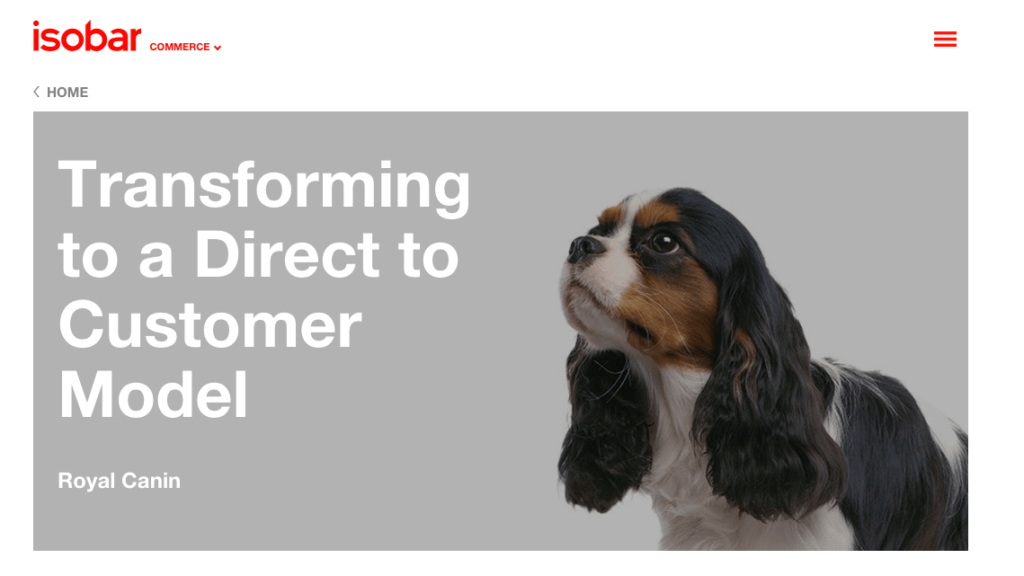
    Isobar content marketing case study

    A Blog Post by Isobar

    IsoBar

    How would you use social media to influence thought leadership?

    Social media offers a unique opportunity for brands to establish thought leadership. Social media platforms have the power to amplify your thought leadership content by manifolds. It’s a great way to improve your brand’s visibility, share your perspectives on ongoing trends and topics, and establish yourself as an expert in your niche.

    It provides different ways to share your message and content. In order to be a thought leader, you need to start by listening to what your audience wants to hear from you. It’s important to be relevant in order to be heard and build your thought leadership around it.

    Even if you don’t have enough time to create lengthy pieces of thought leadership content regularly, social networking sites offers great options to stay connected to your audience and be a thought leader with just a few words. Those few words itself can be tremendously influential. Share helpful articles, curated content by other industry leaders, the latest industry trends and news, these let your audience know that you are constantly providing them the information they need. This way you not establish yourself as a thought leader but you also keep your audience engaged with regular updates.

    Are there any brands that have done a good job in positioning themselves as thought leaders?

    I think HubSpot, an inbound sales and marketing software company, has done a tremendous job in establishing itself as the thought leader in inbound marketing strategies. HubSpot strives to teach businesses how to execute inbound marketing strategies and has developed various forms of thought leadership content to guide brands.

    You can find marketing studies, self- conducted surveys, infographics containing latest industry trends, digital marketing posts, “how to do” self-help articles – just about anything you need help with in inbound marketing, on their website. They publish these thought leadership pieces with the intent to help brands better their inbound marketing efforts.
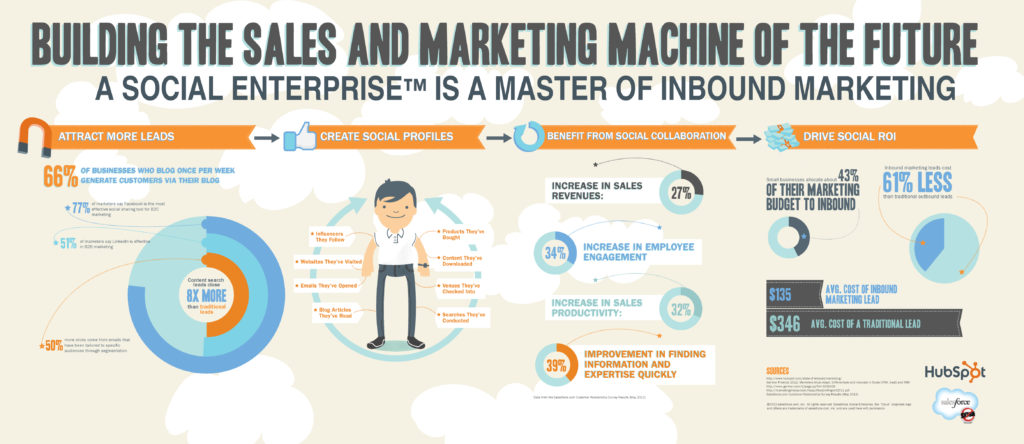
    Hubspot

    Any blogs/content pieces that you want to talk about

    We recently published a whitepaper on Headless Commerce explaining how brands can leverage Headless Commerce to create experiences across an entire ecosystem of touchpoints. Authored by the Isobar UK and Global team, the white paper explains how the Headless Commerce approach provides brands with greater control over the UX, building a foundation to create long-term customer relationships that can deliver sustainable business growth.
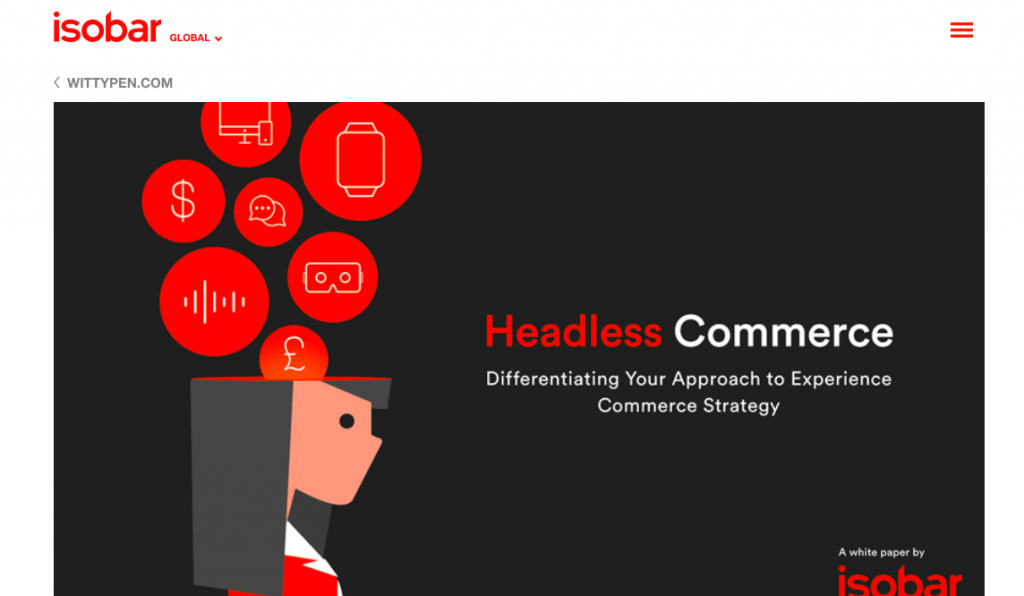
    IsoBar

    Here is the link to the whitepaper on our website.

    Are there any essential tips/suggestions that marketers of today can use for building thought leadership content?

    Most of the times, marketers get carried away with the idea of building thought leadership content pieces. It’s important to know the do’s and don’ts of building thought leadership.

    1. Don’t sell your brand: You should strive to be a resource for useful information for your potential customers. All your thought leadership content pieces should contain valuable and actionable content for your audience. Don’t try to sell your brand through these content pieces, otherwise, it will just become another form of advertisement and your customers will lose interest in them. A genuine blog post, whitepaper or infographic will keep people interested in revisiting your website.
    2. Create your own niche: Thought leadership is about creating your own unique identity in a sea of brands. It’s about being a master of one rather than a jack of all trades. It’s about being a go-to-source in your own niche environment. One article on a unique topic would give you much more credibility than thousands of articles on a vague topic.
    3. Build a conversation with your audience: Pay attention to your audience. Listen to what they want. Churning out pieces of thought leadership content mindlessly would do no good to you unless you provide your audience what they actually need. Listen to what they are asking on social media and Google search, take polls to ask them what’s working for them. This will not only help you in engaging with your audience but would also give you ideas about what your next thought leadership content should be.

    Conclusion

    Thought leadership is not about blowing your trumpet, telling the world that your brand is the best. It’s about building trust with your audience by becoming their go-to-brand for niche valuable resource!
    We heartily thank Swati for taking out the time to answer our questions. These insights have been truly valuable and will help us and others out there to become a thought leader in our respective niches.
  • Native Advertising Tips That Every Marketer Needs To Know

    Native Advertising Tips That Every Marketer Needs To Know

    Lots and lots of content gets produced on a daily basis. But often it doesn’t reach your audience. Reason – There aren’t enough people to consume content that gets created on a massive scale.

    These native advertising tips are the perfect solution to this problem. It’s a great way to distribute your content and extend its reach by leveraging the exposure and brand equity of other publishers. It is also a smart way to connect with consumers and get them to engage with your brand.

    Gaurav Sahota from Medlife sheds light on how content can be used alongside native advertising to promote your brand. But first, let’s have a quick read on Gaurav and Medlife.

    About Gaurav

    Gaurav has been passionate about Performance Marketing & its nuances for quite a while now. He believes that brands today are battling algorithms to stay ahead of their game in the online marketing sphere.
    And this has led him to understand how the core functionalities of Digital Marketing can be used to push buyer behaviour.

    Presently, Gaurav works at Medlife as Digital Marketing Manager for OTC Business (pinhealth.com) & is exploring the trends that command the e-commerce sphere in Pharmaceuticals. He feels that while marketing for this sphere is challenging, its results are what drives him to work harder.

    Gaurav also feels lucky to have worked in various verticals such as F&B, Hospitality, Travel & Adventure, Forex, Telecom and Mobile VAS.

    In his free time, Gaurav spends a lot of time updating himself on the music industry.

    About Medlife

    Medlife provides a wholesome ecosystem where a patient can get e-consultation from a Doctor, opt for lab tests, as well as access to prescription and OTC medicines at discounted rates with the comfort of doorstep delivery.

    For Tushar who’s the CEO and co-founder of Medlife, the reason to create this venture through which people could gain access to multiple healthcare services came from a personal experience where he had to walk up to 40 miles from his home to purchase medicines for his parents.

    Tushar says “Over a period of time, I realised that the healthcare system in India is extremely chaotic. People don’t know where to go to locate the right specialist, find all of their prescribed medicines or even find a good laboratory for their tests. Sometimes, they have to travel to different places to avail these services. I believe that if a person is ill and is already anxious about the disease itself, there should be no need for them to stress any further in getting treatment.”

    Being operational from more than four years, Medlife now processes over 8,000 deliveries a day (including private-label products) that amount to $4.6 Mn (INR 30 Cr) a month and expects 15-20% business growth month-on-month.

    What’s native advertising and how does it affect content marketing?

    You could say it’s a good mix of pull & push marketing. Native advertising is different from regular text ads on Google’s homepage, where the user is stating his needs then & there; it is not to be confused with social media banner ads either.

    By definition, native is a person born in a specified place or associated with a place by birth, where he/she might or might not subsequently stay.

    Similarly, Native content is a piece of content that fits in the environment where it is served, & when you pay to be a part of such environment it becomes native advertising. Native ads match the look & feel of the content or placement where they are served or received.

    On the other side, content marketing has a bigger horizon, wider & long term focused goal. It’s an approach that enables you to connect with consumers on a deeper, more committed level for the longest period of time. For example, being a pharmaceutical company we have a content marketing plan for the next year which includes PR, earned media reviews, blogs, info-graphics designed to interest & share the benefits of online pharma. As part of our larger strategy, we may rely on native advertising to amplify the reach of our online content.

    What are the different types of native ad formats?

    The Interactive Advertising Bureau has set some guidelines for native advertisements & added native advertising into 6 categories, but commonly used are:

    In-Feed Ads

    Users will see sponsored content ads from advertisers while they browse original content on their social media feed.
    The best example is Facebook news feed ads.

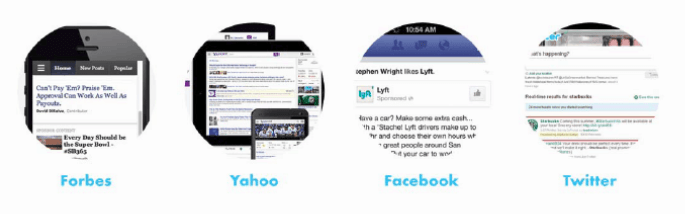
    Facebook, Twitter, Yahoo and Major News Houses all offer in-feed ad units

    Recommendation Widgets

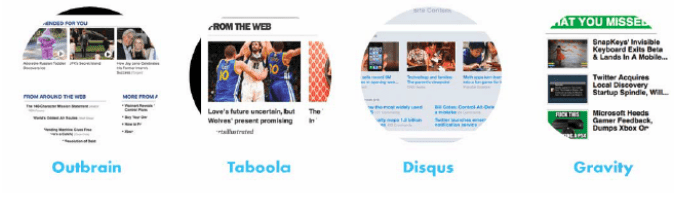
    At the end of nearly all articles, you often encounter ‘Recommended For You’ & ‘You May Also Like’. These widgets are called as recommendation widgets. Advertiser pay to reserve these ad slots to get some traffic back to their websites

    Promoted Content

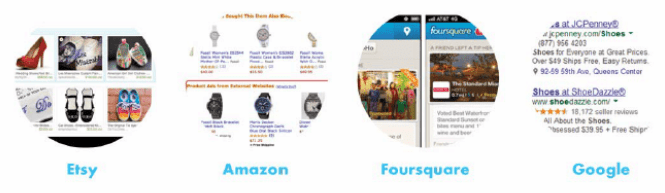
    Most of the E-commerce players give an option to promote your products. E.g, while searching for any product on Amazon you may have encountered with some promoted brands

    From OTC to Pharma we use native ads in almost every business unit. We mostly use In-feed ads on social media & third party websites. I personally feel that In-feed ads work best as they are highly targeted. This is primarily because they match the two important criteria – website content & user interest

    How can you differentiate between native advertising and a regular ad?

    When you go to a website, you see a banner ad at the top of the page or smaller ads next to the main content. These are display ads. Regular ads show up based on several criteria, including how much the advertiser paid for the spot, the content’s relevance to the website and its audience, and whether you’ve had any interactions in the past.
    Instead of looking like a traditional ad, native ads mirror the tone, style and format of the site’s content. At the same time, you will also find a term “Sponsored” or “Promoted” to distinguish it from regular content.

    Can native ads appear to be a little sketchy?

    Yes, native ads can appear to be a little sketchy if not targeted properly. Some native ad platforms and publishers allow irrelevant or unrelated content with their index content to earn some extra bucks. This can be misleading for the audience.

    Can you share some ad campaigns that are doing really well for your brand pertaining to native advertising?

    We are using multiple ad networks, social media & vendors including in-house programmatic to leverage native advertising. As we have different business verticals we have multiple checkpoints & criteria before choosing any native format or network.

    For OTC, in native marketing, I’m spending most of my budgets on Facebook News Feed ads followed by Google Smart Campaigns.

    For Pharma & Medicine, we are using Content DB, Times Columbia & In-house programmatic to run native advertisements; recently I have seen a CTR of 10% which is way higher than regular ads.

    Native Ad Medlife

    Native Ad Medlife

    Native Ad Medlife

    Any tips on native advertising to content marketers?

    Choose the right format

    Not every native ad format suits every advertiser’s needs. Choose the one that establishes you as authority, and pick the advertising options that describe your product & services the best.

    Stay customer centric

    Understand your audience before creating any native ads. Be customer-centric, remember how you make customers feel, you need empathy for good customer experience.

    Create engaging content

    Try to educate & entertain your visitors, be a problem solver, and not a product seller especially when you from the B2B industry

    Use A/B testing

    Your headlines and ad copies are fundamental hooks in native advertising, A/B testing can help you rapidly judge how compelling your titles and descriptions are, and pick those that are getting the most engagement.

    Create an action plan

    An action plan is a major ingredient in your native strategy. Listen and understand, know your audience. Check what is working for you, build great content, listen to the feedback, learn and repeat.

    Conclusion

    We are living in a content-heavy world, and these native advertising tips offers marketers a way to reach out to their audience without being overbearing.
    We heartily thank Gaurav for shedding light on the importance of native advertising and sharing some great tips on the same. These insights will surely help brands in expanding their market reach and in improving engagement with their customers.

  • Interactive Content – Harnessing Its Unique Potential

    Interactive Content – Harnessing Its Unique Potential

    Interactive content has the potential to give more value to your customer because it captivates your user’s attention by not just visuals and text, but much more. If you use interactive content in your content strategy then you are bound to get more engagement and action from users.

    This blog covers our interview with Maryada Dhanuka who heads marketing at Cuemath. Maryada sheds light on the importance of interactive content marketing and explains the right way to go about it. Before going ahead to the interview, here’s a little read about Maryada and Cuemath

    About Cuemath

    Cuemath was born with the vision to create thinkers and problem solvers of tomorrow. The team at Cuemath believes that this can be achieved through a robust foundation in mathematics by helping children learn mathematics the right way.

    Learning Math can be difficult for most kids, mainly because of the traditional ways of teaching the subject which encourages kids to rote learn formulae. Cuemath addresses just this through its personalized program that is learning based on discovery and by doing.

    Their multi-format curriculum approaches math in a holistic way; in the sense, the puzzle cards, workbooks, tabs and the math-box are all used to ensure that the children are engaged throughout and covers school math, mental aptitude and creative reasoning.

    This self-paced program also helps students assimilate concepts at their own pace, making them confident in the subject, one session at a time. This essentially ties back to Cuemath’s core vision.

    Cuemath’s a first-of-its kind ‘Mathematical Universe’ which is one of the most extensive gamification exercises undertaken in education. It’s a step towards enhancing the quality and method of math learning and teaching so the subject is seen as a life skill and not a liability.

    About Maryada

    Maryada Dhanuka heads marketing at Cuemath. She is responsible for driving all the marketing activities for Cuemath. Maryada has about 7+ years of living & breathing marketing. Prior to Cuemath, she has led the brand at Xiaomi India and Freecharge. She has also worked with marketing teams of Vodafone and Google in her earlier days.

    Due to her experience of working with marketing teams of great companies in various sectors, she has learned newer ways of marketing to the right audience in each role of hers. Apart from her vast experience in marketing, she loves to travel and learn about new culture.

    She’s always on the lookout for how brands internationally are reaching out to their target audience, be it through outdoor, print or digital.

    What do you mean by interactive content?

    As the term suggests, interactive content is any kind of content that makes the consumers take an action or engage with the content and not simply read or watch the content. It is a two-way dialogue between the consumer and the brand.

    With the advent of the internet, content marketing became popular and with more and more brands focusing on content marketing, interactive content has come into play. We could say that the Internet gave way to interactive content marketing.

    But according to me, interactive content is not limited to just online marketing, there are various ways that brands are making interactive content in the offline marketing space as well.

    Why is there a need for interactive content in your brand’s content strategy

    Interactive content has manifold benefits for the brand. When your consumers engage with your content by participating with it in any way, they build a relationship with the brand. It increases the quality of recall/awareness for the brand, leading to brand affinity.

    Building brand affinity is one of the toughest tasks for any marketer and good interactive content gives you the platform to build this affinity. When brands successfully build affinity, there is higher brand loyalty and therefore greater consideration scores for the brand.

    What type of contents are interactive?

    Any type of content that drives engagement from the consumer is interactive. It could be as simple as a EMI calculator on a bank website, or a social post that is a poll on a current topic, a quiz or brain teaser, a short 1/2 question survey, interactive infographics, interactive videos & emails, and many more.

    Not to forget there is a wave of interactive content coming with the VR (Virtual reality) technology which will make the watchable content a LOT more interactive and will allow for better experience building by the brands. At Cuemath, given the space we are in we use a lot of interactive content like Puzzles, brain teasers, quizzes, etc. to engage with the audience.

    With these puzzles, quizzes we are also able to communicate the Cuemath way of learning math and communicate our product positioning to our audience. Here are some examples

    Here’s a link to the above.

    Here’s a link to the above.

    Who is your target audience here?

    So at Cuemath, our customers are the parents and our consumers are the kids. At the moment we operate in the space of building mathematical thinking in children in class KG – 8th Grade. Our journey of making our consumers (kids) fall in love with math (brand) starts once they begin consuming the product.

    Before that, until sign up our target audience is the parents of these kids. In fact, with the Cuemath way of teaching, the Cuemath kids interact with Math. They learn the logic, pattern behind the formulae and math concepts. Children learn concepts like fractions, subtraction, addition, geometry with our interactive tools.

    When they interact with these tools, they interact with our brands and our customers (parents) passively interact with the brand when they see these activities done by the kids, helping us build brand affinity.

    How can you use interactive content in different stages of your customer buying journey?

    You can make your content marketing interactive at any stage of the customer/buyer’s journey. At the awareness stage, you can work on interactive videos as videos are a great way of filling the top of your marketing funnel.

    They generate the interest in your brand. You can get the interest going once your consumer has signed up by way of email ID or social login by engaging with them through interactive emails, surveys and polls. At the consideration stage make sure that the consumer interacts with the product or the service to strengthen their decision.

    Do you think there are any brands that are doing well in this arena?

    Not too many brands in India have ventured into interactive content in my opinion. However, one brand which does create great interactive experiences is Coca-Cola.

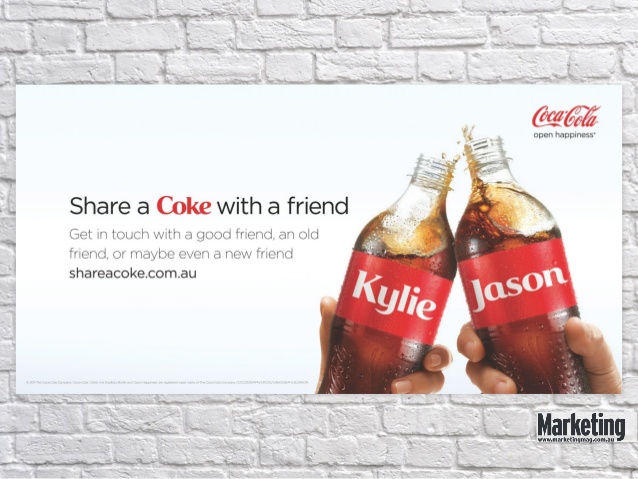
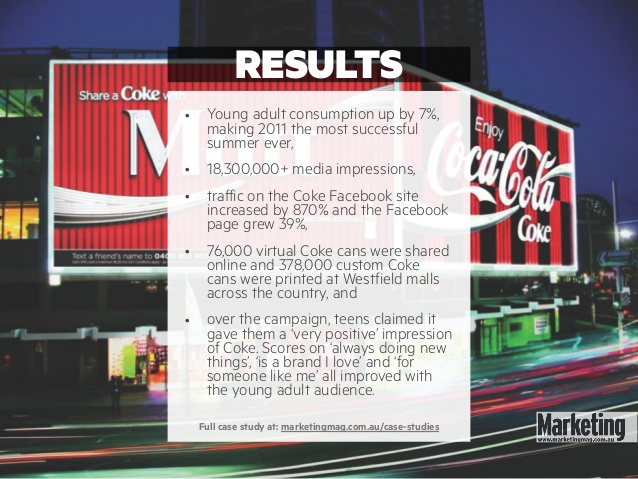
    Their ‘Share a coke’ campaign created millions of conversations around the globe. This campaign was both online and offline. While you can term it as a brand activation, but in my view, every consumer was interacting with the brand.

    Any tips to create good interactive content?

    For creating any type of communication for the consumer – be it interactive or not, the thumb rule is, understand what your consumer wants. Deep dive into what they are looking for. Meet your consumer and understand the problem and how is your brand providing a solution to that problem.

    Gather insights from various data and research results and tap on those insights while making your communication. Any consumer would have three kinds of barriers when they don’t adopt your product –
    1) It’s not for me,
    2) I already have it
    3) You can’t deliver the promise.

    Understand these barriers and create communication to build belief in your product/service. Talking about creating great interactive content – follow this thumb rule ‘what does my consumer want’.

    For example at Cuemath we make the communication to build belief in the Cuemath way of learning Math, where parents understand that our way of teaching math not only makes kids great at math but at mathematical thinking too. When you understand what your consumer wants, you will not fail.

    While meeting all consumers is not easy, meet as many as you can and ask the WHYs and you will arrive at a problem your product can solve. When not meeting formally you would come across a lot of consumer in your daily life, I spend time observing and consuming information and apply that along with research data to build any communication for the consumers.

    Conclusion

    Customers today are actively seeking value from the content you produce. A successful content marketing plan is the one that solves a pain point, answers questions and offers relevant information. Interactive content marketing is a powerful way to give users instant and tailored results. We thank Maryada for helping us understand the importance and relevance of interactive content marketing and sharing some extremely beneficial tips.

  • How to Master The Art Of Video Content Marketing, By Akshatha Kamath

    How to Master The Art Of Video Content Marketing, By Akshatha Kamath

    Video content marketing is becoming popular with each passing day and is the current favourite for so many marketers. Content marketers are able to achieve versatility and virality of their content through different types of videos for marketing.

    In this blog, Akshatha Kamath who heads Content Marketing at Simplilearn talks about the importance of video content marketing. But before we go on to that, let’s learn a little about Akshatha and Simplilearn.

    About Akshatha

    Akshatha Kamath is the Head of Content at Simplilearn. She is a content marketing specialist with close to 12 years of experience in writing, strategizing and managing content for various organizations.

    Before Simplilearn, she’s worked with companies like Vizury and Conzerv (now part of Schneider, India) helping them with content, brand and communication strategies that are aligned with the business goals and brand recall for the digital space.

    She is an avid reader and a traveller who enjoys experiencing the flavors of life from different places. You can check out Akshatha’s social networks here:Twitter Handle,LinkedIn Account

    About Simplilearn

    Simplilearn enables professionals and enterprises to succeed in the fast-changing digital economy. The company provides outcome based online training across digital technologies and applications such as Big Data, Machine Learning, AI, Cloud Computing, Cyber Security, Digital Marketing and other emerging technologies.

    Based in San Francisco, CA, Raleigh, NC and Bangalore, India, Simplilearn has helped more than one million learners and 1000+ companies across 150+ countries get trained, acquire certifications and reach their business and career goals.

    The company’s high-engagement curriculum blends self-paced online learning, instructor-led live virtual classrooms, hands-on projects, student collaboration, and 24/7 global teaching assistants. Simplilearn is recognized by Training Industry as a Top 20 IT Training Company for 2017.

    What’s the role of videos in content marketing?

    There are various reasons why videos are strategically important to your content mix, now more than ever. Videos are the highest consumed content format today. According to Buffer, More than 500 million hours of videos are watched on YouTube every day.

    On social media, videos can help you reach as much as 300% more users and drive upto 150% more engagement. Also, traditional formats such as blogs that contain video content will see a lift in SEO. Videos are more powerful in capturing user attention and keeping them hooked, especially on mobile.

    To sum it all up, video content marketing can help you grow your reach, engagement and the overall marketing ROI.

    Check out Simplilearn’s Blog with an embedded video. To know how to embed videos in our blog, click here.

    Why is repurposing important?

    As content marketers, we mostly strive to create rich and original content that is meaningful to our audience. To create impactful and evergreen content you’ll need to go through the stages of research, topic definition, writing, editing and then distribution – which means, you’ll invest time and sometimes marketing dollars.

    But when you repurpose content, you start with one good idea/theme and then expand that into a different angle or other content formats such as blogs, videos, infographics, slideshare, podcast the list can go on. A strong content repurposing strategy will help you lower costs, reach a wider audience, and extend the longevity of your content piece.

    Repurposing videos and articles from one to the other are popular content marketing practices that work well with the audiences. For example, if you’ve repurposed a blog into a video and then hosted this video on your YouTube channel, you’re doing two things. Firstly, your YouTube users might be different from your blog users, but they will still be similar in demographics. So you’re taking this great piece of content that you’ve created and reaching another set of users who might find this helpful.

    Next, you can embed the video within the article after the first fold. So anyone on the blog who doesn’t want to spend time reading can consume the video content and this will help you increase the average time-on-page for your blogs.

    Who do you target with repurposed content?

    If the underlying theme of the original and re-purposed content are same (which is usually the case), the audience demographic remains similar, but their stage in the buyer’s journey might change.

    For example, let’s say you have an eBook about advanced mobile marketing tips with the original intent of engagement and lead generation. You will be able to repurpose the report and pull-out micro-graphics, blogs, teasers that map out across awareness, engagement and conversion stages.

    How frequently should a brand produce videos?

    As much as you need to. Videos work best for top-of-the funnel engagement and based on your marketing goals and audience you need to carefully weave in videos into your marketing mix. Create a pipeline of videos and do focus on the quality of content and the experience within your videos. Ensure that you have an engaging narrative and most importantly, a story to tell.
    Here are some videos by Simplilearn

    How should you distribute your videos?

    A great video distribution strategy will cover all your major channels such as email, social media, website, blog, YouTube, Slideshare, partner blogs, sales assets, press releases and more. Another interesting use case to repurpose videos is to use a video still and pin it to your Pinterest handle. The key, however, is to reach out to the right audience and use contextual videos across your buyer’s journey.

    What tools do you recommend to create/repurpose videos?

    Not all content marketers are video editing experts. But tools such a Lumen 5, Rocketium have simplified video production. With these tools you can create highly engaging videos that can be used across your website, YouTube or social media. You can use Animaker, VideoScribe to create animated or whiteboard content. But you’ll need some more time and design skills to build these videos.

    Do you promote your videos or do you rely on their organic growth?

    Both are important. If you have good content, you’ll see higher engagement and traffic. But why shy away from promoting it? Organic reach is typical to users who have already consumed your content in the past or are searching for a related topic – these are users who are viewing your videos because they want to.

    But with paid promotions, especially on your social networks, you’ll be able to reach out to new but relevant users. In the case of B2B companies, videos can be used for account-based marketing via paid social ads.
    Promotional Ad by Simplilearn.

    Any video content marketing initiatives that are running currently and previous campaigns that you would like to share?

    Yes, there are two ways in which we’ve leveraged videos in our your content marketing campaigns at Simplilearn.

    1. Video teasers on social media: We’ve implemented video marketing for our blog and webinar promotions across various marketing channels and this has helped us expand our audience size and also keep them hooked for a longer duration when compared with banner posts. Here’s an example.
    2. Video to blog repurposing: Repurposing helps us reach our audiences across our blog and YouTube with engaging content. Here’s an example of a video to blog conversion.
    Simplilearn Content Marketing Strategy

    The article above is repurposed into a video that you can see below.

    Tips for content marketers

    Understand your buyer personas and create targeted videos that solve a problem for your customer. Similar to blog content, follow the 90-10 rule (The first 90% of your video should talk about the user’s problem and a likely solution.

    The last 10% can be reserved to talk about how your offering can help the user.) Focus on the overall experience and the narrative. Choose the most effective way to tell your story. For example, explainer videos are best described with screen grabs and whiteboarding techniques, teaser videos can be stock-heavy, choose talking head videos for influencer content and so on. But above all, tell a story that the user wants to hear.

    To Sum Up

    The growing need for video content -whether it’s a short or long, animated or love, scripted or real has increased. Human beings are more prone to interacting with visuals as opposed to text.
    Since visual content is at it’s highest peak, is easy to create and is highly engaging, content marketers should invest more time and efforts in aligning their content strategy with video marketing.

    Acknowledgement

    We would like to heartily thank Akshatha for taking out the time to answer our questions. These insights on video content marketing are very beneficial and would surely help many individuals and brand take a positive stride.

  • Comprehensive Guide To B2B Content Marketing By Amit Kapoor

    Comprehensive Guide To B2B Content Marketing By Amit Kapoor

    B2B content marketing in simple terms is an art of developing and distributing curated, relevant and valuable content. But B2B content marketing isn’t an easy task, it requires a strategic approach. Amit Kapoor who heads content marketing at Cigniti has answered some of the most significant questions about B2B content marketing. He has also has spoken about a useful approach for creating an effective B2B content marketing strategy. Before proceeding ahead to that, here’s a little read about Cigniti and Amit.

    About Cigniti

    Cigniti is the world’s first Independent Software Testing Services Company to be appraised at CMMI-SVC v1.3, Maturity Level 5, and is also ISO 9001:2015 & ISO 27001:2013 certified. Cigniti’s test offerings include Quality Engineering, Advisory & Transformation, Digital Assurance, and Quality Assurance solutions. It is headquartered at Hyderabad, India. Cigniti’s 2200+ career testers are spread across US, UK, India, Australia, and Canada.

    About Amit

    Amit Kapoor has 17+ years of in-depth experience in the field of technical writing, content, and digital marketing for global organizations. Amit has been awarded as the ‘Most Influential Content Marketing Professional’ by the World Marketing Congress and recognized as a Global Top 200 Content Strategist by MindTouch, and India’s Top 100 Content & Brand Custodian by PaulWriter.

    A mentor & social media influencer, he is a regular speaker on topics pertaining to communication, content and digital marketing. He has been a Speaker and a Guest Lecturer at the TAPMI-Manipal, IBS-ICFAI, Information Developers Conclave 2017, JNTU TechFest 2017, and STC Annual & Regional Conferences 2016-17. He also has been a Panelist at events as National Level Innovation Summit “Prerna-2018”, Tata DocoMo DoBig, and more.

    He writes articles for ET pertaining to MSMEs, and has edited articles published on IEEE. His articles have also been published in magazines & portals such as Hakin9, Industrial Automation, IIT Mumbai (TechFest), and Inc500. A published Poet, two collections being ‘The Waves Flowed On.’ (Amazon.com: https://amzn.to/2sQ7laP) & ‘We Shall Grow’ (Trafford Publishing, SKU-000128736), he is reachable at amitwritesat@gmail.com and www.akwrites.com. He currently heads the content marketing initiatives at Cigniti where he has helped generate content leading to a 1000% increase in visits from search engines at Cigniti.

    aMIT kAPOOR

    The Interview

    What is the definition of content marketing according to you?

    According to me, content marketing is the act of sharing and spreading content that has been created about an organizations’ products and services. It involves understanding the buyers’ persona and their needs so that relevant, clear, and useful content is created and shared across multiple social media platforms. This creation and promotion of targeted content generates awareness and interest about the products being offered. This helps in bettering the brand image, and also leads to higher number of ambassadors and clientele. A very critical aspect of the content being generated is that it should not have a sales-pitch. Rather, it should be written in a manner that is informative and helps the readers get an overview of the challenges facing them, and the solutions available. Today, most organizations wish to have a global presence. While marketing the content in its different formats (blogs, case studies, emailers, infographics, videos, white papers and more) across the social media, one must also ensure the best days and time for publishing the content for a particular region.

    What drives successful content?

    At a high level, relevancy of the topic being covered, information that helps resolve issues, timeliness, ease of readability, consistency and a disciplined approach to publication of content (for example, at Cigniti we follow 2 blogs a week policy – without fail!), and more.

    Blogs

    Keeping an eye on the trending news about what is happening in the world relevant to the services offered leads to well-timed information that is much appreciated. If as content writers and marketers we are able to understand the thought process of our readers and perform in-depth research about the topic being written, the written content will surely be successful! Having a crisp, strong headline/title for your content, adding a call to action (CTA) in your content, having some visual content (images), etc. are a few good ways to increase the success rate of your content.

    Who is your target audience?

    As Head of Content for Cigniti, a global leader in Independent Software Testing Services, my target persona is the person who is at the helm of affairs of technology in an organization that has software testing needs. Usually, it is the CTOs, CXOs, CEOs etc. who are looking at how best to use Quality Engineering, Advisory & Transformation, Digital Assurance, and Quality Assurance solutions to enjoy growth and sustainability of their organizations. If I am able to make these decision makers understand the services that Cigniti can provide, they might come back as possible prospects and even clients. As an individual content contributor, my target persona is anyone who can make successful use of the content I am creating and marketing. And then, based on the satisfaction achieved, come back for more content related activities as a client.

    What’s the style, tone and voice that you use to address your target audience?

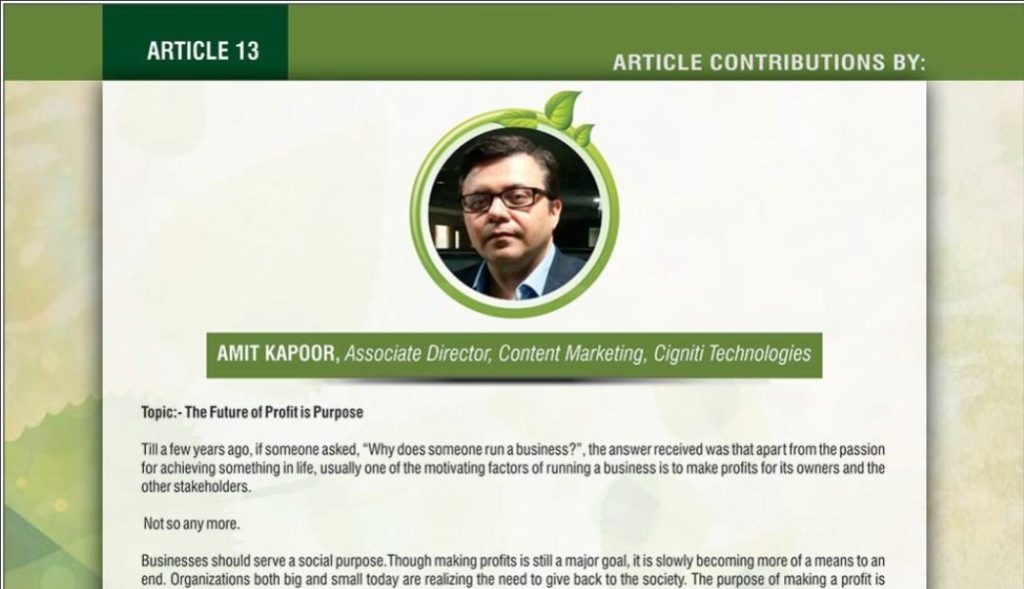
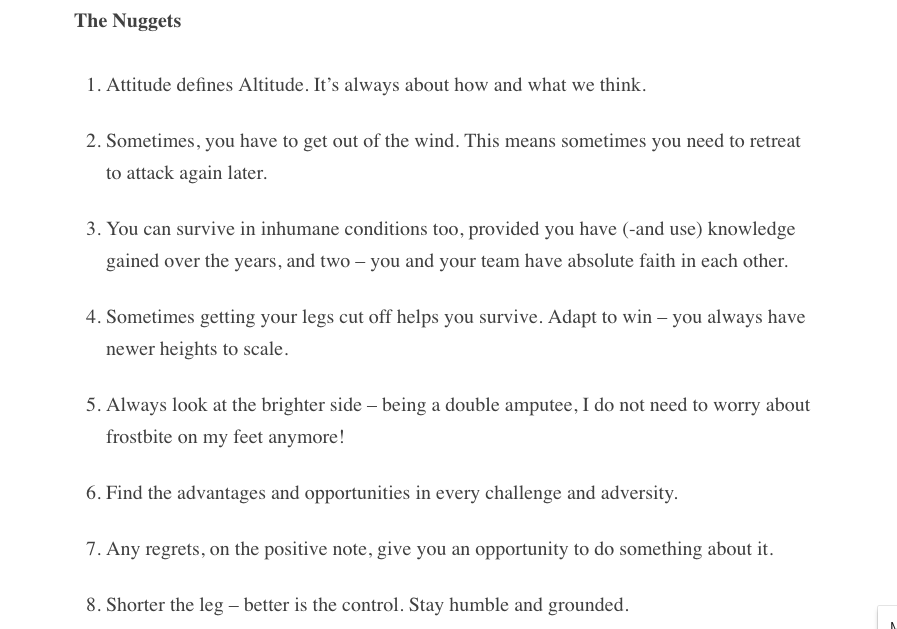
    Depending on the topic that I am writing on, I try to experiment with the style, tone and voice to address my audience. However, as a basic rule, I like to use simple words and avoid jargons and provide an easy, user-friendly flow to my content. I usually address the reader directly in 2nd person (you), and the voice active – unless the situation or topic decides otherwise. An example here is a content piece captioned – Lost Your Legs? Don’t Crib. Find, And Climb Your Own Everest.

    Amit kapoor's article

    An understanding of the target audience plays a critical role in deciding whether to keep the tone conversational or formal. In either case, though, there has to be consistency, clarity of thought, and the feeling of connection with the reader. In case I am writing a blog that intends to inform my audience about something, I would like to keep it informal. But when writing Sales driven marketing collaterals (such as blogs, white papers, case studies), external articles on various authority sites (for Forbes, StickyMinds), or other marketing content, I prefer to keep it formal. An example here is an article on Why SME’s should take digital marketing seriously that I wrote for ET.  Of course, on a lighter note, when writing poems, I just let the words flow!

    How do you go about planning the content strategy for your brand?

    For a brand like ours to succeed, it needs to have a robust B2B content marketing strategy in place. There has to be complete clarity regarding who is the audience, how will it help them overcome their challenges, the multiple formats and platforms that can be utilized for sharing the content, and setting up the schedule of the dissemination of the created content. After deciding the above factors, we also need continuous discussions on how to keep improving the strategy. One of the factors that help ensure the success of a B2B content marketing strategy is to keep the content aligned with the current trends. Another one is to provide a constant, positive push of relevant content on multiple social media platforms. There is also a need to consistently track how the pages are ranking on Google, and how many visitors are landing or bouncing off. While planning the content strategy for Cigniti, we analyze how the keywords that we want to rank are performing based on Google analytics. Once the keywords are finalized, we perform a thorough research on the trending topics around software testing – and in what ways can software testing help organizations. Based on the outcomes, we identify the areas we can publish more blogs, white papers, case studies, infographics, and more, and keep doing it consistently. Apart from this, we also keep refreshing our website content as required.

    What has been the most successful content format for your brand?

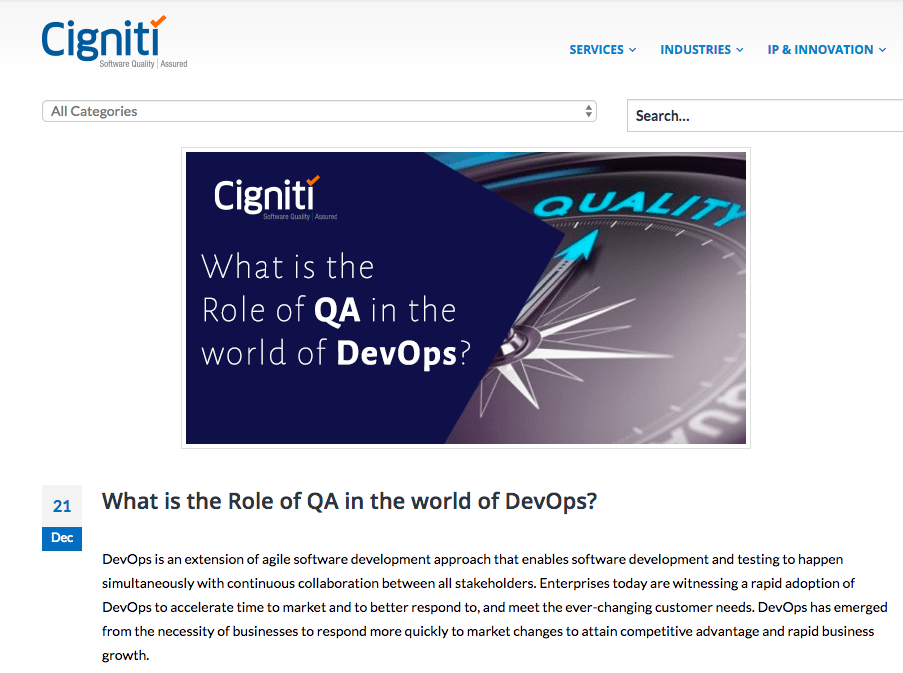
    We have seen great results with blogs which are mostly a combination of text and images. You can check some of our blogs here. What is the role of QA in the world of DevOps?

    Cigniti Blog

    10 Emerging Trends in Software Testing: Predictions For The Next Decade

    Blog Cigniti

    Also, we have seen moderate to reasonable results with videos.

    The most successful content format which we have seen till now is webinars where there is a lot of participation from our users. This helps us to address queries faster and explain better since there is a definite time(an hour) for the webinar. Also, the audience is engaged since they witness a demonstration of capabilities from the delivery rather than the Sales team!

    Have a look at a few of our other concluded webinars. Apart from these formats, we also write case studies and e-books.

    E-Book: The need to embrace digital assurance and digital testing.

    Case Study:North America’s Leading Tire Distribution Provider Leverages Cigniti’s Expertise to Achieve 90% Reduction in Test Execution Efforts.

    Case Study Cigniti

    Why is it necessary to maintain a consistent supply of quality content?

    In all earnestness – there’s probably no other way to be successful. A consistent supply of quality content reflects that there is enough thought leadership and experience that the organization can provide. It is a must-perform task as it helps keep the brand visibility alive. Research by TechiPedia established that consistent brands are worth up to 20% more than those that aren’t. If we also add ‘Engaging content’ to the equation above – along with Consistent Supply and Quality, the reader retention and decision making will surely move up the ladder – not to mention the growth and success of your business. While high quality ensures customer satisfaction, consistency ensures guarantee to our readers who become used to reading a new blog, say, every Monday. This creates a better connect with our readers. Internally, within the team, it helps improve team morale, performance and efficiency as fixed tasks help us plan better, and reduce any confusions regarding lack of direction.

    Are there any tips that you would want to give to the B2B content marketers of today?

    There are some that I personally follow and would advise the marketers of today to follow.

    1. Don’t stop reading, writing, learning, measuring, and experimenting with newer tactics and social media marketing tools, platforms, and channels in this world of digital transformation.
    2. Try to know as much about your customers and competition as much as you do about your company.
    3. Maintain a Consistent Supply of Quality Content.
    4. Keep measuring and analyzing the success or failure rate of your content.

    Conclusion

    There are n number of experiments that you can have with B2B content marketing. There are innumerable benefits of B2B content marketing. But what is important is to recognise content marketing B2B lead generation, following B2B content marketing white paper strategies that are highly actionable, engaging and focused on your audience. The content marketing interview was enlightening and the content marketing tips given by Amit are truly beneficial and we sincerely thank him for taking out the time to answer some of the most significant questions in B2B content marketing.

    Check out our website for other interviews that offer tons of value and information!